Friday, February 20, 2009

Revolutionary Home Fuel Cell Efficiencies Claimed by Melbourne Company

Managing Director Brendan Dow said, “We have now achieved 60% efficiency in a fully integrated fuel cell and heating system, while exporting 1.5 kilowatts of electricity to the grid. This is not a laboratory test but a unit that has all the functions of a commercial unit for homes. Our company’s products will be located in the home, so 60% efficiency is at the power point, with no transmission or electricity distribution losses.”

...After transmission and distribution losses, the average electrical efficiency of conventional power stations in the European Union is less than 35%. A 2007 study of other microgeneration technologies by the UK Carbon Trust, based on a trial of 70 units (including Stirling engines and internal combustion engine) found average electrical efficiencies to be less than 10%. A Japanese Government-sponsored trial of Polymer Electrolyte Membrane (PEM) fuel cell home units showed average electrical efficiency of about 30%. _FuelCellToday
If these 60% efficiency results from the Melbourne company Ceramic Fuel Cells Ltd. hold up, home based fuel cells will likely receive a huge boost. Home fuel cells can supply a home's power and heating / hot water needs independent of the power grid. If they can also export (sell) power back to the utility, they should pay for themselves over a reasonable time period.
Ceramic Fuel Cells’ technology uses fuel cells made from ceramic materials to generate highly efficient and low emission electricity and heat from natural gas and renewable fuels. The technology began at CSIRO in 1992 and has cost $220 million to develop. Today the company employs 100 people in Melbourne, including 60 scientists and engineers.

Ceramic Fuel Cells’ units also recover heat from the electricity production process and use it to heat home hot water, increasing the units’ efficiency to 85%. “We are able to trap the heat from our units and use it to heat a household’s water, taking our efficiency to 85%”, said Mr Dow. “Compare this to average efficiency of the current power grid in Victoria of less than 30% and it represents a huge advantage.” _FuelCellWorks

Labels:

Tuesday, February 17, 2009

Converting CO2 to Methane With Nanotubes

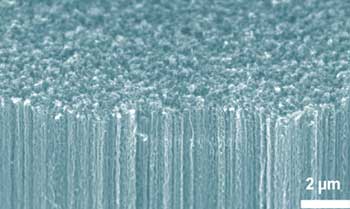
Penn State U. researchers have devised arrays of titania nanotubes to convert atmospheric CO2 to CH4 and other hydrocarbons using sunlight.
The rate of carbon dioxide (CO2) conversion using this method is 20 times higher than that of previously published research. The work is described in the January 27, 2009, online edition of Nano Letters.

....This type of solar-based conversion process only works if a photocatalyst—a material that reacts with light—is used to convert the CO2 into hydrocarbons. A photocatalyst that utilizes the most solar energy possible is the best option.

One popular photocatalyst candidate for the job has been titanium dioxide, also called titania, because it can powerfully react with oxygen. But so far, researchers haven't been able to make titania perform adequately despite experimenting with a variety of forms, such as nanoparticles, pellets, and multi-layer films.

Grimes and his colleagues used arrays of titania nanotubes. They created the nanotubes using a technique that incorporates nitrogen into the nanotubes' structures, which the researchers initially thought would help increase the conversion rate (this turned out to be true only in a very limited capacity).

The process also yields a high total surface area compared to other forms of the material, a property that aids in the conversion. To further boost the process, the group scattered an ultra-thin layer of platinum and/or copper "cocatalyst" nanoparticles on the surface of the array. _PO
Not only will this method produce useful hydrocarbon fuels, but if the global climate cools much further, such nano-arrays could be distributed across the globe to boost atmospheric methane levels -- to trap more of the suns heat, and stave off excessive global cooling. We would need to be careful not to allow methane concentrations to reach explosive levels, however. ;-)

Labels: , , ,

Monday, February 16, 2009

Milli Vanilli Energy Planning Wreaks Havoc

The US gets 48% of its electricity from coal, and less than 3% from wind and solar. So naturally, President "Milli-Vanilli" Obama, wants to put coal mines and coal power plants out of business, and force the country to rely on wind and solar. Makes sense. When all a man knows how to do is to fake it, it is all he can do.Not only are wind and solar very unreliable forms of power, but they are also quite expensive. Even in the best of times, scaling up these intermittent forms of power generation to replace reliable, baseload coal power would be problematic. In a recession-cum-neofascist-revolution, fugidaboudit.

In 20 years, enhanced geothermal and bioenergy will probably provide well over 10% of the US electrical supply. But unless a combination strategy of advanced nuclear plus clean coal (IGCC) is also pursued, times in the neofascist USA will be very difficult.

Labels:

Saturday, February 14, 2009

Hydrogen Argues for A Role In Future Energy

Hydrogen is the simplest and most prevalent element in the universe. The chemical combination of hydrogen with oxygen yields energy and water. But on Earth, free hydrogen is rare and must be manufactured, which costs energy, time, and money.

A country such as Iceland, with abundant hydroelectric and geothermal energy resources, might devote a portion of its electrical power to the electrolytic production of hydrogen from water. The hydrogen can then be used as gaseous fuel for fishing boats and long-haul ground vehicles. Such an approach may work for Iceland, since Iceland has abundant natural potential to generate electricity.

Other nations may have less natural electrical generation potential, but more biomass. The generation of hydrogen from biomass recently received a boost by a team from Virginia Tech, U. Georgia, and Oak Ridge.
Researchers at Virginia Tech, Oak Ridge National Laboratory (ORNL), and the University of Georgia have produced hydrogen gas pure enough to power a fuel cell by mixing 14 enzymes, one coenzyme, cellulosic materials from nonfood sources, and water heated to about 90 degrees (32 C).

The group announced three advances from their "one pot" process: 1) a novel combination of enzymes, 2) an increased hydrogen generation rate--to as fast as natural hydrogen fermentation, and 3) a chemical energy output greater than the chemical energy stored in sugars--the highest hydrogen yield reported from cellulosic materials. _SB
Hydrogen can also be produced from biomass by the production of syngas via biomass gasification. Gasification requires large amounts of energy, however. If the catalytic process above is a more energy-efficient way of producing hydrogen, it is worth pursuing.

Efficiency is at the heart of the decision. There is always an efficiency loss whenever energy is converted from one form to another. Using electricity to produce hydrogen which is later used to produce electricity involves inevitable energy losses with each conversion. Even the most efficient method of converting biomass to electricity will involve energy losses as well. Is hydrogen worth the trouble?

Hydrogen advocates point to the clean effluent of hydrogen fuel cells or hydrogen combustion: steam. What could be cleaner? But if you burn coal to produce the hydrogen in the first place, you are leaving out a big part of the picture.

Al Fin has advocated the use of solar energy to produce hydrogen to power fuel cells for when the sun is not shining, for off-the-grid 24 hour loads. But then, if electricity is what you want, better battery storage makes more sense. Another thing: it takes a lot of energy to produce photovoltaic cells, batteries, fuel cells, and other solar to electricity conversion equipment. Much of that energy will come from fossil fuels. So nothing is completely clean.

Nuclear energy could produce abundant hydrogen. But hydrogen is not the easiest material to store and transport safely. Rather than using hydrogen as the fuel, it might be smarter to use the hydrogen as a chemical reactant for manufacturing other fuels that store and travel more safely, and contain better energy densities than hydrogen. Which is what will probably happen long-term, once the giddy "hydrogen euphoria" wears off and the realities of safety, economics, and energy efficiencies begin to dawn on policy makers.

Labels:

Friday, February 13, 2009

How About Another 3 Billion Tons of Coal?

Roughly 3 billion tons of ultrafine coal sits unused and unusable in both abandoned and active tailing ponds around the US. Finding a way to use those ultrafines would be almost the equivalent to creating 3 billion tons of coal from thin air.
The success of the hyperbaric centrifuge is significant in that the high moisture content of fine coal waste forces coal producers to discard the waste in storage areas called waste impoundments. Estimates indicate that these impoundments nationwide hold about 2 billion tons of fine coal in abandoned ponds and an additional 500 million to 800 million tons in active ponds.

Removing moisture from very fine coal particles left over from the coal preparation process has been difficult in the past. Conventional methods such as thermal dryers or mechanical dewatering have either been too costly or have been unable to dewater ultrafine coal particles (0.1 millimeters or less). The hyperbaric centrifuge addresses those issues.

Yoon and Luttrell have also received $1 million in funding from the US Department of State to also help the Indian coal industry produce a cleaner product. And the Virginia Tech researchers anticipate another project to be funded by Coal India Limited (CIL), the largest coal company in India, with the same a similar objective. The US Department of Energy has been negotiating with CIL for this project on behalf of Virginia Tech. _GCC
Current low costs of coal, oil, and gas may delay this technology for a while. But it is important to develop the ability to use energy resources that are currently unusable. Eventually, energy costs will again rise, and parts of the world will likely experience transient energy shortages. It is best to maintain access to the largest array of energy technologies
that we can.

Labels:

Thursday, February 12, 2009

Bioenergy Momentum

Although the cost of oil is currently low, it will eventually rise again. It is important to develop bioenergy sources such as ligno-cellulosic fuels and algal fuels before oil rises again into the "demand destruction" levels of summer 2008. Fortunately, research into several forms of bioenergy continues due to momentum built over the past few years.

UW Madison researchers have developed an interesting two-step process to produce furans from lignocellulose.
The key to the new process is the first step, in which a novel solvent system converts cellulose into the renewable platform chemical 5-hydroxymethylfurfural (HMF), from which a variety of valuable commodity chemicals and fuels can be made. A paper describing the process was published in the 11 Feb issue of the Journal of the American Chemical Society.

Professor Ronald Raines and graduate student Joseph Binder, a doctoral candidate in the chemistry department, developed the unique solvent system—N,N-dimethylacetamide (DMA) containing lithium chloride (LiCl)—that enables the single-step synthesis of HMF with “unprecedented yield” from untreated lignocellulosic biomass, as well as from purified cellulose, glucose, and fructose.

...In step two, Raines and Binder convert HMF into DMF. Starting by applying the solvent to corn stover, the team then removed the chloride ions from the resulting crude HMF by ion-exclusion chromatography in water. This separation step prevented the chloride from poisoning the copper hydrogenolysis catalyst. They then subjected the crude HMF from corn stover to hydrogenolysis in 1-butanol with a carbon-supported copper-ruthenium catalyst and obtained a 49% molar yield of DMF, similar to that obtained by Dumesic and his colleagues using HMF that contained trace chloride. _GCC
Until now, cellulose has been resistant to breaking down into its constituent sugars. This quick one step method for cellulose to HMF, then the quick second step from HMF to DMF -- a potentially useful biofuel -- may bring about an important shift in the treatment of cellulosic waste from forests, cities, and farms.

The process of converting the "black liquor" waste product from pulp/paper works into useful energy is being expedited by a Swedish company with a US subsidiary.
Chemrec’s black liquor gasification (BLG) technology converts the black liquor waste stream from the paper pulping process into synthesis gas. The synthesis gas can then be processed into a variety of fuels—likely dimethyl ether (DME) and methanol (MeOH), although fuels such as Fischer-Tropsch diesel (FTD), Synthetic Natural Gas (SNG), or hydrogen are also possible. _GCC
And don't forget the promise of algal biofuels. Plans to incorporate algal bioreactors into the overall energy scheme of Scottish distilleries may give algal fuels the push they need to break through into the mainstream.
The bioreactors are glass panels that contain water and algae. When carbon dioxide is percolated through the panels, the algae strips out the carbon atoms, which are made into biodiesel.

The process also produces proteins that could be used to enrich spent grain from the distillery so that it is suitable for sale to fish farmers. _Bioenergy
Notice that the distillers are trying to maximise the utility of byproducts of the main processes. Combining spent distillers grains with the protein from spent algae would make a more valuable fish and animal feed. Even more elaboration in the use of waste byproducts is coming, to increase efficiencies and profits.

Labels:

Tuesday, February 10, 2009

Fuel Cells Grow Appetite for More Fuels Than H2

Most people think of H2 fuel cells, if they think of fuel cells at all. Hydrogen-centric thinking is one reason fuel cells have been so slow to take off. We are learning that fuel cells can be taught to eat methanol, ethanol, natural gas, syngas from municipal waste, carbon, and more.

Another reason fuel cells have been slow to emerge is the high cost of catalysts. Recent research in finding inexpensive replacement catalysts for fuel cells should help to broaden the application outlook for fuel cells.

Fuel cells can play a big role in dealing with the "landfill crisis" more efficiently.
...with improved energy conversion efficiency, fuel-cell power plants can sell more electricity converted from each ton of waste, Waste2Tricity says. As municipal refuse becomes valuable for waste-to-energy processes, less waste will be sent to landfills. AFC and Waste2Tricity also say the fuel-cell powered plants would receive Renewable Obligation Certificates, the UK's renewable energy trading credit.

“It has the potential to play a major role in the reduction of waste going to landfill, reduction in CO2 emissions, provide local authorities with a revenue stream, as well as being a commercially viable proposition,” said Peter Jones of the Waste2Tricity board in a news release. _CT
Fuel cells have been used as backup power plants for several years in industry. Homes in Japan will pioneer the use of fuel cells for primary power and heat provision (CHP). If the experiment is successful, expect the trend to spread to North America, Europe, and A/NZ.

Fuel cell powered automobiles should start appearing within 5 years, as costs are reduced, and fuel demands are made less stringent. Hydrogen gas is not a good fuel for mobile fuel cell applications. Liquid fuels are superior in terms of handling ease, energy density, and safety.

To replace an internal combustion engine (ICE) in automobiles, one needs a powerplant that provides high energy density and high power density. Fuel cells provide a high energy density. The addition of super-ultracapacitors provides high power density for necessary power surges. Intermediate chemical cell batteries may also be used to provide a smooth, steady cruising current.

The exact architecture of the ICE-less hybrid automobile remains to be worked out. Fuel cells are more efficient than ICEs, so a fuel cell serial hybrid might allow the use of less expensive and sophisticated fuel cells, with the load matching provided largely by batteries and capacitors. (perhaps a hybrid battery-capacitor)

Labels:

Friday, February 06, 2009

Green Energy Gets the Blues

Many people have had high hopes for "green energy" technologies such as wind and solar power. But honestly, when all the PV energy in the world amounts to only 1/200th (5 MW) of what a single nuclear reactor or coal power plant might produce with a much higher capacity factor, what kind of person puts his hopes in such over-hyped, under-substantiated technologies?
Because of their need for space to accommodate giant wind turbines, wind farms are especially reliant on bank financing for as much as 50 percent of a project’s costs. For example, JPMorgan Chase, which analysts say is the most active bank remaining in the renewable energy sector, has invested in 54 wind farms and one solar plant since 2003, according to John Eber, the firm’s managing director for energy investments.

In the solar industry, the ripple effects of the crisis extend all the way to the panels that homeowners put on their roofs. The price of solar panels has fallen by 25 percent in six months, according to Rhone Resch, president of the Solar Energy Industries Association, who said he expected a further drop of 10 percent by midsummer. _NYT
The wind does not blow everywhere, nor all the time. The sun only provides perhaps 6 hours of useful energy a day, at best. The capacity factors of these technologies is abysmal. That is why for baseline energy you get far more bang for the buck from geothermal, nuclear, coal, oil sands, gas, and soon from biomass and biofuels.

Labels: ,

Doing More With Less in Fuel Cells


The replacement of expensive and relatively rare materials with cheap and common materials, is the hallmark of "doing more with less." That was the motto of Buchminster Fuller, and other modern revolutionaries such as Julian Simon and Herman Kahn. In the field of fuel cells, the idea is being proven using doped carbon nanotubes as replacement for expensive platinum, for catalysts.
Researchers in the US have developed a novel catalyst based on carbon nanotubes for the electrochemical reduction of oxygen. The new material, they say, could be an effective and cheaper substitute for platinum in certain types of fuel cell.

The team, led by Liming Dai of the University of Dayton, created tightly packed, vertically aligned carbon nanotubes that were doped with nitrogen atoms. When these nanotube arrays were used as cathodes in highly alkaline solution, they were able to catalyse the reduction of oxygen more efficiently than platinum.

The researchers suggest that the nanotubes could be useful in alkaline fuel cells, which were developed decades ago but for a number of reasons have remained commercially unviable. One reason, Dai suggests, is the high cost of platinum which is used as a catalyst in the fuel cells' electrodes. _RSC
This is just one example of the materials revolution that is being enabled by new nanotech methods. And it is only the beginning. Fuel cells have been the promise of the future for far too long. With the help of the materials revolution, fuel cells will soon occupy a prominent place on the energy Acropolis.

Labels: ,

Farther Reaches of Energy

I have always seen "hydrino energy" and "zero point energy" as being highly imaginative scams to bilk investors of their money. But both Brian Westenhaus and Brian Wang have posted multiple times on these topics, and are beginning to introduce small seeds of doubt in my naturally skeptical mind.
The concept of a hydrino, a hydrogen atom with a reduced orbiting electron is something that Randell Mills at Blacklight Power has managed to engineer such that researchers and customers are beginning to quietly line up especially now that Rowan University has confirmed that the device yields energy output.

Cal Tech’s Bernard Haisch and Colorado University’s Garret Moddel are in receipt of a U.S. Patent for another device that is said to extract (Zero Point) energy. In this design the patent states in effect that disruption of the balance between Larmor radiation vs. absorption of radiative energy from the electromagnetic quantum vacuum will yield a release of energy. _NewEnergyFuel
Mr. Westenhaus goes on to describe the patented device. Brian's post was inspired by an earlier post by Brian Wang:
A system is disclosed for converting energy from the electromagnetic quantum vacuum available at any point in the universe to usable energy in the form of heat, electricity, mechanical energy or other forms of power. By suppressing electromagnetic quantum vacuum energy at appropriate frequencies a change may be effected in the electron energy levels which will result in the emission or release of energy. _NextBigFutre
Both Brian's have earlier posts dealing with hydrino energy, with links to more meaty information. When faced with an apparent scam that simply refuses to go away no matter what is thrown at it, one might spare at least a few moments.

The mark of a successful investor is knowing when to doubt and knowing when to act on a doubt. Belief has little to do with successful investing, just as it has little to do with science. Rather, it is useful to replace belief with "expectation," understanding that expectations must be supported by subsequent events, or will be discarded.

So it is my "expectations" of these "outer limits" approaches to energy that have shifted slightly. Belief has got nothing to do with it, pal.

Labels:

Thursday, February 05, 2009

Nuclear Energy for Many Thousands of Years from Depleted Uranium, Thorium, More

Brian Westenhaus describes a new approach to long-term nuclear reactor fueling, using depleted and unenriched uranium.
The idea is that with un-enriched fuel, the reactors could be loaded up with fuel and sealed for 30 to 60 years primarily because the stockpile of uranium would go further. Not using enriched fuel reduces the risks associated with nuclear proliferation and transportation as well as reducing the amount of radioactive nuclear waste. Depleted uranium is also a waste product in the enrichment process. But TerraPower’s reactor needs some enriched uranium, at the beginning to initiate the reaction.

Intellectual Ventures thinks the switch could also mean that the available supplies of uranium could be exploited to provide power for centuries or even thousands of years, far longer than the projections using enriched uranium. _More at NewEnergyandFuel
Brian Wang has an update on Thorium reactor plans, and other ways of extending nuclear fuel.
From Resource Investor: I am personally aware of the fact that, even as I write, major American, Canadian, French and British nuclear engineering companies are forming strategic alliances to seek funding under Hatch-Reid to go forward with the development of thorium-based nuclear power reactors for the production of electricity for civilian use. _Much More at NextBigFuture
Brian further describes a laser uranium enrichment plant being considered for North Carolina. The process is reportedly up to 10 times more efficient than other enrichment methods.

Many clever ways of extending nuclear power into the future are being developed. Sometime, between 10 and 1000 years from now, humans will perfect nuclear fusion as an energy source and hopefully also as a space propulsion method. Until then, we will need to use the energy sources that are available.

Labels:

Wednesday, February 04, 2009

Gas to Liquids to Tap into Huge Gas Reserves

It is estimated that 3,000 tcf, approximately half of all worldwide natural gas resources, are considered remote or stranded in so called abandoned wells or wells with reserves that are not economically accessible to markets by either pipelines or LNG. Energix believes that much of this gas could be utilized if there were an economical or easily moveable GTL production facility such as the one it is currently developing. NanoNow
Natural gas, primarily methane, is both a fossil fuel and a sustainable biofuel. While the production of fossil fuel methane is a relatively slow process, the production of bio-methane is beginning to bloom. By utilising agricultural, forestry, and municipal wastes, biogas production can be ramped up without affecting cropland productivity. The gas can then be converted into liquid fuels, electricity, or used in conventional combustors.

Converting gas in abandoned gas fields into liquid fuels to be piped out, allows access to large quantities of gas otherwise essentially inaccessible.

Labels:

Tuesday, February 03, 2009

Algae vs. Yeast vs. Jatropha vs. Biomass

Algae biodiesel costs about $10 a gallon to produce, at best. So algae isn't ready for prime time. But given time, algae will be the most productive producer of biodiesel currently known.

Fungal fuel, or fuel from yeast, has a long history -- and will only get longer. Genetically altered yeast are now capable of producing complex hydrocarbons. Researchers are tweaking the genes of these yeast to make ever more valuable carbon based chemicals and fuels.
The company performed scores of genetic manipulations, inserting genes from land plants into yeast cells and targeting a dozen or so steps in the Acetyl CoA glycolitic pathway to polymerize hydrocarbons into chains of optimal lengths for fuels. Then, about two years ago, Amyris scientists peered into their first test tube filled with yeast-produced diesel. FungalFuel


So it looks like algae holds the greatest promise for biodiesel, but fungal fuels have a better start and may beat algae to the finish line. What about Jatropha? It takes longer to tweak the genetics of plants than for micro-organisms, but Jatropha produces high quality oil on marginal land at yields well above soy, rape, and maize. Unlike algae, Jatropha is already a player in the marketplace.
Jatropha curcas is a non-edible shrub that is native to Central America. Its seeds contain high amounts of oil that can be used for a variety of bio-based materials including biodiesel and feedstock substitutes for the petrochemical and aviation fuel industries. It can be effectively grown on abandoned lands that are unsuitable for other crops.

Jatropha oil produced by SG Biofuels has been independently evaluated for its biodiesel qualities and verified to be a clean, stable source of fuel for biodiesel that meets or exceeds European specifications. The company’s Latin American Jatropha recently outperformed palm, soy and Jatropha from India on two differentiating criteria: low temperature performance and long-term storage stability. _GCC


Biomass is another "ready for the market" energy technology that can only get better with time. Growing biomass on marginal soils, on saline soils along coasts, and in salt water, greatly expands the planet's capacity to produce human-useful energy. The limits for growth of biomass will not be reached before humans begin colonising the outer solar system and beyond. Biomass will benefit from the blooming biotechnology industry, with tweakable genetics. And while biomass is currently less energy-dense than fossil fuels, it is sustainable into the distant future. It can be made into electricity, liquid and gaseous fuels, plastics, industrial chemicals, structural material, and -- once nanotechnology comes of age -- we will truly begin to learn what biomass can create.

Labels:

Monday, February 02, 2009

Bioliq Biofuels

Biofuels cannot replace fossil fuels currently. But as the infrastructure for biomass and bioenergy grows, and the economics of bioenergy improves, biofuels will gradually displace fossil fuels. One promising approach comes from Karlsruhe Institute of Technology in Germany, called bioliq, described previously at AFE. Bioliq involves pyrolysis of biomass, then gasification to syngas, then synthesis of fuels from syngas.
Bioliq is now taking its first steps towards commercialisation. In conjunction with the German process engineering company Lurgi, KIT is starting to construct a pilot plant based on the bioliq technology, which should be fully completed in 2012. Providing the technology works at this scale, the question then will be how best to implement bioliq at a larger scale, so that it can effectively compete with fossil fuels.....

.....Dahmen and his colleagues quickly realised that incorporating both the pyrolysis and gasification steps at this central plant wouldn't work, because of the problems and expense involved in transporting sufficient quantities of bulky straw and wood to the plant. They estimated that if sufficient plant material was transported on trucks, it would quickly bring the road network around the plant to a halt.

So they came up with an alternative set-up. "Biomass is pre-treated in around 50 regionally distributed pyrolysis plants to produce the biosyncrude," explains Dahmen. "This can then be transported economically over long distances to supply a central fuel production plant with a high capacity."

The advantage of this set-up is that it is much cheaper and more convenient to transport liquid biosyncrude than bulky wood and straw. This is especially the case if the biosyncrude is transported by rail, which is the most cost effective way to transport material over long distances. _Bioenergy
It is rather fascinating that the KIT researchers arrived at the same conclusions as Al Fin in regard to the integration of local/regional pyrolisis plants with more centrally located gasification/synthesis plants. It certainly makes sense to pre-process biomass near the harvest site, and compact it. Then ship compacted biomass to a nearby regional pyrolysis plant. Finally, at a more centrally located gasification/synthesis plant, the final synthetic fuels and chemicals are produced. I am pleased that tenured and well-paid scientists and engineers were able to re-create Al Fin's reasoning on this point. ;-) Perhaps they will eventually catch up on the topic of biomass torrefaction.

On the topic of feedstock, eucalyptus appears to be one promising type of tree -- besides the poplar -- that combines growth in marginal soil with rapid biomass production. Eucalyptus is more energy-dense than most woods, so the economics may work out better than for poplar, as long as growth is equivalent. I would like to see research done on the torrefaction of eucalyptus. I suspect the energy density of torrefied eucalyptus to be remarkably close to that of coal.

More information and links here.

Labels:

Friday, January 30, 2009

Transmuting Waste to Fuels With Neutrons

Ancient and medieval alchemists dreamed of transmuting lead to gold. But modern alchemists can use neutron transmutation to turn nuclear waste into useful energy -- a far more useful transmutation. Recently, both Brian Wang and Brian Westenhaus have discussed a new approach to nuclear transmutation from the University of Texas, Austin.

The Texas group plans to use a combination of a tokamak fusion neutron source along with a "Super X Neutron Divertor" to transform a blanket of nuclear waste into productive nuclear fuel -- producing heat from fission to make steam and generate electrical power.

Is the Tokamak fusor the best source of neutrons for this project? Perhaps, perhaps not. I suspect not. But until Focus Fusion or the Polywell group can begin generating neutrons in the quantities required for converting nuclear waste into fissile fuel, we may be stuck with the Tokamak.

Nuclear fission has been growing safer and more reliable over the past few decades, and the fission power industry has been planning a significant expansion worldwide. An injection of new fuel supplies from this hybrid fusion:fission approach would be an important boost to the long-term sustainability and safety of fission power.

No need to store nuclear waste, just keep re-using it until it is no longer dangerous (or potential fuel). Environmentalist Luddites hate the idea of nuclear energy, and since they dominate the Obama administration, it is unlikely that this important development will receive much support from Luddite DC.

But science continues, even when the dominant reich is made up of fools and nihilists. University labs, National Labs, and private labs have an amazing amount of research momentum going. It will take some time for the Luddites in DC to gain total control. By that time, we can always hope that voters will come to their senses.

Labels: , , ,

Thursday, January 29, 2009

Jatropha Catching On As Biodiesel Oilseed

Jatropha has many things in its favour as a biodiesel feedstock: It's a hardy tree that requires little cultivation, and can be co-cultivated with other crops. Its oil yield per hectare is second only to palm oil, but is much less expensive and far less environmentally destructive than palm oil. Read on:
The drought-resistant jatropha plant and its biofuel potential have presented an exciting opportunity for investment in low-cost land that is not currently arable for most crops or suitable for other agricultural development. Interestingly, since the jatropha fruit is non-edible, using it to produce biodiesel would not affect or be affected by demand for food, a major problem that is constantly faced by the palm oil-based biodiesel and corn “ethanol” industries.

The upshot is that jatropha oil should be a cheaper alternative than the popular “edible” fuels made from rapeseed, corn and palm oil. Jatropha offers a new source of income for smallholders.

To date, the big corporations that lead large-scale production globally include BP and D1 Oils, which announced a US$160mil joint venture with a target to plant an estimated total of 405,000ha in India, South-East Asia, southern Africa, and Central and South America.

Others include Vietnam-based GreenEnergy Ltd with over US$20mil of successful placements, both private and public, for jatropha-specific ventures; Australia-based Mission Biofuels which owns about 8,903ha of jatropha plantations in Malaysia, and South Korea-based Eco Solutions with plantations in the Philippines. _Bioenergy

Labels:

Wednesday, January 28, 2009

Gasify Garbage On-Site to Make Electricity

Converting municipal waste / garbage to syngas and electricity is preferable in many ways to landfills and simple combustion disposal. But collecting the garbage and shipping it to a central gasification plant costs time and money. Why not gasify the waste on-site, then use CHP to maximise efficiencies? Preferably using combined cycle turbine electrical generation. Ecoworld took a look at one such on-site gasifier by IST Energy.
...campuses, military bases, hospitals, and other institutions or commercial complexes can install a waste-to-energy solution from IST Energy, available in modules so it can be scaled to whatever waste processing requirement may apply.

During an interview last week with Stu Haber, CEO of IST Energy, he said the unit they are developing is 30′ by 8.5′ by 8′ high, able to fit in a standard shipping container for intermodal delivery anywhere. Into this volume, the system IST Energy has designed includes space for 3 tons of MSW storage at the front end (so it only has to be fed once per day), with a shredder, dryer, pelletizer, zero-emission gasifier, and internal combustion engine electricity generator that runs on the syngas extracted from the MSW.

...IST Energy intends to sell these units for about $850,000 each, meaning for that price you could process about 1,100 tons of waste each year, generating about 1.3 million kilowatt-hours, along with co-gen heat. At $.15 per kilowatt-hour, you would recover $200K per year just in electricity, plus you would harvest the heat, and presumably, save money on garbage collection fees (only about 5% of the volume of the waste material input remains as ash). If IST Energy can deliver this unit in large quantities according to these specifications, they have a very disruptive technology. _Ecoworld
IST will market this technology to "campuses, military bases, hospitals, and other institutions or commercial complexes". A similar system has been in use at a US base in Iraq since summer of 2008. These systems are relatively small, and shippable via standard shipping container.

But for the big garbage producers -- cities and towns -- a larger facility located at the garbage disposal site should incorporate IGCC technology for CHP production. Pretreatment is key to efficient gasification, and the jury is still out in regard to optimal pre-treatment for municipal waste. Stay tuned.

Labels: , ,

Tuesday, January 27, 2009

Myth of the Oil Crisis

Ari at Peak Oil Debunked has written a review of a recent book by Robin Mills, "Myth of the Oil Crisis." It looks like a good addition to the library of oil realism along with works by Leonardo Maugeri and Daniel Yergin. Read on:
Mills' book's greatest strength is its ability to deconstruct the most frightening of the peak prophecies and show how they are either incorrect, or at the very least, misguided. He is thorough in demonstrating, through both data, and clear, well-sourced arguments, how the extreme pessimists of the energy commentary community are generally incorrect in their arguments and assumptions. He even demonstrates how Hubbert, commonly hailed as a sort of “peak oil prophet” (words mine), was hardly as accurate as he is shown to be. In fact, Mills scrutinizes Hubbert in the fourth chapter, entitled “Half-Full or Half-Empty?”

...Another strength of Mills' book is the credence he pays toward economic factors. He shows, throughout the book, that economic factors play a significant role in energy production. One of the often ignored (or derided) factors in energy is the capital needed to keep it running smoothly. The Geologists see geography as the ultimate factor in deciding energy availability, but they are far too willing to ignore the fact that even assuming you have a powerful physical limitation in place, you cannot drill oil if you lack rigs and manpower. Unfortunately, we live in a world today where the physical and human capital needed to run the oil industry has become significantly scarcer than in decades past-- this is largely a consequence of the previous decades of incredibly cheap oil. These same low prices drove OPEC to reduce production as well, which allowed oil commentators (Simmons, for example) to say that Saudi Arabia is in a state of decline. Unfortunately for Simmons, KSA was merely responding rationally to low prices by reducing production. The reader will see a lot of this kind of debunking throughout the book. For some, it will be interesting to see the shriller voices of energy commentary dismantled. _POD
Go to POD and read the entire review. It is likely to make you curious enough to pick up the book and look it over, the next time you are in the book store or a good library.

Doom-seekers tend to gravitate around "peak oil" and "climate catastrophe" scenarios, as a matter of nihilist chic. But pretending to believe in a catastrophic fantasy does nothing to help anyone, and solves no problems in the real world. It is a way of getting cheap kicks.

Everything runs down eventually. Wise people learn to bridge between fading technologies and technologies of the future. Scarcity only becomes acute and punishing when not taken into account ahead of time. For all the excitement at TOD and other peak oil sites, there seems precious little planning and preparation for bridging the old and new technologies. Mainly fantasies of doom.

Labels: ,

Monday, January 26, 2009

Maize Ethanol Gains Efficiencies With Time


While cellulosic alcohols offer far more promise, maize ethanol researchers and engineers are improving the marginal efficiencies of the overall process of ethanol from maize. From using plant waste to substitute for natural gas in the distillation, to finding better markets for co-products of distillation, maize ethanol grows more efficient with experience.
The results presented in this paper show that current corn-ethanol systems are much more energy efficient and have a much greater potential to reduce greenhouse gas emissions than previously published studies. The reason for this discrepancy is that, compared to the earlier studies, UNL's research team utilized more recent data that better represent how the corn ethanol industry is currently performing. In particular, updated values were used for: (1) yields and inputs required for corn production, (2) energy requirements in the ethanol plant, and (3) a more accurate representation of how co-products are used in livestock diets. _Bioenergy
More information here.

Labels: ,

Sunday, January 25, 2009

Obama Energy Policy is "Wishful Thinking"

Obama wants to move the US away from coal (almost 50% of electric power generation) to renewables such as solar and wind (less than 3% of electric power generation). This is extremely bad news for the US economy, since neither wind nor solar are anywhere close to being able to take over for coal. More bad news for solar comes from a recent National Science Foundation poll of energy experts on the potential of 26 new solar technologies:
“The main point we’re trying to raise is that PV technology may not become economically attractive for large-scale electricity supply in the near term,” says Curtright. “Many low-carbon technologies will likely be cheaper than PV. If we’ve got limited funds – is PV the way to go?” asks Curtright.

But solar power is riding on a wave of enthusiasm for clean energy technologies. Around the globe, governments are introducing legislation that incentivises investment in and deployment of renewables, including PVs.

“This is a cautionary tale for policymakers,” says Curtright. “We all want PVs to work and we’ve certainly come a long way since the 1980s, but we haven’t thought through the cost implications.” _EnergyEfficiencyNews
Obama has said he will flush many billions of dollars down the wind and solar rat-hole, many years before the technology and infrastructure will be prepared to deal with large scale power from those technologies. It is, simply, wishful thinking. But then, very little solid, real world communication is coming out of this pie in the sky administration.

Perhaps we will need to wait for all the political scandals to die down, for the Obama administration to show that it is thinking in real world terms, and for some of the worst anti-energy offenders of the Pelosi / Boxer congress to get a good slap-down. Perhaps that is what the Obama administration needs to see. There is always Oynklent Green [OTC:OYNK] if all else fails.

Labels: ,

New Oil Sands Technique Holds Promise for Future Development of Vast Canadian Oilsands

A technological revolution is brewing in the Canadian oilsands which promises to make the vast fossil fuel resources both more economical and of higher quality. A partnership between Nexen Inc. and OPTI Canada has developed a way of substituting syngas from low quality bitumen in place of expensive natural gas, which is used to generate steam to soften bitumen so that it will flow to the surface. The bitumen is then upgraded and hydrocracked to a light synthetic crude oil.
Briefly, bitumen is steamed out of the earth, then processed to separate out the sand and water, as other steam assisted gravity drainage projects, then the water gets recycled back into steam.

Where Long Lake gets interesting is that the diluted bitumen then gets partially upgraded, and those products get further upgraded through a hydrocracker into light synthetic crude with low sulphur content, with the asphalt-like bits turned into synthetic gas. The gas is subsequently burned to produce the steam to produce the bitumen, and as a source of hydrogen for the hydrocracker that produces the synthetic crude. _CalgaryHerald
Combining the substitution of syngas-from-trash-bitumen for expensive natural gas plus the upgrading to low sulfur light synthetic crude, will vastly improve the economics of the entire oilsands venture.

Until Hyperion and other companies can provide small nuclear reactors to provide the steam and energy for harvesting oilsands and upgrading in situ, this new gasification process will probably be the frontrunner for oil sands development.

It is too bad that BP and Husky weren't in on the project. They will either have to play catch-up or get out of the game.

Labels: , ,

Obama EPA Moves Quickly to Choke US Energy

The Obama administration EPA is moving quickly to halt the building of critically needed new energy generation plants. Influenced by radical environmental lobbies, the Obama administration is putting leftist ideology first, over the needs of US residents and the economy. Given Obama's boasts to wealthy environmentalist backers that he would "put the coal industry out of business", these moves are not surprising.
Taylor said the EPA decision could be "a real killer" for the planned coal-fired plant and that it gives opponents time to consider it more seriously.

"I just can't help but believe that the change in the administration had something to do with this," she said.

In November, the EPA was blocked from issuing a permit for a proposed coal-burning power plant in Utah without addressing global warming, a ruling that meant the Obama administration likely would determine the fate of other similar plants. _Examiner
This is just the beginning. So far, "Dear Fuhrer's" anti-energy pogrom is flying mostly below the radar. As this leftist Luddism begins to bite deeper into an already depressed economy, more people will start to notice. The corrupt special interests at fault here include some of the oldest environmental organisations in the US -- recently becoming much more radical since the popularisation of the global warming crusade -- including the Sierra Club.

Labels: ,

Friday, January 23, 2009

Microbes and Gene Engineering at the Heart of Future Fuels Production

Scientists are slowly learning to produce in hours and days what took nature millions of years to produce. Ancient deposits of fossil fuels have been useful in jump starting the industrial age of Earth, but eventually humans will need to learn how to make their own fuels on a "pay as you go" basis.

A recent publication in Springer's Journal of Industrial Microbiology & Biotechnology provides a review of microbial approaches to the production of new fuels, by Professor Arnold Demain.
Demain reviews how microbes can help solve the energy problem, and focuses on the organisms that ferment lignocellulosic biomass to produce bioethanol, biobutanol, biodiesel and biohydrocarbons in particular. His review also highlights how the use of these biofuels would help to reduce greenhouse gas emissions. The plants that produce the biomass remove carbon dioxide from the atmosphere as part of their growth and normal metabolism.

Demain also highlights a number of important commercial developments, including the establishment of biotechnology companies in the biofuel sector since 2006, either alone or with companies of the petroleum and chemical industries. In addition, there have been a number of U.S. Government initiatives pushing for and backing the development of biofuels.

Demain concludes that: "What remains is a major effort and challenge to biochemical engineering at the many new plants being built for biofuel production. The new processes have to be scaled up and carried out in cost-effective way. The future of biofuels looks very bright...the best is yet to come." _AtoZMaterials _ via _Biotechnology
In other publications, Demain has written:
Life on earth is not possible without microorganisms. Microbes have contributed to industrial science for over 100 years. They have given us diversity in enzymatic content and metabolic pathways. The advent of recombinant DNA brought many changes to industrial microbiology. New expression systems have been developed, biosynthetic pathways have been modified by metabolic engineering to give new metabolites, and directed evolution has provided enzymes with modified selectability, improved catalytic activity and stability. More and more genomes of industrial microorganisms are being sequenced giving valuable information about the genetic and enzymatic makeup of these valuable forms of life. _MolecularBiotechnology
and further:
In order for a natural product to become a commercial reality, laboratory improvement of its production process is a necessity since titers produced by wild strains could never compete with the power of synthetic chemistry. Strain improvement by mutagenesis has been a major success. It has mainly been carried out by ‘‘brute force’’ screening or selection, but modern genetic technologies have entered the scene in recent years. For every new strain developed genetically, there is further opportunity to raise titers by medium modifications. _JInd.MicrobiologyBiotech
Beyond using microbes such as algae, yeast, and bacteria, the possibilities of modifying the genomes of multicellular organisms such as plants and animals to produce fuels and useful chemicals / catalysts / pharmaceuticals are growing more realistic.

Despite a significant economic downturn plus a new US administration that aims to make the economy far worse than it is at present, universities continue to train new researchers who must do experiments and publish the results. The momentum of scientific discovery is immense -- despite the massive waste of resources being shunted to unscientific endeavours like catastrophic greenhouse warming.

New scientific discoveries contain the seeds of entire new industries and support structures, the building of which will pull a recalcitrant economy out of its doldrums. Obama, Pelosi, Boxer, Schumer and the other Luddites and Paleo-Socialists who currently hold unprecedented political power will try to keep the economy mired in their new Dark Ages of feudalist fascism. It is unlikely that the restless forces of human nature and evolution will allow them to take their repressive reich beyond a certain point.

Labels: ,

Thursday, January 22, 2009

New Approach to Cellulosic Bio-fuels Should Make Biofuels from Biomass Easier

The main obstacle to wide-scale use of biomass to biofuels fermentation is the difficult and expensive task of breaking down cellulose to fermentable sugars. Michigan State University researchers have invented a new approach which promises to make the entire process significantly more economic and affordable.
A patented Michigan State University process to pretreat corn-crop waste before conversion into ethanol means extra nutrients don't have to be added, cutting the cost of making biofuels from cellulose.

The AFEX (ammonia fiber expansion) pretreatment process, developed by Bruce Dale, University Distinguished Professor of chemical engineering and materials science, uses ammonia to make the breakdown of cellulose and hemicellulose in plants 75 percent more efficient than when conventional enzymes alone are used. Cellulose in plants must be broken down into fermentable sugars before they can be turned into biofuel.

"Doctoral student Ming Lau and I have shown that it's possible to use AFEX to pretreat corn stover (cobs, stalks and leaves) and then hydrolyze and ferment it to commercially relevant levels of ethanol without adding nutrients to the stover," Dale said. "It's always been assumed that agricultural residues such as corn stover didn't have enough nutrients to support fermentation. We have shown this isn't so." _NewsMSU
If this new process can reduce the expense of the conversion of cellulose to fermentable sugars by 75% or more, the entire economic equation has just been shifted to favour biomass to biofuels fermentation.

The current best way of creating fuels from cellulosic biomass is via gasification or pyrolysis, plus thermochemical conversion. An inexpensive chemical conversion plus fermentation would save considerable energy involved in either gasification or pyrolysis. The final step of separation of fermented biofuels from the "mash" would likely require distillation, although various methods of membrane separation have been developed to increase fuel concentrations and reduce the energy required in separation.

There is much cellulosic biomass that goes to waste every year in forests, agricultural fields, and municipal landfills. And as we have seen here at AFE, the planet Earth itself is capable of growing many multiples of its current biomass crop if given the opportunity.

Labels: ,

Wednesday, January 21, 2009

Seaweed to Biofuel: 6 (!) Harvests per Year !

The Earth is a biological planet. For that reason, the best way to make any chemical -- including fuels -- will be to use a biological approach. Large areas of the land surface can be used which are not suitable for growing food. But even more, the ocean itself can be used to grow abundant biomass for making chemicals and fuel. And the ocean can produce an abundant harvest indeed.
Now a group at the Korea Institute of Technology in South Korea has developed a way to use marine algae, or seaweed, to produce bioethanol and avoid taking up land altogether.

The group says seaweed has a number of advantages over land-based biomass. It grows much faster, allowing up to six harvests per year; unlike trees and plants, it does not contain lignin and so requires no pre-treatment before it can be turned into fuel; and it absorbs up to seven times as much carbon dioxide from the atmosphere as wood.

The group's patent suggests treating all sizes of algae - from large kelp to single-celled spirulina - with an enzyme to break them into simple sugars, which can then be fermented into ethanol.

The resulting seaweed biofuel is cheaper and simpler to produce than crop or wood-based fuels, and will have no effect on the price of food, says the group. _NS
Of course you can make other fuels such as butanol, jet fuel, diesel, gasoline . . . . All you need is the right catalysts and either a gasification plant or a pyrolysis plant (or both). You can make plastics, solvents, or program the algae to make valuable pharmaceuticals or other commercial products.

The only thing that threatens the human enterprise on this planet is bad leadership, and unfortunately we have a bumper crop of that.

Labels: ,

Coal: From 49% to 47% US Power Generation Over the Next 20 Years

Currently, coal-fired plants produce just under 50 percent of America's electricity. Renewables, other than hydroelectric, produce 3.4 percent of our electric power. _ Reason
Yes, that's right. In the US coal's share of power generation will drop a whopping 2% over the next 20 years, according to the EIA. The alternative to coal is an energy starvation that the US economy would never recover from.
In early 2008, Obama told the editorial board of the San Francisco Chronicle, "If somebody wants to build a coal-powered plant, they can. It's just that it will bankrupt them because they're going to be charged a huge sum for all that greenhouse gas that's being emitted."

Coal is cheap, but CCS (carbon sequestration) is not. Currently, Electric Power Research Institute (EPRI) estimates suggest that the cost of electricity from new coal plants designed for CCS will be 40-80 percent higher than from conventional coal-fired electric power plants. It's not just the extra capital costs, but also the additional 30 percent of energy it takes to capture, compress, and transport the carbon dioxide emissions. EPRI analysts believe that it might be possible to cut the energy penalty from 30 percent to 15 percent eventually. _Reason
As you know if you are an AFE reader, IGCC is a highly efficient form of utilising coal for power generation. Coal is gasified to syngas, syngas is fired in a gas turbine, and the resultant heat boils steam for a steam turbine. The CCS is an add-on carbon sequestration step to satisfy the carbon hysterics who are taking over the asylum. CCS takes away much of the efficiency of IGCC. Go figure.

The good thing about carbon sequestration is that CO2 can be used to feed algae for biofuels and other valuable processes. So eventually, the insanity can be put to good use.

Labels: ,

Tuesday, January 20, 2009

Personal Fuel Cells from Nippon Oil Corp

In Japan, various corporations have been experimenting with supplying homes with their own fuel cells for CHP, combined provision of power, heat, and hot water. These projects are likely to be emulated in other parts of the world, as the bugs are worked out, and as new technology comes online that is better adapted to home use.
Nippon Oil Corp. will begin full-scale sales of home-use fuel cell systems in the year ending March 31, 2010 by creating a nationwide dealership network comprising 100 or so liquefied petroleum gas (LPG) and kerosene sales agents. The company is targeting sales of 10,000 units in fiscal 2010.

Switching to fuel cells reduces carbon dioxide emissions from homes by 30-40%, and the Japanese government is expected to start subsidizing fuel cell installations in fiscal 2009 as a measure for reducing Japan’s global warming gas emissions.

Nippon Oil’s fuel cell production joint venture with Sanyo Electric Co. is slated to start mass-production in April. By fiscal 2015, the company hopes to lower the price of its household fuel cell systems to around 500,000 yen [US$5,500] and bolster their sales to 40,000 units a year.

Idemitsu Kosan Co., in partnership with Toshiba, is also developing home-use fuel cell systems. _Fuelcellsworks
Notice that these fuel cells were designed to run on natural gas or kerosene. Hydrogen is a cleaner fuel for such purposes but the infrastructure for hydrogen distribution and home use is not in place. Trying to adapt hydrogen fuel cells for homes will be easier than for automobiles, however.

The CHP aspect of fuel cells is a good match for home use, particularly in colder climates. But even in warm climates, hot water is always needed, and more creative uses of waste heat are being devised all the time.

Labels:

Sunday, January 18, 2009

Wind Kite Power, Hot Air Balloon Power, More


This Rotokite wind generator is an interesting variation on the wind power theme. It has much in common with this new hot air balloon power generating scheme. Both methods utilise natural forces to provide a slow cyclic up and down movement over significant distances, like two stroke engines with a very long stroke.

The sun only provides about 6 hours of useful energy per day, and the wind is quite unpredictable. The best way to make use of solar and wind currently, is by either grid intertie or off-grid, on a small to medium scale. For grid intertie, you will need to negotiate with the utility. For off-grid, you will need your own method of power storage, for sunless, windless periods of time. Off-grid applications will need to be extremely energy efficient, preferably making maximum use of passive solar design and insulation. Power use and state of energy storage will need to be metered in real time, to prevent excessive depletion of power storage. A lot of trouble, sure. But for some it is worth it.

For large scale "modern" society, attached to utility power, the choices are clear: increase power generation and upgrade the transmission networks. Failure to do either or both will result in energy starvation and increasingly serious power failures on a wide scale. Addicted to power, modern societies will not function well without plentiful power supplies.

We understand that the narcissist-elect is inexperienced, unqualified, and incompetent. But is he completely unintelligent, so unintelligent as to be unaware of the problem? Is he as stupid as Boxer and Pelosi? We will soon see.

Labels: , , ,

Friday, January 16, 2009

Gasifier Equipped Honda Runs on Syngas


For more information, go to AllPowerLabs. They can get you started building gasifier kits of your own.

Labels: ,

A Million Ways to Get Rich Here Are Two:

Free market economies offer abundant opportunities for personal advancement and enrichment. Within the bio-energy field, two ways of making it big include producing the bio-energy yourself, or facilitating the production of bio-energy by someone else.

NextStep Biofuels Inc. plans to get wealthy via the production of cellulosic ethanol from tree-based waste products.
OMAHA, Neb. - NextStep Biofuels, Inc., an Omaha-based cellulosic ethanol development company, has signed a 20-year feedstock procurement contract with Arkansas-based wood processing giant The Price Companies.

The contract calls for The Price Companies to supply NextStep annually with up to 500,000 tons of woodchips, bark, pulpwood and other tree-based waste products for conversion into cellulosic ethanol.

“There are three key pieces to the cellulosic puzzle: technology, feedstocks and operations,” explains NextStep President Kevin Dretzka. “There are a lot of sharp companies out there with viable cellulosic technologies, but that doesn’t mean they know how to secure price-stable access to feedstocks, identify and permit sites in strategic locations or cost-effectively build and operate bio-refineries.” _Bioenergy
In the example above, The Price Companies plan to acquire more wealth by supplying NextStep with ample feedstock to meet production goals.

Two companies that plan to act as technology facilitators for bio-energy producers are Promethegen and Proteus. Promethegen specialises in advanced microbe technology for converting biomass feedstock to fuel.
Promethegen’s approach includes using genetically altered microbes that enhance the biomass fermentation-to-fuel process. The targeted biomass can be composed of a wide variety of organic matter, such as sugar cane or corn, cellulose or wood waste.

The company’s offering will include both the microbe technology and processes connected with the conversion, said Johnsen. It will be easier to sell Promethegen’s highly productive microbes and process improvements to the existing ethanol and biodiesel production plants instead of trying to build its own facilities, said Johnsen. _Bioenergy
Proteus is a biotech company specialising in producing valuable proteins and enzymes. It plans to team with Syngenta to produce special enzymes for next generation biofuels production.
Protéus is a worldwide recognized biotechnology company which focuses on the discovery, engineering and manufacturing of proteins of industrial interest, and on the development of innovative protein-based bioprocesses. The efficiency of Proteus' technology platform has been demonstrated by the successful track record of the company in the life sciences industry, including healthcare, chemistry (fine or specialty chemicals), environment and bioenergy.

Protéus reinforces the competitive edge of its clients by providing them new industrial solutions and new industrial property rights. The comprehensive offering of Protéus includes industrial manufacturing capabilities to accelerate the development, the industrialization and the time-to-market of its clients' new products.

In order to fulfill this mission, Protéus possesses unique proprietary technologies including an exclusive biodiversity (source of new genes), protein engineering tools (for the delivery of bespoke enzymes for industrial application) and a protein manufacturing platform, allowing use of proteins as new industrial biocatalysts.

_Bioenergy
So you see that some companies make the end product, and a host of other companies act as facilitators for the "producer." This type of relationship works all the way down the line in a market economy, as the facilitators are themselves "producers" who utilise facilitating companies themselves.

It is important to teach children such market relationships as they grow older -- particularly children who display an interest or aptitude in business or entrepreneurship.

In socialist societies, the best way to achieve financial security is by working one's way up the bureaucracy to a nice sinecured position. Maximum security, minimum risk. Of course, in a socialist society a lot of other things are minimised -- desirable things.

Obama brings greatly expanded socialism to the US. This will reduce the type of widespread innovation and risk taking that causes market economies to be so dynamic and unpredictable. The country will suffer and the world will suffer. But who will ever know? (what might have been)

Labels:

Wednesday, January 14, 2009

Biomass to Chemicals Too Valuable to Burn?

Butanol is one form of bio-chemical that is currently too valuable to burn. It cannot compete with gasoline at the pump, but bio-butanol will easily compete with petro-butanol in the chemicals market. Brian Westenhaus describes how new organisms for fermenting butanol from biomass are opening the door to a bio-butanol boom in the chemicals trade.
Currently butanol is much more costly than gasoline. With attributes like clean burning, high energy density, and good prospects for bio sources, bio butanol could well find a market to displace or substitute for gasoline. There remain several unanswered problems, like the low concentration of butanol poisoning microorganisms, separation issues and other process matters.

In any case, what the paper makes clear is that the possible range of biomass to butanol has grown and the organism can produce to higher concentrations – both worthwhile results. Butanol is in fairness dozens of centuries behind ethanol and methanol in its development. The small carbon molecules are easier to make and do offer more hydrogen available if the market goes to fuel cells.

But for internal combustion, chemistry and industry butanol is a top target, the current best use if it can be made to market scales in the tens of millions of gallons per year. _NewEnergyandFuel
More on butanol here.

In Quebec, Enerkem is preparing to produce bio-ethanol and bio-methanol from cellulosic feedstocks at its new gasification plus catalysis plant. Gasification plants can also easily feed more advanced catalytic synthesis processes to produce gasoline, diesel, jet fuel, and other chemicals. Such biofuel plants can get an early start producing ethanol, then convert to more sophisticated processes as they gain experience.

One place that more sophisticated catalysts for thermochemical conversion of biamoss are being developed, is at the Oklahoma University Chemical Engineering Dept. OU chemical engineers are working to make the pyrolysis oil to biofuel conversion more economical. Pyrolysis to biofuels cannot compete with current prices for petroleum, but prices will certainly rise within the next 5 to 10 years. And perhaps engineers can develop chemicals from pyrolysis oils that are more valuable than fuel -- too valuable to burn. These products may finance production while the cheaper petroleum is being used up.

Labels: ,

Tuesday, January 13, 2009

What Would You Do With 49,000 Horses?

American Superconductor and Northrop Grumman have successfully tested a 49,000 hp (36.5 MW) superconducting electric motor at full power. The motor is built for naval ship propulsion, powered by a nuclear reactor capable of providing 36.5 MW of power. Don't try this at home, the cost of feed for 49,000 horses alone will bankrupt you.
WASHINGTON--(BUSINESS WIRE)--American Superconductor Corporation (NASDAQ: AMSC), a leading energy technologies company, and Northrop Grumman Corporation (NYSE: NOC) announced today at the Surface Navy Association’s 21st National Symposium the successful completion of full-power testing of the world’s first 36.5 megawatt (49,000 horsepower) high temperature superconductor (HTS) ship propulsion motor at the U.S. Navy’s Integrated Power System Land-Based Test Site in Philadelphia. This is the first successful full-power test of an electric propulsion motor sized for a large Navy combatant and, at 36.5 megawatts, doubled the Navy’s power rating test record.

This system was designed and built under a contract from the Office of Naval Research to demonstrate the efficacy of HTS motors as the primary propulsion technology for future Navy all-electric ships and submarines. Naval Sea Systems Command (NAVSEA) funded and led the successful testing of the motor.

Incorporating coils of HTS wire that are able to carry 150 times the power of similar-sized copper wire, the motor is less than half the size of conventional motors used on the first two DDG-1000 hulls and will reduce ship weight by nearly 200 metric tons. It will help make new ships more fuel-efficient and free up space for additional warfighting capability.

“The successful load test of our HTS motor marks the beginning of a new era in ship propulsion technology,” said Dan McGahn, senior vice president and general manager of AMSC Superconductors. “This motor provides the U.S. Navy with a truly transformational capability relative to size, stealth, endurance and survivability, providing our Navy with a clear performance advantage for years to come. We are grateful for the steadfast support from the Office of Naval Research, Naval Sea Systems Command and the Naval Surface Warfare Center.” _Source _ via _ NextBigFuture

Monday, January 12, 2009

Putin Holds Europe Hostage, Time to Go Nuclear?

The Czech Republic, Slovakia, Hungary, Croatia, Serbia, Bosnia, Macedonia, Romania, Bulgaria and Greece have all been affected by last week's halt in Russian gas supplies coming to the region through Ukraine. On Sunday night, Russia and Ukraine were still negotiating the restarting of gas flows to Europe. Even after they reach an agreement, it will still take days before Eastern European consumers are ensured normal levels of gas supplies. _ipsnews
Eastern European nations are torn between EU environmental concerns demanding that they give up their nuclear power reactors, and the stark reality of being held hostage to Russia's natural gas. And the winter is cold, very cold.
... with entry to the EU, Bulgaria has had to start phasing out its nuclear plant at Kozloduy, considered an environmental and safety hazard. Kozloduy was producing much of the electricity used in the country, and allowed Bulgaria to become an exporter in the Balkans.

Kozloduy became a hot issue between Bulgaria and the EU during the accession negotiations, but over the past week some European officials have been pushing for reopening two reactors at the plant. _ipsnews
Slovakia had a similar problem recently, and is forced to re-start a reactor previously closed by EU insistence.

Labels:

Friday, January 09, 2009

Bio-Syntrolysis BTL from Idaho National Labs

Researchers at Idaho National Lab are claiming revolutionary biomass carbon to biofuels efficiencies from a new process they call "bio-syntrolysis."
Bio-Syntrolysis would thus convert about 90% of the carbon in biomass to liquid synthetic fuel, INL says. By comparison, INL notes, conventional biomass or coal gasification to liquid fuels converts only ~35% of the carbon to liquid fuel. Likewise, conventional biological routes for ethanol production convert only ~35% of biomass carbon to liquid fuel.

In Bio-Syntrolysis, process heat from the biomass gasifier produces the steam to improve the hydrogen production efficiency of the HTSE process, while the biomass itself is the source of the carbon. Hydrogen from HTSE allows a high utilization of the biomass carbon for syngas production, while the oxygen resulting from water splitting is used to control the gasification process. The new process is an evolution of INL’s earlier work on co-electrolysis (Syntrolysis).

... INL is proposing locating Bio-Syntrolysis plants regionally, close to where the biomass is grown. A 25,000 barrel (1.05 million gallon US, 3.974 million liter) per day plant for full biomass to liquid fuels would entail a capital cost of around $2 billion and an annual operating cost of $1 billion per year.

The plant, according to INL analysis, would have a production cost of around $2.80 per gallon, and use 1,000 MW of electricity. Biomass would be gathered from an area 40-50 miles in diameter. _GCC

So INL researchers claim that their new process increases BTL conversion efficiencies by a factor of 2 to 3? Impressive if true. The new process attempts to achieve maximal chemical work from the process heat created by the gasification step. Each bio-syntrolysis plant may require a nearby biomass to electricity to supply the necessary electric power used by the process.

Production costs of $2.80 per gallon would not be profitable for producing fuel compared with today's US fuel costs. Such plants are not being researched, tested, and designed for today, however.

Biomass cannot compete with coal or gas in terms of energy per kg or cubic foot. But biomass can be produced into the indefinite future, whereas it is possible to foresee the end of cheap oil, coal, and gas. Wise species plan for contingencies.

Labels: , ,

Thursday, January 08, 2009

German 3 Stage Biomass to Liquids Process

Lurgi GmbH of Germany has announced an interesting 3 Stage process pilot plant for BTL to be completed by 2012. The cost of production would not be competitive with US diesel prices as they are now, but perhaps competitive with European diesel prices. Certainly by 2012 the odds are good that such a process would be a useful alternative to expensive or uncertain supplies of diesel.
According to Lurgi, the first stage of the bioliq process is to use flash pyrolysis at 500 degrees Celsius to generate pyrolysis oil and pyrolysis coke from virtually any dry biomass within a twin-screw mixing reactor. The oil and coke are mixed in the reactor to form the bioliqSynCrude liquid suspension. In the second stage, the bio-crude is then heated to 80 degrees Celsius, pressurized, atomized, mixed with oxygen, and fed into an entrained flow gasifier where it’s converted to syngas at 1400 degrees Celsius and 80 bar of pressure. In the third stage, the syngas is purified and converted into synthetic fuels. It’s expected that the process will produce one liter of synthetic diesel fuel for less than €1 ($1.29). _BiomassMag
Interestingly, after the pyrolysis step the pyrolysis oil and pyrolysis solids are mixed to form a "biocrude". This biocrude is then processed to syngas, and then refined to synth fuel hydrocarbons.

The 3 step process allows the removal of intermediate pyrolysis oil or bio-char or syngas in the first and middle stages if desired, or the full 3 step synthesis can deliver diesel, jet fuel, gasoline, or other desired chemicals. In other words, it is a more versatile BTL process than one that involves pyrolysis alone, gasification alone, or gasification plus chemical synthesis without pyrolysis. The ability to also torrefy the biomass would allow a further versatility in dealing with the feedstock, depending upon customer requirements. That would make it a 4 step process.

Can anyone think of any other advantages to the pyrolysis step 1? To be economical, one must use the least amount of process energy to make the product.

Labels: , , ,

Thermoelectrics Revolution

Most of the energy from combustion processes such as an automobile's engine, is lost as heat. It seems a lot of waste to pump or dig fuels from the ground, only to lose most of the energy to the atmosphere as waste heat. Consequently, around the world engineers, scientists, and technologists are scrambling to find better ways to re-capture the huge mass of energy that is going missing every year.

Thermoelectrics is a growing and revolutionary method of redeeming waste heat to electricity -- analogous to photovoltaics except converting heat to electron flow rather than light. Brian Westenhaus brings us up to date on Nextreme Thermal, a company at the forefront of efficient thermoelectric conversion.
The thermoelectric field is gathering momentum and increasing efficiency. Many manufacturers are attending to this technology, as it requires no moving parts so the durability and miniaturization prospects look quite good.

For many heat producing power generation kits the excess heat is a nuisance, expensive to dispense with and money simply lost into things like rivers, the atmosphere and simply radiated away warming anything nearby which can be even more expense. From huge power installations generating electricity to automobiles thermoelectric on to microelectronics, thermoelectric conversion should find welcoming places. In the U.S. and Europe automakers from GM to BMW express enthusiasm for the technology to add to the electric output and reduce fuel requirements.

...The breakthrough product seems to be the Thermal Copper Pillar Bump (CPB) design that has applications in electronics where the technology can be used to cool and recover heat back into power. A highly desired goal is application in PC data centers where the operating costs for power to cool the electronics exceeds the power to process the data.

How good have they managed to get? A temperature difference of 60ºC has been achieved across the 60 µm (0.06 mm) high Nextreme CPB by running an electrical current through it. The Nextreme CPB demonstrated maximum power pumping capabilities exceeding 150 W/cm2. When subjected to heat the Nextreme CPB has demonstrated the capability to generate up to 10 mW of power per bump.

150 W/cm2 . . . That seems like a lot of power from a differential of 60ºC. Things are coming along faster than I had expected. _NewEnergyandFuel
Here is another look at the growing field of thermoelectrics, from Brian Wang.

More efficient retrieval and use of waste heat amounts to an energy revolution in its own right. Consider it but one more important piece in the puzzle problem to provide abundant energy to the growing needs of the future.

Cross posted at Al Fin

Labels: ,

Tuesday, January 06, 2009

Biofuels Help Keep Demand for Oil Flat

The US Energy Administration (EIA) projects a flattened demand for oil in the US through the year 2030, thanks at least in part to biofuels expansion. As biofuels and bio-electricity production expands rapidly, bioenergy will be used to substitute for fossil fuels -- particularly oil.

Algae company GreenShift is pairing up with Montana maize ethanol operations to utilise their CO2 output for producing algal biofuels.

In California, Primafuel revealed ambitious plans for both algal biofuels and specialty chemicals operations, designed in the two phases of bioproduction and chemical refinery.

Another bioenergy company with big plans for production of specialty chemicals from biomass is BioEnergy International of Quincy, MA.

Commercial alcohol distilleries are discovering advantages to bioenergy. Yet another distillery in the UK is installing a biomass Combined Heat and Power (CHP) generating plant to provide operating power and process heat/steam for its main operation. The new plant will be installed at Combination of Rothes Distillers LTD in Scotland by Helius Energy. Over 1.5 GW of power from biomass has been announced in the UK since the beginning of 2008.

It took humans several thousand years to learn how to use the energy stored by the sun in fossil fuels over billions of years. Now, in the dozens of decades left before humans use all the accessible fossil fuels, would be a good time for them to learn to use shorter term solar storage, such as bioenergy, and for them to learn to use solar energy directly.

Earth orbiting solar power plants would be best, able to collect solar energy at its strongest, for 23 hours a day or so.

Labels:

Monday, January 05, 2009

Top Bioenergy Companies and Biofuels Stories

From Biofuels Digest, the top 10 biofuels stories of 2008.

The top 50 Bioenergy Companies ( source). 17 are involved in cellulosic ethanol, 9 are algae fuels companies, and 9 companies plan other types of advanced fuel or energy processes.

1. Coskata
2. Sapphire Energy
3. Virent Energy Systems
4. POET
5. Range Fuels
6. Solazyme
7. Amyris Biotechnologies
8. Mascoma
9. DuPont Danisco
10. UOP
11. ZeaChem
12. Aquaflow Bionomic
13. Bluefire Ethanol
14. Novozymes
15. Qteros
16. Petrobras
17. Cobalt Biofuels
18. Iogen
19. Synthetic Genomics
20. Abengoa Energy
21. KL Energy
22. INEOS
23. GreenFuel
24. Vital Renewable Energy
25. LS9
26. Raven Biofuels
27. Gevo
28. St.1 Biofuels Oy
29. Primafuel
30. Taurus Energy
31. Ceres
32. Syngenta
33. Aurora Biofuels
34. Bionavitas
35. Algenol
36. Verenium
37. Simply Green
38. Carbon Green
39. SEKAB
40. Osage Bioenergy
41. Dynamotive
42. Sustainable Power
43. ETH Bioenergia
44. Choren
45. Origin Oil
46. Propel Fuels
47. GEM Biofuels
48. Lake Erie Biofuels
49. Cavitation Technologies
50. Lotus/Jaguar - Omnivore
Even most of the conventional maize ethanol or soy biodiesel companies on the list have plans to move into cellulosic fuels, algae fuels, or other 2nd and 3rd generation bioenergy projects.

My favourite crop for all-around bioenergy is hemp. But since the dufus government refuses to let farmers grow hemp, there are several dozen other alternatives for normal soil, arid soil, salty soil, and saltwater cultivation. Other than glaciers and other ice cover, very little land area of Earth cannot support some form of biomass or bioenergy crop, given proper support. After a few more years or decades of genetic engineering, bioenergy crops will probably be able to dance and sing.

Biomass to electricity is more efficient, but there will be a continuing need for biomass to liquid and biolipids to biodiesel for along time. Of course, once algae cultivators get all their ducks in a row, and once Craig Venter and his fellow magic microbe wizards develop their full repertoire of tricks, the game will truly be on.

Labels:

Friday, January 02, 2009

Microbial Communities Can Form "Super - Organisms" to Produce Fuels and Other Products Beyond the Ability of Single Microbe Species to Create

Synthetic biologists are working to find ways to manipulate entire microbe communities to get them to do things they ordinarily wouldn’t — like tracking down cancer cells to deliver drugs, fighting antibiotic-resistant infections or manufacturing fuel. _ScienceNews
Most of the microbial approaches to bio-fuels and synthetic fuels involves the attempt to find or create the perfect microbe. This perfect microbe would be able to turn feedstock into a valuable fuel, virtually on its own. But it is possible that a community of multiple microbe species working together might be able to out-perform even the "perfect microbe." Using Adam Smith's famous specialisation of labour, microbe production workers may show the same improved productivity that human factory workers demonstrate on the job.
Ideally, a synthetic bioengineer would be able to choose from a number of organisms to design a community capable of getting the job done. At the moment, most labs are focusing on ways to engineer communities of bacteria made up of a single species because these systems are better characterized and easier to manipulate than multispecies groups. And bacteria’s well-studied system for communicating provides a way for scientists to steer the conversations among congregating microbes by changing the way they talk to each other....

Bacteria sense their neighbors and respond to the presence of others in the colony by exchanging small molecules and bits of proteins called peptides — a process known as quorum sensing. Through this exchange, bacteria send and receive chemical cues that turn genes off or on. This process enables many types of bacteria not only to communicate with their neighbors, but also to collaborate in intricate ways to divide labor and perform tasks requiring multiple steps. At first, quorum sensing, discovered in marine bacteria, seemed a special ability, but in the time since its discovery, scientists have racked up quite a list of chatty microbe species. In fact, some scientists believe that nearly all bacteria communicate in one form or another. _ScienceNews

Labels:

Newer Posts Older Posts