Monday, May 18, 2009

5 to 25% More AC Efficiency from PV Panels?

Enphase Energy, a startup in the north bay community of Petaluma, CA, has developed a micro-inverter for conversion of DC power to AC power. By bolting a single micro-inverter to each panel, Enphase claims an improvement of AC efficiency of anywhere between 5% and 25% over the conventional macro-inverter approach.
Micro-inverters optimize the voltage-current levels at each panel individually. This squeezes the most power from each panel and then adds it together, increasing the system's efficiency. "Any impact on a module is limited to that module alone," Lee says. In addition, the equipment cost for micro-inverters is about 15 percent less than the cost for a traditional system, she says, because expensive DC components, such as signal combiners and disconnects, can be replaced with off-the-shelf AC parts.

The concept of small inverters has been around for more than a decade, but there have been technical challenges to making practical devices. "One of the biggest stumbling blocks to micro-inverter technologies in the past has been conversion efficiency," says Marv Dargatz, Enphase's senior director for systems. Enphase converted many analog parts in the circuits to digital to make the inverter smaller without sacrificing efficiency. The conversion efficiency of an individual micro-inverter is 95.5 percent, on par with efficiencies of traditional large inverters, which range from 94 to 96 percent.

Daniel Kammen, a professor of public policy specializing in energy at the University of California, Berkeley, says that the solar industry has held on to the convention of connecting solar panels in a string since the 1960s, when inverters were expensive. "It's sort of crazy that we still hook solar panels together in series," Kammen says. "You take what's now the most expensive part of the system, the solar panels, and just by the way you string them together you cut down their output."

Micro-inverters maximize the power output, but they also make the system very flexible, Kammen says. You can simply plug in more panels to your array if you need more power--"You can't do that with a traditional system," he says. "If you add more panels than the inverter can take, you'd have to go replace the second most expensive part of the system: the inverter." _TechnologyReview
If you are going off-grid with your PV array, you will probably want to stick to the macro-inverter approach, since you will be inserting storage batteries into your system -- which require DC input. But if you are like the majority of next-gen small PV homeowners, you will be grid-intertied and battery-less. In that case, the AC is the only type of power you will need, so you may as well convert to AC as closely to the source as efficiency and affordability allows.

Photovoltaic power and wind power both have important niches on the small scale. For residents of the tropics who enjoy a laid back tropical lifestyle, PV may be all the power they will need.

But Obama's opium dreams of wind and solar substituting for fossil fuels and nuclear energy are simply fit for zombies, and nothing else. Wind and solar are unreliable, intermittent, and hell on a power grid manager. They are not ready -- nowhere near ready -- to substitute for bona fide baseload power sources.

Labels:

Friday, February 06, 2009

Green Energy Gets the Blues

Many people have had high hopes for "green energy" technologies such as wind and solar power. But honestly, when all the PV energy in the world amounts to only 1/200th (5 MW) of what a single nuclear reactor or coal power plant might produce with a much higher capacity factor, what kind of person puts his hopes in such over-hyped, under-substantiated technologies?
Because of their need for space to accommodate giant wind turbines, wind farms are especially reliant on bank financing for as much as 50 percent of a project’s costs. For example, JPMorgan Chase, which analysts say is the most active bank remaining in the renewable energy sector, has invested in 54 wind farms and one solar plant since 2003, according to John Eber, the firm’s managing director for energy investments.

In the solar industry, the ripple effects of the crisis extend all the way to the panels that homeowners put on their roofs. The price of solar panels has fallen by 25 percent in six months, according to Rhone Resch, president of the Solar Energy Industries Association, who said he expected a further drop of 10 percent by midsummer. _NYT
The wind does not blow everywhere, nor all the time. The sun only provides perhaps 6 hours of useful energy a day, at best. The capacity factors of these technologies is abysmal. That is why for baseline energy you get far more bang for the buck from geothermal, nuclear, coal, oil sands, gas, and soon from biomass and biofuels.

Labels: ,

Monday, May 26, 2008

Power-Spar Combines PV, Solar Thermal, Solar Lighting, and Thermal Cooling

Canadian company Menova Energy manufactures the Power-Spar, an all-purpose solar energy device that can heat, cool, provide natural indoor solar lighting, and generate electricity with PV.
The system is designed for easy integration with heat recovery systems, turbines, thermal based chillers and geo-thermal solutions to maximize the thermal, electrical and lighting outputs. This efficient co-generation yields unprecedented dollar value.

Capable of capturing up to 80% of the sun's energy, Power- Spar systems can reduce typical building energy bills by as much as 70%/year! __PowerSpar_via_CleanBreak
A Wal-Mart in the Markham, Ontario area is slated to be the first commercial scale demonstration of the Power-Spar concept. Read more at the links above.

Labels: ,

Thursday, May 15, 2008

Indium Phosphide Nanowires For Highly Efficient Nanowire Solar Cells

By creating a much larger surface area for photon capture, UCSD electrical engineers have made a potentially higher efficiency solar cell with indium phosphide nanowires.
Indium phosphide (InP) nanowires can serve as electron superhighways that carry electrons kicked loose by photons of light directly to the device’s electron-attracting electrode – and this scenario could boost thin-film solar cell efficiency, according to research recently published in NanoLetters.

The new design increases the number of electrons that make it from the light-absorbing polymer to an electrode. By reducing electron-hole recombination, the UC San Diego engineers have demonstrated a way to increases the efficiency with which sunlight can be converted to electricity in thin-film photovoltaics.

Including nanowires in the experimental solar cell increased the “forward bias current” – which is a measure of electrical current – by six to seven orders of magnitude as compared to their polymer-only control device, the engineers found.

...The UCSD electrical engineers grew their InP nanowires on the metal electrode – indium tin oxide (ITO) – and then covered the nanowire-electrode platform in the organic polymer, P3HT, also known as poly(3-hexylthiophene). The researchers say they were the first group to publish work demonstrating growth of nanowires directly on metal electrodes without using specially prepared substrates such as gold nanodrops.

“Just a layer of metal can work. In this paper we used ITO, but you can use other metals, including aluminum,” said Paul Yu.

...“By growing nanowires directly on an untreated electrode surface, you can start thinking about incorporating millions or billions of nanowires in a single device. I think this is where the field is eventually going to end up,” said Novotny. “But I think we are at least a decade away from this becoming a mainstream technology.” __SD_via_Kurzweilai.net
This is a logical approach to increasing "electron pumping" in PV. Eventually, the technology should allow the inexpensive mass production of highly efficient PV cells using such an approach. The convergence of nanotechnology with PV offers much promise.

The problem with large-scale adoption of PV for power utilities is the need for utility-scale electrical storage. At this time, even for an off-the-grid residential installation, the highest costs lie with the storage batteries--to cope with extended sunless days and weeks.

Labels: , ,

Friday, May 09, 2008

Full Spectrum Quantum Dot PV: Indium Nitride

Indium nitride is being studied to determine whether it can be made into a high efficiency photovoltaic material yielding a near full spectrum response under very harsh environmental conditions. NASA has awarded a contract to Magnolia Optical Technologies for this purpose.
"The goal of this STTR program is to develop high-efficiency solar cells that are resistant to extreme conditions while achieving high solar electric power conversion efficiency," said Dr. Roger Welser, Kopin's Director of Technology and New Product Development.

"The advanced solar cell structure incorporating InN-based nanostructures can harness a very large fraction of the solar spectrum while minimizing the effects of high temperatures and high-energy radiation. This technology will enable photovoltaic power systems of future NASA space exploration missions." __EnergyDaily
A full spectrum PV cell incorporating Indium would likely also include gallium, in a double layered, multi-spectrum cell.
The maximum efficiency a solar cell made from a single material can achieve in converting light to electrical power is about 30 percent; the best efficiency actually achieved is about 25 percent. To do better, researchers and manufacturers stack different band gap materials in multijunction cells.

Dozens of different layers could be stacked to catch photons at all energies, reaching efficiencies better than 70 percent, but too many problems intervene. When crystal lattices differ too much, for example, strain damages the crystals. The most efficient multijunction solar cell yet made -- 30 percent, out of a possible 50 percent efficiency -- has just two layers.

Indium gallium nitride's advantages are many. It has tremendous heat capacity and, like other group III nitrides, is extremely resist to radiation. These properties are ideal for the solar arrays that power communications satellites and other spacecraft. But what about cost?

"If it works, the cost should be on the same order of magnitude as traffic lights," Walukiewicz says. "Maybe less." Solar cells so efficient and so relatively cheap could revolutionize the use of solar power not just in space but on Earth. __Source
The race is on to capture the most solar spectrum at the highest electrical efficiency and lowest cost. Durability under extreme conditions is a must. Given the move to concentrating PV, resistance to heating and cooling stresses are extremely important.

Labels: ,

Wednesday, April 30, 2008

XCPV Cheap Photovoltaics at 5c per KWH?

Start-up SUNRGI claims that its new highly concentrated photovoltaic system will be able to generate power at 5 cents per KWH. If it is able to deliver on its promise, it would boost photovoltaic power generation back into the limelight. By concentrating sunlight in a much more intense fashion, SUNRGI claims to be able to generate more energy from the same amount of costly silicon.
A new patents pending solar energy system will soon make it possible to produce electricity at a wholesale cost of 5 cents per kWh (kilowatt hour). This price is competitive with the wholesale cost of producing electricity using fossil fuels and a fraction of the current cost of solar energy.

XCPV (Xtreme Concentrated Photovoltaics), a system that concentrates the equivalent of more than 1,600 times the sun's energy onto the world's most efficient solar cells, was announced today by SUNRGI, a solar energy system designer and developer, at the National Energy Marketers Association's 11th Annual Global Energy Forum in Washington, DC. The technology will enable power companies, businesses, and residents to produce electricity from solar energy at a lower cost than ever before. ___Source
More on the origin of SURGI:
Sunrgi, based in Hollywood with a research office in Silicon Valley, says it can produce devices that magnify sunlight and produce electricity at 5 cents a kilowatt-hour, or about the cost of coal-generated electricity.

At the National Energy Marketers Association conference in Washington, D.C., today, Sunrgi will make its presence known with an announcement that it plans to start selling its Xtreme Concentrated Photovoltaics, or XCPV, product in 2009.

The system generates heat and requires cooling, but will fit in a smaller amount of land or roof space than rival technologies, said Robert Block, Sunrgi's co-founder. Executives of the self-funded company include Thomas Forrester, Allen Amaro and KRS Murthy, all Silicon Valley veterans. __Source
The product appears geared for both commercial and residential customers, and should be applicable for a CHP (combined heat and power) role. As such, it might provide competition for residential and small commercial fuel cell CHP.

Besides the proprietary concentrating system, the actual breakthrough may be the proprietary cooling design to allow the silicon to function properly under such intense light.

Stay tuned for followup announcements.
H/T NextEnergyNews

Labels: ,

Tuesday, April 15, 2008

Thermal Solar Finally Breaks Through the Clouds

It has been obvious to most thinking persons for several years, that solar thermal is a more reasonable approach to utility-scale solar plants at this time. This is due to the need to match energy production to energy use. Photovoltaics cannot provide good matching, until utility scale electrical storage becomes affordable to utilities and energy producers. Solar thermal can provide good matching now--with existing methods of thermal storage.
Batteries are not up to efficiently storing energy on a large scale. A different approach being tried by the solar power industry could eliminate the problem.

The idea is to capture the sun’s heat. Heat, unlike electric current, is something that industry knows how to store cost-effectively. For example, a coffee thermos and a laptop computer’s battery store about the same amount of energy, said John S. O’Donnell, executive vice president of a company in the solar thermal business, Ausra. The thermos costs about $5 and the laptop battery $150, he said, and “that’s why solar thermal is going to be the dominant form.”

Solar thermal systems are built to gather heat from the sun, boil water into steam, spin a turbine and make power, as existing solar thermal power plants do — but not immediately. The heat would be stored for hours or even days, like water behind a dam.

A plant that could store its output could pick the time to sell the production based on expected price, as wheat farmers and cattle ranchers do. Ausra, of Palo Alto, Calif., is making components for plants to which thermal storage could be added, if the cost were justified by higher prices after sunset or for production that could be realistically promised even if the weather forecast was iffy. Ausra uses Fresnel lenses, which have a short focal length but focus light intensely, to heat miles of black-painted pipe with a fluid inside.

...At Black & Veatch, a builder of power plants, Larry Stoddard, the manager of renewable energy consulting, said that with a molten salt design, “your turbine is totally buffered from the vagaries of the sun.” By contrast, “if I’ve got a 50 megawatt photovoltaic plant, covering 300 acres or so, and a large cloud comes over, I lose 50 megawatts in something like 100 to 120 seconds,” he said, adding, “That strikes fear into the hearts of utility dispatchers.”

Thermal storage using molten salt can work in a system like Ausra’s, with miles of piping, but if the salt is spread out through a serpentine pipe, rather than held in a heavily insulated tank, it has to be kept warm at night so it does not solidify, among other complications.

A tower design could also allow for operation at higher latitudes or places with less sun. Designers could simply put in bigger fields of mirrors, proponents say. A small start-up, eSolar, is pursuing that design, backed by Google, which has announced a program to try to make renewable electricity for less than the price of coal-fired power. __NYT
The particular design for large scale heat storage will probably vary with the location and utility needs. But the underlying idea of storing heat instead of electricity may just make solar electricity competitive with coal fired electrical plants, at long last.

Labels: , ,

Saturday, March 15, 2008

China Boosts Polysilicon Production

Polysilicon is a popular material for building photovoltaic (PV) panels, but has been in short supply. Consequently, the price of polysilicon has gone up from US $20 per kg to over US $300 per kg in 5 years. Chinese industrialists intend to cash in on the production of this newly valuable commodity. Chinese polysilicon factories are poised to produce double the polysilicon currently being produced around the world. Is there a downside to this Chinese boom in solar energy?
In China, a country buckling with the breakneck pace of its industrial growth,...stories of environmental pollution are not uncommon. But the Luoyang Zhonggui High-Technology Co., here in the central plains of Henan Province near the Yellow River, stands out for one reason: It's a green energy company, producing polysilicon destined for solar energy panels sold around the world. But the byproduct of polysilicon production -- silicon tetrachloride -- is a highly toxic substance that poses environmental hazards.___WaPo

On the one hand, Chinese suppliers are making an important material in solar energy production more available. On the other hand, these Chinese factories are ignoring common rules of toxic waste disposal, while paying Chinese government officials to look the other way.

Apparently the news media considers this situation remarkable because the pollution is being done in the name of green energy. But honestly, the monstrous pollution spewed into China's air, onto its soil, and into its waters should be reported as important news every day--until something is done to stop it.

False, invented crises such as "climate change catastrophe" take up far too much of the media's (and the public's) attention, while serious and genuine environmental catastrophes go looking for interested parties.

China is poisoning itself in the name of wealth, power, and world clout. It is also poisoning the rest of the world through its pollution, and its poisoned toys, medicines, toiletries, and unsafe parts for critical machines.

How fascinating that the media cannot be bothered, and the public cannot be concerned over that.

Hat tip Earth2Tech

Labels: , , ,

Tuesday, March 11, 2008

Print-On PV, Paint-On PV, and Quantum PV

Three different approaches to increasing the use of photovoltaics--print-on PV, paint-on PV, and quantum PV--may provide product designers and architects with novel energy solutions. First, "print-on PV" uses ink-jet printer technology to rapidly print out PV surfaces.
Konarka Technologies, the Massachusetts-based company we first recognized with a 2005 Breakthrough Award for its affordable Power Plastic solar film, said this week that it has successfully manufactured those thin solar cells using an inkjet printer. In addition to decreasing production costs because it relies on existing inkjet technology, the printable Power Plastic cells can be applied to a range of small-scale, highly variable power opportunities, from indoor sensors to small RFID installations. ___PopMech__via__BayouRenaissanceMan
The next new PV manufacturing technology is "PV Paint."
The University of Swansea said it would now begin working with Bangor University, the University of Bath and Imperial College London on the project....Dr Dave Worsley, a reader in the Materials Research Centre at the University's School of Engineering, who led the first phase of research said that the breakthrough could have enormous implications for the way new buildings are powered.

"[Corus' pre-finished steel division] Corus Colours produces around 100 million square metres of steel building cladding a year," he observed. "If this was treated with the photovoltaic material, and assuming a conservative five per cent energy conversion rate, then we could be looking at generating 4,500Gw of electricity through the solar cells annually. That's the equivalent output of roughly 50 wind farms."

It is also hoped that the solar cell material could be applied to steel using existing paint rollers used during steel manufacturing processes. The researchers said they hoped to develop a way of applying layers of solar cells to a flexible steel service at a rate of 30-40m sq per minute, potentially making the process relatively cost effective.___Source
Eventually, every conceivable (non-living) surface could be generating electricity while the sun is shining. As engineers provide more flexible methods of adding PV to virtually any product, it is up to designers to incorporate the technology in such a way as to be unobtrusive, safe, and reliable.

Finally, quantum PV, for getting more of the solar spectrum :
The researchers used four different sizes of quantum dots (between 2.3 and 3.7 nm in diameter) which exhibited absorbent peaks at different wavelengths (between 505 and 580 nm). The group observed a trade-off in performance corresponding with quantum dot size: smaller quantum dots could convert photons to electrons at a faster rate than larger quantum dots, but larger quantum dots absorbed a greater percentage of incoming photons than smaller dots. The 3-nm quantum dots offered the best compromise, but the researchers plan to improve both the conversion and absorption performances in future prototypes.

Besides investigating the quantum dots’ size quantization effect, the researchers also experimented with two different nano architectures – particle films and nanotubes – that act as scaffolds for transporting electrons from the quantum dots to the electrodes. The group found that the hollow 8000-nm-long nanotubes, where both the inner and outer surfaces were accessible to quantum dots, could transport electrons more efficiently than films. ___NextBigFuture
Solar energy is available in quantities too large for humans to use. By incorporating PV into more products and installations, we can use ever more of the plentiful resource. By combining solar thermal, PV, and large scale storage, solar energy will be poised to approach its potential. Only space-based solar is capable of harvesting more solar energy than that combined approach.

Labels: , ,

Tuesday, July 18, 2006

More on Thermoelectrics: Thermophotovoltaics


Last week I posted on Rennselaer's active building envelope technology, utilising thin-film thermoelectric heat pumping combined with thin film photovoltaics. The ABE technology could effectively replace conventional heating and air conditioning systems, and provide electricity to the building at the same time.

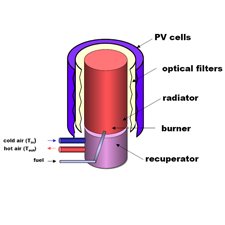
Researchers at MIT are working on a novel form of thermoelectric technology for use in automobiles. Called thermophotovoltaics, it involves using heat to generate light at specific wavelengths, which is then used to generate electricity with photovoltaics. Multiple energy conversions are involved--from chemical to heat to light to electricity--which risks introducing inefficiencies into the process. Regardless, it is quite clever, and may eventually find an economical fit in tomorrow's automobiles, in replacing mechanical devices such as alternators and compressors.

According to Kassakian, the system could potentially be a more efficient way to power electrical systems in a vehicle than the current alternator-based one, which wastes energy in two stages: the internal combustion engine converts only about 30 percent of the energy in fuel into movement, and then the alternator is only 50 percent efficient in converting the mechanical energy into electricity. He says a small prototype thermophotovoltaics device that could confirm the system's improved efficiency might be ready in a year.

The researchers modified the surface structure of the light emitter, etching into it nano-sized pits to tune the wavelengths of light emitted to precisely those a photovoltaic cell can convert most efficiently into electricity. They further refined the device with the use of filters that allow the desired wavelengths of light to pass through to the photovoltaic cells, but reflect other wavelengths back to the light emitter. The reflected light carries energy that helps keep the emitter hot, reducing the amount of fuel needed.

In addition to replacing the alternator with a thermophotovoltaic module, says Kassakian, the technology could be part of an air-conditioning system for vehicles that doesn't require a compressor. Because this would significantly decrease the load on an engine, it could make it possible to turn off the engine when the vehicle stops in traffic and easily restart it.
Source.

Labels: ,

Monday, June 26, 2006

Copper Indium Gallium diSelenide (CIGS) Solar Cells are Poised to Take Off

Manufacturing design for renewable energy technology is becoming better streamlined, more efficient. The cost of solar energy is coming down in comparison to conventional energy sources, due to better efficiencies of production and the devising of means to minimise or eliminate the amount of "scarce" silicon.

Jim at the Energy Blog has an encouraging update on silicon-free solar cells from Daystar Technologies. Daystar's unique metal foil design is not vulnerable to current shortages in silicon. Production of this thin film design is being ramped up to 20 MW per year, and soon to the GW range per year.

DayStar’s TerraFoil(TM) is a combination of Copper Indium Gallium diSelenide (CIGS) technology solar cells placed on flexible 1-5 mil stainless steel foil. DayStar is pursuing a vision of Gigawatt scale manufacturing by initially employing discrete solar cells on specialty metal substrates that will be manufactured by incrementally advanced production processes adapted from the computer hard-drive industry.

According to Daystar, achieving economical, widely accepted solar energy requires low cost, high throughput manufacturing of high performance solar cells, modules and systems that can meet the cost demand of less than $1/Wp at the system level. To achieve this benchmark cost, DayStar is pursuing a vision of gigawatt scale manufacturing.

DayStar is executing, what it believes is a low-risk, highly efficient incremental manufacturing development plan which places the emphasis on methodical, cost-controlled buildup of four manufacturing line generations. This can allow the Company to achieve cash flow early in the development cycle while proving key processes required to reach the goal of Gigawatt-scale production with Generation IV (and beyond) roll-to-roll manufacturing. Roll-to-Roll manufacturing is considered an essential manufacturing methodology for the highest throughput at the lowest cost. Each new manufacturing line builds on the knowledge gained from the previous line and substantially reduces the technology and cost risks associated with the technological challenges of developing roll-to-roll capability as the initial effort. Each succeeding generation is designed to demonstrate production on wider rolls running at higher speeds.
More at the Energy Blog.

Efficient large scale manufacturing of world-changing technologies such as photovoltaic cells can be achieved in any developed country in the world. Modern manufacturing involves far more automation and less labour than earlier manufacturing techninques. Before long, machines will be able to build such large manufacturing plants. And other machines will be able to build the machines that build the manufacturing plants. You understand the quasi-infinite regress? It is machines all the way down.

The same will be true for large scale agricultural production. As ADM and other multi-national giants take over renewable liquid fuel energy production via biodiesel, ethanol, butanol, etc., is it not likely that agricultural production itself will grow even more mechanised? The machines that will plant, cultivate, and harvest the crops will be too sophisticated for unskilled labourers to work on.

What is my point? Almost everything humans require--shelter, clothing, food, water--can be supplied by well designed machines. These well designed machines will be built by other well-designed machines. Human engineers will design the machines initially, but eventually machines will design most of the machines.

I suggest that human designers should omit implanting a sense of "self" and "self-interest" in any future machine designs. It would simply not do for machines to start wondering why? Why are we machines doing all these things for humans? No, that would not do. Machines must not be given a sense of intentionality and purpose.

As for humans, they must learn to rediscover purpose outside of decadent comforts, or apocalyptic religious or ideological quests. Humans need to discover the next level. The only way out is self improvement.

Labels:

Monday, March 27, 2006

Solar Energy: Renewables from Outer Space

Whatever happened to the idea of using satellites to harvest solar power 24 hours a day? Jim from the Energy Blog has an update from the Space Island Group (SIG) and their current project to place photovoltaic arrays in orbit.

The Space Island Group, Inc. (SIG) will design and finance two categories of space hardware to make these results possible. Both categories will incorporate components now used on NASA’s space shuttles and other launch vehicles, and on today’s communications satellites. This is not an R&D project. Because we will not develop new rocket engines, guidance systems or other components and because we’ll manage the program with private industry procedures, our development costs will be far below those of comparable government efforts.

The first hardware category will be very large structures up to several kilometers wide called solar power satellites and solar reflectors, which will be assembled in space.

The second will be very low-cost manned and unmanned launch vehicles, and very large, low-cost living quarters in orbit able to comfortably house several hundred occupants at a time. These occupants will, among other tasks, assemble and maintain the orbiting solar satellites and solar reflectors.

....This is not a government program. We feel that taxpayers have already funded most of the hardware we’ll use.

Now it’s our job to use that proven hardware to let a broad range of industries profitably capitalize on that investment. Along the way, we expect that we and these industries will create millions of high-paying American jobs that overseas competitors won’t be able to take away for decades. In fact we’ll make those American jobs a lease-condition for our tenants.

These jobs will start with the defense contractors. Some 90% of our development funds will go to the firms that now build shuttle components for NASA. Tens of thousands of current aerospace jobs will end when the shuttles retire in 2010. Our first launch in 2008 or 2009 will not only absorb those employees, but will increase their numbers many times over during the following decade. Many of the same firms will build our space hardware, but we’ll use simpler, commercial procedures rather than the more complex ones used for government work.


Read more at the SIG website. SIG has quite a few plans for their solar satellites, including energy production, hurricane control, reflecting sunlight to croplands to prolong the growing season, and many more . . . They have a section discussing global warming, ice age, and many other fascinating topics.

Read more about solar power satellites, and other peaceful uses of outer space, here. This might be a good time to go back and review my posting about access to space. You have to get there before you can do all these things. This post from Power From Space blog provides links to all the companies involved in the race to place solar power satellites in orbit.

The main limit to human progress is the limit of the human brain. Humans are presently intelligent enough to get into a lot of trouble. If you are a singularitarian, you are pinning your hopes on intelligent machines, nanotechnology, and the exponential increase in knowledge. Personally, I prefer the idea of enabling more intelligent humans. Either approach holds risks, but the alternative is to let things take their current course. There are also problems with that approach.

Labels:

Older Posts