Thursday, January 10, 2013

Germany Undergoing Contortions to Make Energiewende Work

Big wind and big solar are hopelessly intermittent and unreliable forms of energy production. But Germany has rashly committed itself to supplying 40% of its power from the intermittent unreliables by 2020. As a result of this giant leap of faith, German energy planners are scrambling for ways to convert big wind and big solar energy to more reliable forms of energy that can be stored, and used whenever needed.
As seen in the diagram above, a new €3.3 million project aims to produce methane from wind and solar generated electricity, using alkaline electrolyser stacks.
Once the hydrogen has been produced it passes through a methanisation process. The resulting methane can be injected directly into the natural gas grid, thus allowing for renewable energy storage on a timescale of months or more. The gas contributes to decarbonising the grid, and can be used for electricity generation or to fuel natural gas vehicles. _FuelCellToday
Here is more information about an earlier, preliminary research project to prove the concept:
The Centre for Solar Research Baden-Württemberg (ZSW) has inaugurated a research facility to convert solar power to methane. The methane is then added to the natural gas grid.

The project uses solar power to electrolyse water in a pressurised alkaline electrolyser, producing hydrogen and oxygen. The hydrogen gas then undergoes methanation, and with the facility able to produce up to 300 cubic meters of renewable methane per day, it is the largest of its type in the world. _FuelCellToday
More information from ZSW (in German)

Needless to say, the concentration of CO2 in the Earth's atmosphere is vanishingly small (0.04%) -- making atmospheric CO2 far too rare and expensive as a CO2 source, for an industrial-scale project. This being the case, it is clear that the project will have to use concentrated CO2 effluent from a hydrocarbon-burning power plant, cement plant, or other industrial scale plant.

And as it happens, Germany is burning much more coal lately, as a result of its impulsive decision to shut down its nuclear power plants. All of which brings up a very good question: "If Germans want to produce methane from CO2 and H2 from the electrolysis of water, why not use nuclear power as your source of electricity?" Nuclear power is cheaper, more reliable, and more potentially abundant than the intermittent unreliables -- big wind and big solar.

Perhaps the answer to the question is that the Germans are not actually serious about all of this, but are merely posturing for the energy and environmental media -- and for green oriented voters and power blocs.

That would be a shame. Germany is in dire need of competent people who are willing to take a serious approach to present and future electrical power needs.

Labels: , , ,

Monday, December 10, 2012

Gas, Oil, and Electricity from Oil Shale Kerogens Using In Situ Solid Oxide Fuel Cells


Trillions of barrels of oil equivalent locked inside oil shale kerogens are waiting for a clean and profitable approach of production. We have discussed one likely approach -- high temperature gas cooled nuclear reactors -- which is likely to be an effective, clean, and profitable approach to oil shale kerogen production. But it is likely to take between 15 and 20 years of development before such a method is ready for the Green River formation in the US Rocky Mountain west.

A different approach was patented by Marshall Savage, utilising solid oxide fuel cells (SOFCs) placed within the rock at strategic locations. This approach would produce oil, gas, and electricity using an in situ process, without significant mining or rock removal.
The present invention is a subterranean heater composed of fuel cells. In the preferred embodiment, the apparatus comprises a plurality of fuel cells assembled in a vertical stack via plates generally referred to in the art as “interconnect plates”, or “bipolar plates”. Conduits throughout the stack supply the cells with fuel and air or other oxidant, and remove exhaust gases. Preferably, the fuel cell stack is enclosed in a casing adapted for insertion into a well bore. An electrical connection is provided to the far end (typically bottom) of the stack to allow completion of an electric circuit.

The encased fuel cell stack is inserted into a wellbore, preferably vertically, but potentially horizontally or at some other orientation. Preferably, the encased stack is cemented into the borehole by a suitably heat conducting grout. Fuel and air are pumped into the stack through the incorporated conduits to the fuel cells. Within the fuel cells, electrochemical reactions take place to produce electricity and heat. The electricity passes out of the stack through an electric circuit. Fuel cells, of the solid oxide type, which are preferred, operate at temperatures in the 800 to 1000 degree Centigrade range. This is also the preferred temperature range for many subterranean heating applications. Heat passes from the fuel cell stack to the underground formation by thermal conduction. Thus, the operating fuel cell stack acts as a down-hole conduction heater of enormous magnitude, perhaps taking a year of operation to prepare a resource layer for in situ mining.

In the preferred embodiment of the invention, conduits for air, gaseous fuel, and exhaust are formed by aligning holes in the interconnect plates. Communication for circulation of these gases is provided by channels formed in the surface of the interconnect plates. _PatentsOnline


http://www.energytv.com/videos/view/4396

A small Colorado company is moving ahead with testing and development of this in situ fuel cell approach -- called Geothermic Fuel Cells because they put heat into the rock rather than taking it out.
A little-known energy technology company in Parker... stands at the forefront of a new era in domestic energy production. Independent Energy Partners Inc. is in the early stages of rolling out an industry game-changer, a device that holds tremendous promise in helping the United States harvest energy in a cost-effective and environmentally friendly way.

The seven-employee firm with offices on Pine Drive is about to turn the oil shale industry upside down with its in-situ Geothermic Fuel Cell, a solid oxide fuel cell unit that heats subterranean rock formations to recover three energy components from “unconventional hydrocarbons,” said Al Forbes, chief executive officer of IEP.

The first, accounting for roughly two-thirds of the recovered hydrocarbon energy, is a high-quality oil from the processing of kerogen in the shale. The second is natural gas. The third is “baseload green electricity,” captured via the “electrochemical process” of fuel cells. The electricity is produced as a by-product of the process, with nearly 80 percent being surplus and sold to utility or industrial companies, which offsets some of the costs associated with the process and the manufacturing of the high-tech Geothermic Fuel Cells.

Perhaps the most exciting aspect is that the unit is designed to operate on a portion of the gases produced during the process, resulting in a low carbon footprint, especially when compared to antiquated methods that are still being used. The GFC becomes a self-sustaining device that requires only a small amount of natural gas to start the process.

After getting patents, IEP worked closely with the U.S. Department of Energy’s Pacific Northwest National Labs on design and engineering to confirm the “technical feasibility” of the Geothermic Fuel Cell. IEP has also entered into agreements with Total Petroleum and the Colorado School of Mines, which has contributed technical support and will help conduct testing.

The partners have leases or options on oil shale resources in the Rocky Mountain Region that contain an estimated 16 billion barrels of oil; IEP owns mineral rights in the Piceance Creek Basin on the Western Slope that contain roughly 2 billion barrels of oil.

The low-emission process was developed by Marshall Savage, who approached Forbes with his idea in 2003. The founder of IEP was so convinced that the “revolutionary” product would succeed, that he dropped all other business ventures, including renewable energy, to strictly focus on the GFCs.

...The company, alongside the Colorado School of Mines, has begun an 18-month program to test the prototype prior to field demonstration, and Delphi has reconfigured some of its products to adapt to IEP's application. Forbes expects commercial production of GFCs by 2015 or 2016. _ColoradoNews
IEP's website

PDF comparison of oil shale production technologies, including a good look at the Geothermic Fuel Cell approach (PDF)

The in situ SOFCs are fueled by gas that is released from the rock once the fuel cells have warmed up. In other words, the process is self-sustaining once the SOFCs achieve operating temperature using an initial startup boos from natural gas.

The combined products of electric power, gas, and oil, provide the operation with multiple sources of cash flow.

Warm-up time required before commercial oil production can begin is estimated to be up to 2 years.

The total oil equivalent in the Green River kerogen deposit is estimated to be up to 3 trillion barrels.

Labels: , ,

Friday, August 24, 2012

Energy Briefs

One-step closer: Biofuel from Biomass
New research from scientists at the University of Georgia who are members of Department of Energy's BioEnergy Science Center (BESC) provides a genetic method for manipulating a group of organisms, called Caldicellulosiruptor, that have the ability to use biomass directly at temperatures over 160 Fahrenheit. The ability to modify the microbes to make the needed fuel products is a required first step for modern industrial fermentations. This allows researchers to combine the natural ability to consume renewable plant materials with an altered improved ability to make what is needed. _PO
Tough industrial-strength microbes that can be programmed to produce the fuels or chemicals desired, should take biofuels and bio-chemicals production to a higher level.

Unlimited high-value chemicals from engineered microbes: Freeing up petroleum can provide a 25% boost to global petro-production!
Although the major products of crude oil refineries are fuels such as gasoline and jet fuel, approximately 20 percent of crude oil is refined, in several complicated, energy-intensive steps, into petrochemicals. These chemicals permeate our daily lives in products ranging from candles and perfume to disposable diapers, toys, tires and plastic packaging, among many others.

As an alternative to crude oil, researchers around the world are studying ways to produce fuels and chemicals from renewable sources, including plant biomass and algae. Current production processes are energy-intensive and generate sugars or oils, which are "intermediate" products. "Then you would take those intermediates and do traditional processing, whether it's biological or chemical," says Pfleger. _PO
So, if we take that 20% of crude oil production that is used for chemicals, and put it back into global oil markets, we achieve what is in essence a 20% boost 25% boost in oil production, in terms of fuels etc...

Sure, it is more complicated than that, since some fractions of petroleum are more suitable for one use than for others, but you can get a vague idea as to why substitution of unlimited renewable chemicals and feedstocks can have a powerful effect on global oil markets.

Why Iowa finds itself at the center of the ongoing revolution in next generation biofuels

New nano-composite material for fuel cells achieves a 5X increase in electric current per milligram of platinum
IBN's new nanocomposite material can produce at least 0.571 amperes of electric current per milligram of platinum, compared to 0.109 amperes per milligram of platinum for commercial platinum catalysts. This is also the first time that a catalyst has been shown to enhance both the stability and activity for the fuel cell reaction with a significantly reduced platinum content. _PO
This is a low level, nuts and bolts type advance in fuel cell mechanics and economics. But with the coming global bonanza of tight gas, we are likely to see increasing use of methane fuel cells for both primary production in residences and small business, and as critical power backup for commercial, municipal, and industrial enterprises.

None of these stories are particularly earth-shaking in themselves, but over time such innovations tend to accumulate, combine, rearrange, and evolve into significant advances.

Labels: , ,

Saturday, June 02, 2012

Triple Cycle Power Generation Gets 70% + Efficiency

Start with a solid oxide fuel cell (SOFC). Use the waste heat from the SOFC to drive a gas turbine. Then use the waste heat from the gas turbine to drive a steam turbine. Et, voila! A triple cycle power generation system that can achieve over 70% in fuel to power efficiency.

Mitsubishi Heavy Industries Ltd. is developing the necessary technologies to put such a system together.

GCC

In a triple combined cycle power generation system, an SOFC power generation system is placed before the GTCC system. By generating power at three stages—the fuel cell, gas turbine, and steam turbine—the resulting fuel cell combined cycle (FCCC) system achieves outstanding efficiency in generating power from natural gas. The FCCC system is expected to achieve the world’s highest power generation efficiency exceeding 70% (LHV) for several hundred MW class power generation and over 60% (LHV) efficiency for several tens of MW class power generation.

MHI sees FCCC triple combined cycle power generation as a revolutionary technology that will result in 10% to 20% improvements in power generation efficiency over existing natural gas-fired power generation systems. The company plans to pursue development based on the results of the basic technologies study, with the ultimate goal of commercializing the technology. _GCC
The idea is to milk as much power out of natural gas (and eventually methane hydrates) as possible. Japan desperately needs to improve efficiency in generation, transmission, and utilisation, in the aftermath of a rash governmental decision to shut down reliable nuclear plants.

Triple cycle power generation is also likely to be used with new generation nuclear power plants, which operate at even higher temperatures than SOFCs. Additional power gen cycles can be added to the cascade at either end, depending upon the starting temperature.

In fact, even with SOFCs, an additional power gen cycle could be added at the low end below the steam turbine cycle, utilising the lower temperature waste heat from the steam turbine.

There are many uses for waste heat besides generation electrical power. And we have only begun to discover a few of them.

Labels: , ,

Friday, June 01, 2012

Interesting New 57% Efficient Solid Oxide Fuel Cell

Fuel cells can burn a wide range of fuels: from hydrogen to biomass to methane to diesel. They are also more efficient than internal combustion engines. This makes them practical for both stationary power generation facilities, and for mobile power generation in electric-powered vehicles. Below we have republished two excerpts from stories reporting on important developments in solid oxide fuel cell (SOFC) design and development, which makes SOFCs more efficient and practical.
GCC

Researchers at the Pacific Northwest National Laboratory report on a highly efficient, small-scale solid oxide fuel cell system featuring PNNL-developed microchannel technology in combination with adiabatic, external steam reforming and anode gas recirculation. The heat and water required for the endothermic reforming reaction are provided by the recirculated anode gas emerging from the SOFC stack. They refer to this as adiabatic steam reforming because external heat sources, such as a combustor or an electric-resistance heater, are not necessary to support the reaction.

The new fuel cell system achieves up to 57% efficiency—significantly higher than the 30 to 50% efficiencies previously reported for other solid oxide fuel cell systems of its size—according to a study published in this month’s issue of the Journal of Power Sources. The pilot system generates about 2 kW of electricity; the PNNL team designed it to be scaleable to produce between 100 and 250 kW. _GCC
NewEnergyandFuel

The PNNL SOFC system has been streamlined to make it more efficient and scalable by using PNNL-developed microchannel technology in combination with processes called external steam reforming and fuel recycling. PNNL’s system includes fuel cell stacks developed earlier with the support of Department of Energy’s Solid State Energy Conversion Alliance.

The big numbers for the efficiency of this small SOFC system is the use of a PNNL-developed microchannel technology in the system’s multiple heat exchangers. Instead of having just one wall that separates the two gases, PNNL’s microchannel heat exchangers have multiple walls created by a series of tiny looping channels that are narrower than a paper clip. This increases the surface area, allowing more heat to be transferred and making the system more efficient. PNNL’s microchannel heat exchanger was designed so that very little additional pressure is needed to move the gas through the turns and curves of the looping channels. Even more interesting is the second unique aspect of the system – it recycles the heat. _NewEnergyandFuel
SOFCs using heat recycling fuel reformers, should eventually be able to use a wide range of carbonaceous fuels -- including biomass. So much for the collapse of civilisation when crude oil is abandoned as a primary fuel.

More on biomass fuel cells (PDF)

Here is a "kinder, gentler" way of turning biomass into energy. As we have predicted, the conversion of cellulose to energy and fuels is likely to follow a rough trajectory over various processes. The "brute force" thermal and thermochemical approaches are more practical initially. As better organisms and enzymes are engineered, the biological approach is likely to grow more efficient. Finally, as nanotechnological bio-mimics improve, the greater robustness of inorganic nanotech-catalysts should facilitate their use in place of more fragile bio-based catalysts. In the background, the movement of more advanced societies to safe, clean, reliable, and affordable gen III and gen IV nuclear reactors at various scales, is likely to increase the energy and fuel production choices of societies almost exponentially.

Labels: , , ,

Thursday, May 17, 2012

Replacing Internal Combustion Engines

First let's look at a common and widespread industrial application for electric vehicles, and how manufacturers and owners eventually settled on a hybridised solution combining batteries with ultracapacitors, to successfully replace internal combustion engine performance in the short-range heavy duty vehicles.
Forklift manufacturers have tested out several technologies over the years in attempts to increase the efficiency of their vehicles. Their success was limited, and they have traditionally settled for batteries as the energy storage system of choice. However, batteries have proven to be less than satisfactory. They are energy dense but not power dense, and they have temperature and lifespan limitations that affect productivity. Increasingly, forklift manufacturers are adopting ultracapacitors in tandem with batteries. Ultracaps are power dense, but not energy dense, and they allow for a lower charge rate, enabling the application to operate at a lower temperature. The result of the ultracap-battery combination: longer lifespan and better performance.

Ultracaps also offer other benefits to forklift manufacturers and AGV owners. In an emergency situation, ultracaps provide enough energy for peak shaving, which lowers the power to a safe and manageable level. In full-crane operations, users need only four megawatts of ultracap banks. Ultracaps also increase the life of the batteries with which they partner; a 3,000 pound lead acid battery partnered with an ultracap can last up to four hours, when alone it would last only one hour. And finally, ultracaps have endured and successfully completed crash tests, meaning they are rugged enough for the nature of the work AGVs do.

Ultracapacitors are particularly useful in dynamic systems where applications perform several accelerations that last just a few seconds. These rapid movements, typical in AGVs, set the stage for energy recapture, which ultracapacitors excel at doing. The high-power and high-energy applications in the AGV market can benefit significantly from a hybridized solution of ultracapacitors and batteries, while seeing a payback on the ultracapacitor investment in just 18 months. _Environmental Leader
This solution will not be enough to replace internal combustion engines (ICEs) for on-road vehicles, due to their lack of range. To replace ICEs for on-road vehicles, a triple-hybrid solution might be best: fuel cells, batteries, and supercapacitors.
Internal Combustion Engines Best Single Power Source for Energy & Power Densities

It is impossible at this time for any single electrical power storage device to match the internal combustion engine for both power density and energy density, particularly when taking expense into account.
Comparing Fuel Cells, Batteries, and Supercapacitor Power Response

As you can see when comparing fuel cells, batteries, and supercapacitors, each has different strengths and weaknesses in terms of supplying power for acceleration, and in terms of storing energy for long range driving between recharge or refuel.
Specific Energy vs Specific Power for Fuel Cells, Batteries, and Capacitors

Energy Management for Fuel Cell - Battery - Supercapacitor Vehicle

This paper proposes a perfect energy source supplied by a polymer electrolyte membrane fuelcell (PEMFC) as a main power source and storage devices: battery and supercapacitor, for modern distributed generation system, particularly for future fuelcell vehicle applications. The energy in hybrid system is balanced by the dc bus voltage regulation. A supercapacitor module, as a high dynamic and high power density device, functions for supplying energy to regulate a dc bus voltage. A battery module, as a high energy density device, operates for supplying energy to a supercapacitor bank to keep it charged. A FC, as a slowest dynamic source in this system, functions to supply energy to a battery bank in order to keep it charged. Therefore, there are three voltage control loops: dc bus voltage regulated by a supercapacitor bank, supercapacitor voltage regulated by a battery bank, and battery voltage regulated by a FC. To authenticate the proposed control algorithm, a hardware system in our laboratory is realized by analog circuits and numerical calculation by dSPACE. Experimental results with small-scale devices (a PEMFC: 500-W, 50-A; a battery bank: 68-Ah, 24-V; and a supercapacitor bank: 292-F, 30-V, 500-A) corroborate the excellent control principle during motor drive cycle. _Abstract of Journal of Power Sources study

Fuzzy logic power management for fuel cell - battery - supercapacitor electric vehicle IEEE Vehicular Transactions

Some manufacturers are attempting to combine the battery and the ultracapacitor into a single device, and others are combining the two into a single sealed package. The advantage of combining the two devices for better total power and energy densities is clear. The addition of the fuel cell to provide much longer range -- providing for fully charged batteries and ultracaps over an extended time -- creates more expense and a more difficult technical challenge, but appears to be the only way of replacing the ICE ultimately.

A future invention which combines the functions of all three devices in one, is not out of the question, and is likely to reduce the cost of the all-electric powerplant eventually, when it can be manufactured as an integrated device.

Labels: , , ,

Wednesday, January 04, 2012

How to Power the Coming Micro-Robot Explorers of the Solar System

Images via robhogg.com

Micro-robot explorers will be cheaper and easier to mass produce and deliver to the various planetary bodies of the solar system -- all the way to Pluto and beyond.

It is not yet clear how to best power these tiny robots -- so far from Earth and the sun. But one idea is to use microbial fuel cells. That approach would work best, of course, if the microbes were able to find a native source of food on the planetary body. More:
RobHogg

Microrobotic explorers, powered by microbial fuel cells, could represent an efficient and reliable energy source on a planet without human intervention.

Microbial fuel cells harness the metabolic processes of bacteria, sending harvested electrons through an anode-cathode-resistor circuit to generate electricity. The advantages are that bacteria can be squashed into a battery with high energy density compared to traditional lithium-ion power sources, and the ability of microorganisms to reproduce acts like a natural battery charger.

Scott reckons that a portion of the microbial energy would be used to maintain onboard electronics and control systems, while the rest would be directed toward slowly charging a battery or capacitor. Once enough energy is stored, the autonomous robot would be able to use a more power intensive scientific instrument or to propel itself forward.

His research will focus on a pure culture anaerobic bacterium, such as Geobacter sulfurreducens, and look at ways to increase the energy produced by MFCs, and eliminate the existing bulk associated with the battery infrastructure, such as large, power intensive pump systems.

"As we move forward in the utilisation of MFCs as an energy generation method, this research begins to lay the groundwork for low powered electronics with a long-term potential for space and robotic applications," says Scott. Microbial fuel cells coupled with extremely low-power electronics and a low energy requirement for mobility addresses gaps in power technology applicable to all robotic systems, especially planetary robotics." _Wired.co.uk
Microbial Fuel Cell.org

Wikipedia: Microbial Fuel Cell

The Wired.co.uk article above did not explain specifically where the bacteria were to get their food. If bacterial fuel cells are eventually used to power micro-robotic space explorers, they will need to be fashioned specifically for the type of food resource available on the targeted space body.

Of course, what we actually want to send to the planetary bodies of the solar system are micro- and nano-robotic systems that are able to self-power, self-reproduce, and work together as swarm intelligences. They should function not only as exploratory probes, but as preparatory builders of infrastructure -- preparing habitats and resources for later human occupants.

It is not clear whether bacterial fuel cells can provide enough power for that more difficult secondary mission. But they should be kept in mind as one power source among many possibilities, including nuclear power packs and charging stations.

Labels:

Thursday, November 17, 2011

Fuel Cells are Coming On for Scalable Backup and Transportation

You can get a good idea of where fuel cell technology and markets are going by reading through the Fuel Cell Today Industry Outlook 2011 (PDF) report. Fuel cell markets are growing particularly well in Europe and North America, although Asian markets are also seeing significant growth.
Image Credit: Fuel Cell Basics
The fuel cell schematic above shows a generic hydrogen / oxygen fuel cell. Modern fuel cell developments allow for a wide range of fuels which act as hydrogen donours, from methane to diesel to coal to sugars.

Utilities are starting to look at fuel cells for several applications:
Utility adoption of fuel cells can include multiple levels, such as:
Residential combined heat and power (resCHP) for units up to 10 kW per single home and 20 kW per multiple family dwellings.
Baseload generators in commercial buildings and public facilities.
Non-spinning and spinning reserves.
Grid strengthening.
Energy storage for time shifting of renewables.
Off-grid power production._FierceEnergy
Fuel cells are being used at all scales, from industrial backup to remote off-grid applications to power supplies for portable consumer electronics and cellular phones. Fuel cells appear to be particularly resilient in the face of natural disasters, which is reassuring -- since one of the main applications for fuel cells is for backup power when the grid goes down. Perhaps if the Fukushima nuclear reactors had been backed up with fuel cells, at least some of the backup power might have survived to help prevent the meltdown.

Fuel cell researchers are becoming quite clever at substituting low-cost materials for expensive platinum, thus lowering the costs and extending the markets for fuel cells.

Fuel cells are finding applications as power sources for various transportation vehicles -- including airplanes! Military UAVs in particular are utilising fuel cells to achieve quiet flight. An interesting look at a fuel cell hybrid UAV

One particularly fascinating type of fuel is the bacterial fuel cell. The fuel cell discussed in the linked article is meant to purify waste water, but other bacterial fuel cells are meant to generate hydrogen gas, or electricity.

Fuel cells would also be suitable for wilderness resorts and retreats. Propane-powered fuel cells would be particularly appropriate, although if an operator combined some form of H2 generation via renewables with a hydrogen / oxygen fuel cell, he might just hit on the best possible use for wind and solar energy.

Labels:

Monday, November 14, 2011

Is $56,000 Too Much to Pay for a 5 kW Home Fuel Cell?

Lake Oswego Review Clear Edge Power

The Clear Edge Power 5 kW residential fuel cell runs on methane, and sells for $56,000. It is estimated that owners will pay roughly 9 cents per kWh in some states, when all incentives and subsidies are taken into account. In many other states, of course, the owner will pay more.
ClearEdge has sold 120 CE5s since introducing its first fuel cell in April 2010 and has back orders to sell another 1,063. The company raised an impressive $73.5 million in venture capital in August to help it expand into Europe and Asia.

The CE5 produces electricity on site from piped-in natural gas, with up to 40 percent less carbon dioxide emissions than electricity produced at massive utility gas-fired power plants. When state and federal subsidies are factored in, the long-term cost of the electricity is as low as 9 cents per kilowatt hour in some states, Ford says. That’s half the price charged by some California utilities, where prices are much higher than in the Northwest. PGE’s typical residential rate is about 11 cents a kilowatt hour.

Local buyers include a McDonald’s Restaurant in Jantzen Beach, a Hillsboro fire station, the Sylvania campus of Portland Community College and PGE. Bigger demand is coming from Palm Springs and San Diego, where electricity prices are high, as well as overseas.

Ford, a former defense industry executive at Lockheed Martin Corp., took the reins of the 8-year-old company in 2008, when ClearEdge had 20 employees. Now it has 200 employees in Hillsboro plus roughly 25 elsewhere. And it’s poised for more growth.

Ford predicts the company will become profitable in two months.

Within a few years, he says, ClearEdge could produce 10,000 fuel cells a year at its Hillsboro plant and hit $750 million a year in sales. That would require about 1,500 employees at the headquarters and adjacent assembly plant, he says.

...In mid-November, Ford says ClearEdge will release a family of new fuel cells to complement its 5-kilowatt cell, which produces enough electricity to power four or five typical Portland homes. ClearEdge expects to introduce 10-kilowatt, 15-kilowatt, 20-kilowatt and 25-kilowatt models, Ford says.

In addition, the company will release a direct-current version for the telecommunications market and a power unit for data centers. _LakeOswegoReview

The ideal home fuel cell would run on fuel that could be stored locally in an underground tank. Besides home power, it should also supply home space heating and hot water. That might require a separate heat storage unit -- molten salt, graphite, etc. And as long as you are digging a hole for a large storage tank, you should also dig deep trenches for geothermal heat exchange for both heating and cooling purposes.

The unit pictured above provides heat, but to integrate the heat into your home system would presumably require additional engineering.

The most valuable feature of the Clear Edge unit is independence from the power grid. But as featured, you would still be dependent on the natural gas supplier. Alternatively, Clear Edge has been said to be able to use propane in its fuel cells, which is much easier to store (in liquid form) in quantity at home than methane. Propane fuel cells are catching on with the US military.

Labels:

Saturday, September 24, 2011

Domestic Fuel Cells Make More Sense than Big Wind & Solar

Imagine if each home were able to supply its own electric power, hot water, and space heat from one simple appliance -- the domestic fuel cell? Such a development would go further toward "disaster-proofing" your home than virtually any other single change you could make. Whether you chose to go off the grid, or to remain grid-intertied, a home fuel cell along with a backup fuel supply, could keep your home warm and well-lit during even extended power outages.

More on domestic fuel cells:
According to The Japan Times, demand for the fuel cell units has grown since the March 11th earthquake and tsunami, which severely impacted the supply of power in Japan.

Toho Gas sold 220 units in 2009, the first year on the market, and a further 515 last year.

Now, having already delivered 283 systems, the firm expects to sell 900 units this year, according to the newspaper.

"Since the March 11th disasters, more people have been revisiting the way they use energy at home and paying attention to the combination of electricity and gas for their use," Hironari Tachi, senior manager for marketing, told the news provider.

According to its makers, a household with an Ene-Farm system can save 50,000 yen (£425) a year in energy bills, and reduce CO2 emissions by 1.3 tonnes annually.

"The co-generation system offers the superb functionality of fuel cells in a compact and easy to use form, and can even provide you with hot water from the heat it generates producing power," they explain. _PlatinumToday

This unconventional fuel cell approach uses your home wastewater to generate power and fuel

One reason why power utilities have not objected more to having big wind and big solar crammed down their throats, is that even though big wind and big solar are very difficult to deal with technically, at least the utilities will still control end-user access to power. With the rise of home-scale generation of power, the big utilities will begin to lose a lot of support.

More:
Fuel cells generate electricity and heat as a by product. The advantages over stirling CHP are no moving parts, less maintenance, and quieter operation. The surplus electricity can be delivered back to the grid.[2]

As an example, a PEMFC fuel cell based micro-CHP has an electrical efficiency of 37% LHV and 33% HHV and a heat recovery efficiency of 52% LHV and 47% HHV with a service life of 40,000 hours or 4000 start/stop cycles which is equal to 10 year use.

United States Department of Energy (DOE) Technical Targets: 1–10 kW residential combined heat and power fuel cells operating on natural gas.[3] _Wikipedia

As long as utilities can pass the exorbitant costs of unreliable green fairy dust power schemes -- such as big wind and big solar -- along to their customers, they will play along with incompetent and ideologically bound governmental bureaucracies.

But you, as a free citizen, can do what you want.

Labels: ,

Tuesday, June 21, 2011

Another Way Make Clean Use of the Abundant Coal Resource

The US has roughly 1 trillion barrels of oil equivalent in coal resources,or more. It has twice that amount in kerogen resources, but we are looking at coal specifically. The challenge has been to find ways to burn this massive coal resource cleanly, so as to provide abundant and inexpensive electrical power and heat to what should have been a healthy economy -- if not for a government policy of planned energy starvation.
Georgia Tech. researchers have devised self-cleaning anodes for a solid oxide fuel cell, which may provide yet another clean way of making use of the massive global coal resource.
Conventional coal-fired electric generating facilities capture just a third of the energy available in the fuel they burn. Fuel cells can convert significantly more of the energy, approximately 50 percent. If gas turbines and fuel cells could be combined into hybrid systems, researchers believe they could capture as much as 80 percent of the energy, reducing the amount of coal needed to produce a given amount of energy, potentially cutting carbon emissions.

...But that would only be possible if the fuel cells could run for long periods of time on coal gas, which now deactivates the anodes after as little as 30 minutes of operation.

The carbon removal system developed by the Georgia Tech-led team uses a vapor deposition process to apply barium oxide nanoparticles to the nickel-YSZ electrode. The particles, which range in size from 10 to 100 nanometers, form "islands" on the nickel that do not block the flow of electrons across the electrode surface.

When water vapor introduced into the coal gas stream contacts the barium oxide, it is adsorbed and dissociates into protons and hydroxide (OH) ions. The hydroxide ions move to the nickel surface, where they combine with the carbon atoms being deposited there, forming the intermediate COH. The COH then dissociates into carbon monoxide and hydrogen, which are oxidized to power the fuel cell, ultimately producing carbon dioxide and water. About half of the carbon dioxide is then recirculated back to gasify the coal to coal gas to continue the process.

"We can continuously operate the fuel cell without the problem of carbon deposition," said Liu, who is also co-director of Georgia Tech's Center for Innovative Fuel Cell and Battery Technologies.

The researchers also evaluated the use of propane to power solid oxide fuel cells using the new anode system. Because oxidation of the hydrogen in the propane produces water, no additional water vapor had to be added, and the system operated successfully for a period of time similar to the coal gas system.

Solid oxide fuel cells operate most efficiently at temperatures above 850 degrees Celsius, and much less carbon is deposited at higher temperatures. However, those operating temperatures require fabrication from special materials that are expensive – and prevent solid oxide fuel cells from being cost-effective for many applications.

Reducing the operating temperatures is a research goal, because dropping temperatures to 700 or 750 degrees Celsius would allow the use of much less expensive components for interconnects and other important components. However, until development of the self-cleaning process, reducing the operating temperature meant worsening the coking problem.

"Reducing the operating temperature significantly by eliminating the problem of carbon deposition could make these solid oxide fuel cells economically competitive," Liu said.

Fuel cells powered by coal gas still produce carbon dioxide, but in a much purer form than the stack gases leaving traditional coal-fired power plants. That would make capturing the carbon dioxide for sequestration less expensive by eliminating large-scale separation and purification steps, Liu noted.

The researchers have so far tested their process for a hundred hours, and saw no evidence of carbon build-up. _PO


The problem with making the removal of CO2 a priority, is that it destroys whatever profitability exists within the coal energy sector. But destroying coal energy production has always been one of President Obama's long-term goals, as he confessed to supporters in San Francisco before being elected in 2008. When so much of the government of the world's only superpower is dedicated to the destruction of reliable forms of energy such as coal, nuclear, oil sands, unconventional gas, offshore oil, etc etc, it becomes difficult for industry and commerce to survive. Since the prosperity and power of the world's only superpower is based upon its industrial and commercial might, it appears that the Obama administration is committing democide and a grand scale, via its broad policies of energy starvation.

Fortunately for this government, the lickspittle media -- including comic lickspittles such as Jon Stewart and Stephen Colbert -- are firmly on board the bandwagon of destruction and decline. It is up to more productive groups and persons to find within themselves the fortitude to outlast their dysfunctional overseers in government.

Images transplanted from an earlier posting at AFE 

Labels: ,

Saturday, May 07, 2011

Sugar Fuel Cells, and Other Responses to Inflated Oil Costs

AzoCleanTech

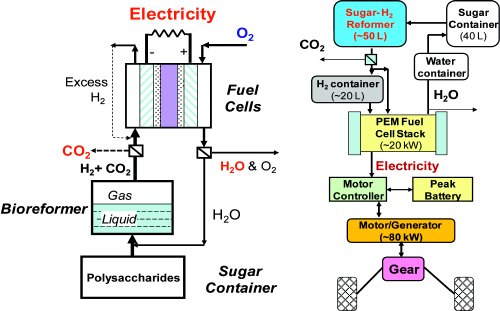
Energy prices have been over-inflated since oil passed the $80 a barrel level, triggering a world-wide rush to develop alternative fuels and energy sources. One of the interesting ideas for new energy is the sugar fuel cell, where cheap sugars from biomass sources would power fuel cells of all sizes for a wide range of applications from hand-held consumer products to utility-scale power backup and load leveling.

Here we suggest an out-of-the-box solution - use of renewable biomass carbohydrates as a high-density hydrogen carrier. This new solution can efficiently address the above challenges for the transportation sector. Here we present the recent advances in cell-free synthetic pathway biotransformation (SyPaB), the roadmap of SyPaB from high-end to low-end applications, and its potential impacts.

A Sweet Solution to the Hydrogen Economy - Sugar as High H Carrier

Cellulosic biomass is the most abundant renewable biological resource (ca. 1 x 10¹¹ tons/year)3. Biomass is produced locally, and is more evenly distributed than are fossil fuels. Each year, the overall chemical energy stored in biomass by terrestrial plants is approximately 6-7 times the total human energy consumption. Also, renewable carbohydrates (e.g., cellulosic materials and starch) are less expensive based on energy content than are other hydrogen carriers, such as hydrocarbons, biodiesel, methanol, ethanol, and ammonia1. The use of a small fraction of low-cost renewable biomass for producing transportation fuels (e.g., cellulosic ethanol and hydrogen) provides benefits to the environment, economy, and national security3.

_Azo
Follow the link to the full article, with illustrations, links, and more detailed explanations and arguments.

On other alternative fuels and energy fronts:

Accelergy is moving ahead with construction of demonstration CBTL (coal and biomass to liquids) plant in Pittsburgh

Australian company Linc Energy is promoting its underground coal gasification and gas to liquids technology in the land down under. In situ underground coal gasification is suitable for difficult to mine coal of even the lowest quality. Syngas to liquids technologies are becoming more economical with better catalysts and process designs.

Offshore and other small-scale gas to liquids (GTL) is getting closer to feasibility, thanks to microchannel architecture reactors.

Powerful members of the US House of Representatives are beginning to push back against President Obama's policies of energy starvation. Besides promoting increase US offshore oil & gas production, congress is likely to promote coal to liquids and increased development of oil shales, heavy oils, and oil sands.

Advanced nations have multi-trillion dollar infrastructures devoted to mainly liquid fuels (and secondarily gaseous fuels). But if sugar fuel cells truly can provide a disruptive fast track technology to multi-scale, decentralised production of electrical power, then solid fuels may join the club. The more the merrier.

If Obama's Nuclear Regulatory Commission ever wakes up and realises that it has an important job to do besides preening before the mirror, nuclear power may begin to fulfill its immense promise as well.

Labels: , , ,

Friday, April 22, 2011

Catalysts and Solvents: Making Everything Possible

While we like to dwell on more exotic technologies and scientific theories, it is the nuts and bolts of modern industry and industrial scale agriculture which keeps you safe, warm, dry, and well fed. Almost no one likes to think about catalysts and solvents, but the quality of those arcane, mundane, nitty-gritty ingredients of your hidden underworld, determines much of what you can do with yourself.

Some interesting developments in catalysts:

New, cheaper nickel-based catalysts may spark a fuels and chemicals revolution

Newer, cheaper, platinum-free catalysts may open the door to cheap fuel cells, and fuel cell automobiles

Cheap molybdenum catalysts may make electrolysis of water to hydrogen / oxygen cheap and practical

Nanotechnology advances add an extra dimension to progress in catalysts

Solvents are even more easily ignored in everyday discussion than catalysts -- except in the context of a faux environmental armageddon. But they are no less important to everyday life for all of that.

New ionic solvents likely to revolutionise oil sands industry -- making oil sands and heavy oils environmentally friendly and setting back peak oil decades.

Supercritical CO2 and steam are proving to be effective solvents for more and more processes.

The movement toward cleaner, cheaper, more sustainable and effective solvents is accelerating, just like the movement toward better catalysts. And those are just two of the basic foundations of modern life where marginal improvements can pay huge dividents in quality of life.

Paying attention to such things can provide amazing investment opportunities as well.

Labels: , , ,

Tuesday, March 29, 2011

"Artificial Leaf" Hype

Scientists today claimed one of the milestones in the drive for sustainable energy — development of the first practical artificial leaf. Speaking here at the 241st National Meeting of the American Chemical Society, they described an advanced solar cell the size of a poker card that mimics the process, called photosynthesis, that green plants use to convert sunlight and water into energy. _ACS
The problem with this announcement at the 241st ACS national meet is that the basic technology is decades old. An MIT scientist, Daniel Nocera, has apparently devised a new mix of catalysts -- including nickel and cobalt -- to facilitate the photonic separation of H2 and O2 from water. The device has run continuously for 45 hours without loss of output. Great things are expected...yada, yada, yada....
Placed in a single gallon of water in a bright sunlight, the device could produce enough electricity to supply a house in a developing country with electricity for a day, Nocera said. It does so by splitting water into its two components, hydrogen and oxygen.

The hydrogen and oxygen gases would be stored in a fuel cell, which uses those two materials to produce electricity, located either on top of the house or beside it. _ACS
Nocera suggests that his device might allow third world villages in Africa etc. to produce their own electricity. And yet the requirement for fuel cells -- still exorbitantly expensive -- will prevent all but the wealthiest villages from even thinking about taking that approach. How fortunate that Case Western Reserve researchers are using nano-tubes to reduce the cost of fuel cells by perhaps a factor of half.

It will be nice to achieve the cheap photonic splitting of water -- and further, the cheap splitting of CO2. Nature achieves both as starting points and no one issues a press release or makes announcements at national meetings.

When we finally do get cheap sources of H2, it is likely that we will use it in industrial processes, for the production of chemicals and fuels to substitute for petroleum and other fossil hydrocarbons. The "hydrogen economy" jive is another source of endless hype that has been oversold since at least the 1960s.

If Nocera and his academic kin truly wish to help the villagers of the third world, the best place to start would be in providing them ways to live more independently of bloody tyrants and dictators, and give them more property rights to their personal production. A permanent "smart drug" like NZT -- except longer lasting -- would also help the third world enormously, given the clear regional discrepancies in measured intelligence and intellectual achievement.

Labels: , , ,

Tuesday, March 22, 2011

Cutting the Cost of Fuel Cell Catalysts by a Factor of 650?

Platinum, which represents at least a quarter of the cost of fuel cells, currently sells for about $65,000 per kilogram. These researchers say their activated carbon nanotubes cost about $100 per kilogram. _Physorg
That sounds like a significant reduction in the costs of fuel cells if the new catalysts work as advertised. Engineers from Case Western Reserve University have got a lot of tricks up their sleeve, which may change the face of the global fuel cell market.
In testing, the fuel cell produced as much power as an identical cell using a platinum catalyst.

But the activated nanotubes last longer and are more stable, the researchers said. Unlike platinum, the carbon-based catalyst: doesn't lose catalytic activity and, therefore, efficiency, over time; isn't fouled by carbon monooxide poising; and is free from the crossover effect with methanol. Methanol, a liquid fuel that's easier to store and transport than hydrogen, reduces activity of a platinum catalyst when the fuel crosses over from the anode to the cathode in a fuel cell. _Physorg
The engineer-researchers have plans that may actually increase efficiency of the nanotube catalysts over that of platinum. That would be quite an accomplishment -- but actually just a trifle of an early hint of the possibilities for the new age of nano. Catalysis is a particularly promising area for nanotechnology, but there are quite a few other radical changes which are certainly on the way.

Buckle up.

Labels: , ,

Thursday, February 24, 2011

Off-Grid Local Power Generation Using Wastewater & Other Waste

Pilus Energy is converging digester, fermenter, scrubber, and other time-proven technologies into a single solution we call an electrogenic bioreactor (EBR). This transformative technology is the basis of the Pilus Cell™. The EBR harnesses genetically enhanced bacteria and harvests the direct current (DC) electricity, economically important biogases like hydrogen, isoprene, and methane from bacterial metabolism (cellular respiration) of organic molecules. _Pilus


Pilus Energy of Ohio is partnering with Horizon Fuel Cell Technologies of Singapore to provide a sustainable self-contained waste-to-electric power generation platform.
Ohio-based Pilus Energy has announced a strategic relationship with Horizon Fuel Cell Technologies in Singapore, to combine Horizon hydrogen fuel cells with Pilus Energy’s renewable hydrogen production platform.

The partnership will integrate Horizon’s PEM fuel cells with Pilus Energy's platform for renewable hydrogen production, to provide a unique turnkey, end-to-end solution to generate clean power at low cost.

Distributed or localized production of hydrogen can reduce reliance on external hydrogen supplies, and opens up the opportunity for self-sustainable power systems in remote, off-grid locations. Using waste or wastewater as feedstock for distributed bio-hydrogen production also offers a carbon-free solution for both urban and remote environments. _RenewableEnergyFocus

This combination of microbial hydrogen-from-waste plus fuel cell power generation, should allow for sustained power generation without need for relying on an outside source of fuel.

Labels: , , ,

Friday, October 15, 2010

New Diesel and Bio-Diesel Powered Fuel Cell

Brian Westenhaus has a story about a new solid-acid fuel cell capable of running on diesel and biodiesel fuels. The development comes from research taking place in Norway. If the new fuel cell proves out, it should be a big boost for electric vehicles -- allowing rapid re-fueling with current infrastructure. Future biodiesel infrastructures will easily fit into the scheme for both vehicular and stationary applications.
In trials, a 200-watt solid-acid fuel cell ran on both pure hydrogen and on hydrogen produced from diesel by the unit’s reformer – with only an insignificant difference in performance. The system is another handy way to solve the hydrogen production and storage issue as well as keep consumers access to abundant fuels used at very high efficiencies.

Diesel is a hydrocarbon thus CO2 is an issue. The reformer section converts the hydrocarbons into hydrogen, CO2 and heat. Due to the unit’s high efficiency, CO2 emissions are substantially lower than in conventional combustion engines, and no other demonstrable exhaust is discharged – meaning that diesel particulates, black carbon soot, nitrous oxide (NOx) and carbon monoxide (CO) are eliminated. An added plus is that the reformer emits no smoke or odor. And, it’s dead silent.

The silent electric generator is being developed and produced by the Norwegian company Nordic Power Systems (NPS). The new type of fuel cell is being developed and delivered from the California firm SAFCell. The development of solid-based acid fuel cells (SAFC) was pioneered in the Haile Lab of the Material Science Department at Caltech. Dr. Calum Chisholm, together with a team of experienced scientists, engineers, and business executives founded SAFCell to bring the technology to the market in November of 2009. Things are moving very fast – it not been a year yet and the prototype field test units are being built. _BrianWestenhaus

Update on waste-to-fuels enterprise by Terrabon

Labels: , ,

Saturday, May 15, 2010

Novel Electrochemical Cell Produces Electricity AND H2

GCC


Scientists from the Energy Technology Research Institute, AIST in Tsukuba, Japan, have developed a lithium-water electrochemical cell for the controlled generation of hydrogen and electricity. The researchers, headed by Haoshen Zhou, foresee the use of this process in fuel cells for mobile applications. A paper on their work was published in the journal ChemSusChem.

Although direct chemical reactions between water and certain metals—alkali metals including lithium, sodium and others—can produce a large amount of hydrogen in a short time, these reactions are too intense to be controlled.

...Only lithium ions can pass across the LISICON film. The rate of both half reactions within the lithium–water electrochemical cell can be controlled by the current, indicating a controllable hydrogen generation.

Another attractive aspect of this technology is that lithium metal can be produced from salt solutions (e.g., sea water) by using sunlight. In other words, energy from the sun can be “stored” in the metal, and then be used on demand by reacting the lithium in the fuel cell. Recharging the battery would be a matter of replacing the lithium metal cell. _GCC
The device is in its early stages, and inefficient. But a controllable hydrogen generator -- once perfected -- could be useful in several ways.

Labels: ,

Monday, April 12, 2010

Methanol Fuel Cells Make Sense


Brian Westenhaus takes a look at a successful California manufacturer of methanol fuel cells for fork lift vehicles. A Nissan assembly plant in Tennessee recently ordered 60 units of the relatively new methanol fuel cell.
Fuel cells can be much more quickly and easily re-fueled than a large battery bank can be recharged. Using fuel tanks, fuel cells can easily hold far more energy than batteries as well. Methanol is safe and easy to handle and store, and is inexpensive, when compared to hydrogen -- which is the fuel usually thought of for fuel cells -- or other gases besides hydrogen.
Oorja’s Protonics’ methanol fuel cells eliminate the dangerous and time-consuming task of switching out and recharging batteries and owning the extra sets Oorja’s OorjaPac fuel cell sits on the forklift and feeds electrons to the battery pack, charging it as the day progresses. Filling up the fuel cell at the beginning of a shift, ideally, provides enough power for the day. A 3.4 gallon-storage tank of methanol powers a vehicle for 10 hours.

...The Nissan factory in Smyrna Tennessee has tested Oorja’s product over 18 months and then ordered 60 units. Mark Sorgi, senior manager of material handling at Nissan said the factory would save near $225,000 per year and avoid spending $300,000 for battery replacements. Oorja’s fuel cells also save time and reduce its greenhouse gas emissions. “We can probably run anywhere from 14 to 16 hours on one tank of methanol,” Sorgi said. “It takes 60 seconds to refill versus battery change-out that takes 15 minutes.”
Methanol, a one-carbon atom chemical is one of the mostly commonly produced chemicals in the world, costs about $1 to $2 a gallon and doesn’t have to be transported under pressure so it’s easy to ship. It’s the main chemical in windshield washer fluid. Methanol can be delivered in large plastic drums and is fully biodegradable.
Oorja has improved the performance of its fuel cell. The new 1.6-kilowatt Model H is about 25 percent to 30 percent smaller than the previous version, at $16,000 costs about 50 percent less than the earlier version, and can be refilled with methanol in about a minute. _NewEnergyandFuel
Entrepreneurs are oriented toward problem solving -- because that is how they make a living. Academics and pundits, on the other hand, are oriented toward magnifying problems and extending a problem's lifespan. That makes sense, because academics and pundits make a living by studying problems, not by solving them.

It may well be that when fuel cells, batteries, and supercapacitors reach their next limitational plateus, that the best electric vehicle will include a combination of a fuel cell feeding the batteries and supercapacitor, a medium sized battery pack between the fuel cell and the motor, and a modest supercapacitor for quick bursts of power. The battery will be kept topped off by the fuel cells, and will provide normal cruising. Supercapacitors will provide rapid acceleration, and will likewise be kept charged by the fuel cells.

Such a combination would come close to matching the performance of an internal combustion engine -- and would beat the ICE at low speed torque.

Labels: , ,

Thursday, February 25, 2010

Bloom Energy Founder KR Sridhar Interview


Both Brian Westenhaus and Brian Wang have been reporting on the Bloom Energy fuel cell which was highlighted on the US TV show "60 Minutes" recently as an energy breakthrough. Both Brians provide useful insights into what is happening behind the headlines.

The interviewer in the video above attempts to discover from Bloom's founder, "what is so special about Bloom's fuel cells?" Sridhar answers in general terms, providing some intriguing hints. One cannot expect Sridhar to divulge trade secrets in such a competitive environment, and in advance of a public stock offering.

The Bloom fuel cells can apparently be "run backwards" to split water into hydrogen and oxygen. That was the original idea Sridhar had for NASA -- to create oxygen for Mars' atmosphere. That project was cancelled, but the idea survived and was developed.
Sridhar (in the video and earlier in the day) also explains how Bloom may enhance the fuel cell in the future for a push into the domestic market in about a decade and the enhancement represents both a step forward and a step back. Carbon dioxide and water are byproducts of the gas-to-electricity reaction. By adding some additional "plumbing" components, the fuel cell can capture the water, run it through the fuel cell later and produce hydrogen. Hydrogen could then be stored until needed to power a car or provide electricity to a home.

The water-to-hydrogen reaction will require additional electricity. Bloom suggests that solar panels can provide this power. Although the fuel cell could do this reaction now, Bloom isn't putting in the components because the market isn't ready, said Sridhar. So having a path to energy storage: a step forward.

So what is the step back? Bloom's patents discuss taking both the carbon dioxide and hydrogen, running them through the fuel cell and producing a methane-like fuel. _GreenTechMedia
If Bloom Energy has solved some of the harder problems of fuel cells -- as Sridhar claims -- we may be seeing some disruptive new technology coming from the company. Up to this point, we seem to be seeing what is in many ways a better fuel cell.

Sridhar plans to sell large units only for at least a decade. These could be used as power backup units for corporations, factories, hospitals, city disaster units, and even large power utilities. The cost of power production is still too expensive to use Bloom units as primary substitutes for coal, nuclear, or gas powered generators.

Labels:

Older Posts