Monday, November 26, 2012

In the US, Natural Gas is King; Everywhere Else It's Coal

The US is set to become the world's most prolific producer of natural gas within the next 2 years, and the largest producer of oil by 2017 -- according to the International Energy Agency.

The US is already benefiting from its rapid growth in affordable natural gas supplies. And famed Harvard historian and author, Niall Ferguson, says that as long as President Obama avoids killing the golden gas goose, the US is in for a big economic boost ahead.

Already the US has begun to move away from the use of coal to generate electricity -- helping the country to "reduce its CO2 emissions" at a time when virtually every other region of the world is increasing coal use and CO2 output.

How fast is coal use increasing outside of North America?

More than 1,000 new coal plants are planned worldwide.
...after a slight dip during the economic troubles of 2008, the global coal trade has rebounded and rose by 13 percent in 2010.

...Most new coal-fired plants will be built by Chinese or Indian companies....

...However, Germany, the UK and France remain in the top 10 importers, and coal use rose 4 percent in 2011 in Europe as prices fell and plants due to close under clean air rules use up their allotted running hours. Indonesia and Australia are the largest coal exporters, with the latter planning to triple its mine and port capacity to almost 1 billion tonnes a year.

Many developing countries, such as Guatemala, Cambodia, Morocco, Namibia, Senegal and Sri Lanka, and Uzbekistan, are planning new coal-fired plants even when they produce almost no coal at all.... _1000 New Coal Plants
There are many ways of mining, shipping, processing, and burning coal cleanly and responsibly. The US coal industry would already be using many of these clean coal methods, if not for the Obama EPA's blatant and counter-productive energy starvationism and faux environmental anti-economic biases.

Nevertheless, the rest of the world is building a huge demand for coal from the US, Australia, and wherever else coal can be found in plentiful quantities.

Eventually, with the aid of high temperature gas cooled nuclear reactors (HTGRs) and other important breakthroughs, the use of coal for conversion to chemicals, fuels, fertilisers, and other necessaries, will attract no more comment from responsible regulators and environmentalists than "a good day to you sir, madam."

Labels: ,

Wednesday, November 14, 2012

Global Coal Industry Booms: India and China Alone Adding 200 New Coal Plants

In the US, natural gas is replacing coal in new electricity generating power plants. As a result, CO2 emissions in the US have declined. In Europe, on the other hand, six times more coal units than natural gas units will be installed by 2015. You can imagine what that will do to Europe's carbon emissions.

But the true champions of coal are China and India, where 200 large new coal power plants will be built over the next few years. All of this while green faux environmentalists in western governments are working to institute ruinous carbon regulations on Europe, North America, and Oceania -- in the name of reducing global carbon emissions!

But another problem stood out. India relies on coal for 55 percent of its electric power and struggles to keep enough on hand.

Coal remains a critical component of the world’s energy supply despite its bad image. In China, demand for coal in 2010 resulted in a traffic jam 75 miles long caused by more than 10,000 trucks carrying supplies from Inner Mongolia. India is increasing coal imports.

So is Europe, as it takes advantage of lower coal prices in the United States. Higher-priced natural gas on the Continent is creating demand for more coal imports from the United States, where coal is taking a drubbing from less expensive natural gas.

...Coal is not subject to the vagaries of windless or sunless days, and can easily meet base-load demands of electricity consumers without interruption. So can nuclear power, but the nuclear industry is still reeling from the March 2011 disaster at the Fukushima Daiichi power plant in Japan. Countries like Germany have turned away from nuclear reactors.

Global demand for coal is expected to grow to 8.9 billion tons by 2016 from 7.9 billion tons this year, with the bulk of new demand — about 700 million tons — coming from China, according to a Peabody Energy study. China is expected to add 240 gigawatts, the equivalent of adding about 160 new coal-fired plants to the 620 operating now, within four years. During that period, India will add an additional 70 gigawatts through more than 46 plants.

“If you poke your head outside of the U.S., coal-fired plants are being built left and right,” said William L. Burns, an energy analyst with Johnson Rice in New Orleans. “Coal is still the cheapest fuel source.” _NYT_via_GWPF
While the leadership of Europe, North America, and Oceania are suffering from carbon insanity, the leaders of China and India are not so deluded. They understand the critical importance of electrical power that does not turn off when the sun goes down or when the wind stops blowing. Modern industrial nations cannot run on the intermittent unreliable energy sources which Obama, Merkel, Gillard, and the others of similar mental turpitude tend to favour.

And please take note of the hypocrisy of the European governments that are willing to mortgage their economic and industrial futures on the backs of big wind and big solar for the sake of carbon reductions -- while at the same time building huge new coal power plants.

Modern societies cannot afford such stupid leaders as these, if they are to survive to reach the next level of abundance. But it seems that we may have reached a point of diminishing returns as far as democracy is concerned. When democracy becomes a rule of the mob which simply votes itself favours and sinecures, it is time for the more productive and competent to consider how to trim the fat and the dead weight.

As governments commit energy and industrial suicide via intermittent unreliables, and fall victim to carbon hysteria, their productive base tends to diminish. This increases instability in the overall system, and leads to chaotic shifts in foci of power and control.

Keep a close watch as things develop.

Labels: , , ,

Saturday, September 22, 2012

Coal to Chemicals via MTO: Methanol to Olefins

Several leading industrial nations are beginning to substitute cheaper coal and and natural gas -- in place of more expensive crude oil -- in the production of high value "petrochemical" products, including valuable polymer feedstocks.
UOP LLC, a Honeywell company, announced today that China s Jiutai Energy (Zhungeer) Co. Ltd. has licensed Honeywell s UOP methanol-to-olefins (MTO) technology to convert methanol from coal into key plastics building blocks. Honeywell s UOP/Hydro MTO process converts methanol from gasified coal or natural gas to produce high yields of ethylene and propylene, building block materials used in the production of films, packaging, plastics and other petrochemicals. The breakthrough technology allows producers in countries such as China to tap abundant coal resources, rather than more expensive petroleum, to produce petrochemicals. _Equities.com


I. Overview of MTO Process


The Methanol to Hydrocarbons process was discovered at Mobil Oil in 1977. This process is used to convert methanol to products such as olefins and gasoline. The methanol can first be obtained from coal or natural gas. In the Methanol to Olefins (MTO) process, the methanol is then converted to olefins such as ethylene and propylene. The olefins can be reacted to produce polyolefins, which are used to make many plastic materials. An MTO process flow diagram advertised by Honeywell is shown below.

__UC Berkeley

Substituting cheaper and more abundant coal and natural gas, in place of crude oil, will make crude oil supplies go much further. Such substitution will also place a de facto ceiling, of sorts, on intermediate to long-term oil prices.

The real energy prospect is the world now faces a problem of newly found, or newly developed, and ever increasing energy resources and supplies - not a crisis of energy scarcity.

The turnaround has been lightning rapid, in at most 5 to 7 years, and has wrongfooted many analysts, most politicians, and the world's "historic major" energy corporations, as well as the green movement and "ecology politicians" who still claim energy supplies are rapidly declining and we face an inexorable energy crisis - very like their residual attempts to peddle global warming apocalypse. In fact the prospect of us facing energy penury, shortage and scarcity has been turned upside down. _The Energy Crisis that Wasn't

Besides displacing crude oil from the petrochemicals business, coal and natural gas will be displacing more and more crude oil from the petrofuels business. Gas to liquids (GTL) and coal to liquids (CTL) are gradually becoming more economically profitable, at the same time that crude oil prices have been creeping upwards.

As biomass to liquids (BTL), kerogens to liquids (KTL), and gas hydrates to liquids, become ever more viable, conventional crude oil will find itself competing with massive hydrocarbon resources amounting to many trillions of barrels of oil equivalent.

Yet another story about Russia's Gazprom being forced to confront the global reality of tight gas resources.

Russia's national oil & gas companies had been growing fat and lazy, not to mention corrupt. It looks as if Russia will be forced to ask for outside help to develop its huge tight oil & gas resources -- before it gets priced out of European and some Asian markets.

Labels: , ,

Wednesday, September 19, 2012

Global Demand for Coal Skyrocketing

The coal plants in India's pipeline -- almost 100 more than China is preparing to build -- would deliver 519,396 megawatts of installed generating capacity. That is only slightly less than pending new capacity in China, which remains the undisputed king of coal consumption.

...The research found 1,231 new coal plants with a total installed capacity of more than 1.4 million MW proposed worldwide. Beyond the biggest users -- China, India and the United States -- the assessment finds a heavy coal demand building up in Russia, Vietnam, Turkey and South Africa.

...According to the WRI analysis, more than 34,000 MW of coal capacity is slated to come online in Vietnam, 30,000 MW in Turkey, and 22,000 MW in South Africa.

China, which has been on a coal binge for the past 15 years, still has the largest pipeline in the world in terms of megawatts. The WRI assessment notes that China's 12th five-year plan approved 16 giant coal-power bases, mainly in northern provinces and close to mining fields.

...Catelin of the World Coal Association argued that so far this century, half the world's incremental primary energy needs have been met by coal. _Scientific American _ via _ GWPF

While US President Obama's EPA is working behind the scenes with faux environmental groups such as the Sierra Club to shut down the building of new, clean coal power plants, the rest of the world's appetite for coal is growing to binge level.

This means that US coal exports are likely to continue growing.

Thinking persons will not take long to realise that the carbon hysteric energy starvationist tactics of the Obama EPA and global faux environmental groups -- no matter how well intended -- will not reduce the global burning of oil, coal, or other hydrocarbons. They are merely shifting the location from areas where the energy would be burned cleanly -- the advanced world -- to areas where the hydrocarbons will contribute the maximum pollution to the Earth's atmosphere.

Considering the unspoken subtext of the faux environmental movement, such an achievement may well amount to a big "mission accomplished."

Labels:

Tuesday, July 31, 2012

Obama's War On Coal Leaves US Vulnerable

Energy Fix
The coal-fired electricity projected to be retired over the next five years is more than four times greater than retirements executed during the preceding five-year period, a mere 6.5 GW by comparison. The estimated 9 GW of coal-fired capacity retirements expected in 2012 will likely be the largest one-year amount EVER. And that record likely won’t stand very long because 10 GW are projected to be retired in 2015.

...The risks of brownouts and perhaps even blackouts on weekdays challenged by extreme weather loom as a growing risk that could trigger a backlash against emissions regulations, renewable sources of electricity and competitive power markets. _EnergyFix
As Obama fulfills his campaign promise to green supporters to put coal plants out of business -- and to prevent the building of new coal plants -- he is placing the US power grid and US industry in an increasingly vulnerable position.

Obama mad grand promises about the potential for "green energy" and "green energy jobs", but out of the tens of billions wasted on green energy projects, almost all are either bankrupt or struggling.

Put simply: Green energy cannot replace coal


Reading the entire analysis at the energy collective will help you to understand just how badly the green strategies go wrong. You will get the barest hint of how much this grand green strategy will cost American power consumers.
Based on this analysis of replacing all U.S. coal power with clean energy, total U.S. CO2 emissions would also be reduced by almost 22% from 2005 levels; the ACES base year for target CO2 reductions. Assuming other clean energy alternatives are competitive to replacing coal power with natural gas & wind clean power (i.e. $51.50/MT CO2), the total average-annual cost to achieve the ACES ultimate 80% CO2 reduction target would be about $220 Billion/yr. This is equivalent to about $1,835 direct + indirect increased Household annual power related expenses or almost 4% of total average gross Household income. _Green Energy Cannot Replace Coal

The reality will be much worse than even the above very sober analysis reveals. The reality is always worse than what the government promises, than what emotionally earnest advocates promise.

Obama's approach to energy and to the economy has been misguided and ideologically skewed.

From offshore drilling to Canadian oil sands to coal to nuclear, Obama's approach to energy has resulted in a stunting of energy production and a slowing of economic growth. The only exception is in tight oil & gas fracking -- and Obama's EPA came very close to trying to shut down that enterprise -- virtually the only bright spot in Obama's entire economy.

The third world and the emerging world show us what happens when bad energy policies are superimposed upon government corruption, debt, and demographic decline. If the current US president is re-elected, we should expect to see the US more firmly set upon a parallel declining path.

Labels: ,

Sunday, July 29, 2012

China's Coal to Chemicals: Guest Post by Rembrandt

Note: The article below is reprinted from the peak oil site "The Oil Drum" to illustrate that even peak oil sites occasionally publish informative and factual material. Most of this information has already been published here at Al Fin Energy over the past few years. But it is always good to encourage the publishing of important, positive information by websites which typically focus on the negative.

The following article by Rembrandt was originally posted at The Oil Drum

In this post, I give an overview of developments in China to create a coal to chemicals industry, primarily using methanol as an intermediary feedstock. In doing this research, to my surprise, I found that the Chinese chemical economy is advancing rapidly in its use of coal as a chemical feedstock, as opposed to crude oil in other countries. In many cases, coal already represents 20% or more of chemical feedstocks, and in special cases such as PVC, the country already sources virtually all of its input from coal. Since China produces 20% of the world's PVC, such transitions have a substantial impact on the global energy system.

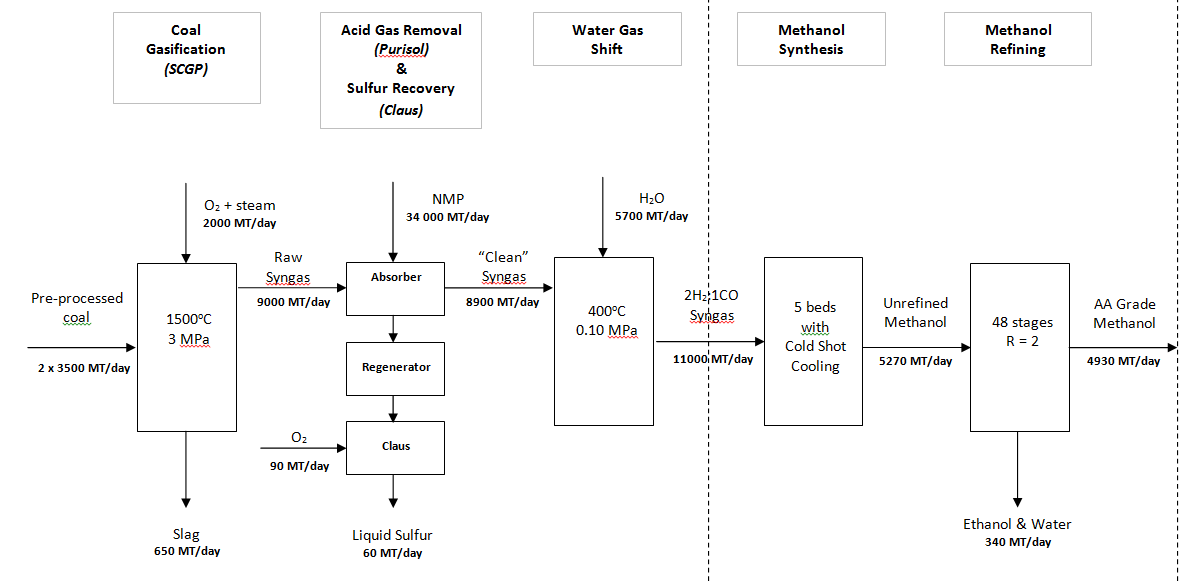
The primary raw chemical input produced from coal is methanol, which is produced through coal gasification and subsequently, methanol synthesis and refining (see picture below for overview of process steps).

Figure 1 - Block flow diagram of coal to methanol synthesis. Source: Inouye et al. 2008

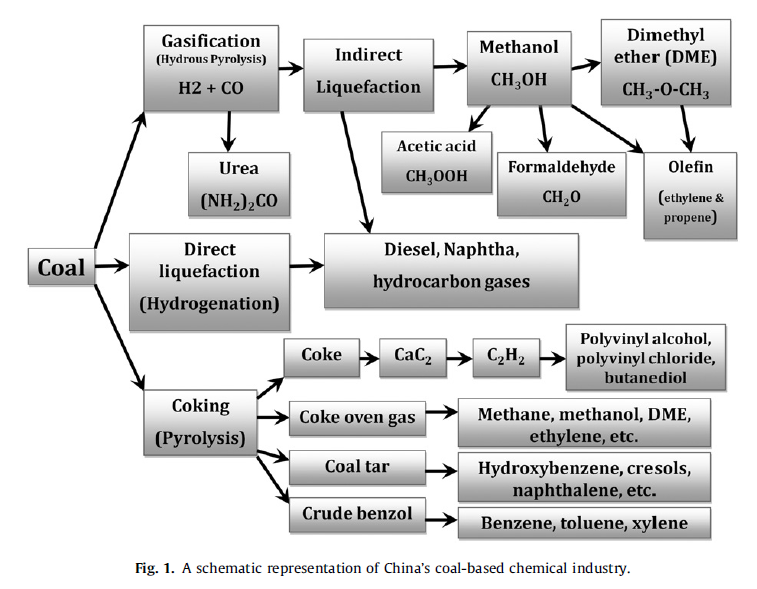
Today, methanol is used to produce a wide variety of chemicals including formaldehyde, MTBE, acetic acid, DME, esters, olefins, and other products. These are used for fuels, pesticides, medicines, plastics, fibres, resins, etc. China currently produces approximately 25% of the world’s output of methanol.


Figure 2 - Products produced in the coal to chemical's industry of today. Source: Yang and Jackson 2012

The current status of China’s coal to chemical industry.

Since 2000, China has been investing an increasing amount into the production of coal-based petrochemicals, substituting these for traditional crude oil based processes. The plausible reasons are the cheap price of coal and the strategic desire to be self-sufficient in resource inputs. The industrial base originally focused on five areas of petrochemical replacement. More recently, the industry is gearing up to produce other petrochemicals by Chinese R&D, and through establishing technology partnerships with non-Chinese players such as TOTAL Oil Company.

The five base chemical products currently made from coal in China are:

• Light oil (containing benzene, toluene and xylene) as a by-product of coke oven steel industry operations. The COLO (coke oven light oil) is utilized in the production of aromatics. It has been estimated that approximately 27% of benzene production in China is coming from this source. Benzene is a precursor for tens of thousands of chemical products including cosmetics, drugs, pesticides, lubricants, dyes, explosives, detergents, nylon, polymers, and plastics. Source: Jeffrey Plotkin 2012

• Acetylene used for production of vinyl chloride monomer (VCM) and 1,4 Butanedoil (BDO). VCM is used to produce polyvinyl chloride (PVC) plastics. BDO is used for a variety of plastics, elastic fibres, and polyurethanes. It is estimated that approximately 85% of VCM produced in China is through coal based routes. Source: Jeffrey Plotkin 2012

• Urea and Ammonia used mainly for the production of fertilizers. Roughly 70% of nitrogen fertilizers in China are produced from coal feedstocks, and all expansion in the future will likely be coal, given the lack of natural gas supplies in China. Source: China Fertilizer Consultants 2010

• Coal to Olefins (CTO), also referred to more commonly as alkenes. These are used to process into a large number of other building block chemicals including ketones, carboxylic acids, ethylene, and alcohols. The first commercial plant was started in 2010.

• Monoethylene Glycol (MEG) production, utilizing a new process route based on gasification of coal with several further reactions to obtain methyl nitrate into dimethyl oxalate into MEG. The first commercial plant began operating in 2009 at a rate of 200,000 tons per year.

Future ventures

The country's industry is expanding its current operations rapidly, as well as implementing new process routes. For example, the company Celanese is looking at commercializing technologies to produce ethanol from coal. A few of the upcoming developments include:

• Dow Chemicals together with Shenhua will launch a large multi million tonnes coal to many chemicals plant in 2016, called the Yulin Integrated Chemicals project, for the production of methanol, methanol to olefins, monoethylene glycol, ethanolamines/ethylendiamines, polyether polyols, acrylic acids, acrylic esters, chlorinated methanes, ethylene dichloride, vinyl chloride monomers, and PVC’s. Source: Business Wire 2010.

• A substantial number of companies are planning to expand methanol to olefins production at commercial scales. Currently there are three methanol to olefins plants with a capacity of 1.56 million tonnes, using coal based methanol inputs. Another nine such plants have been approved and are under construction, and thirty such plants are in the planning stage with a combined capacity of 20 million tonnes. It is estimated that half of these projects would be sufficient for China to become self-sufficient in ethylene supply (primarily from Coal).Source: Ken Yin 2012

• PetroChina is planning to build two coal to paraxylene facilities, one of the main building blocks of PTA for the production of polyester. The facilities are planned at a capacity of 1.6 million tonnesSource: Ken Yin 2012

While ambitions exist, the Chinese government has announced that it aims to cap methanol production capacity at 50 million tonnes by 2015. Current capacity is around 40 million tonnes, of which only 50% is utilized. I.E. half of the plants stand idle due to over-expansion of the industry. Beyond the obvious too fast expansion, there appears to be other strategic reasons such as potential competition over coal use for electricity, and restrictions on water availability to produce coal. Some other key challenges lie in the distance of the coal seams to major consumer markets, and competition over other fossil fuel feedstocks from the Middle-East.


Original article by Rembrandt at The Oil Drum

Labels: , ,

Sunday, June 24, 2012

Coal Is Becoming Both Versatile and Clean

Technology for turning coal into electric power, process heat, and liquid fuels has come a long way over the past ten years. And science and engineering have just begun developing cleaner and more efficient ways of utilising coal for heat, power, and transportation fuels.
The table above reveals the superior yields and efficiency of direct coal liquefaction (and hybrid liquefaction) as compared to gasification plus Fischer Tropsch, or indirect coal liquefaction.
The presentation summary above describes some economic advantages of direct coal liquefaction over indirect liquefaction -- including lower startup costs.
State-owned China Shenhua Group made a profit from its pioneering direct coal-to-liquids (CTL) project in the first half of this year (2011), raising hopes that the world’s second largest oil consuming nation may expand forays into alternative fuel production.

China has rich coal reserves but limited oil deposits. After backing CTL as a way of improving energy security and easing its growing dependence on overseas crude oil, China went cold on the technology in 2008, cancelling dozens of projects amid concerns about high production costs and the impact it would have on scarce water supplies.

The parent of China Shenhua Energy Co , the country’s biggest coal producer, produced 470,000 tonnes of oil products from coal in the first half and costs of the fuel were equivalent to crude oil prices of less than $60 a barrel, according to Shenhua Group’s General Manager Zhang Yuzhuo. _Shenhua DCL Project Proves Profitable
As long as oil costs remain high (above $80 a barrel), such projects should provide healthy returns to their backers.

The CTL approach depicted above utilises methane as a hydrogen donour in a unique liquefaction process which utilises gasification plus methanol production. The methanol can be further converted to diesel or jet fuel.

More details

This Accelergy approach to CTL utilises biomass gasification as a hydrogen donour for the coal liquefaction. At this point in time, methane is likely to be more practical to provide hydrogen.
The above image portrays three ways of CTL, including Exxon Mobil's coal to methanol to gasoline (MTG), traditional gasification plus Fischer Tropsch, and the use of biomass gasification to provide hydrogen for direct liquefaction of coal to liquids.

And just to remind you that the world is not giving up on coal for the generation of electrical power, this EIA graphic projects a steady growth in the use of coal for electrical power generation through 2035 -- consistent with the recent 2012 BP Statistical Review.


Coal is second in size only to gas hydrates as a global hydrocarbon resource. Any rational projection of future energy and fuels production would necessarily include coal.

Rather than to reject coal altogether, more intelligent energy analysts and policy-makers would do better to continue to press for cleaner, safer, and more efficient ways of utilising this massive energy source -- as a bridge to future sources of energy which can be used for many thousands of years, such as advanced nuclear fission, nuclear fusion, and hybrid fission - fusion.

Labels: ,

Saturday, June 23, 2012

Coal Will Thrive Long After Obama Is Gone

The National Coal Council delivered a report to the US DOE which points to increasing uses of coal -- to generate electric power, to produce large quantities of liquid fuels via CTL, and to expedite enhanced oil recovery (EOR) using CO2 recovered from coal gasification (both IGCC and CTL).
  • By 2035, the combination of coal-based EOR and CTL technology could provide up to 30 percent of U.S. liquid fuel demand and ensure America's energy security for decades....
  • Use of ... CTL could generate $200 billion in economic activity, more than 1 million skilled jobs and $60 billion in tax revenues.
  • At least 100 gigawatts of advanced coal generating capacity could be built or retrofitted over the next two decades. These advanced plants would use an additional 300 million tons of coal annually.
  • CTL plants with carbon capture could convert coal into more than 2.5 million barrels a day of additional oil. An additional 450 million tons of coal would be used annually in these operations.
  • Capturing a high volume of CO2 for commercial purposes, coupled with CTL operations, would increase coal use to 1.75 billion tons annually. This production level is well within the capability of the United States, home to 30 percent of the world's coal reserves.
_Nat.Coal Council Report to US DOE

Obama's misguided war against coal -- along with his war against all other forms of viable energy -- mark him as a political activist rather than a true leader. Obama's war against energy and against the US private sector has led to a stagnant economy with very slow job creation.

Meanwhile, Primus Green Energy is pushing ahead with a shale gas - to - liquids project which hopes to produce 100 million gallons of gasoline from shale oil per year.
The allure of cheap nature gas has altered the course of a New Jersey biofuel start-up’s path to commercialization. Shale gas will serve as Primus Green Energy’s (PGE) bridge fuel until it shifts to biomass feedstocks.

PGE today held a dedication ceremony for a demo plant at its Hillsborough, NJ headquarters. Local luminaries and a swarm of politicians, including former governor Jim Florio, Representative Leonard Lance, and an Obama administration agricultural official, were in attendance.

The plant will create up to 5 barrels of fuels per day, which will be used for customer certification testing and approvals. It is also a proof of concept for technology that PGE says can scale to upwards of 100 million gallons per year at a significantly higher yield (35 percent) than the industry average.

The company is hoping to raise US$150 million to build a facility next year that would produce 20 million gallons of fuel annually. In comparison, the Pearl GTL (gas to liquids) facility in Qatar has cost over $19 billion to build. _SP
The Pearl GTL plant in Qatar expects to yield profits of $6 billion a year, for as long as the price of crude oil (Brent) remains above $80 a barrel.

Primus Green Energy had intended to be a biomass-to-liquids (BTL) company rather than a GTL company, but basic economics dictated Primus' decision to go with shale gas rather than biomass -- at least in the beginning.

Meanwhile, commodities prices remain well above 2007 levels, suggesting that without big government stimulus from the US, Europe, and China, there is still significant deleveraging and deflating of bubbles that could occur.

The Obama government has injected about $1.5 trillion per year of fiat stimulus into the US economy, with very little positive effect to show for it -- except a rapidly growing debt which could destroy the economy if interest rates should be forced upward.

The energy world does not exist apart from the political and economic worlds, but is rather inextricably enmeshed within both.

Obama has attempted to re-shape the energy worlds, the political worlds, and the economic worlds -- as a legacy to his own unique greatness. Time will tell what lasting impact Obama's policies have had on those worlds -- if any.

Labels: , ,

Friday, June 22, 2012

Coal Under Attack on All Fronts . . . Plots Comeback

Coal is the second-most plentiful hydrocarbon resources on the planet, second only to gas hydrates. Yet, increasingly, coal is being displaced by natural gas power plants across North America, and is being threatened with replacement by new generations of safe, clean, affordable, small modular nuclear fission reactors.

Is coal taking all of this lying down? No. In fact, in many ways, coal is the rising star of global energy production.
image via GWPF

BP’s annual statistical review reports that global coal production increased 6 per cent last year, twice the celebrated rate of increase in global natural gas production. This most notorious of fuels now accounts for 30 per cent of global energy consumption – the highest percentage since 1969. It will almost certainly account for more in the years ahead. It is, after all, one of the cheapest primary sources of energy in the world. And its reserves are, for all practical purposes, inexhaustible.

...Americans themselves are consuming less coal – 5 per cent less in the past decade. As U.S. electrical producers shift from cheap coal to cheap natural gas, more coal will be released for export to other countries (where demand for coal increased by almost 50 per cent in the same decade, the energy equivalent of 23 million barrels of oil a day). Already the world’s fourth-largest coal exporter, after Australia, Indonesia and Russia, the U.S. could plausibly become the world’s largest exporter in coming years. The United States possesses more coal reserves, after all, than any other country.

How much more? Energy analyst Robert Bryce, a senior fellow at the Manhattan Institute, says U.S. coal reserves contain nearly as much energy as the proven oil reserves of all 12 Organization of Petroleum Exporting Countries combined. U.S. coal deposits, he says, hold the energy equivalent of 900 billion barrels of oil. The OPEC countries have proven oil reserves of one trillion barrels. _Globe&Mail
We know that new, super-clean coal plants using IGCC (integrated gasification combined cycle) and CHP (combined heat and power) technologies, are both very efficient and very environmentally responsible. But science and engineering have just begun to start cleaning up coal's act:
One of the new technologies, which involves pressurizing the oxygen, is being developed by a partnership between ThermoEnergy, based in Worcester, Massachusetts, and the major Italian engineering firm Itea. A version of it has been demonstrated at a small plant in Singapore that can generate about 15 megawatts of heat (enough for about five megawatts of electricity).

The technology simplifies the clean-up of flue gases; for example, some pollutants are captured in a glass form that results from high-temperature combustion. It also has the ability to quickly change power output, going from 10 percent to 100 percent of its generating capacity in 30 minutes, says Robert Marrs, ThermoEnergy's VP of business development. Conventional coal plants take several hours to do that. _TechnologyReview

Coal is a massive and affordable source of energy that is begging to be produced and utilised in a clean and responsible manner.

While everyone from gas advocates to nuclear advocates to green dieoff.orgiasts rail against coal as the mineral from hell, more responsible energy analysts understand that we will need to learn to utilise all sources of energy in clean and responsible ways, if we are to transition smoothly into the age of advanced nuclear fission and nuclear fusion.

Labels: , , ,

Thursday, June 14, 2012

World Coal Demand Growing Fastest of All Fuels: BP Statistical Review of World Energy 2012

This article was first published on Al Fin blog

The 2012 BP Statistical Review of World Energy is now available for download. It reveals that worldwide demand for coal is growing significantly faster than worldwide demand for crude oil. And that is just the beginning.
BP via GCC

Oil demand grew by less than 1%—the slowest rate amongst fossil fuels—while gas grew by 2.2%, and coal was the only fossil fuel with above average annual consumption growth at 5.4% globally, and 8.4% in the emerging economies.

...Emerging economies accounted for all of the net growth, with OECD demand falling for the third time in the last four years, led by a sharp decline in Japan. China alone accounted for 71% of energy consumption growth.

...Fossil fuels still dominated energy consumption with 87% market share, while renewables rose fastest but are still only 2% of the global total. The fossil fuel mix continues to change with oil, the world’s leading fuel at 33.1% of global energy use, losing share for 12 consecutive years. _GCC

In North America, natural gas is increasingly replacing coal for purposes of electrical power generation. As global natural gas prices decline, the same type of substitution should be seen in other areas which benefit from large scale tight gas deposits.

Worldwide, however, coal should continue to be in high demand for power generation and other industrial uses.

Renewables such as big wind and big solar continue to be less than impressive, as predicted. Intermittent unreliable sources of energy cannot be depended upon. No wonder a significant part of China's installed wind power capacity continues to lack connections to any power grid. I suppose the capacity looks good on paper, even if it isn't doing anything but sit and rust.

BP Statistical Review of Energy 2012 Download PDF

Labels:

Tuesday, June 12, 2012

Will Obama's War on Coal Cost Obama his Job?

The“war on coal” is closing power plants and outraging miners whose livelihoods it threatens. More, it means price hikes for electricity — particularly in northern Ohio, a crucial state that broke for Obama in 2008.

Back then, union workers helped flip the state blue, reversing GOP wins in 2000 and 2004. This year, maybe not. Last November, the EPA adopted new regulations on emissions that sounded a death knell for many of our country’s older coal-fired power plants. Already struggling to compete with cheap natural gas, owners of some facilities decided against investing in the pollution-control equipment needed to comply with the new regs.

...Many [coal plant] closings will come in Ohio, where Akron-based FirstEnergy was first out of the box in announcing several planned shutdowns. It spent five years and $1.8 billion installing scrubbers on its largest plant located on the Ohio River; costly upgrades to the smaller units simply didn’t make sense.

The lost capacity will be replaced mainly by cheaper natural-gas plants, but the shift will require costly improvements to transmission facilities, expected to run more than a billion dollars in Ohio alone. Projected electric-rate hikesalarmed Ohio small businesses, which protested to the state’s Public Utility Commission...

...Nor was the November rule the EPA’s only assault on coal. The agency also recently imposed carbon-dioxide emission standards that could effectively prohibit any new coal-plant construction. That ruling almost guarantees the nation will continue to shift electricity production from coal to natural gas....

...This determination to kill coal is short-sighted. There’s no guarantee that natural-gas prices will stay at today’s 10-year low. The shale boom has pushed them down, but soaring demand could eventually push prices higher. The appetite for natural gas as a transportation fuel for large truck fleets or for export, for example, is just getting rolling.

And (surprise!), now that natural gas is cheap, the same environmental groups behind the “war on coal” are now suddenly finding all sorts of (scientifically dubious) reasons to block natural-gas production.

America has a 250-year reserve of inexpensive coal — in energy terms, roughly the equivalent of the Saudis’ oil reserves. With the nation seeking to reassert itself as a manufacturing powerhouse, why deny access to cheap power?

The assault on coal is also risky for Obama. Ohio is a must-win for the president. State GOP chairman Bob Bennett notes that, for Vice President Joe Biden’s recent visit to the state, angry miners turned out spontaneously to protest the White House’s anti-coal policies — and “The GOP had nothing to do with that.”

With the EPA’s rulings likely to cost the state jobs and hike electric bills, he says, “Obama gives people more reasons to vote for [Mitt] Romney every day.”_NYP

Obama's war against coal, offshore and Arctic oil, Canadian oil sands, the Keystone pipeline, nuclear power, etc etc, is popularly known at the Al Fin Institute as Obama's agenda of energy starvation. The natural effects of this agenda are increased costs of doing business and increased uncertainties as to future costs of doing business -- which discourages new startups and new jobs formation.

It is no coincidence that Mr. Obama's policies on other fronts -- such as healthcare, taxes, regulations, growth of government . . . -- have the same depressing effects on the private sector's ability to grow the economy.

Most independent US voters have family members who are out of work or are looking for work and unable to find it. They may not understand the entire long chain of factors and hidden agendas that connect Obama to the US private sector's ongoing difficulties, but they know enough to blame Obama for not doing what he promised in regard to new jobs and new hope.

Labels: ,

Tuesday, May 08, 2012

The Coal Industry Has a Great Deal of Life Left

The future of electric power generation is nuclear. But it is likely to take a few decades for advanced societies to move to new generations of cleaner, safer, more reliable nuclear power reactors. In the meantime, advanced societies will utilise coal for power generation in cleaner ways, while at the same time improving the clean and economic production of liquid fuels, high value chemicals, lubricants, polymers, and more from coal.

Technology is already at the point that the advanced world can use its vast resources of coal cleanly and responsibly. IGCC -- integrated gasification with combined cycle power generation -- plus combined heat and power production, helps make the most of the coal resource while minimising environmental impacts. Coal liquefaction -- CTL coal-to-liquids -- is another approach to clean coal, which converts solid coal into high value liquid fuels, chemicals, and more. Here is more information on recent coal developments and projects in the US:

Is Coal Dead? Not a Chance

World Class IGCC Coal Plan Moves Ahead in Permitting

Kern County California IGCC Coal Plant Pursues Certification

Medicine Bow Wyoming CTL Plant Still Pressing Ahead for Funding

Kemper County Mississippi IGCC plant re-certified for construction by state utility regulators

The Texas Clean Energy Project IGCC coal plant in Odessa continues development


With the development of high temperature gas-cooled modular nuclear reactors, the EROEI of coal to liquids will become much more favourable. With the coming of abundant electrical power from advanced gen III and gen IV nuclear plants, it is quite certain that the use of coal will shift from power generation to the production of liquid fuels, chemicals, polymers, lubricants, and other high value materials.

Labels:

Tuesday, March 27, 2012

Next Big Thing in Energy? Think Scalable GTL

When most people think of earth-shaking breakthroughs in energy, they tend to think of nuclear fusion, advanced nuclear fission, LENRs, or even advanced solar power. But the more likely source of important near term energy advances will likely tie in to cheap and abundant resources of natural gas and/or coal. And since the most pressing energy need besides electricity is for liquid transportation fuels, the important advance will involve the liquefaction of gas and/or coal.
Velocys

It is clear that the cost of oil has ballooned so far beyond the cost of gas (and coal) per mmbtu, that GTL and CTL conversions have become very attractive economically. The big problem with GTL and CTL up to this point, has been the huge up-front costs of capitalisation for production facilities. The Shell Pearl GTL plant in Qatar, for example, required almost $20 billion in development costs alone. Granted, the Pearl plant will generate profits of roughly $6 billion per year. But few companies can afford the up front capital costs to build such a plant.

That is why the idea of a scalable GTL plant (and CTL, BTL, etc) has become so intriguing. The Velocys F-T GTL approach is not likely to be as efficient or economical as the huge Shell Pearl GTL plant, but it is far more affordable and practical for placing onboard an offshore rig, or for installing at stranded wells far from gas pipelines.
Unless green energy starvationists inside the governments of the EU and the US can completely shut down shale gas production, natural gas production is likely to stay high, and natural gas prices are likely to stay relatively low compared to crude oil, for a matter of decades.
Inside Futures

Coal prices have been driven downward at least partially due to the low costs of natural gas. This makes scalable CTL more attractive as well, although it seems clear that GTL is much more easily scaled downward than CTL will be. Biomass to liquids (BTL) is another up and coming liquefaction technology for synthetic fuels production, but it is likely to thrive only in areas which lack cheap natural gas, at least for the next two decades. Political mandates, regulations, taxes, and prohibitions can change that equation, of course.
Carpe Diem

Inside Futures

Besides Velocys, other opportunistic entrants into the scalable GTL field include Carbon Sciences, Compact GTL, GTL Solutions, Gas Techno, and more.

Basic information on large scale GTL

Within the next 10 to 15 years, large scale CTL and GTL producers will be able to take advantage of cheap nuclear process heat from high temperature gas cooled nuclear reactors -- which will shift up efficiencies and profits considerably. Once new processes are developed to take advantage of that rich, abundant new resource, most of the things you think you know about the future of liquid fuels will change.

More on how utilities choose between natural gas and coal for electric power generation here and here. Until more national governments begin promoting safe, efficient, reliable new nuclear technologies, even the most advanced societies will remain dependent upon coal and natural gas for electric power generation.

But once new nuclear technologies come on board, vast new supplies of power -- both baseload and load-following -- and industrial process heat will become available. This will shift a significant amount of coal and natural gas away from power generation, and toward liquid fuels production.

It is all up to governments, and how hard they wish to make things for their industries and their populations. Current leaders of the EU and the US apparently want to make things very hard indeed. Shame on them, and shame on the voters and supporters who allow them to stay in power.

Labels: , ,

Sunday, March 25, 2012

Massive Global Coal Resource in Demand

Thanks to growing demand for energy in India and China, global demand for coal is increasing. For example:
China's coal consumption, including its growing imports totaled about 3.75 billion tons in 2011. At that rate and for China's estimated 1.33 billion population, this is a consumption rate of 2.8 tons per person a year... _Source
Worldwide, several projects for large scale conversion of coal to gasoline and other liquid fuels are in the works, including two in the US -- in Wyoming and West Virginia. Both of the proposed US plants are under attack from faux environmentalist green groups such as the Sierra club, but the Wyoming plant appears to be making progress against the lefty-Luddite assault:
“We think Wyoming is a pacesetter here,” said Kelly, executive chairman of DKRW Advanced Fuels, which wants to build the $1.7 billion to $2 billion plant to convert coal into gasoline and carbon dioxide for sale, among other products. “This would be the first project like this in the U.S. and really, the West.”

...The company won a critical victory in March 2011 when the Wyoming Supreme Court upheld a state-issued air quality permit for the project and its adjacent mine, despite a Sierra Club challenge. But the plant and similar projects continue to face opposition from the club and other environmental advocacy groups.

...Medicine Bow Fuel and Power, the company’s project subsidiary, has obtained the right to use technology key to the plant’s conversion process. It also has a buyer for both gasoline and carbon dioxide to pump into old fields to boost production.
The DKRW plant will use a General Electric coal gasification technology, which produces a synthetic gas, also known as syngas, and strips it of nearly all sulfur and carbon dioxide. Using a licensed ExxonMobil technology, the syngas is converted into methanol, which is converted into gasoline.

DKRW has also retained CitiBank as adviser in its search for private financing. DKRW has sunk $100 million into the project’s development so far, according to Kelly.
“All that’s a big task, and it takes a long time,” Kelly said. “Those are gigantic things to do and they’re expensive things to do.” _BillingsGazette
The project still faces significant financial obstacles -- primarily due to delays caused by faux environmentalist lawsuits and other ideologically-based red tape.

Another obstacle to standard CTL plant projects in North America is the very cheap price of natural gas there. Some projects are switching from CTL to GTL (gas to liquids) to take advantage of cheap gas prices, and the possibility of a quicker route to production.

A better approach to coal liquefaction (CTL) might be a combined coal and natural gas approach, where natural gas is used as a hydrogen source. At today's natural gas and coal -- compared to oil prices in North America and elsewhere -- such an approach makes sense.

The best approach of all for synthetic liquid fuels production would be the use of nuclear process heat for CTL, GTL, and combined gas and coal liquefaction. The only meaningful resource limits, after all, are those in the human mind.

If we allow the lefty-Luddite dieoff.orgy green mentality of energy starvation to take over modern societies, we will have little to look forward to but increased global poverty, violence, and societal decay.

One way or another, humans will make use of the massive coal resource. It would be best if coal were cleanly converted to liquid fuels or electricity. But if faux environmentalist greens prevent the clean use of coal, coal will be used in dirty ways, using increasingly more primitive and polluting technologies prevalent in the growing third world.

Labels: ,

Wednesday, March 07, 2012

The US Must Have Both Nuclear and Coal: Obama Forbids Both

NewAmerican

An industrial society requires massive amounts of affordable fuels and electrical power. For electrical power, both nuclear and coal are suitable to provide the huge levels of baseload output required. But US President Obama is fighting a war to close down coal plants, while at the same time dragging his feet on allowing safe and revolutionary new nuclear designs to be licensed and approved.

Senator Obama declared a war against coal back in 2008, when he was still running in the Democratic presidential primaries against Hillary Clinton:
Consider candidate Obama’s January 2008 comment to the San Francisco Chronicle: “So if somebody wants to build a coal-powered plant, they can. It’s just that it will bankrupt them because they are going to be charged a huge sum for all that greenhouse gas that’s being emitted.”

Obama originally planned to keep this promise through cap-and-trade legislation, a scheme to tax companies for their so-called greenhouse-gas emissions. Lacking congressional approval, the President has turned to his Environmental Protection Agency to kill coal by way of crippling new regulations just put into effect this year. _NewAmerican
Mr. Obama's EPA has taken extraordinary steps to shut down coal plants -- thus progressively destabilising the North American power grid and raising the cost of power to industrial, commercial, municipal, and residential customers. In the midst of an ongoing economic downturn, these policies would never be permitted in a rational society with a rational governmental system. More:
...the EPA passed new emission regulations that had to be complied with by utility companies within six months — in the past, utilities were given years to comment on the workability of the rules, plan the implementation of new rules, and adjust their budgets for the adoption of the regulations, because adding air scrubbers or other major implements to a coal-fired power plant is not as easy as adding a new deck to one’s house. Obviously, the new regulations were designed to lead to the closure of certain utilities, mainly coal-fired power plants.

How will this affect our citizenry? When utilities cannot afford to do the bidding of bureaucrats with respect to their generation facilities, they shut them down. According to the February 12 Wheeling (WV) News-Register, “It was revealed at least 32 coal-fired power plants in 12 states, including West Virginia and Ohio, would be closed so utility companies could comply with the Obama administration’s air pollution regulations.” Up to 55 million households will be in danger of outages, brownouts, or, at the least, higher rates due to this unnecessary EPA rule. Already financially strapped Americans will be thrust into what is known in Europe as “energy poverty.”

...The effect of depriving a population of reliable sources of electricity is catastrophic. This can be quantified by examining the average national use of electricity in watts per person, compared to life expectancy in those nations.

...The United States is considered by many geologists as the “Saudi Arabia” of coal. This resource provides life-saving and life-enhancing energy for America, but it is under attack for this very reason by those who would take us back to an earlier era that was infinitely dirtier, deadlier, and with fewer opportunities to move civilization to new levels of freedom and prosperity. Government should not pick winners and losers to subsidize or regulate out of existence but should get out of the way and allow the free market come up with solutions to provide our energy needs.

In the future coal should probably be a feedstock for liquid fuels and for production of iron and steel, with nuclear energy providing our electrical base load. Coal is a resource that is proven and available. _NewAmerican
Eventually, either American voters will eject this dysfunctional president and his administration, or time will run out on his lame duck presidency. By then, the damage will have been done.

A huge power generating infrastructure can be shut down by the act of putting pen to paper. It cannot be re-built nearly so easily.

It is taking Obama only a few years to dismantle a coal power producing infrastructure which will require decades to replace with nuclear -- if it can ever be replaced. The alternative to abundant energy is a depleted economy, a depleted agriculture, and depleted lives of citizens.

US voters require the facts, so that they can make a rational choice.

More: The Manhattan Institute recently held two panel discussions on the topic of "Keeping the Lights On: What Role for Coal and Nuclear?" Videos for Part 1 and Part 2 (Each session is just over 1 hour)


Power 2012 - Keeping the Lights on: What Role for Coal and Nuclear - Part I

Panelists: Laszlo Varro, Jacob Williams, Porter Bennett

March 1, 2012


Power 2012 - Keeping the Lights on: What Role for Coal and Nuclear - Part II

Panelists: David Mohler, David Diamond, David Dismukes

March 1, 2012

Labels: , ,

Wednesday, January 11, 2012

Smart Energy: Clean Efficient Use of Cheap, Dirty Coal

Integrated Gasification Combined Cycle (IGCC) power production is a highly clean and efficient way to utilise relatively cheap and dirty coal, while removing the pollution. GE technology has been selected by Korea Western Power Co. for a integrated gasification combined-cycle (IGCC) power plant to be built in South Korea and one of the first in Asia.

The coal is gasified to syngas, which is used to power a gas turbine to generate electrical power. Heat is recovered from the gas turbine exhaust and used to create steam, which is then used to drive a steam turbine. By using both a gas turbine cycle and a steam turbine cycle, an IGCC power plant converts more of the energy from the coal into electrical power.
Specifically designed for IGCC applications, GE's 7F Syngas Turbine operates on cleaner burning syngas fuel produced from coal. For the Taean plant, the turbine will operate on syngas produced from the gasification of low BTU coal. Key equipment for the project will be shipped during the first half of 2014, with the plant's commercial operation to start in late 2015.

GE is a pioneer in the development of syngas turbine technology and has provided syngas-capable gas turbines for several milestone IGCC projects, including the pilot Coolwater IGCC plant in Barstow, Calif., and Tampa Electric's 250-MW Polk Power Station in Florida.

Turbines for the South Korea plant use the same technology as the turbines to be used in one of the largest IGCC plants in the world, which is slated to be commissioned in 2012.

To date, GE's Heavy Duty Gas Turbines have accumulated more than 1.3 million operating hours on syngas, including 400,000 operating hours on F-class gas turbines. GE's syngas turbines are an enabling technology for IGCC, which allows for the efficient production of electricity via the conversion of coal to gas, in a process that removes pollutants from the gas. _Powergrid
Additional heat retrieval can be utilised in an IGCC plant, to provide hot water for space heating and industrial use, if that feature is desired and designed into the plant.

Coal gasification is a cleaner way of using coal -- even cheap and dirty coal. IGCC plants can also utilise a mixture of coal and torrefied biomass -- also known as "green coal."

Coal is a particularly abundant resource globally, and should be utilised wherever it is possible to do so cleanly and efficiently, to assist in the transition from a hydrocarbon economy to a post-combustion economy which relies largely on electricity from nuclear power -- which is likely to take a number of decades to achieve.

Labels: ,

Wednesday, December 21, 2011

Peak Oil: Meet SRI's Cheap, Clean New Coal to Liquids Process

Research from SRI International has identified a promising new way to produce liquid transportation fuels from coal without consuming water or generating carbon dioxide. Based on data from bench-scale tests, SRI engineers estimate that the capital cost for a full-scale plant using SRI's process would be less than half that of a conventional coal-to-liquids (CTL) plant that uses a process called Fischer-Tropsch synthesis (FTS). _Marketwatch
Given the vast reserves of coal residing in the nations of the Anglosphere, a cheap and clean coal-to-liquids (CTL) process sounds like a dream. Interestingly, SRI's new cheap & clean CTL process also relies on another plentiful hydrocarbon: natural gas, or methane.
SRI's new process uses natural gas to provide the hydrogen needed to convert coal to syngas (a mixture of carbon monoxide and hydrogen). Syngas is first converted into methanol, which can then be efficiently processed to make transportation fuels.

Using natural gas eliminates the need to add water as a source of hydrogen, reduces the need to add energy to drive the gasification reaction, and results in the use of a smaller gasifier. In conventional CTL approaches, energy is supplied by burning a portion of the coal feed, which then produces carbon dioxide. SRI's approach makes it economical to use carbon neutral electricity, such as nuclear, hydro, or solar as a source of additional energy.

"The implications of this research are expansive, including enhancing US energy security through the use of domestic carbon sources," said Robert Wilson, Ph.D., director, Chemical Science and Technology Laboratory, SRI International. "The process can also dramatically reduce the environmental footprint associated with alternative transportation fuels."

...The SRI process was recently presented at the 28th Annual International Pittsburgh Coal Conference in a presentation titled, "Coal Gasification with Methane Reforming: A Novel Environmentally Benign CTL Process" by Ripudaman Malhotra, associate director of SRI's Chemical Science and Technology Laboratory. _Marketwatch
Of course, we cannot expect the US Obama administration to support this vast, cheap, clean new source of liquid fuels and chemicals. Not in the same way it has supported crony enterprises in big solar and big wind energy. CTL is a reliable form of energy and fuels, after all. Obama only likes and invests in unreliable forms of energy -- particularly if the firms are likely to go bankrupt.
Regardless, this type of alternative form of liquid hydrocarbon production is likely to emerge, once the energy starvationists are chased out of positions of power and influence. Advanced CTL will take its place alongside advanced and scalable forms of gas-to-liquids (GTL) as viable alternatives to crude oil, for transportation fuels, chemical feedstocks, and as precursors to a wide range of important materials.

More from GreenCarCongress:
SRI estimates the efficiency of its CTL plant at 67%—significantly higher then traditional CTL plants predominately because it is converting 100% of the carbon feed into product and it utilizes electricity generated off-site. Accounting for the heat rate of generating that electricity from a traditional coal plant would result in a plant efficiency of 47%.
The implications of this research are expansive, including enhancing US energy security through the use of domestic carbon sources. The process can also dramatically reduce the environmental footprint associated with alternative transportation fuels.

—Robert Wilson, Ph.D., director, Chemical Science and Technology Laboratory, SRI International
SRI performed a series of analyses to examine the environmental impact of the technology under several scenarios. Based on these analyses, if diesel were produced using biogas as the source of methane, the resulting product would qualify as an alternative fuel under the revised Renewable Fuels Standard of the Energy Independence and Security Act of 2007. The Act requires alternative fuels to meet a standard of 50% reduction of greenhouse gas emissions compared to other fuels.

The work was supported by DARPA under Contract No. HR0011-10-0049.

DARPA solicitation. The DARPA solicitation set goals for a coal-to-liquids process for JP-8 of:
Process scalable to 100,000 bbl/day
Production cost of JP8 less than $3.00/gallon
No CO2 emissions during process
Water consumption less than 235 kg/barrel
Capital cost less than $15,000/daily barrel
(The availability of CO2-free electricity was assumed.)
_GCC
Images via GCC

A small modular nuclear reactor paired with such a plant would allow a company to locate the CTL plant near the fossil fuel resource, to minimise transport costs, and maximise operating efficiency to near 67%.

More: Be sure to check out coverage of this story by Brian Westenhaus and Brian Wang

This story reminds us that with huge piles of coal, kerogens, bitumens, and methane lying around, clever people will find ways to deal with the threats of political peak oil coming from OPEC, Russia, and the Obama White House.

PS: Don't forget all that offshore and Arctic oil that Mr. Obama has put off limits, and the abundant and replenishing supply of methane hydrates just waiting for a clever person to discover how to safely and cleanly extract and utilise them.

Labels: , ,

Friday, December 02, 2011

This Coal is Clean: Massive Source of Liquid Fuels for N. America

US coal reserves are a massive store of hydrocarbon, and a potential source of abundant amounts of liquid hydrocarbons -- should they ever be needed. New ways of clean utilisation of this vast resource are being developed. Here is a report of a recent development:
The Medicine Bow project will use Carbon Basin coal optioned from DKRW partner (and coal mine operator) Arch Coal to produce refined hydrocarbon liquid products. Initial commercial operation of up to a 20,000–22,000 barrels per day project is expected to start in 2014.

The coal to liquids (CTL) facility will utilize GE coal gasification technology to produce syngas, which will be cleaned to remove substantially all of the sulfur and carbon dioxide. The cleaned syngas is conditioned, modified and converted to methanol, which is then converted to gasoline via the licensed ExxonMobil Research and Engineering methanol-to-gasoline (MTG) process.

Other key elements include Selexol acid gas removal and Davy Process Technology (methanol synthesis).

MBFP says it plans to sequester the CO2 that is captured from the facility by selling the CO2 for enhanced oil recovery (EOR). MBFP earlier this year entered into a contract with a subsidiary of Denbury Resources Inc. to purchase the CO2 for use in their EOR operations. EOR has been used for years in Wyoming, West Texas and the US Gulf Coast to increase oil production from depleted oil and gas fields.

DKRW Advanced Fuels is completing final development on the project and expects to complete financing activities and ramp up construction on the facility in 2012. _GCC
Much of the western US hydrocarbon resource is located on native American Indian land. Some of these tribes are eager to cash in on their huge potential wealth, and are chafing against the Obama EPA restrictions -- which appears quite arbitrary and almost punitive to the tribes. Particularly in the light of the clean, advanced technologies which are becoming available for harvesting energy and fuels from the coal.
Around the country, at least a dozen Indian tribes are pushing for agreements with the government that would help them exploit their oil, gas and coal, said Robert Middleton, director of the Interior Department’s Office of Indian Energy and Economic Development. _Source
But these tribes are running head-on into the Obama policy of energy starvation, just like the rest of the US. Perhaps it is the Obama administration which should be locked up on a reservation, so that the rest of the nation can begin to function and prosper once again?

Labels:

Tuesday, October 11, 2011

Coals to Newcastle: Is it Rational to Make Ethanol from Hydrocarbons?

Celanese Corporation has developed a process called "TCX", for producing ethanol from hydrocarbons such as coal and gas. The company produces a range of acetyl products, including acetic acid, and patented a process for converting acetic acid to ethanol. Celanese has plans to build a coal-to-ethanol plant in China, and a gas-to-ethanol plant in Texas.

Everything hinges on the economics, of course. Celanese is focusing on the "industrial ethanol" market rather than the "fuels ethanol" market. The industrial ethanol market is a much smaller niche, and Celanese believes it can use its TCX process profitably if it aims at this smaller market.
The price comparisons in the table above suggest that if the production economics are comparable, it would be smarter to produce gasoline (or diesel) from your less valuable hydrocarbon feedstock -- coal or gas -- than to produce alcohols. But that is if you are targeting the fuels market.

Markets for industrial chemicals work a bit differently, and tend to fall under different sets of regulations. Celanese is already thoroughly involved in the industrial chemicals and materials business on a global scale. Often it is best to stay with what you know best, as long as you can make the numbers work.

Al Fin chemical engineers and industrial economists suggest that we are facing an ethanol glut on a global scale. Ethanol producers who are able to economically convert to butanol production should give such conversion serious consideration. And anyone considering either coal to liquids (CTL) or gas to liquids (GTL) for use as fuels, should probably avoid ethanol as a final product.

Labels: , ,

Thursday, October 06, 2011

Global Coal Prospects are Good

...200 gigawatts of coal-fired power capacity is under construction around the world - Australia's entire baseload generation is about 25 gigawatts - and on any carbon pricing scenario coal will be the dominant global source of power for decades.

It is the source of more than 50 per cent of power generation in the United States, and more than 70 per cent in China, and in both countries, and in China in particular, growth in coal consumption for energy far outweighs growth in energy production from alternative sources including solar, wind and nuclear energy.

This trend will continue for many years...

China...is responsible for more than half the world's steel production. Even if its growth slows for a while from today's clip of about 9.5 per cent, it will need both iron ore and coking coal in prodigious and increasing quantities.

The prices of traded metals, including copper, aluminium and nickel have fallen sharply since July in the market downturn, but coking coal and steaming coal contract prices are still strong.

Coking coal contracts are being set at about $US285 ($A300.6) a tonne, 20 per cent below their highs this year when supplies were disrupted by the Queensland floods, but well above the 2010-11 June year average of $US146.80. Steaming coal contracts are being set between $US115 to $US125 a tonne, up from $US77.80 in 2010-11.

At those levels coal mining is highly profitable: New Hope posted a July year operating profit of $147 million in the year to July on sales of $662 million, for example. The prospect of profits continuing to flow strongly for years even if Western world growth is sub-par is the bait that is luring the overseas bidders. _SMH
More on China's ongoing dependence on coal

Greens are delusional if they think that their anti-nuclear tirades are having a beneficial impact on the environment. The global power choice is between coal and nuclear. It is time for dieoff.org greens to get over their utopian delusions and get honest with themselves.

Labels:

Older Posts