Friday, June 22, 2012

Coal Under Attack on All Fronts . . . Plots Comeback

Coal is the second-most plentiful hydrocarbon resources on the planet, second only to gas hydrates. Yet, increasingly, coal is being displaced by natural gas power plants across North America, and is being threatened with replacement by new generations of safe, clean, affordable, small modular nuclear fission reactors.

Is coal taking all of this lying down? No. In fact, in many ways, coal is the rising star of global energy production.
image via GWPF

BP’s annual statistical review reports that global coal production increased 6 per cent last year, twice the celebrated rate of increase in global natural gas production. This most notorious of fuels now accounts for 30 per cent of global energy consumption – the highest percentage since 1969. It will almost certainly account for more in the years ahead. It is, after all, one of the cheapest primary sources of energy in the world. And its reserves are, for all practical purposes, inexhaustible.

...Americans themselves are consuming less coal – 5 per cent less in the past decade. As U.S. electrical producers shift from cheap coal to cheap natural gas, more coal will be released for export to other countries (where demand for coal increased by almost 50 per cent in the same decade, the energy equivalent of 23 million barrels of oil a day). Already the world’s fourth-largest coal exporter, after Australia, Indonesia and Russia, the U.S. could plausibly become the world’s largest exporter in coming years. The United States possesses more coal reserves, after all, than any other country.

How much more? Energy analyst Robert Bryce, a senior fellow at the Manhattan Institute, says U.S. coal reserves contain nearly as much energy as the proven oil reserves of all 12 Organization of Petroleum Exporting Countries combined. U.S. coal deposits, he says, hold the energy equivalent of 900 billion barrels of oil. The OPEC countries have proven oil reserves of one trillion barrels. _Globe&Mail
We know that new, super-clean coal plants using IGCC (integrated gasification combined cycle) and CHP (combined heat and power) technologies, are both very efficient and very environmentally responsible. But science and engineering have just begun to start cleaning up coal's act:
One of the new technologies, which involves pressurizing the oxygen, is being developed by a partnership between ThermoEnergy, based in Worcester, Massachusetts, and the major Italian engineering firm Itea. A version of it has been demonstrated at a small plant in Singapore that can generate about 15 megawatts of heat (enough for about five megawatts of electricity).

The technology simplifies the clean-up of flue gases; for example, some pollutants are captured in a glass form that results from high-temperature combustion. It also has the ability to quickly change power output, going from 10 percent to 100 percent of its generating capacity in 30 minutes, says Robert Marrs, ThermoEnergy's VP of business development. Conventional coal plants take several hours to do that. _TechnologyReview

Coal is a massive and affordable source of energy that is begging to be produced and utilised in a clean and responsible manner.

While everyone from gas advocates to nuclear advocates to green dieoff.orgiasts rail against coal as the mineral from hell, more responsible energy analysts understand that we will need to learn to utilise all sources of energy in clean and responsible ways, if we are to transition smoothly into the age of advanced nuclear fission and nuclear fusion.

Labels: , , ,

Wednesday, January 11, 2012

Smart Energy: Clean Efficient Use of Cheap, Dirty Coal

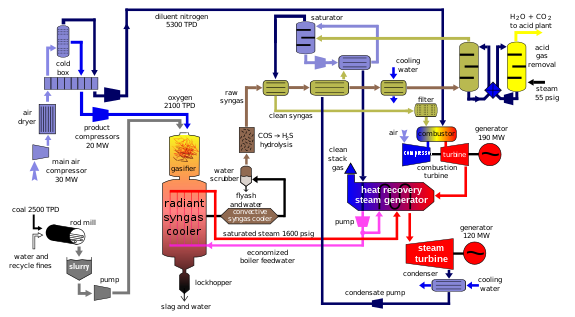
Integrated Gasification Combined Cycle (IGCC) power production is a highly clean and efficient way to utilise relatively cheap and dirty coal, while removing the pollution. GE technology has been selected by Korea Western Power Co. for a integrated gasification combined-cycle (IGCC) power plant to be built in South Korea and one of the first in Asia.

The coal is gasified to syngas, which is used to power a gas turbine to generate electrical power. Heat is recovered from the gas turbine exhaust and used to create steam, which is then used to drive a steam turbine. By using both a gas turbine cycle and a steam turbine cycle, an IGCC power plant converts more of the energy from the coal into electrical power.
Specifically designed for IGCC applications, GE's 7F Syngas Turbine operates on cleaner burning syngas fuel produced from coal. For the Taean plant, the turbine will operate on syngas produced from the gasification of low BTU coal. Key equipment for the project will be shipped during the first half of 2014, with the plant's commercial operation to start in late 2015.

GE is a pioneer in the development of syngas turbine technology and has provided syngas-capable gas turbines for several milestone IGCC projects, including the pilot Coolwater IGCC plant in Barstow, Calif., and Tampa Electric's 250-MW Polk Power Station in Florida.

Turbines for the South Korea plant use the same technology as the turbines to be used in one of the largest IGCC plants in the world, which is slated to be commissioned in 2012.

To date, GE's Heavy Duty Gas Turbines have accumulated more than 1.3 million operating hours on syngas, including 400,000 operating hours on F-class gas turbines. GE's syngas turbines are an enabling technology for IGCC, which allows for the efficient production of electricity via the conversion of coal to gas, in a process that removes pollutants from the gas. _Powergrid
Additional heat retrieval can be utilised in an IGCC plant, to provide hot water for space heating and industrial use, if that feature is desired and designed into the plant.

Coal gasification is a cleaner way of using coal -- even cheap and dirty coal. IGCC plants can also utilise a mixture of coal and torrefied biomass -- also known as "green coal."

Coal is a particularly abundant resource globally, and should be utilised wherever it is possible to do so cleanly and efficiently, to assist in the transition from a hydrocarbon economy to a post-combustion economy which relies largely on electricity from nuclear power -- which is likely to take a number of decades to achieve.

Labels: ,

Friday, July 22, 2011

Texas Moves Forward With Clean Coal IGCC and Much More

Pulverized coal feedstock will be introduced into the two Siemens gasifiers along with limited amounts of nearly pure O2 gas and converted into syngas comprising H2 and CO, varying amounts of CO2, nitrogen (N2), sulfur species, methane, volatilized metals, and PM. The syngas will be cooled and cleaned of PM.

Next, the syngas flows through a water-gas shift reactor, in which steam is injected in the syngas over a catalyst bed, initiating a reaction where the CO in the syngas would be converted to CO2 and the steam would be converted to additional H2 in the syngas stream. This provides a syngas stream that is concentrated in both CO2 and H2.

Subsequently, the syngas would pass through a mercury removal system and then an acid gas removal system where first the sulfur species would be removed, then the CO2, creating a clean, H2-rich concentration syngas upon exiting the acid gas removal unit.

Captured CO2 will be further cleaned and compressed, and then transported by pipeline to an existing regional CO2 pipeline or, potentially, to a nearby EOR field. A portion of the captured CO2 will also be used to produce urea. The H2-rich syngas stream will be split, with part used to produce electricity via the turbine and the other part be used to produce urea for fertilizer. _GCC
GCC

Texas is home to some of the largest producing oil and gas fields in the continental US, including the Permian Basin. Whiting Petroleum needs lots of CO2 for EOR (enhanced oil recovery) in its Permian Basin wells, and coal plants make a lot of CO2 -- so the Texas Clean Energy Project (TCEP) is combining a clean coal IGCC power plant with CO2 recovery for Whiting's EOR. TCEP is even throwing in a urea from H2-rich syngas production process for fertiliser, using the Haber process.

Here is how it will work, after the coal is gasified to syngas:
The H2-rich, low-CO2 syngas will be combusted in a [gas] turbine generator to produce electricity. Combustion of the H2-rich fuel gas will produce water vapor and a low-CO2 exhaust gas with significantly lower CO2 emissions than would occur if the coal itself, or the raw syngas, had been combusted.

The exhaust gas would be ducted through an HRSG (heat recovery steam generator), which would generate high-temperature, high-pressure steam. This steam would be piped into a steam turbine-generator, which would generate additional electricity. This integration of the combustion turbine-generator, HRSG, and steam turbine-generator is known as a combined-cycle power plant.

The combined power generation from the combustion turbine-generator and the steam turbine generator would be approximately 400 MW (gross) with 213 MW sent to the grid, on average, and the remainder being used to run the plant’s equipment. The electricity sold would be transmitted to the regional electrical grid by a high voltage transmission line system. Natural gas would be used to start up the polygen plant and as a backup fuel (natural gas would also be used during operations to heat drying gases, supply an auxiliary boiler, and provide burner pilot flames such as for flares).

With two Siemens gasifiers, the TCEP will produce more syngas than can be used for electricity production. The additional syngas produced will be converted to NH3 using the Haber process. In that process, the H2 in the syngas is reacted with N2 from the air separation unit, forming NH3. Downstream, the NH3 is reacted with a portion of the CO2 from a syngas cleanup system, thereby forming urea in a Bosch-Meiser process. The urea is produced as a granular product common in the fertilizer industry.

...Argon and H2SO4 are by-products of the gasification process and would be made available for commercial sale. Inert slag, another by-product of the gasification process, would be sold for manufacturing and construction uses or disposed of off-site. _GCC
The plant could also utilise heat recovery processes to increase overall efficiency further.

This rather comprehensive approach to clean coal is capital intensive in terms of equipment required, design, and construction. Bureaucratic red tape adds a great deal more to overall costs. But once built, such a plant is far more reliable than wind or solar, and will last much longer if maintained properly.

This is not an approach that would be conceived by the lefty-Luddite dieoff.orgiasts who occupy government offices or by those regressive Greens who have so much clout with the Obama administration and EU governments.

But such an approach is a bona fide bridge to a cleaner energy future which will make good use of the abundant coal resource which exists. With only slight modification, "green coal" (torrified biomass) can be substituted for a portion of the coal to extend the resource even further.

Labels:

Sunday, January 23, 2011

A Brief Look at Coal

The energy we get from coal today comes from the energy that plants absorbed from the sun millions of years ago. All living plants store solar energy through a process known as photosynthesis. When plants die, this energy is usually released as the plants decay. Under conditions favourable to coal formation, the decaying process is interrupted, preventing the release of the stored solar energy. The energy is locked into the coal.
Coal formation began during the Carboniferous Period - known as the first coal age - which spanned 360 million to 290 million years ago. The build-up of silt and other sediments, together with movements in the earth's crust - known as tectonic movements - buried swamps and peat bogs, often to great depths. With burial, the plant material was subjected to high temperatures and pressures. This caused physical and chemical changes in the vegetation, transforming it into peat and then into coal. _worldcoal.org
Images from World Coal Org
Proven coal reserves are sufficient to meet world demand at current levels for about 120 years. But proven coal reserves are only a fraction of the total coal resource. Proven reserves are apt to expand significantly should the need ever arise.
ResourceThe amount of coal that may be present in a deposit or coalfield. This does not take into account the feasibility of mining the coal economically. Not all resources are recoverable using current technology.
ReservesReserves can be defined in terms of proved (or measured) reserves and probable (or indicated) reserves. Probable results have been estimated with a lower degree of confidence than proved reserves.
Proved ReservesReserves that are not only considered to be recoverable but can also be recovered economically. This means they take into account what current mining technology can achieve and the economics of recovery. Proved reserves will therefore change according to the price of coal; if the price of coal is low proved reserves will decrease.
_worldcoal.org
The chart above displays global reserves of coal, gas, and oil by region. As with coal, gas and oil reserves are ranked as proved or not proved. Proved reserves are apt to increase as economic conditions and technological sophistication changes. A good example of that is the huge expansion of shale energy resulting from improvements in horizontal drilling and fraccing technologies.

US coal deposits as currently understood are pictured above. The US has the largest coal resource of any single nation. In addition, the US has the largest overall hydrocarbon resource, when kerogens are included. Canada and Russia belong in the same category of top ranked overall hydrocarbon resource nations. Persian Gulf nations are in the "enviable" position of having more easily accessible, economically valuable, and readily usable hydrocarbon resources.
Coal varies in quality, depending upon its life history during formation. An important thing to remember is that even the cheapest and dirtiest coal can be utilised cleanly with gasification technologies. Cheap dirty coal can be cleanly utilised via IGCC with CHP, or via coal to liquids technologies with also utilise gasification.

Another means of utilising dirty and/or hard to get to coal, is via in situ gasification. That approach is being explored in Alaska, Canada, and China -- and has been tested in Europe and New Zealand.

It is believed that the coal resource is the largest hydrocarbon resource of all. But that is unlikely to be true, given the little-known mechanisms of hydrocarbon production and transformation inside the Earth's mantle -- which feeds hydrocarbon of unknown quantity (mostly wet gas) back into the crust. Much of that mantle-originated gas is likely to end up as methane clathrates beneath sea sediments -- the bulk of which has almost certainly been recycled many times via plate tectonics.

The planet's carbon cycle is far more vast and deep than most analysts understand, involving organic and non-organic carbons. Photosynthetic microbes and plants are key to the global cycling of carbon -- as are unimaginably powerful geologic processes. The Earth is floating in hydrocarbons.

If humans are smart, they will move beyond their dependency on hydrocarbons as fuels within the next several decades. At that point, the total cumulative human consumption of the global hydrocarbon resource will have been a tiny drop in a very big bucket.

Labels: , , ,

Thursday, December 09, 2010

Another Possible Use for CO2 Produced from CTL and BTL

NewEnergyandFuel
The best use for CO2 was evolved over eons by biological life on Earth. Humans have many uses for CO2 in chemical and beverage plants as well. With a recent concern for the CO2 generated by biomass / fossil fuel use, researchers have been looking at new uses for excess CO2 produced by human activity.

University of Illinois’ scientists Dr. Paul Kenis and graduate student Devin Whipple are developing a number of catalytic conversions of CO2 to useful chemicals. Another team on a similar quest is led by Liviu M. Mirica, PhD, assistant professor of chemistry at Washington University in St. Louis. Turning CO2 into useful products requires a lot of concentrated CO2, a lot of energy, and the proper catalysts. The approaches taken by the two research teams above are are detailed by Brian Westenhaus at the links provided.

It is useful to look at such research, since there is a convergence of sorts developing. First, cheap, reliable, and safe nuclear power is being developed via factory-built small modular fission reactors. These can easily provide the energy needed for the reaction, and can be co-located with a variety of CO2 - producing industrial plants. Second, there is a growing societal interest in recycling waste products -- including CO2. While CO2 is not properly thought of as a "pollutant", it is certainly a waste product of industry and power production. Third, there is a need to develop the vast coal, gas, heavy oil, oil sands, and biomass resources around the world, to supplement the energy needs of emerging nations such as China, India, and California.

The graphic below looks at carbon which might be retrieved from various carbon energy and fuels production processes, using various technologies.
GCC

A detailed study by researchers from China and the US has concluded that Fischer-Tropsch synthetic liquid fuels (FTL) are typically less costly to produce when electricity is generated as a major coproduct than when the plants are designed to produce mainly liquid fuels.

Furthermore, coproduction systems that utilize a co-feed of biomass and coal (CBTL) and incorporate CO2 capture and storage (CCS) in the design offer attractive opportunities for decarbonizing both liquid fuels and power generation simultaneously. Such co-production systems, when considered as power generators, can provide decarbonized electricity at lower costs than is feasible with new stand-alone fossil fuel power plants under a wide range of conditions, according to the study by Liu et al. published in the ACS journal Energy & Fuels. _GCC
If one's goal is to sequester CO2 from carbon (fossil fuels plus biomass) power plants as economically as possible, then Liu et al. may be onto something. Certainly if one had an economic use for the CO2 being sequestered, the entire combined process would provide a better return.

In reality, IGCC + CHP -- integrated gasification combined cycle + combined heat and power -- of coal and biomass, is more economical than IGCC plus carbon sequestration. But as the methods of making use of concentrated CO2 from power plants, cement factories, etc. become more economical, perhaps carbon sequestration will begin to make sense, economically.

The US EPA and Interior Department under President Obama, are full of carbon hysterics. The same is true for other governments of the Anglosphere and governments in the EU. As long as these fools have any influence on industrial and energy policy, carbon sequestration -- as uneconomical as it is on its own -- may well play a part in energy policy. If that is the case, one may as well develop as many technologies as possible to mitigate the economic harm that these idiot policies are certain to bring.

Labels: , , , ,

Friday, July 23, 2010

Coal Gasification Plant to be Built Near Odessa, TX

The new polygeneration IGCC project will use coal as its feedstock. With a gross capacity of 400 megawatt (MWe), the plant will also produce urea for the U.S. fertilizer market. With a carbon capture rate of 90 percent, the plant will have one of the highest carbon capture rates of any IGCC plant in the world. The CO2 will be used for enhanced oil recovery in the West _Thomasnet
The Texas Clean Energy Project will combine Integrated Gasification Combined Cycle (IGCC) technology for efficient energy production from coal, with co-products of urea (for agricultural fertilisation) and CO2 (for oil well enhanced recovery).
The Texas Clean Energy Project will be located in Penwell, near Odessa, Texas. Siemens will deliver the gasification island technology, which will include two SFG-500 gasifiers. The power block will be based on an SGT6-5000F gas turbine modified to operate on high H2 syngas, which will allow the plant to have a very high carbon capture rate of about three million tons/year. The power block will also include a Siemens SST-900RH steam turbine, air-cooled generators and SPPA-T3000 controls.

...IGCC technology is part of Siemens' Environmental Portfolio. In fiscal 2009, revenue from the Portfolio totaled about EUR23 billion, making Siemens the world's largest supplier of ecofriendly technologies. In the same period, the company's products and solutions enabled customers to reduce their CO2 emissions by 210 million tons. This amount equals the combined annual CO2 emissions of New York, Tokyo, London and Berlin. _Thomasnet
IGCC technology is more efficient because it combines gas turbine cycle and steam turbine cycle to capture more energy from the coal. Capturing the CO2 for productive use -- enhanced oil recovery -- is far preferable to mere sequestration, which is wasteful of energy, money, time, and CO2.

As long as the effluent of a coal power plant is just steam and CO2, there is no need for further "cleanup" of the effluent. Most of Earth life evolved at times when atmospheric CO2 was much higher than at present. Most Earth life is literally "starving for CO2." Nature will welcome the additional CO2, if humans have no use for it.

Labels:

Tuesday, September 29, 2009

China Pioneers Commercial IGCC Coal to Gas

While the Obama administration and the Pelosi Congress are doing everything possible to prevent viable new baseload energy production in the US, China is developing technology originally invented in the US and the west. With IGCC, even the dirtiest forms of coal can be used cleanly. Given China's record of coal pollution, we can only hope they hurry to install IGCC in all of their coal power plants.
Southern and KBR's gasification design can use dirty coal because, compared to other gasification reactors, it uses a relatively slow, low-temperature process. Conventional gasifiers, such as General Electric's and Shell's, rely on temperatures around 1,500 ºC to turn finely ground coal into a combustible mixture of carbon monoxide and hydrogen known as syngas. Unfortunately, such temperatures melt ash and other mineral contaminants in the coal, forming a glassy slag that eventually eats through the ceramic tiles that protect the reactors' steel walls. Even reactors using high-quality coal have to be taken out of service for installation of new tiles at least every three years. They are thus ill-adapted for lower-quality coals that would produce several times more slag.

Dongguan's gasifier will sidestep those issues by operating at just 925 ºC to 980 ºC, below the contaminant melting temperature, explains Randall Rush, Southern Company's general manager for gasification systems. Coal nevertheless gasifies completely at these lower temperatures because it spends twice as long in Southern and KBR's process.

The technology is an adaptation of the fluidized catalytic cracking employed in refineries since the 1940s, which processes petroleum by "transporting" it around a loop along with solid catalyst particles. In the gasification reactor, the incoming feed of fresh coal is transported with a looping flow of solid coal contaminants, primarily ash. The hot mass drives off most of the coal's energy content as syngas. The solids left over simply join the flow. __TechnologyReview
Al Fin engineers have long recommended the use of IGCC (integrated gasification combined cycle) plus CHP (combined heat and power) for using coal. The fact that even the lowest quality coal can be consumed cleanly using this highly efficient technology, greatly expands the useful coal reserves worldwide.

Extra!!!: Here is a fascinating look into the much ballyhooed wind energy movement in China. More wind means more coal. As simple as that. Denmark's experience should have been enough to prove to die-hard airheads that utility scale wind power is much more expensive than virtually any other form of energy, due to the need for constant backup power. Utility scale storage would help, but would not totally solve the problem. Think baseload.

Labels: ,

Wednesday, January 28, 2009

Gasify Garbage On-Site to Make Electricity

Converting municipal waste / garbage to syngas and electricity is preferable in many ways to landfills and simple combustion disposal. But collecting the garbage and shipping it to a central gasification plant costs time and money. Why not gasify the waste on-site, then use CHP to maximise efficiencies? Preferably using combined cycle turbine electrical generation. Ecoworld took a look at one such on-site gasifier by IST Energy.
...campuses, military bases, hospitals, and other institutions or commercial complexes can install a waste-to-energy solution from IST Energy, available in modules so it can be scaled to whatever waste processing requirement may apply.

During an interview last week with Stu Haber, CEO of IST Energy, he said the unit they are developing is 30′ by 8.5′ by 8′ high, able to fit in a standard shipping container for intermodal delivery anywhere. Into this volume, the system IST Energy has designed includes space for 3 tons of MSW storage at the front end (so it only has to be fed once per day), with a shredder, dryer, pelletizer, zero-emission gasifier, and internal combustion engine electricity generator that runs on the syngas extracted from the MSW.

...IST Energy intends to sell these units for about $850,000 each, meaning for that price you could process about 1,100 tons of waste each year, generating about 1.3 million kilowatt-hours, along with co-gen heat. At $.15 per kilowatt-hour, you would recover $200K per year just in electricity, plus you would harvest the heat, and presumably, save money on garbage collection fees (only about 5% of the volume of the waste material input remains as ash). If IST Energy can deliver this unit in large quantities according to these specifications, they have a very disruptive technology. _Ecoworld
IST will market this technology to "campuses, military bases, hospitals, and other institutions or commercial complexes". A similar system has been in use at a US base in Iraq since summer of 2008. These systems are relatively small, and shippable via standard shipping container.

But for the big garbage producers -- cities and towns -- a larger facility located at the garbage disposal site should incorporate IGCC technology for CHP production. Pretreatment is key to efficient gasification, and the jury is still out in regard to optimal pre-treatment for municipal waste. Stay tuned.

Labels: , ,

Wednesday, January 21, 2009

Coal: From 49% to 47% US Power Generation Over the Next 20 Years

Currently, coal-fired plants produce just under 50 percent of America's electricity. Renewables, other than hydroelectric, produce 3.4 percent of our electric power. _ Reason
Yes, that's right. In the US coal's share of power generation will drop a whopping 2% over the next 20 years, according to the EIA. The alternative to coal is an energy starvation that the US economy would never recover from.
In early 2008, Obama told the editorial board of the San Francisco Chronicle, "If somebody wants to build a coal-powered plant, they can. It's just that it will bankrupt them because they're going to be charged a huge sum for all that greenhouse gas that's being emitted."

Coal is cheap, but CCS (carbon sequestration) is not. Currently, Electric Power Research Institute (EPRI) estimates suggest that the cost of electricity from new coal plants designed for CCS will be 40-80 percent higher than from conventional coal-fired electric power plants. It's not just the extra capital costs, but also the additional 30 percent of energy it takes to capture, compress, and transport the carbon dioxide emissions. EPRI analysts believe that it might be possible to cut the energy penalty from 30 percent to 15 percent eventually. _Reason
As you know if you are an AFE reader, IGCC is a highly efficient form of utilising coal for power generation. Coal is gasified to syngas, syngas is fired in a gas turbine, and the resultant heat boils steam for a steam turbine. The CCS is an add-on carbon sequestration step to satisfy the carbon hysterics who are taking over the asylum. CCS takes away much of the efficiency of IGCC. Go figure.

The good thing about carbon sequestration is that CO2 can be used to feed algae for biofuels and other valuable processes. So eventually, the insanity can be put to good use.

Labels: ,

Thursday, December 18, 2008

Obama's and Pelosi's Backward Coal Stance: Outsmarted by China

In a brilliant feat of legerdemain, China has demonstrated its own adroitness on the world energy scene. Anticipating the carbon-phobic stance of the incoming Obama / Pelosi reich, China has laid the foundation for supremacy in clean-coal IGCC (integrated gasification combined cycle) technology. Coal gasification is a critical component of any intelligent "bridge energy policy" meant to span the gap in time between the "cheap oil age", and the "abundant clean sustainable energy age".

Coal is an abundant energy resource worldwide, and using IGCC technology coal can be cleaner than most other current large-scale forms of energy production. But US carbon-hysteric politicians in the Obama / Pelosi reich are afraid of coal, and are unlikely to allow most large scale coal gasification projects to proceed. That carbon-phobic stance leaves the door wide open for any nation willing to develop this vital bridge energy technology.
The oil and gas giant BP reinforced China's position as a clean-coal technology leader last month, by establishing a $73 million research center in Shanghai with the Chinese Academy of Sciences to help commercialize technologies such as carbon capture and storage (CCS) and gasification. In another sign of the country's suddenly bold role in green technology, China's battery giant BYD launched the world's first mass-produced plug-in hybrid vehicle yesterday.

Underpinning China's potential leadership in carbon-neutral coal power is broad expertise with gasification. By 2010, China will have installed 29 gasification projects since 2004, compared with zero in the United States, according to the Gasification Technologies Council, a trade group based in Arlington, VA. Most of these Chinese projects turn coal into synthesis gas (or syngas)--a blend of carbon monoxide and hydrogen--to feed catalysts that synthesize chemicals and fuels. IGCC technology uses the same syngas to drive turbines and generate electricity with far less pollution than conventional coal plants. For example, mercury and soot levels are close to those seen at natural gas-fired plants, while carbon dioxide comes out in a pure stream that should be easier to capture and sequester.

...The project plans to start up a 250-megawatt IGCC plant in Tianjin in 2010 using a novel gasifier designed by the Thermal Power Research Institute in Xi'an; the plant will also supply some syngas and heat to local chemical plants. GreenGen plans to catapult the output of the gasifier design, from a 36-tons-per-day pilot plant, directly to commercial scale of 2,000 tons per day.

And GreenGen is already preparing to scale up further: in April, GreenGen and Tianjin officials signed an agreement for two 400-megawatt IGCC units. Meanwhile, Chinese utility firm Huaneng, GreenGen's majority stakeholder, started up a CCS pilot project at its Beijing coal power plant this summer. _TechReview
With the experience and expertise of building and operating large scale IGCC projects under their belts, Chinese enterprises will be in the driver's seat, energy-wise. As Europe and the Anglosphere grow more carbon-phobic and energy-starved, China will be the only one experienced enough with IGCC and "clean coal" to bail out the foolish carbon hysterics.

Of course if the west pursues advanced generation nuclear fission, or gets lucky with scalable nuclear fusion, coal can be used for making chemicals and polymers instead of energy and fuel -- sometime in the next 30 or 40 years. In the meantime, several decades will need to be spanned with some form of plentiful energy source.

China is betting on a sure thing, the same "sure thing" at which the Obama / Pelosi reich turns its nose up. In fact, the O / P reich turns its nose up at a lot of things, including oil sands, oil shale, coal, nuclear, offshore oil, arctic oil, and almost any other form of energy you can think of.

Solar thermal and geothermal are two likely sources of energy with big futures, which are also sustainable. In 20 or 30 years, they could both be a hugely important part of the energy portfolio. Wind is too unreliable for anyone but airheads to rely on it. Photovoltaics are still waiting for large scale energy storage that is affordable. Even biomass -- the best renewable -- will take decades to scale up to its potential.

Any way you slice it, coal gasification (IGCC is the best form), is a very good bet. You can judge the good players and the poor players by how they react to that technology.

Previously published at Al Fin

Labels: , ,

Thursday, November 13, 2008

General Electric + University of Wyoming = IGCC

General Electric has partnered with the University of Wyoming to find optimal clean solutions for burning Powder River Basin coal, and other Wyoming coals. GE has developed IGCC, integrated gasification combined cycle electricity generation from coal to an advanced state. This allows the clean and highly efficient production of electricity using both gas turbines and steam turbines in combined cycles. In addition, process heat can be produced for industry and general heating needs, further increasing overall efficiency and usefulness of the process.
Wyoming is uniquely positioned in the nation's energy landscape and has vast coal resources capable of supporting a substantial portion of the nation's energy needs. The state produces approximately 40 percent of all of the coal used in the United States to generate electricity.
The new center will include a small-scale gasification system that will enable researchers from GE and the university to develop advanced gasification solutions for Powder River Basin and other Wyoming coals. The research is expected to expand the range of coals that can be used with GE's integrated gasification combined-cycle (IGCC) technology for power plants. The facility is expected to be operational by 2012.

.... GE is a world leader in IGCC technology and has been at the forefront of IGCC technology since the Coolwater project, a 120 MW technical demonstration IGCC project started in 1984. GE's IGCC technology also has operated at the 250 MW TECO Polk I station in Florida for more than 12 years. Today, GE offers a 630 MW IGCC reference plant that produces 75 percent less SOx, 33 percent less NOx, 40 percent less particulate matter, uses 30 percent less water and offers 90 percent mercury capture, compared to a traditional pulverized coal plant.

In addition to providing a cleaner alternative for power generation, IGCC is well-suited for carbon capture. Carbon capture technology is in use in GE's industrial gasification applications around the world today. _Source
Regular readers of Al Fin Energy know that Al Fin is concerned about reducing pollution, but not particularly concerned about reducing CO2--which is far from being a pollutant. IGCC reduces the important pollutants that come from coal by a large margin.

If a radical environmentalist-driven Obama reich blocks such gasification coal plants on the basis of CO2 release, it would the the epitome of stupidity and self-destruction. Nevertheless, it is what we expect the Obama administration combined with the Pelosi/Boxer congress to do. Keep your eyes open, so that you will have the best possible options available to you.

Labels: , , , ,

Friday, September 26, 2008

Coal Polygeneration: Cleaner, More Efficient Coal

A new special report from Nexant provides information on the exciting new possiblities from the co-production of power,chemicals, or fuels using clean and efficient coal gasification technologies.
Advanced coal gasification technologies have raised the efficiency of coal conversion far above that of conventional coal combustion. As a result, these advanced technologies offer the promise of economically and environmentally acceptable uses of coal for chemicals and liquid fuels.

One of the more promising advanced development concepts is polygeneration from coal. Polygeneration involves the gasification (or conversion) of coal to produce synthesis gas (syngas) that can be simultaneously used for the generation of electricity and in the manufacture of chemicals and liquid fuels. This approach offers an integrated strategy for optimizing the value of coal.

In polygeneration from coal, electricity is produced in conventional integrated gasification/ steam turbine combined cycle (IGCC) systems, while commodity chemicals (methanol, ammonia, and their derivatives such as olefins and acetic acid from methanol and fertilizers from ammonia) or liquid fuels (methanol, diesel, dimethyl ether (DME), and gasoline) are produced via state-of-the-art chemical processes.

Since 2006, the unprecedented rise in prices of crude oil and other forms/sources of energy, along with a range of technology advances, has resulted in a significant favorable change in coal's potential investment economics. In the interim, despite price volatility, mid-2008 prices are still well above those in the first quarter of 2008. Thus, we observe that many petrochemicals can now be made very competitively on a full cost basis by using syngas made via polygeneration. Polygeneration-based syngas as a feedstock is demonstrating increasing competitiveness. _Nexant
The greatest obstacle to the use of clean, efficient coal polygeneration is the US Congress--particularly Nancy Pelosi, Barbara Boxer, Harry Reid, and their co-religionist US Congressional believers in the orthodoxy of carbon hysteria. Boxer, Pelosi, and their ilk have brought the US economy to the brink of disaster, and US energy supplies to a choking point. Religion and legislation should not be allowed to mix, but Pelosi and Boxer are mixing it up at a record pace.

If US voters decide in favour of the carbon hysteria orthodoxy in November, by giving Boxer and Pelosi's co-religionists complete control of the US government, they will have slit their own throats. Such a suicidal gesture will not be the end, but it will be the acceleration of some very bad times.

Labels: , , ,

Older Posts