Wednesday, July 07, 2010

SCORE: Stove for Cooking, Refrigeration, and Electricity

BrianWang
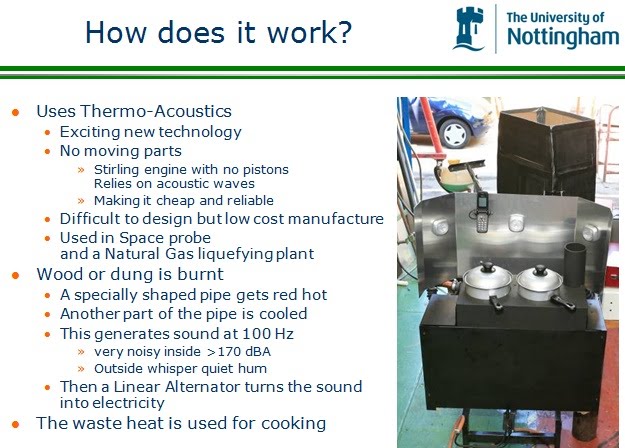
Information about an interesting approach to small scale heat and electricity co-generation comes from a NextBigFuture posting. This thermo-acoustic device can burn any carbonaceous fuel -- even dried cow dung -- to produce the heat, which is converted to electricity via a linear generator.
BrianWang

* Target of 100-150 Watts electrical thermo-acoustic generator (stove, fridge, electricity) for £20 in 1 million quantities with half the wood and no smoke
* weight: 10-20kg
* 1.6 kWth for cooking and 0.75 kWth for simmering.
- Fuel: consumption 1 kg/hour, wood, dung and other bio-mass.
* fuel is placed inside the stove and burned. The fire heats compressed air that has been pumped into specially shaped pipes located inside the stove's chimney and behind the stove. The heated air begins to vibrate and produce sound waves. Inside the pipes, the noise is 100 times louder than a jet taking off. But because the pipes are stiff and do no vibrate, the sound waves have nowhere to go. So outside the pipe, people hear only a faint hum.

* The sound waves vibrate a diaphragm located at the end of the pipe. The diaphragm is attached to a coil of metal wires that sit inside a magnet. As the wire coil vibrates — about 50 times per second — it generates an electrical current, which is captured by wires and converted to the proper voltage.
* The stove has electrical sockets, where the homeowner can plug in, for example, a mobile phone for charging. Or she can sell the electricity as a phone-charging service.
* For refrigeration, the heated, compressed air is sent through a different part of the pipe, where sound waves cause the air to expand. As it expands, it cools to a temperature that can produce ice. It takes about two hours of stove use to produce enough ice that will keep the fridge cold for 24 hours. But homeowners have the option of producing more ice to sell for income. _NextBigFuture

Research innovation:
- Research into the combination of the thermo-acoustic engine, linear alternator and cool
box in a single device, powered by a biomass stove.
- Design of a rugged and inexpensive linear alternator that could be easily mass-produced.
- Overall system design from the view point of low cost, application of indigenous materials,
use of local manufacturing skills and simplicity of assembly, which are major research issues
compared to the current high-cost and thermo-acoustic systems.
Standing wave thermo-acoustic engine:
- Fractional wave length design.
- Combustor: wood burning, high efficiency, low emissions and used for cooking.
- Hot heat exchanger (1): 500 C gas temperature.
- Stack: heats and cools gas packets.
- Ambient Heat Exchanger (2): water cooled, also used for cooking. _SCORE.UK_PDF

This is one of many attempts to provide efficient cooking, heating, refrigeration, and small-scale power to the third world. Besides the need for clean water, inexpensive shelter, and abundant, nutritious food, the third world most needs practical sources of cooking fuel, refrigeration, and small power. Inexpensive, practical level medical and dental care would also score high on the list.

The challenge for the advanced world is to not allow itself to turn into the impoverished third world before it is able to solve the most pressing problems of the third world.

Labels: ,

Thursday, November 13, 2008

General Electric + University of Wyoming = IGCC

General Electric has partnered with the University of Wyoming to find optimal clean solutions for burning Powder River Basin coal, and other Wyoming coals. GE has developed IGCC, integrated gasification combined cycle electricity generation from coal to an advanced state. This allows the clean and highly efficient production of electricity using both gas turbines and steam turbines in combined cycles. In addition, process heat can be produced for industry and general heating needs, further increasing overall efficiency and usefulness of the process.
Wyoming is uniquely positioned in the nation's energy landscape and has vast coal resources capable of supporting a substantial portion of the nation's energy needs. The state produces approximately 40 percent of all of the coal used in the United States to generate electricity.
The new center will include a small-scale gasification system that will enable researchers from GE and the university to develop advanced gasification solutions for Powder River Basin and other Wyoming coals. The research is expected to expand the range of coals that can be used with GE's integrated gasification combined-cycle (IGCC) technology for power plants. The facility is expected to be operational by 2012.

.... GE is a world leader in IGCC technology and has been at the forefront of IGCC technology since the Coolwater project, a 120 MW technical demonstration IGCC project started in 1984. GE's IGCC technology also has operated at the 250 MW TECO Polk I station in Florida for more than 12 years. Today, GE offers a 630 MW IGCC reference plant that produces 75 percent less SOx, 33 percent less NOx, 40 percent less particulate matter, uses 30 percent less water and offers 90 percent mercury capture, compared to a traditional pulverized coal plant.

In addition to providing a cleaner alternative for power generation, IGCC is well-suited for carbon capture. Carbon capture technology is in use in GE's industrial gasification applications around the world today. _Source
Regular readers of Al Fin Energy know that Al Fin is concerned about reducing pollution, but not particularly concerned about reducing CO2--which is far from being a pollutant. IGCC reduces the important pollutants that come from coal by a large margin.

If a radical environmentalist-driven Obama reich blocks such gasification coal plants on the basis of CO2 release, it would the the epitome of stupidity and self-destruction. Nevertheless, it is what we expect the Obama administration combined with the Pelosi/Boxer congress to do. Keep your eyes open, so that you will have the best possible options available to you.

Labels: , , , ,

Sunday, September 14, 2008

Cogeneration, CHP, Heat Recovery

A typical coal plant has an efficiency in the low 30% range, meaning 65% or more of the energy is wasted. CHP can improve the plant efficiency to the 60%-80% range._Source
Excess heat production in US industry could potentially provide up to 20% of the nation's electrical power. For now, most of that energy goes into the atmosphere and is lost. With increased heat recovery methods, that heat will be converted to useful power. Some new plants, such as a Hormel meat processing plant in Texas, and other new plants are beginning to salvage waste heat for useful purposes--including electric power.
More than half of the energy potential in traditional power generation goes up the stack as waste heat. In contrast, the UTC Power fuel cell power system converts heat exhaust into heating and cooling, turning potential waste into useable energy. While central powerplants achieve conversion percentages in the lower 30s, the PureCell® system can attain energy conversion efficiencies up to 90 percent. High system efficiencies translate into greater fuel utilization, thereby conserving natural resources and energy. _Source
Here is more on co-generation, or Combined Heat and Power (CHP):
Any place energy is wasted, there's a chance to capture it and do useful work. The scale of waste heat in a steel mill, cement plant or silicon plant makes the potential obvious, but there are a few other types that take a sharper eye.

The heat from a power plant, instead of being lost in a cooling tower or surrendered to the atmosphere, can be used for local heating via underground hot water or steam pipes to nearby businesses, homes or industry. There's a limit on how far the heat can travel, hence the name, district heating. Once more common, today in the US this is mostly limited to college campuses and a few old downtown neighborhoods.

Anytime there is a pressure drop in a pipe, a backpressure turbine generator can capture the lost energy. For example, long distance natural gas pipelines operate at high pressure and when the pressure is reduced for local distribution, some of the significant energy originally used to pressurize the pipe can be recovered. This is sort of like regenerative braking for gas lines. An investment of $8 to $10 billion could capture 6.5 GW, another bargain at $1,250 to $1,500/kW. Steam pipelines are more numerous and have even more potential. The college campuses with district heating mentioned above could also be producing some fuel-free power where ever the steam pressure is reduced from transmission pressures to the pressure used in buildings.

Many industrial processes have leftover gas or create some low quality gas that can be burned. Quite often, this is simply flared ( that is, burned ) at the top of a smokestack. I watched flaring gas coming off steel mill blast furnaces for years as a kid in Gary, Indiana without knowing what it was. In any event, I was awed by 15 foot high tongues of flame dancing on top of a 300 foot high stack. Other sources are oil refineries, auto painting plants, carbon black plants and ethanol refiners.

One more advantage of CHP is that the electricity usually doesn't have to travel far and rarely requires new transmission lines. Unlike many large utility plants sited far away from population centers, most CHP installations are already where there are people and power demand. _Co-Generation
Technically, co-generation is the combined generation of useful heat and electricity. CHP is an equivalent term. Heat recovery, on the other hand, can refer to the retrofitting of heat recovery technology to previously wasted process heat, to yield electric power and/or other productive energy from waste heat. The distinction may seem too fine after the fact, but is quite meaningful at the design stage.

Labels: , ,

Monday, February 18, 2008

Energy Briefs

ZeaChem and Coskata are promising high volume bio-ethanol at US $1 a gallon, by 2012. New Canadian startup Syntec promises even cheaper bio-ethanol--40 cents a gallon.
The Syntec B2A technology, initially developed at the University of British Columbia, is focused on second-generation cellulosic ethanol production. The Syntec process parallels the low-pressure catalytic synthesis process used by methanol producers. Syntec's innovative technology uses any renewable waste biomass such as hard or soft wood, sawdust or bark, organic waste, agricultural waste (including sugar cane bagasse and corn stover), and switch-grass to produce syngas. This syngas, comprised of carbon monoxide and hydrogen, is then scrubbed and passed through a fixed bed reactor containing the Syntec catalysts to produce ethanol, methanol and higher order alcohols. The Syntec technology can also produce alcohols from biogas (sourced from anaerobic digestion of manure and effluent), landfill gas or stranded methane.__NextEnergy
Better information regarding the efficiencies of biofuels indicates that recent articles published in Science that were extremely critical of biofuels efficiencies, were highly misleading. The category of "biofuels" is too wide, varied, and inclusive to be susceptible to simplistic analyses such as were presented in the articles referred to by the link above.

The waste heat from internal combustion engines used in passenger and freight vehicles could be put to better use than heating the atmosphere. Honda is looking to put heat-mining technology in its hybrid vehicles.
Honda is exploring the use of a Rankine cycle co-generation unit to improve the overall efficiency of a hybrid vehicle by recapturing waste exhaust heat from the internal combustion engine and converting it to electricity to recharge the battery pack. Honda engineer Kensaku Yamamoto presented an overview of the work in a paper at the 2008 SAE Hybrid Vehicle Technology Symposium in San Diego.

Test results showed that in 100 kph (62 miles/hour) constant-speed driving, the use of the Rankine cycle improved the thermal efficiency of the engine by 3.8%. In the US highway cycle, the Rankine cycle system regenerated three times as much energy as the vehicle’s regenerative braking system.___GCC __via_Ecogeek
Hopeful discoveries in gas storage technology may make gas-phase powered vehicles more feasible.
In the case of gas storage, MOFs offer the crucial advantage of soaking up some of the gas pressure exerted by the molecules. This makes hydrogen derived from non-fossil energy sources such as biomass, or even genetically engineered plants, potentially viable as a fuel for cars while the alternative of pressurised canisters is not, says Ferey. The key difference is that the amount of gas stored in a conventional cylinder at say 200 atmospheres pressure could be accommodated in an MOF vessel of the same size at just 30 atmospheres, which is much safer...The porous nature of MOFs enables them to be exploited in quite another way as catalysts to accelerate chemical reactions for a wide variety of materials production and pharmaceutical applications, although this field, as Ferey noted, is still in its infancy. ____Source
This technology will likely require another ten or more years to become available for production model vehicles. By then, it is likely that series hybrids powered by bio:fuel cells will be common, incorporating a number of different ways of capturing waste heat to re-charge auxiliary batteries and super-capacitors.

Labels: , ,

Saturday, March 31, 2007

Gas Turbines--An Important Part of the Power System

Gas turbines are important machines in the production of energy for electricity and transportation. When used as part of a cogeneration system, they contribute to high efficiencies for scalable power plant systems.


A short but interesting animation of gas turbine operation for electricity generation. It depicts the operation of the compressor phase of the gas turbine.

This is a video portraying the reliability testing procedures for a new GE gas turbine for jet aircraft.

Here is more information on some specific turbine gensets.

Labels: , ,

Older Posts