Thursday, November 29, 2012

Global Trends in Nuclear Power

Russia's Rosatom recently signed a deal with 13 collaborating Czech companies to build an advanced lead-cooled fast reactor SMR called the SVBR-100.
The main advantage of fast-neutron reactor technology over traditional nuclear power plants is that it can utilise this waste product – irradiated or highly-enriched nuclear fuel – in the process of generating energy. Fast reactors also produce far less new nuclear waste than conventional reactors, while some reactors, called fast-breeder reactors, can be used to produce an excess of plutonium, which can then be used in nuclear weapons or recycled to fuel the plant.

According to Leonid Bolshov, professor at the Institute for the Safe Development of Nuclear Energy of the Russian Academy of Sciences, the development of fast nuclear reactors is essential to close the nuclear fuel cycle.“Fast reactors will help us solve one of the most pressing problems connected with atomic energy, and that is what to do with the atomic waste from nuclear power stations that are currently operational.”

In Britain, the Nuclear Decommissioning Authority is considering plans to build two fast reactors at Sellafield in Cumbria to deal with the 120-ton plutonium waste problem there – the world’s largest stock of civilian plutonium. A feasibility study has already been submitted for building the plants, which, if given the go-ahead, could eradicate the British plutonium stockpile by around 2030. This would also have the benefit of generating electricity in the process. _Behind the Headlines
More at the link above.

ATMEA, a Gen III + reactor collaboration by Areva and Mitsubishi Heavy Industries, is on the way to being installed in Jordan, Argentina, probably in Brazil, and elsewhere:
The ATMEA1 reactor is an evolutionary Generation III+ medium-sized pressurized water reactor (PWR) embedding proven technologies and providing top level safety as well as high economical and operational performance. As such, it is the best response to Brazil’s energy needs and constraints. Perfectly adaptable to Brazil’s grid requirements, the ATMEA1 reactor can provide Brazilian utilities with advanced operational flexibility.

The ATMEA1 reactor has already been pre-selected in Jordan and pre-qualified in Argentina for those countries’ nuclear new-builds programs. ATMEA is also looking at other opportunities in Asia, where utilities have expressed interest in the ATMEA1 reactor. _ATMEA Reactor
Here is an update from Brian Wang on China's high temperature gas cooled reactor (HTGR) developments. China is commencing its nuclear buildup, after a safety delay caused by concerns over the Fukushima earthquake & tsunami caused accident at a nuclear power plant.

The Next Generation Nuclear Power Plant Industry Alliance accepted two new members recently -- the Savana River Site Community Reuse Organization, and the Advanced Research Center. The goal of the alliance is the production of high and very high temperature reactors for joint production of electricity and high quality industrial process heat.
Rick McLeod, Executive Director of the SRSCRO said “These high temperature reactors present a very real and very exciting possibility for our region of the country. We have several local industrial heat users in South Carolina and Georgia that would greatly benefit from the price stability and environmental benefits of heat produced by this type of small modular reactor. Our community is a pro-nuclear community and we have an existing skilled nuclear work force associated with the Savannah River Site and surrounding nuclear industry. We also have established training programs to train future workers for jobs in the nuclear industry. Plus, there are a number of well-characterized and appropriate sites for these next generation modular reactors.”

Fred Humes, Director of the Advanced Research Center added “The market for HTGRs is substantial. The NGNP Industry Alliance and the Idaho National Laboratory have conservatively estimated that in North America alone, there is a market for over 700 of these advanced high temperature SMRs. The Aiken area can be in on the ground floor in terms of fuel manufacturing, components, materials, etc. The need to build out this capability definitely plays to our strengths. In addition, there are several potential uses of the technology that are particularly intriguing to me, including high temperature steam for our industries along with an added advantage of a supply of electrical power. There’s also the very exciting potential for using HTGR heat and electric power for the production of large quantities of hydrogen without fossil fuel use – this could be revolutionary for petrochemical and carbon conversion industries around the world.”

On the subject of timing, Moore stated that “The impression some people may have that HTGRs are decades away is simply false. There is a good historic legacy, including in the U.S., for this technology. Two test reactors are currently operational globally and a commercial sized unit is being built in China. Although a technology development effort is needed in parallel with a modern, U.S.-based licensing process, the technology development risk is very low. With a focused, aggressive effort, the first-of-a-kind modern HTGR module could be up and operating in the U.S. by about 2026 as part of a multi-module deployment.” _NextGen Nuclear Power Plant Alliance
Finally, Microsoft's former Chief Technology Officer Nathan Mhyrvold, continues to push the development of Terrapower's Traveling Wave Reactor, which is a fast reactor design. Bill Gates and other wealthy backers have been supportive of Terrapower, in the hopes that the design will lead to safer nuclear power plants which consume nuclear waste along with depleted uranium and more conventional nuclear fuels.

Nuclear power offers the potential for virtually unlimited clean safe and affordable electrical power and industrial heat -- if it is done properly.

Labels: ,

Saturday, November 17, 2012

Advanced Materials and Design Tools for NextGen Nuclear Reactors

Nuclear reactors take a lot of punishment in the way of heat and sub-atomic particles. More durable materials would allow reactors to have longer lifetimes -- reducing overall costs and increasing profits.

Nano-engineered materials have the potential to resist damage from heat and irradiation for longer periods of time than conventional materials currently used.
In order to build the next generation of nuclear reactors, materials scientists are trying to unlock the secrets of certain materials that are radiation-damage tolerant. Now researchers at the California Institute of Technology (Caltech) have brought new understanding to one of those secrets—how the interfaces between two carefully selected metals can absorb, or heal, radiation damage.

... During nuclear irradiation, energetic particles like neutrons and ions displace atoms from their regular lattice sites within the metals that make up a reactor, setting off cascades of collisions that ultimately damage materials such as steel. One of the byproducts of this process is the formation of helium bubbles. Since helium does not dissolve within solid materials, it forms pressurized gas bubbles that can coalesce, making the material porous, brittle, and therefore susceptible to breakage.

Some nano-engineered materials are able to resist such damage and may, for example, prevent helium bubbles from coalescing into larger voids. For instance, some metallic nanolaminates—materials made up of extremely thin alternating layers of different metals—are able to absorb various types of radiation-induced defects at the interfaces between the layers because of the mismatch that exists between their crystal structures.

... in a metallic nanolaminate material, small helium bubbles are able to migrate to an interface, which is never more than a few tens of nanometers away, essentially healing the material. "What we're showing is that it doesn't matter if the bubble is within the interface or uniformly distributed—the pillars don't ever fail in a catastrophic, abrupt fashion," Greer says.

She notes that the implanted helium bubbles—which are described in the Advanced Functional Materials paper—were one to two nanometers in diameter; in future studies, the group will repeat the experiment with larger bubbles at higher temperatures in order to represent additional conditions related to radiation damage.

In the Small paper, the researchers showed that even nanopillars made entirely of copper, with no layering of metals, exhibited irradiation-induced hardening. _R&D Mag
Advanced computational design tools provide another way in which future generations of nuclear reactors can be made safer and more durable:
... many of the highly complex physical phenomena that affect reactor performance and safety remained somewhat of a mystery. It wasn't possible to "see" what was taking place inside this very harsh environment—until now.

Researchers are using some of the world's most powerful computers at the Argonne Leadership Computing Facility to take a leap forward in nuclear reactor design, analysis and engineering. Their efforts could shave millions of dollars off the cost of reactor design, development, preparation for licensing, and construction.

Researchers have developed a suite of computer tools, called the Simulation-based High-efficiency Advanced Reactor Prototyping (SHARP) Reactor Performance and Safety Simulation Suite, that numerically mimic and allow researchers to "see" the physical processes that occur in a nuclear reactor core. SHARP users can build complex virtual reactor models, which can run the reactor through a variety of operational or accident scenarios that would be impractical or impossible in the real world. _PO
US national energy labs utilise some of the most advanced hardware and software computer tools in the world -- including the ORNL Titan supercomputer, the world's most advanced. As mentioned here previously, the Titan will be used to design better nuclear reactors, along with a few other energy related tasks.

Labels:

Friday, November 16, 2012

HTGRs: One Revolutionary Key to an Abundant Energy Future

The importance of cheap, plentiful, high quality industrial process heat cannot be overstated . . .

Here is a short link list of some things that you can do with cheap, virtually unlimited high quality process heat:

  1. Unlock the trillions of barrels oil equivalent in oil sands (PDF)
  2. Unlock the trillions of barrels oil equivalent in coal to liquids and gas to liquids (PDF)
  3. Unlock the trillions of barrels oil equivalent in shale oil kerogens 
  4. Provide abundant industrial process heat for production of fertilisers, refining fuels, making plastics, etc 
  5. Split CO2 into CO to use as a hydrogen carrier 
  6. Overturn conventional fears of EROEI and Peak Oil 
Those things, and many more -- including biomass to liquids and gas hydrates to liquids -- will be accomplished by next generation gas-cooled high temperature nuclear reactors.
A group of far-sighted companies, including AREVA, ConocoPhillips, Dow Chemical, Entergy, Graftech International Ltd., Mersen, Petroleum Technology Alliance Canada, SGL Group, Technology Insights, Toyo Tanso Co. Ltd., and Westinghouse are pursuing the development of a true next-generation nuclear technology referred to as the High Temperature Gas Cooled Reactor (HTGR) for the past few years. Without too much technical detail, HTGRs are helium-cooled, graphite-moderated reactors with robust ceramic-coated fuel that operate at temperatures at or above 750 Degrees Celsius (1400 Fahrenheit) where conventional light water reactors operate at temperatures less than half that. In short:

The design is intrinsically safe. It requires neither active or passive systems nor operator interventions to remain safe, thereby allowing co-location near major industrial facilities.
High temperature output that allow direct substitution for fossil fuel use in industrial process heat applications.
Much higher efficiency leading to lower energy cost, making it competitive with natural gas in many places of the world today without any price for carbon. _NGNPAlliance_via_NBF
NGNPAlliance Home Page

4 Page PDF HTGR Description w/ Images

The image above matches different industrial processes with the level of heat required. Since HTGRs can provide abundant heat up to 850 C or 900 C, all of the lucrative processes listed in the image suddenly come within economical reach -- once HTGRs are perfected, licensed, and mass produced in factory-built modular units.

The image above provides thumbnail images of different processes that will become more profitable with the abundant availability of high temperature, high quality process heat.

Why do we at Al Fin Energy continue to emphasise the importance of HTGRs? Because if the US government had devoted half as much attention to developing and perfecting the mass production of safe, relatively inexpensive, and reliable HTGR modules -- instead of wasting hundreds of $billions on intermittent unreliable forms of energy -- the "energy crisis" would have been solved by now.

The fact that this has not been done, reveals for a certainty that government is not serious about providing inexpensive, clean, abundant energy for industry and society at large. Government energy policy is instead based upon more corrupt and ideological motivations, which delay the era of energy abundance unnecessarily.

Labels: ,

Wednesday, October 31, 2012

New Nuclear Technologies: Fusion and Fission

Brian Westenhaus takes a look at Tri-Alpha Energy's approach to Boron fusion:fission. That article complements an earlier piece by Brian Wang on Tri-Alpha.
Tri-Alpha’s position is, “We want to know the energy and location of every outgoing alpha particle.” This is important because in a pB11 reaction the harvest is high energy Helium that can be used to directly generate electricity.

The news from Tri-Alpha is the discovery of two high-energy α-particles (alphas) – that will have a huge impact on pB11 fueled reactor designs because the alphas are much easier to extract and convert more efficiently into electricity.

This is quite significant news and powerful information that may apply to the other two leading pB11 fueled efforts, the Lerner Focus Fusion effort and the Bussard Wiffle Ball work. _Brian Westenhaus

Tri-Alpha's approach is a hybrid form of fusion:fission, where high energy protons are forced into Boron 11, converting it to Carbon 12 in a highly energetic state. The Carbon 12 decays -- or fissions -- emitting up to 3 high energy alpha particles.

79 page PDF document explaining this approach more thoroughly

Brian Wang has more recently discussed a report by Kachan & Co. on new nuclear technologies. Here is the executive summary of the report (PDF).


Below is a talk by Mark Halper on future innovations in fusion and fission (via Brian Wang):

We have barely learned to extract energy from basic matter. Ideological green faux environmentalists want us to reject advanced energy technologies, and to return to primitivist quasi-feudal societies of a subsistence nature. Such an approach, if enacted, would result in the deaths of billions of humans across the planet.

It can be assumed that most intelligent humans -- if properly informed -- would choose an advanced technology approach to a future of abundant energy.

Labels: ,

Thursday, September 20, 2012

Regarding Nuclear Power: Japan May Not Be as Stupid as Germany

Japan's government is suggesting that it may not be ready to shut down its nuclear power plants by the year 2040, as was previously suggested.
The Japanese government backtracked Wednesday on its aspirations to go nuclear-free, refusing to give full cabinet approval to a plan to phase out nuclear energy by 2040 following sharp criticism from the pronuclear business lobby.

Japan's Economy Minister Motohisa Furukawa told reporters that the cabinet has decided to take the nuclear-free plan unveiled last week "into consideration" when formulating the country's long-term energy policy rather than giving the entire plan formal cabinet approval. _WSJ
Europe is a stronghold for the irrational green dysfunction, but few other parts of the world have become quite so deranged and divorced from reality.

Nuclear power is set to grow over the next four decades even after Japan shuts down its reactor fleet, the International Atomic Energy Agency says.

Global installed capacity is set to rise to at least 469 gigawatts of energy by 2050 from 370 GWe today, according to the IAEA's most pessimistic scenario. Nuclear capacity may reach as much as 1,137 GWe in a more favorable investment climate, the Vienna-based agency said.

There are presently 435 nuclear reactors in 30 countries worldwide, according to the IAEA. Sixty-four additional nuclear power plants are under construction. _NorthJersey Bloomberg News
The technology of nuclear power continues to advance, leading toward advanced reactors which are cleaner, safer, cheaper, more scalable, and more reliable with longer useful lifetimes.

General Atomics is working hard to develop one such type of advanced nuclear reactor:
The EM2 uses helium to cool the reactor and directly drive the turbine with gas heated to 856 degrees Centigrade — more than twice the light water temperature. The helium will turn an enclosed turbine at an incredible 6,000 to 12,000 revolutions per minute for 30 years before the reactor has to be shut down. By contrast, conventional reactors have to be shut down and refueled every 18 months.

...The EM2 is designed to produce 240 megawatts of electricity, but a smaller 71-MWe version will come first. The cost of EM2 electricity is expected to be about half that from today's water reactors. Most light water reactors are in the 1200-MWe range.

...It will use uranium as a starter fuel, enriched to 12 percent of fissile uranium 235 to get a neutron flux going, but after that it will burn nuclear waste or depleted uranium. It will effectively eliminate the nuclear waste issue and multiply the power gained from uranium fuel by a factor of 262 times over today's water-cooled reactors.

The essence of a fast reactor is the high energy of the neutrons, ergo their ability to react with the fissile material left in nuclear waste and depleted uranium. Being a fast reactor, EM2 will both burn up nuclear waste and generate enough radioactive "seed" during its operational cycle to refuel another reactor. _WHChronicle
With new nuclear technologies such as the EM2 coming along, the way will soon be clear to burn conventional LWR waste and/or depleted uranium for fuel. In addition, the ability to use high temperature heat for both electrical generation and for industrial processes will free up hydrocarbons for more lucrative uses -- such as the creation of high value chemicals, lubricants, polymers, fertilisers, jet fuels, and other materials.

Societies have been steeped in dysfunctional philosophies of resource scarcity and unlikely eco-catastrophe. Instead, children should be trained to develop their problem-solving ingenuity in ways that will make resource scarcity most unlikely and costly eco cleanups unnecessary.

Instead of indoctrinating our young in negativity -- as the green lefty-Luddite dieoff.orgiast stasists are apt to do -- we should be training them to use their minds in positive, creative, and productive ways. But then, if that were to take place, 90% of college administrators, politicians, attorneys, lobbyists, environmentalists, and other parasites, would be out of work.

Labels: , , ,

Monday, July 02, 2012

Electric Power Costs by Source and Country

These images come via "Neutron Economy"'s article: Deconstructing anti-nuclear economic myths - a response to Veronique de Rugy. (h/t 111th Carnival of Nuclear Bloggers at Yes, Vermont Yankee)

This image looks at EU countries by residential costs of electricity. It can be seen that nations which depend upon big wind and big solar -- such as Germany and Denmark -- pay a high price for power. And their costs are just beginning to build, as they double down on stupid.


The above image looks at levelised costs of electricity by source. Solar and offshore wind score particularly badly by this metric. But regular onshore wind would score almost as badly if the costs of intermittency were included in overall costs. That is one of many deficiencies in the "levelised cost" metric, failing to account for all the costs of intermittency -- which over the long run is the largest cost of big wind power besides the short lifespan of the powerplant.


James Conca Energy Cost Comparisons in Forbes suggesting natural gas as the current frontrunner. Full set of references included.
Conca differentiates between lifetime costs and other ways of comparing costs, specifically overnight costs and levelized costs:

"By life-cycle costs, I mean the total costs of building, operating, maintaining, fueling and decommissioning a thermal power plant, a solar array, a wind farm or hydroelectric dam over its life, that is, 15 years for a wind turbine, 40 years for a fossil fuel plant, 60 years for a nuclear plant, or 80 years for a large hydroelectric dam. Dividing those total costs by the amount of energy actually produced, not theoretically possible or installed capacity but actually produced, gives a life-cycle cost in ¢/kWhr. How we finance this cost is a totally different issue, one at which we generally fail as a society."

As the graph shows, hydro has the lowest costs at 3.3 cents per kWhr. This is due mainly to almost zero fuel costs and the 80-year life cycle of hydroelectric dams. Nuclear is second lowest with 3.5 cents, largely because of low fuel costs and the 60-year life expectancy of nuclear reactors. Coal is 4.1 cents, wind 4.3 cents, natural gas 5.2 cents and solar is the most expensive at 7.7 cents per kWhr.

Although fuel costs are free for wind and solar, their intensive capital costs, aggravated by the enormous amount of collection facilities that must be built, drive up their lifetime costs. It takes 9,500 windmills, for instance, to equal the life-cycle output of one AP1000 nuclear reactors, which is not the biggest reactor being built. Wind requires ten times the steel, concrete and copper per kWhr than any other energy source.

Natural gas plants are relatively cheap to built but are entirely dependent on future prices of natural gas, since fuel supplies make up 90 percent of the cost. _RCE Summary of James Conca at Forbes

A comprehensive analysis would have to include several other factors which are rarely included in a cost comparison. But it is good to have more people working on this problem.

Cost effectiveness of nuclear power for surface ships

The above study looks at US navy ships, but the cost comparisons should hold across the board for all long voyage, ocean going vessels.

More: Japan restarts Ohi reactor No. 3

Despite irrational green-fueled public protest, Japan carried through with the re-start of one nuclear reactor over the weekend. This should be only the first of many re-starts, as it is uneconomical to allow expensive power plants to sit unused in the midst of a power shortage. Particularly when the cost of nuclear fuel is extremely low in comparison to other forms of fuel.

Japan's political challenge of re-starting its nuclear facilities points out the global challenge of combating lefty-Luddite dieoff.orgiast anti-nuclear greens -- whether in Japan, Germany, Australia, the UK, or the US. Greens are leading Germany down a treacherous slope which will result in energy catastrophe unless a wiser leadership steps in.

Labels: ,

Wednesday, May 16, 2012

What if Peak Oil Died and Nobody Noticed?... and Other Energy Stories

A lot of hucksters are making a good living from peak oil doomerism. It has gotten to the point that it no longer matters whether peak oil has any intrinsic importance or not -- it is the symbolism of peak oil doom and devastation that matters. It is the catastrophic image inside the minds of the believers which drives the apocalyptic movement.

In the real world, things are not nearly so clear cut as in the mind of a cultist:
Apparently something terrible happens when we get to peak oil. I've never really quite understood the argument myself, but when we've used half of all the oil then civilisation collapses or something. I'm not sure why this should happen: we don't start starving when there's only half a loaf of bread left. But I am assured that something awful does happen.

That oil fields do get pumped out is obviously true – and also that you can have a good guess at when the ones we're currently pumping will run out. The part I don't get is the catastrophe. Some people seem to think that "peak oil" is when we can't actually pump out a higher amount: that if we've got 70 million barrels a day, then that's the most we can ever have, 70 million a day. Which is also called a disaster. Apparently this means that demand will move ahead of supply, which is simple sheer ignorance of the price system. There is no such thing as "supply" or "demand". There is only either of them at a price. So, if there really is a limit on how fast we can pump the stuff up, the price will rise.

Like it is at the moment. There's a lot more demand for $50-a-barrel oil than there is supply of it, which is why the price is $100 a barrel. It's true that if we really do reach some production plateau, then it's likely that the price will rise. But I still don't even see the catastrophe there. What with the taxes we pay, oil in the UK is around $300 per barrel at present. It is indeed a bit of a strain filling up the car, but other than that I don't see any more signs of the imminent collapse of civilisation than we normally have with politicians in charge.

Even if we accept the geological conventional wisdom, then there's still no cause for panic. Prices will rise, yes, so people will go off and do other things. Either use something else instead of oil (that ever cheaper shale gas for example) or simply doing things that require less energy. That's what a price system is for, after all, providing the signals that a certain resource is in scarce supply.

But the thing is, we really shouldn't be accepting this geology either.
The Green River Formation—an assemblage of over 1,000 feet of sedimentary rocks that lie beneath parts of Colorado, Utah, and Wyoming—contains the world’s largest deposits of oil shale. USGS estimates that the Green River Formation contains about 3 trillion barrels of oil, and about half of this may be recoverable, depending on available technology and economic conditions. The Rand Corporation, a nonprofit research organization, estimates that 30 to 60 percent of the oil shale in the Green River Formation can be recovered. At the midpoint of this estimate, almost half of the 3 trillion barrels of oil would be recoverable. This is an amount about equal to the entire world’s proven oil reserves.
Yes, we do know how to get this out: these reserves are similar to the Bakken shale in North Dakota that is spurting out oil as you read. _Telegraph
The author of the piece -- like many others recently -- may be understating the challenges of clean and economical extraction of the Green River kerogen oil shales. But that may be because we are not even close to the point that we need to extract oil shale kerogens to use in place of crude oil.

The best tool for clean, economical extraction of oil shales, oil sands, and conversion of gas, coal, and biomass to liquid fuels -- is high temperature gas cooled nuclear reactors of the generation IV variety. Areva and other engineering firms are working on perfecting that gen IV reactor technology, and although it may take the US government another 10 to 20 years to approve and license the designs, that is just about the time that we will need to start cleanly converting oil shale kerogens to crude.

In other energy news, the African nation of Ghana is looking for ways that it can integrate nuclear power into its overall energy mix. Nigeria is another African nation that is pushing to develop its own nuclear power industry.

Intermittent unreliables such as big wind power, are finding it more difficult to get lucrative subsidies from governments. Perhaps it is the fact that intermittent unreliables such as big wind and big solar are so unreliable and expensive, which is causing some governments to step back from the abyss.

And yet, tech powerhouse Google persists in its green energy dreams. Is it possible that for all of its brainpower, Google has allowed political activists to grab control of its energy plans and blueprints? That might explain Google's green energy idiocy.

Does anyone have access to the medical records of climate hack James Hansen? His recent attacks against Canada show the friend of Al Gore to have jumped the shark, right over a cliff. When a person confuses a computer model for the actual climate, he no longer deserves to be called a scientist.

There is a difference between educating oneself and indulging in self-indoctrination into a doomsday cult. It may be too late for this generation of peak oil doomer cultists, but if we hurry we may be able to save at least some of the newer generations -- and turn them into truly competent, independent, and very dangerous children. Which is precisely what the future needs.

Labels: , , ,

Wednesday, March 07, 2012

The US Must Have Both Nuclear and Coal: Obama Forbids Both

NewAmerican

An industrial society requires massive amounts of affordable fuels and electrical power. For electrical power, both nuclear and coal are suitable to provide the huge levels of baseload output required. But US President Obama is fighting a war to close down coal plants, while at the same time dragging his feet on allowing safe and revolutionary new nuclear designs to be licensed and approved.

Senator Obama declared a war against coal back in 2008, when he was still running in the Democratic presidential primaries against Hillary Clinton:
Consider candidate Obama’s January 2008 comment to the San Francisco Chronicle: “So if somebody wants to build a coal-powered plant, they can. It’s just that it will bankrupt them because they are going to be charged a huge sum for all that greenhouse gas that’s being emitted.”

Obama originally planned to keep this promise through cap-and-trade legislation, a scheme to tax companies for their so-called greenhouse-gas emissions. Lacking congressional approval, the President has turned to his Environmental Protection Agency to kill coal by way of crippling new regulations just put into effect this year. _NewAmerican
Mr. Obama's EPA has taken extraordinary steps to shut down coal plants -- thus progressively destabilising the North American power grid and raising the cost of power to industrial, commercial, municipal, and residential customers. In the midst of an ongoing economic downturn, these policies would never be permitted in a rational society with a rational governmental system. More:
...the EPA passed new emission regulations that had to be complied with by utility companies within six months — in the past, utilities were given years to comment on the workability of the rules, plan the implementation of new rules, and adjust their budgets for the adoption of the regulations, because adding air scrubbers or other major implements to a coal-fired power plant is not as easy as adding a new deck to one’s house. Obviously, the new regulations were designed to lead to the closure of certain utilities, mainly coal-fired power plants.

How will this affect our citizenry? When utilities cannot afford to do the bidding of bureaucrats with respect to their generation facilities, they shut them down. According to the February 12 Wheeling (WV) News-Register, “It was revealed at least 32 coal-fired power plants in 12 states, including West Virginia and Ohio, would be closed so utility companies could comply with the Obama administration’s air pollution regulations.” Up to 55 million households will be in danger of outages, brownouts, or, at the least, higher rates due to this unnecessary EPA rule. Already financially strapped Americans will be thrust into what is known in Europe as “energy poverty.”

...The effect of depriving a population of reliable sources of electricity is catastrophic. This can be quantified by examining the average national use of electricity in watts per person, compared to life expectancy in those nations.

...The United States is considered by many geologists as the “Saudi Arabia” of coal. This resource provides life-saving and life-enhancing energy for America, but it is under attack for this very reason by those who would take us back to an earlier era that was infinitely dirtier, deadlier, and with fewer opportunities to move civilization to new levels of freedom and prosperity. Government should not pick winners and losers to subsidize or regulate out of existence but should get out of the way and allow the free market come up with solutions to provide our energy needs.

In the future coal should probably be a feedstock for liquid fuels and for production of iron and steel, with nuclear energy providing our electrical base load. Coal is a resource that is proven and available. _NewAmerican
Eventually, either American voters will eject this dysfunctional president and his administration, or time will run out on his lame duck presidency. By then, the damage will have been done.

A huge power generating infrastructure can be shut down by the act of putting pen to paper. It cannot be re-built nearly so easily.

It is taking Obama only a few years to dismantle a coal power producing infrastructure which will require decades to replace with nuclear -- if it can ever be replaced. The alternative to abundant energy is a depleted economy, a depleted agriculture, and depleted lives of citizens.

US voters require the facts, so that they can make a rational choice.

More: The Manhattan Institute recently held two panel discussions on the topic of "Keeping the Lights On: What Role for Coal and Nuclear?" Videos for Part 1 and Part 2 (Each session is just over 1 hour)


Power 2012 - Keeping the Lights on: What Role for Coal and Nuclear - Part I

Panelists: Laszlo Varro, Jacob Williams, Porter Bennett

March 1, 2012


Power 2012 - Keeping the Lights on: What Role for Coal and Nuclear - Part II

Panelists: David Mohler, David Diamond, David Dismukes

March 1, 2012

Labels: , ,

Tuesday, February 21, 2012

Thorium Reactors and Fast Breeder Reactors in the News

The Washington Post is reporting on the recent push for thorium nuclear reactors in the US.
... a small group of scientists, entrepreneurs and advocates see the post-Fukushima era as the perfect opportunity to get the United States to consider a proposal they have made with no success for years. What about trying a new fuel, they say, and maybe a new kind of reactor?

The proposed fuel is thorium, an abundant silver-gray element named for the Norse god of thunder. It is less radioactive than the uranium that has always powered U.S. plants, and advocates say that not only does it produce less waste, it also is more difficult to turn into nuclear weapons.

They’re pushing the idea of adapting plants to use thorium as a fuel or replacing them with a completely new kind of reactor called a liquid-fluoride thorium reactor, or LFTR (pronounced “lifter”). The LFTR would use a mixture of molten chemical salts to cool the reactor and to transfer energy from the fission reaction to a turbine.

Proponents say such a system would be more efficient and safer than existing plants, which use pressurized water to cool uranium fuel rods and boiling water or steam to transfer the energy they create.

“A molten-salt reactor is not a pressurized reactor,” said John Kutsch, director of the Thorium Energy Alliance, a trade group based in Harvard, Ill. “It doesn’t use water for cooling, so you don’t have the possibility of a hydrogen explosion, as you did in Fukushima.”

Kutsch and others say that a thorium-fueled reactor burns hotter than uranium reactors, consuming more of the fuel. “Ninety-nine percent of the thorium is burned up,” he said. “Instead of 10,000 pounds of waste, you would have 300 pounds of waste.” _WaPo
Thorium is approximately three times as abundant as uranium in the earth’s crust, reflecting the fact that thorium has a longer half-life. In addition, thorium generally is present in higher concentrations (2-10%) by weight than uranium (0.1-1%) in their respective ores, making thorium retrieval much less expensive and less environmentally damaging per unit of energy extracted. Countries with significant thorium mineral deposits include: Australia, India, Brazil, USA, Canada, China, Russia, Norway, Turkey, Venezuela, Sri Lanka, Nigeria, South Africa, and Malaysia.

Naturally occurring thorium has one isotope- thorium-232. In the DBI reactor, the initial start up fuel mix is a combination of thorium and uranium-235. The uranium acts as the “seed” source of neutrons needed to achieve criticality for the first reactor. This combination of fuels decreases the time and capital required to start the thorium fuel breeding cycle. As the DBI reactor design begins producing electricity, Uranium-233, bred from the Thorium-232, increased core reactivity and power output. Over time, the original uranium-235 is burned up and subsequently the reactor is fuelled only with Thorium-232. Over the life of the DBI reactor design (approx. 60 years), about 3% of the original load mass (thorium only) will be added every 18 months. Depending upon operational choices available with the DBI designs, no or very little additional uranium will be needed. _DBI
As noted here recently, famed futurist Gerald Celente is proposing that Iran and other unstable third world dictatorships consider developing thorium cycle reactors rather than uranium cycle, should they insist upon developing a nuclear infrastructure.
The thorium cycle is far more efficient and simpler than the uranium cycle. So besides the fact that significantly more thorium reserves are present than uranium, it is possible to extract far more of the potential energy from the thorium -- with much less effort -- than from uranium.
Thorium is well distributed globally, providing an ample supply for industrial and emerging nations well into the future.

More information on the future of thorium energy:  Flibe

Besides thorium, other alternative approaches to nuclear reactors being developed include the fast breeder reactor. Brian Wang looks at fast breeder reactor development in India and other countries. More on the Indian FBR development:
India plans to commission the first-of-its-kind Prototype Fast Breeder Reactor (PFBR) early in 2013, kickstarting the second stage of its nuclear programme. The 500 MWe reactor, being developed by the Indira Gandhi Centre for Atomic Research (IGCAR) at Kalpakkam in Tamil Nadu, uses a unique mix of uranium and plutonium which significantly enhances the capability to generate electricity per tonne of fuel utilised.

The indigenously-developed PFBR is at an advanced stage of construction under the aegis of state-owned Bhartiya Nabhikiya Vidyut Nigam (BHAVINI).

"The construction will be completed by September and fuel will be lowered by December. We expect commissioning by early 2013," IGCAR Director S C Chetal said here. _HindustanTimes
Future high-tech nuclear infrastructures in advanced countries will likely include LFTRs, advanced PWRs, integral fast reactors, gas cooled high temperature reactors, and a variety of small modular reactors meant to produce both electrical power and industrial process heat.

As noted here many times, nuclear power is well suited to assist in the production of a wide array of synthetic liquid hydrocarbon fuels as well as industrial chemicals, lubricants, and other high value materials such as polymers. In this manner, nuclear power will act to generate plentiful substitutes for crude oil, at a time when political turmoil and "the coming anarchy" is likely to lead to frequent artificially caused short supply of crude.

Labels:

Monday, January 30, 2012

Can Canada Leverage Its Hydrocarbon Wealth to Create An Abundant Future Based Upon Advanced Energy Sources?

Canadians are understandably upset at the US in general, and at US President Obama in particular. Obama's abrupt and corrupt killing of the Keystone XL pipeline sent an unfriendly message of contempt and disregard to the US' neighbors to the north.

While the US Republican Congressional members are attempting to devise a way to approve the Keystone XL pipeline's completion and border crossing, Canadians are forced to contemplate other markets for their increasingly valuable oil sands product. After all, oil sands production has been ramped up in anticipation of cheap & ready pipeline transport to the south, all the way to refineries on the Gulf of Mexico. With the destruction of that rational plan by the congenitally feckless Obama, China is forced to look to China and India as alternative markets:
While the media fixates on the political spin around the Obama government's rejection of TransCanada's Keystone XL pipeline, there's another, more important element to this story that has been grossly underplayed:... in Asia...demand for energy of all kinds will continue to soar, according to BP's 20-year forecast....

``By 2030 China and India will be the world's largest and third-largest economies and energy consumers, jointly accounting for about 35 per cent of global population, GDP (Gross Domestic Product) and energy demand,'' the report says.

``Rapid economic development means industrialisation, urbanisation, and motorisation. Over the next 20 years China and India combined (will) account for all the net increase in global coal demand, 94 per cent of net oil demand growth, 30 per cent of gas and 48 per cent of the net growth in non-fossil fuels.''

No, that's not a typo. Let me repeat that: over the next 20 years, BP says China and India will account for 94 per cent of the net worldwide increase in oil demand. _Canada.com
The author goes on to warn of Canada's dependency on the US as an export market, at a time when US consumption of imported oil continues to decline.

Canada itself needs to also think about what kind of energy infrastructure it wishes to build for itself, using the oilsands wealth as a springboard. In the medium and long-term, advanced nuclear fission (and later, fusion) technologies make the most sense. Canada has rich ore resources for production of nuclear fuels, and with rational recycling and breeding technologies, the resource could last almost indefinitely, in practical terms.

Wisely, Canadian utilities are beginning to look toward building their nuclear infrastructure:
Utilities in Canada are expressing interest in the Westinghouse AP1000 pressurized waterreactor (PWR) and the Westinghouse Small Modular Reactor, a 200 MWe class integral PWR currently under development that is suited for smaller electrical grids, distributed generation, and process heat requirements. _Power-Eng
In an attempt to create a more sustainable oil sands industry, engineers are looking for ways to substitute geothermal heat in place of natural gas, for the production of oil sands. The key factor is industrial heat, which can be provided in multiple ways.

Al Fin energy analysts prefer the use of gas-cooled nuclear reactors for long term in situ production of oil sands, oil shales, heavy oils, and for even more unconventional fuels such as coal to liquids (CTL) and gas to liquids (GTL). Canada is rich in several hydrocarbon resources which could be economically converted to high quality fuels and high value chemicals, using process heat from gas cooled nuclear reactors.

All of these projects will require significant capital, which can be at least partially provided from export profits derived from sales of oil sands. The key issue is to convert a modern-day source of export wealth into a long term foundation for energy abundance, industrial sustainability, and commercial viability.

Neither large-scale wind power nor big solar power are rational foundations for a prosperous Canadian future, as both of these green approaches are inherently unreliable, expensive, intermittent, difficult to manage, and lead to exponential increases in customer energy bills.

Labels: , ,

Saturday, October 01, 2011

US DOE Not Giving Up on Nuclear -- Blames US NRC for Obstructing Technology

The US Department of Energy is promoting the development of new nuclear technology, including small modular reactors, molten salt reactors, and other advanced reactors. In a recent energy technology review (PDF), the DOE points to the licensing policies of the US Nuclear Regulatory Commission as being a primary obstacle to the timely production of cleaner, safer advanced nuclear reactors.

The DOE is financing research and development of advanced reactor technology both in the US and overseas:

MIT wins DOE grant to study and develop next generation advanced nuclear reactors

US and Czech Republic join to research advanced molten salt reactors and other nuclear reactor technology

China is certainly eager to develop advanced reactor technologies, and will not be held back by the US NRC's obstructionism. One area of advanced reactor research in China is the development of the thorium molten salt reactor. Thorium is cheaper, more abundant, and will burn more completely than uranium fission cycle fuels.

Babcock and Wilcox (B&W) has completed its integrated system test facility (IST) for the purpose of extensive testing of its small modular reactor, mPower. B&W is an established nuclear developer and manufacturer, and intends to do what it takes to outlast the sluggish and demanding NRC licensing obstacle course.

Governments of Jordan, South Africa, Vietnam, and perhaps Nigeria, Kenya, and Egypt, are still planning to develop new nuclear power in their countries.

Video: Westinghouse's Michael Anness says that small modular nuclear reactors (SMRs) are the future of nuclear power

Labels:

Saturday, August 06, 2011

Korea's 330 MW SMART Reactor Hoping for Commercial Approval in 2011

SMART is a 330MWth pressurized water reactor (PWR), designed to generate up to 100MWe for thermal applications such as seawater desalination.

MEST believes that SMARTs are more cost-effective and safer than the current generation of conventional reactors. _Nuclear Energy Insider
Korea's Ministry of Education, Science, and Technology has developed a 330 MW modular reactor that it hopes to get approved for commercialisation this year. It hopes to begin exporting the reactor beginning next year.
The Ministry of Education, Science and Technology has succeeded in developing a system-integrated modular advanced reactor (SMART) by investing 170 billion won ($160 million) since 1994. The reactor is likely to receive approval for commercialization this year, opening the way for exporting the model as early as next year.

SMART is a small-sized reactor with a generating capacity of 330 megawatts. Just as other modular reactors, SMART is manufactured at a plant and brought to the site fully built. This reactor can be constructed on smaller sites to provide stable power to towns with around 100,000 residents.

The ministry is making efforts to help export the SMART model to some 20 countries needing small-sized reactors. The model has already received a positive evaluation from the International Atomic Energy Agency (IAEA). _KoreaTimes
The main threat to implementation of Korea's SMART reactor strategy is competition from another Korean ministry, the Ministry of Knowledge and Economy, which wants to develop its own reactor design. Best not to dig too deeply into this governmental internecine competition to determine winners and losers in large industrial designs and contracts. They could tell you, but then they'd have to kill you. ;-)

Nuclear power is under siege on many fronts internationally, particularly since the Japanese earthquake and tsunami - caused nuclear meltdown. There are many ways to make nuclear power safer, cheaper, and potentially cleaner in terms of waste products. But as long as governments are making it difficult or impossible for new designs to be properly tested and developed, it will be difficult for nuclear to realise its potential.

Labels:

Sunday, June 12, 2011

New Subcritical Thorium Reactor Revolution

GWPF

Somewhere in Cheshire an energy revolution is brewing. Modern nuclear researchers are developing new approaches to safe subcritical reactors, using fertile thorium as fuel. The new reactor designs will be incredibly safe, proliferation resistant, and will produce only miniscule and easily stored amounts of long-lived nuclear waste.
Imagine a safe, clean nuclear reactor that used a fuel that was hugely abundant, produced only minute quantities of radioactive waste and was almost impossible to adapt to make weapons. It sounds too good to be true, but this isn’t science fiction. This is what lies in store if we harness the power of a silvery metal found in river sands, soil and granite rock the world over: thorium.

One ton of thorium can produce as much energy as 200 tons of uranium, or 3.5 million tons of coal, and the thorium deposits that have already been identified would meet the entire world’s energy needs for at least 10,000 years. Unlike uranium, it’s easy and cheap to refine, and it’s far less toxic. Happily, it produces energy without producing any carbon dioxide: so an economy that ran on thorium power would have virtually no carbon footprint.

Better still, a thorium reactor would be incapable of having a meltdown, and would generate only 0.6 per cent of the radioactive waste of a conventional nuclear plant. It could even be adapted to ‘burn’ existing, stockpiled uranium waste in its core, thus enormously reducing its radioactive half-life and toxicity.

...The good news is that, thanks to funding from the Research Councils UK Basic Technology Programme, we’ve taken the first, critical step to making this dream a reality – constructing an incredibly hi-tech, cutting-edge machine with a surprisingly ordinary name: Emma.

Daresbury, the science park where Emma lives in a big, bare building with solid concrete walls more than two feet thick, isn’t especially scenic – it’s overlooked by a power station and stands on the boggy Cheshire flatland between Runcorn and Warrington, at the head of the Mersey estuary.


...Emma is a particle accelerator, the first of an entirely new type. Since the first such machines were built nearly 80 years ago, accelerators – devices that propel beams of electrons, protons or other particles to high speeds – have played a vital role in experimental physics, opening up fresh insights into the origins of the universe and the nature of matter. But most are big and expensive. The best known and biggest of all is the Large Hadron Collider operated by CERN in Switzerland, an underground ring 17 miles in circumference, which cost billions to construct.

Emma is different. She is the world’s first ‘non- scaling, fixed-field, alternating-gradient’ (NS-FFAG) accelerator. In layman’s terms, says Bliss, this means she is a ‘pocket-sized’ machine, the prototype of a new generation that will be significantly smaller and cheaper than its predecessors.

And this is Emma’s special significance. Making particle accelerators affordable means they could be built and used in practical, everyday settings – such as thorium power stations. The key to thorium energy is likely to be the further development of ‘pocket-sized’ machines – precisely the kind of accelerator that looks and behaves like Emma.

... Thorium atoms only start to undergo fissile nuclear reactions and thus to release their energy when they’re bombarded with neutrons, and these would have to be supplied by an external source – ultimately, an accelerator.

‘This means the margin of safety is far greater than with a conventional plant,’ says Cywinski. ‘If the accelerator fails, all that will happen is that the reaction will subside. To stop the reactor, all you would have to do is switch off the accelerator.’
And if hit by an earthquake, he adds, even one as powerful as the one that wrecked Fukushima, a thorium plant would be ‘intrinsically safer’.

‘There’d be some residual radioactivity heating the core, but sustained nuclear fission would simply stop. Everything would cool much faster. You’d be left not with potential catastrophe, but just a heap of molten metal and metal oxides.’

This type of plant – dubbed the Energy Amplifier by the Nobel Prize-winning physicist Carlo Rubbia in 1993, when he patented the basic design – wouldn’t be simple. Because neutrons carry no electrical charge, the magnets in a particle accelerator have no effect on them.

Hence, the way to generate the neutrons necessary to trigger nuclear reactions in thorium would be to build a ‘spallation source’ in the middle of the reactor core. This is a substance – molten lead, for example – which produces neutrons when you fire a beam of protons at it. That beam, in turn, would come from a particle accelerator.

...Last year, ThorEA published a report, Towards An Alternative Nuclear Future, which concluded it should be possible to build the first 600MW power plant fuelled by thorium with three attached ‘pocket-sized’ NS-FFAG accelerators within 15 years, at a cost of about £2 billion – making it highly competitive in relation to fossil-fuel or conventional nuclear alternatives. _GWPF_from_MailOnline
Using "pocket-sized" accelerators to generate spallation neutrons to breed fissile U233 from fertile Th232 might allow for highly scalable and versatile reactor designs, which would certainly be safer than any nuclear reactors currently generating power. And nuclear is by far the safest form of power generation currently in existence.

Below, you can see researcher Rachael Buckley standing inside the EMMA device.
Thorium itself is plentiful, and will be quite cheap once the infrastructure is developed. The cost for subcritical reactor designs depends mainly on the cost of the accelerators and reactor vessels, and containment. The fuel itself is a negligible expense. And by reducing the quantity of waste to be stored and lowering the proliferation potential of the reactor dramatically, those costs would also plummet.

This technology will also be useful in the perpetual fight against cancer.
‘I’m optimistic we can build a machine that overcomes the technical challenges and would be applicable for cancer therapy straight away,’ he says. ‘I think Pamela can be built for an overall cost of £10-15 million, and would take about five years. And that would be a crucial stepping stone towards a thorium power station. It wouldn’t be cheap. But it would be highly competitive.’

Read more: http://www.dailymail.co.uk/home/moslive/article-2001548/Electron-Model-Many-Applications-Technology-save-world.html#ixzz1P4ubEPYz


It will take time to put the pieces together, but the writing is on the wall, if modern humans will only take the time to read it and take action.

Labels: ,

Sunday, May 15, 2011

Nuclear News and Oddities

Nuclear News of note can be found at:

The 52nd Carnival of Nuclear Energy at ANS Nuclear Cafe

Brian Wang's Next Big Future Nuclear Update

Nuclear Street Nuclear Portal

Nuclear Town Hall

An interesting nuclear oddity popped up on the radar screen: An unconventional fusion researcher, Bodgan Maglich (inventor of Migma Fusion Cells), has re-emerged in connection with the recently announced Exyder Cell -- a 10" fusion neutron breeder which creates fissile Uranium 233 from fertile Thorium 232.
”India has 360,000 tons of thorium against only 45,000 tons of natural uranium… Installing one or two exyder type mini breeders to serve each nuclear power plant operating on Thorium/U-233 cycle would eventually render the power station self sufficient…” Computer simulation indicated that one Exyder module could economically produce 100grams/day, 35 kg/year of U-233, at electric energy cost of $50/Kg vs. $300/Kg for U-238. CANDU type reactor of 235 megawatt burns 10 Kg of U-233/year. “Even sub-engineering’ energy breakeven fusion systems which consume a net amount of electric energy to generate fissile U-233, can play a critical role in cutting the production cost.” _Businesswire
This use of fusion -- to create neutrons for use in breeding fissile fuel from fertile fuel -- may find common use in the future, if it is found to facilitate a more economical, safe, and sustainable nuclear fuel cycle.

Another potential approach to a safe "breeder-reactor" is the sub-critical reactor which is powered by a nuclear accelerator, and spallation neutrons. Both of these approaches (fusion-powered breeders and accelerator-powered breeders) may well also represent solutions to the nuclear storage problem and some potential proliferation problems (via re-cycling).

Thorium is more common globally than Uranium, and is distributed somewhat differently. This means that nations and regions which do not have abundant Uranium supplies, may well have plenty of thorium to fuel fission plants for hundreds of years.

Another approach to a Thorium cycle reactor, is the Molten Salt Reactor. Charles Barton at Nuclear Green covers the molten salt reactor regularly.

It is crucial to understand the energy density advantage of nuclear fuels and nuclear reactions. When one also understands the central role of abundant energy to the advancement of humans as a species and as a cosmic enterprise, one's short, intermediate, and long-term energy goals should be much clearer.

Labels: , ,

Saturday, May 14, 2011

Heat from Nuclear Fission and Decay: Using it More Wisely

SpaceflightNow via Brian Wang

Most electrical power is generated from heat: either combustion heat or the heat of nuclear fission and decay. I was disappointed many years ago when I first learned that nuclear power plants generate their huge production of power using primitive heat -- just like coal and gas plants. But as long as we are using heat, we may as well use it more efficiently and more ingeniously.

US NASA is proposing an advanced sterling radioisitope generator (ASRG) for powering space missions -- because the sterling engine provides greater efficiency for the limited amount of fuel allowed on weight-sensitive space missions.
...each ASRG creates between 130 and 140 watts of electricity with 1 kilogram, or about 2.2 pounds, of plutonium-238. More than four times more plutonium would be required to generate the same power in an existing RTG, according to the Energy Department.

Officials want to complete extensive ground testing and a low-cost flight demonstration before flying ASRGs on a multi-billion dollar flagship mission. _SpaceFlightNow_via_BrianWang

The same principle could be used for low power generators powered by "nuclear batteries" of various types, for remote location applications. Arctic and antarctic locations in particular cry out for low power nuclear battery applications, as would deep undersea locations.

Another way of using the heat of nuclear decay more efficiently is by making better use of waste heat from conventional nuclear power.
Nuclear desalination uses the excess heat from a nuclear power plant to evaporate sea water and to condense the pure water. Writing in the appropriately named International Journal of Nuclear Desalination, a team from India and Italy argue that despite public concerns, the low energy costs and convenience of this latter process make it the preferred option. _SD
Waste heat from many industrial sources is seriously underutilised. For nuclear power plants located along salt water estuaries and coastlines, the combination of power-production and nuclear desalination should have been implemented long ago.

Other uses for the waste heat of nuclear reactors include the production of more electrical power by a wide range of means, process heat for industry, and comfort space heating in winter.

Western societies are being squeezed into energy starvation by their well-meaning but stupid politicians, academics, and media personalities. Greater efficiencies from currently existing plants will be one way to survive this designed energy starvation. Many other inventions and workarounds will be required if humans are not to be herded like lemmings off the cliffs, by their lefty-Luddite green dieoff.orgiasts in charge.

Labels: , ,

Thursday, April 21, 2011

Stark, Simple Reality of Energy Density


MaterialEnergy Density (MJ/kg)100W light bulb time (1kg)
Wood101.2 days
Ethanol26.83.1 days
Coal32.53.8 days
Crude oil41.94.8 days
Diesel45.85.3 days
Natural Uranium5.7x105182 years
Reactor Grade Uranium3.7x1061171 years
__Source of table
It should be remembered, that the specific energy release from fission is many orders of magnitude larger than from chemical, mechanical or photoelectric processes (for example: O2 + C = CO2 yields 4.1 electron volts (ev) of energy, fission of a Uranium nucleus yields ~200 million electron volts), and thus it is not surprising that the resources besides Uranium, and some day Thorium, that a nuclear power plant requires (land, water, machinery etc), which do have substitution-value, are modest compared to other electrical energy sources. _Michael Natelson, Nuclear Engineer
Nuclear reactions may release from 10^6 to 10^8 more energy than chemical reactions.

Even LENRs (low energy nuclear reactions) such as claimed for the Rossi / Focardi E-Cat reactor could have much higher energy density than simple combustion reactions. That is why such a few grams of nickel may be able to release as much energy as many tonnes of coal.
This type of reaction, also called LENR_Low Energy Nuclear Reactions, belongs to the family of low energy nuclear reaction: it differs from the most famous hot reaction to extremely low values ​​of temperature and pressure at which it operates, with the support of a catalyst - such as palladium. In the case of 'E-Cat, were a few grams of hydrogen and nickel to fuse their nuclei, releasing energy (12 kW to 6 kW input) and a piece of copper as residue - in particular, is a proton' hydrogen into the core of nickel, copper turning. The scientific community, meanwhile, is now divided in accepting the Bologna experience as a real reaction to cold or some other phenomenon of nature is still unclear. _Italia (translated)
Clearly those who are trying to develop small modular nuclear reactors, small fusion such as Bussard or Focus Fusion, and LENRs such as the E-Cat, are all focused upon a much higher level of energy and power production than those who are necessarily stuck on coal, gas, and petroleum. Clearly bioenergy has a significant distance to go to compete with fossil fuels, but it is indefinitely sustainable, and provides necessary mobile liquid chemical energy for many applications. As for wind and solar, they have almost nothing going for them -- except for small, niche applications such as off-grid isolated locations.

Much better to face the stark and simple reality of energy and power density, and to work with that reality toward an abundant energy future. Anything less than that is a failure to comprehend the obvious.

Labels: , ,

Friday, March 11, 2011

On Going Where the Real Energy Is: Fundamental Forces

Images from Wikipedia "forces" and "quarks"
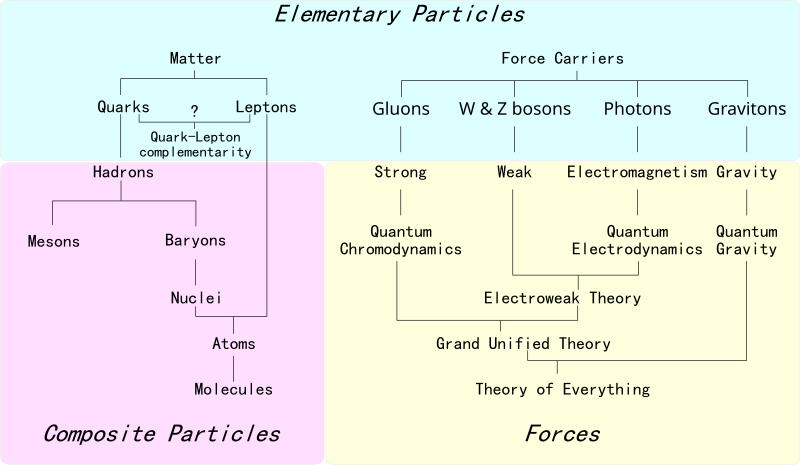
The image above portrays three "quarks", particles which when combined make up larger particles such as neutrons and protons. Quarks come in different varieties, and are bound together to form larger particles by "gluons." Gluons moderate the so-called "strong nuclear force," which may hold the answer to a limitless source of energy.
Humans get most of their energy from chemical reactions, moderated by the electromagnetic force. Such chemical energy is far less potent (less dense) than nuclear energy -- either fission, fusion, or LENRs (low energy nuclear reactions). The forces moderating nuclear reactions are far more powerful than the electromagnetic forces moderating chemical reactions -- which is why smart fission can provide humans with abundant energy for thousands of years, and fusion power is essentially limitless in human terms. But to truly take best advantage of fission, fusion, and LENRs, we need to understand the nuclear forces better.
...Despite many hundreds of well-functioning nuclear power plants, our understanding of nuclear forces is only empirical, and empirical knowledge is always imperfect.

For example, in producing nuclear energy, the decay reactions repeat many times, with the imperfections of every repetition resulting in a loss of predictive power of computations. This hampers the optimisation process, and is one of the main reasons why several large projects investigating energy production using more abundant uranium-238 or thorium (fast breeder reactors) were closed in Europe and the United States before they achieved the expected level of performance.

Another problem is the nuclear waste that emerges when energy is produced in the decay process. The waste can be substantially, or even completely, reduced if we could use an alternative form of nuclear decay that is triggered by externally accelerated particles. Here, too, however, we need more precise knowledge of the properties of nuclear processes.

The force binding atomic nuclei is a special case of the "strong force", one of the four fundamental forces in nature, and is extremely difficult to investigate, because it acts very quickly and violently. Around 50 years ago, it was proposed to study the strong forces by firing protons at each other at very high energies.

...Several large accelerator research centres were built, and the scattering of particles at high energies revealed a fascinating structure of matter. New particles, called gluons, were found to mediate the strong force. Their discovery should provide a clue to precise knowledge of the strong force.

At short distances, gluons create an attractive force that is pretty weak and well understood. But, at larger distances, comparable to the proton radius, the force becomes really strong, and a very large number of gluons is involved, forming complicated structures that are not well known today. Therefore, for some time, it was not expected that the properties of the strong force could be directly derived from the properties of gluons.

In the last few years, however, experiments at the HERA accelerator in Hamburg, Germany, have observed the strong interaction effects in slow motion, which could open a way to a precise understanding of the strong force.

...The appearance of such clear gluonic structures was unexpected; the experiments at HERA were not designed to study them. But the precision experiments required to measure the strong force can be designed and built with known technology. So two large groups of physicists - one concentrated around the Brookhaven and Jefferson National Laboratories in the United States, and the other around CERN in Geneva - are proposing to restart the investigation of electron-proton interactions.

The study of these interactions should provide a precise understanding of the strong force....A precise understanding of the strong force could be just as important, opening new ways to use nuclear-energy resources while solving the problems of safety and nuclear waste. _AlJazeera

Humans are slightly advanced monkeys, swinging from meager knowledge trees, flinging gobs of shite at each other and hooting into the night. It's going to take some time, discipline, and work to move forward.

Labels:

Tuesday, March 08, 2011

Video Report on Small Modular Reactors Featuring NuScale


The short video highlights Corvallis, Oregon's NuScale reactor -- which hopes to submit paperwork to the NRC within the next 3 years. If the NRC accepts the application paperwork, it may take at least 10 years to evaluate the data as it runs through its own bureaucratic circular jerkular procedures. There is no guarantee that the NRC will approve the application, regardless of how safe, efficient, and economical the NuScale reactor (and other SMRs) may prove to be.

It should be noted parenthetically that Oregon State University's department of Nuclear Engineering lost a great deal of talent when NuScale personnel departed the school's faculty and staff. The aftermath of that split-up has not been kind to OSU, causing significant loss of reputation and prestige to the university. Just one example of OSU's fall from grace. Let's hope OSU finds some new staffing to bring its nuclear engineering department back from the brink.

Labels: ,

Saturday, February 26, 2011

Nuclear News and Views

South Korea is entering the small modular reactor (SMR) field with its new SMART line of mini-reactors. (via Energy Tribune)

Russia is driving ahead with its Gen-IV fast neutron reactors (FNRs). The FNRs are designed to burn fertile U238, which is available in nature in much higher quantities than naturally fissile U235.

Thorium cycle nuclear reactors are another unconventional approach to fission which hold a lot of promise. Thorium232 is fertile, and is converted to fissile U233 by neutron bombardment by a starter fuel, or perhaps eventually by a spallation neutron source -- in a sub-critical reactor.

Time magazine looks at Obama's NRC and the logjam it is putting in front of innovative nuclear companies such as Hyperion.

More on Obama's NRC bottleneck here

Brian Wang looks at several new developments in nuclear energy.

Japan's Chubu Electric Power Co. is planning a new 3 to 4 GW nuclear plant

French nuclear companies to collaborate in development of new SMRs

Advanced nuclear fission holds the promise for clean, sustainable power for many thousands of years. If humans cannot perfect unlimited fusion power over that time span, then it is clear that the destiny of humans was always to swing from trees like the monkeys.

Labels:

Monday, February 21, 2011

Nuclear Fuel Was Meant to be Recycled: What's Wrong With the NRC?

ImageSource


Failure to pursue a program for recycling spent nuclear fuel has put the U.S. far behind other countries. It represents a missed opportunity to enhance the nation's energy security and influence other countries.

These themes are the heart of a talk by Dale Klein, Ph.D., (left) the former chairman of the Nuclear Regulatory Commission (NRC) given Sunday, Feb 20 at a session of the AAAS annual meeting being held in Washington, DC.

Dale Klein, who is now Associate Vice Chancellor for Research at the University of Texas System, said largely unfounded concerns and "long-held myths" about the reprocessing of spent fuel have prevented the U.S. from tapping into an extremely valuable resource.

Spent nuclear fuel, which includes some plutonium, often is inaccurately referred to as waste, Klein said.

"It is not waste," he said. "The waste is in our failure to tap into this valuable and abundant domestic source of clean energy in a systematic way. That's something we can ill-afford to do." _More at EnergyCollective

The US NRC is basically slow about everything it does. Consequently, the US is thrown to the back of the pack, in terms of new nuclear development. For that to change, the entire political makeup of the US NRC must be overthrown.
...a lengthy trial and approval from the Nuclear Regulatory Commission is required before MOX [Mixed Oxide Fuel] can be used as routine in a commercial US reactor. _WorldNuclearNews
More on nuclear fuel recycling:
The first step in recycling fuel is separating the plutonium from the remaining uranium (about 96% of the spent fuel) and the fission products with other wastes (together about 3%). Then the plutonium needs to be separated from most or all of the uranium. All this is undertaken at a reprocessing plant.

The plutonium, as an oxide, is then mixed with depleted uranium left over from an enrichment plant to form fresh mixed oxide fuel (MOX, which is UO2+PuO2). MOX fuel, consisting of about 7-9% plutonium mixed with depleted uranium, is equivalent to uranium oxide fuel enriched to about 4.5% 235U, assuming that the plutonium has about two-thirds fissile isotopes. If weapons-grade plutonium were used (>90% 239Pu), only about 5% plutonium would be needed in the mix.

Plutonium from reprocessed UO2 fuel is usually fabricated into MOX as soon as possible to avoid problems with the decay of short-lived plutonium isotopes. In particular, 241Pu (half-life 14 years) decays to americium-241 (241Am), a strong gamma ray emitter, giving rise to a potential occupational health hazard if separated plutonium over five years old is used in a normal MOX plant. The 241Am level in stored plutonium increases about 0.5% per year, with corresponding decrease in fissile value of the plutonium. 238Pu (half-life 88 years) is increased in high-burnup fuel. It is a strong alpha ray emitter and a source of spontaneous neutrons. 239Pu, 240Pu and 242Pu are long-lived and hence little-changed with prolonged storage. (see also paper on plutonium)

Reprocessing of 850 tonnes of French used fuel per year (about 15 years after discharge) produces 8.5 tonnes of plutonium (immediately recycled as 100 tonnes of MOX) and 810 tonnes of reprocessed uranium (RepU). Of this about two thirds is converted into stable oxide form for storage. One third of the RepU is re-enriched and EdF has demonstrated its use in 900 MWe power reactors.

Fast neutron reactors allow multiple recyclings of plutonium, since all transuranic isotopes there are fissionable, but in thermal reactors isotopic degradation limits the plutonium recycling potential and most spent MOX fuel is stored pending the deployment of more effective fast reactors. The plutonium isotopic composition of used MOX fuel at 45 GWd/tU burnup is about 37% 239Pu, 32% 240Pu, 16% 241Pu, 12% 242Pu and 4% 238Pu.

In 2007 EdF said that the plutonium stored at La Hague from reprocessing could provide the start-up fuel for seven Generation IV fast reactors, with 15 tonnes for each (the French inventory of separated plutonium at the end of 2006 was 49 tonnes, Russia had 41 tonnes). _EOEarth
France, Russia, and the UK are storing fuel in preparation for newer Gen-IV reactors which can utilise it.

Another problem spot for the US NRC is its inability to study safer, cheaper, more reliable reactor designs without charging companies exorbitantly extortionate fees for the service. It looks as if even tiny Jamaica may approve and utilise new small modular reactors (SMRs) before the US gets around to it.
SMRs operating costs (O&M+fuel) are estimated at around US 2¢/kWh and the capacity factor is more than 90 per cent. Estimated total project costs (TPC) is expected to vary between US$3,000/kW and US$6,000/kW (about US 11¢/kWh and US 15¢/kWh). The electricity production from SMRs would qualify for carbon credits, varying between US 2¢/kWh and 5¢/kWh (assuming the carbon tax/trading at US$16 to US$36 per tonne).

The SMRs have opened up real options for the SIDS to generate cheaper electric power over the medium to longer term and should be considered Jamaica's long-term energy security. However, before proceeding with the selection of nuclear technology, there is a long list of issues from IAEA that must be addressed. It is likely that Jamaica can commission its first nuclear plant in the 2020s. The recommendations from the minister's Task Force on Nuclear Energy (which was chaired by Professor Lalor) should be considered by the Cabinet to include nuclear energy into Jamaica's long-term energy-supply mix. _ Jamaica Gleaner
Of course the current Obama regime policy of "energy starvation" will last years beyond the exit of Obama from the White House. That is the way of bureaucratic inertia and an innate Luddism within large bureaucracies. So by the time all the Obama-Green detritus and leavings are cleaned out and sanitised it may be decades before SMRs are widely adopted in the US.

Labels: , , ,

Older Posts