Tuesday, November 27, 2012

Gas to Liquids (GTL): A Growing Market; And More

Due to plentiful supplies and an attractive gas to oil price differential, the natural gas to liquid fuels (GTL) market is beginning to take off, according to a new report, The Gas-to-Liquids Market 2013 - 2023. The 182 pp report suggests that the GTL global market will already exceed $5 billion in 2013. And this market is just getting started.
Two large-scale commercial Gas-to-Liquids plants have been opened in the 21st century and both are accumulating vast revenues due to the potentially lucrative differential between the price of natural gas and the price of oil. Building on the success of these facilities and a range of other factors, the Gas-to-Liquid market is set to grow strongly over the next 10 years. Visiongain has determined that the value of the global Gas-to-Liquids market in 2013 will reach $5.29bn. _ReportLinker _ via _ SacBee
The two large scale GTL plants built by Shell appear to be generating healthy profits. And as detailed in the above report, a number of startups are planning to build smaller scale GTL plants, which are also expected to be very profitable -- given the big price differential between crude oil and natural gas.
Carbon Sciences Inc. (OTCBB: CABN), provider of a complete solution for transforming abundant and affordable natural gas into clean burning gasoline and other transportation fuels, today announced its plan to act as the project developer of a "miniGTL" plant in the United States.

Flared and stranded natural gas is abundant and available. The World Bank estimates that 134 billion cubic meters of gas was flared worldwide in 2010, equivalent to almost 5 trillion cubic feet. If all this gas were converted to liquid fuels, it would equate to around 500 million barrels each year...

..."As the world searches for the security of new energy and fuel sources, miniGTL operations have the potential to unlock a vast quantity of natural gas that is either wasted or less accessible. We believe that flared gas could generate around 3 million barrels per day of synthetic fuel, and 'problem' gas, either stranded reserves or that associated with crude oil which would currently be re-injected, a further 20 million barrels per day," concluded Elton. _Equities.com
Going beyond natural gas to liquids, we see that several other feedstocks can also be profitably converted to liquid fuels, if the price of crude oil remains inflated.
The United States could eliminate the need for crude oil by using a combination of coal, natural gas, and non-food crops to make synthetic fuel, a team of Princeton University researchers has found.

...In the Princeton research, Floudas' team found that synthetic fuel plants could produce gasoline, diesel, and aviation fuels at competitive prices, depending on the price of crude oil and the type of feedstock used to create the synthetic fuel. About two-thirds of crude oil consumed by the United States is used for transportation fuel, according to the federal Energy Information Administration (EIA). The EIA said the United States imports about 45% of its annual crude oil consumption.

"Even including the capital costs, synthetic fuels can still be profitable," says Richard Baliban, a chemical and biological engineering graduate student who graduated in 2012 and was the lead author on several of the team's papers. "As long as crude oil is between $60 and $100 per barrel, these processes are competitive depending on the feedstock," he says.

The core of the plan is a technique that uses heat and chemistry to create gasoline and other liquid fuels from high-carbon feedstock ranging from coal to switchgrass, a native North American grass common to the Great Plains. The method, called the Fischer-Tropsch process, was developed in Germany in the 1920s as a way to convert coal to liquid fuels.

The chemistry is complicated, but it basically takes the carbon and hydrogen from the feedstock and reassembles them into the complex chains that make up fuels like gasoline and diesel. Essentially, the feedstock material is heated to 1,000 to 1,300 C and converted to gas, and using the Fischer-Tropsch process, the gas is converted to chains of hydrocarbon molecules. These hydrocarbon chains are then processed over catalysts such as nickel or iron. The end products include fuels, waxes, and lubricants normally made from crude oil. _RDMag
Synthetic liquid fuels from natural gas, coal, biomass, bitumens, kerogens, gas hydrates, etc. have enormous potential to substitute for crude oil, should the price of oil remain high.

As inexpensive process heat becomes more widely available, a wide range of synthetic fuels will become more profitable to produce.

High temperature and very high temperature nuclear reactors of advanced design will begin to provide very economical high temperature process heat for multiple high value purposes, beginning in the early to middle 2020s.

Labels: , ,

Monday, July 30, 2012

Waste to Energy: Micro-Channel Fischer Tropsch

Sierra Energy plans to build a municipal waste to liquid fuels plant in Northern California, based upon the scalable microchannel Fischer Tropsch technology developed by Velocys / Oxford Catalysts.

The microchannel FT technology can affordably convert any carbonaceous form of matter -- from biomass to coal to natural gas to municipal waste, etc. -- to high quality diesel fuel and other high value chemicals.
The waste-to-liquids process involves two main operations: production of a synthesis gas (syngas) using a gasifier; followed by FT synthesis. The resulting FT product can then be upgraded via hydrocracking and fractionation to produce a range of liquid hydrocarbon fuels. The fuels produced can be directly substituted for conventional fuels, and are generally of higher quality than those derived by conventional means.

In the commercial demonstration, which will be hosted by SacPort Biofuels, the gasification will be carried out using Sierra Energy’s proprietary FastOx waste gasification process. The FT synthesis will be carried out using Velocys’ microchannel FT reactor technology. Sierra Energy intends to use this commercial demonstration as the basis for the design of a turn-key, waste gasification system called the FastOx Pathfinder.

The FastOx gasifier is a simple derivative of the blast furnace, specifically designed to convert waste; waste is fed into the top of the gasifier while oxygen and steam are injected into the bottom. The injection of oxygen and steam is one of Sierra Energy’s patented innovations. The waste passes through four reaction zones as it descends in the gasifier:
Drying occurs when the hot syngas produced at the bottom of the gasifier rises and passes through the waste in the top zone of the unit, drying the waste as it passes.

Devolatization is where the majority of the organic matter is driven off into syngas.

Partial oxidation occurs when carbon-containing materials in the waste react with the injectors. This reaction creates high temperatures in the range of 4,000 °F, allowing for the thorough conversion of remaining carbon into syngas.

Melting of inorganic compounds results from the high temperatures occurring in the partial oxidation zone. These compounds collect at the bottom of the unit and are continuously removed as inert stone (slag) and recycled metals.
_GCC

While California's government is attempting to promote this nifty technology for waste to liquids, a more economical use at this time would be on offshore oil platforms and at stranded gas wells -- to reduce the level of natural gas flaring and to make economical use of stranded and offshore gas.

This technology would also work well for decentralised biomass to liquids (BTL) production on a local and regional level -- once the infrastructures for collection and densification of biomass are developed.

Labels: , , ,

Thursday, June 28, 2012

More on Primus Green Energy's Use of Natural Gas as a Bridge Feedstock

Primus Green Energy Multi-Feedstock Synthetic Fuels

Here is another look at Primus Green Energy and its compromise use of cheap natural gas as feedstock -- in place of the original plan to use biomass feedstock. Just like Sundrop Fuels, Primus Green Energy is behaving in a pragmatic and flexible fashion, to establish proof of technology first, and to develop the essential cash flow which will allow them to proceed with their longer range plans.
The Hillsborough, New Jersey-based company has developed a process for converting biomass into gasoline, jet fuel, and other chemicals. But because its biomass technology isn't quite ready for prime time and its process works with natural gas, its first demonstration plant will use natural gas as a feedstock.

"We're using natural gas as either a bridge to biomass or a bridge to natural gas," says CEO Bob Johnsen, a biofuels veteran who joined the company in March. "We can develop our processes for biomass while concurrently producing product at larger scale."

The company broke ground on the demonstration plant last week and is seeking to raise $60 million to $70 million for a commercial-scale operation which it hopes to begin building later this year or next year. To date, it raised $40 million from conglomerate Israel Corp. in 2007.

Johnsen, a co-founder of Mascoma and the company which became Verenium, was attracted to Primus Green Energy because the flexibility of its technology and because it's at stage where it can be scaled up, he says.

The company has modified a 1970s-era process called Methanol to Gasoline (MTG) originally developed by Mobil. Its plants have multiple steps but the core technology is converting synthesis gas, or syngas, into gasoline or jet fuel. That syngas can be made either from biomass, such as wood pellets or miscanthus, or from natural gas using a steam reformer. Because it's biomass-to-syngas gasifier didn't achieve the performance needed, the company will move ahead with natural gas first.

Once the syngas is produced, the gas is treated with catalysts to produce methanol and then fed into a reactor to synthesize the gas into liquid high-octane gasoline or jet fuel. The company has modernized the MTG process and engineered a more efficient system using a combination of its own inventions and off-the-shelf products, executives say. _TechnologyReview

There is nothing wrong with biomass to liquids in principle. But BTL cannot compete with either GTL or CTL in today's marketplace. And if the price of crude oil keeps dropping, even GTL will be unable to compete with oil.

It is fine to be idealistic. But if you are in business, you will need to temper your idealism with a healthy dose of realism, based upon current and near-term future market conditions.

Labels: , , ,

Sundrop's Methanol to Gasoline Plant to Use Exxon Mobil MTG

The methanol-to-gasoline (MTG) process developed by Exxon Mobil doesn't care where the methanol comes from originally. MTG turns methanol into gasoline regardless of the original source -- natural gas, coal, biomass, etc. Economics will dictate whether the overall process can be profitable in the current marketplace -- and business startups had best pay attention to a thorough economic analysis before the first shovelfull of dirt is dug.

Sundrop Fuels Inc. intends to fight the current economic conditions of cheap natural gas and cheap coal, in order to prove a point. Sundrop wants to prove that it can fight the markets and survive, while producing "green gasoline."
Sundrop Fuels will use a multi-phase process to convert sustainable forest waste into a bio-based drop-in gasoline for use in today’s combustion engines. A gasification process converts the forest waste combined with hydrogen from natural gas into a synthesis gas, which will then be converted into methanol and then into gasoline in a fixed bed reactor system via the MTG process.

The MTG process first dehydrates methanol to dimethylether (DME); an equilibrium mixture of methanol, DME and water is then converted to light olefins (C2-C4). A final step synthesizes higher olefins, n/iso-paraffins, aromatics and naphthenes. The shape-selective catalyst limits the synthesis reactions to 10 carbons.

MTG reactor product is separated into gas, raw gasoline and water. Raw gasoline is separated into LPG, light gasoline and heavy gasoline; heavy gasoline is hydro-treated to reduce durene content, then heavy and light gasoline are re-combined into finished MTG gasoline. The result is sulfur-free gasoline with a typical 92 Research Octane.

The gasoline yield represents 38% of the feed, and 87% of the hydrocarbon product. Water (H2O) represents 56% of the feed.

The company’s first facility will also provide an operational platform for Sundrop Fuels to begin field integration of its proprietary RP Reactor radiant particle heat transfer gasification technology. The super-efficient, ultra high-temperature process will drive Sundrop Fuels’ future massive-scale biofuels plants, planned to produce more than 300 million gallons of renewable, drop-in biofuels annually.

Plans are for Sundrop Fuels to achieve a combined production capacity of more than one billion gallons by 2020—a significant percentage of the cellulosic advanced biofuels goal set by the nation’s Renewable Fuels Standard (RFS).

Significant backing for Sundrop Fuels comes from Chesapeake Energy Corporation, the largest producer of natural gas in northern Louisiana’s Haynesville Shale Field and second-largest producer in the nation. Chesapeake invested $155 million in Sundrop Fuels in mid-2011. The company’s investors also include two of the world’s premier venture capital firms, Oak Investment Partners and Kleiner Perkins Caulfield & Byers. _GCC
As we mentioned in an earlier posting, Sundrop will prove much of its technology using natural gas as a feedstock Sundrop will use natural gas to power its gasifiers and as a hydrogen donour -- thus explaining their success at raising capital from Chesapeake Energy Corp. Chesapeake needs to prove that GTL can be profitable -- either using MTG or using Fischer Tropsch to make diesel -- and it needs to help boost as many other uses for natural gas as possible. Chesapeake doesn't care how the gas is used so long as it is profitable.

Sundrop's pragmatic move to the initial use of natural gas for its MTG plant instead of using solar powered gasifiers, demonstrates a certain flexibility that is extremely important, if a "green business" is to stay in business.

First establish a cash flow while proving and perfecting your processes. Then you can branch out.

Labels: , , , ,

Thursday, June 14, 2012

First Prove Yourself & Make Money -- Then You Can Go Avant - Garde

Sundrop Fuels was forced to learn a basic axiom of business: First create a reliable cash flow. Then you can branch out into more experimental areas.
The decision to use natural gas rather than solar heat reduces costs: in part due to recent low natural-gas prices, it's far cheaper to burn that fuel than to build a field of mirrors to concentrate sunlight. The natural gas, in addition to heating the gasifier, will also provide a source of extra hydrogen. The ratio of hydrogen and carbon in biomass isn't the same as in gasoline—the hydrogen from natural gas makes up the difference, increasing the fuel yield from biomass. The other option would be a reaction that uses carbon monoxide to produce hydrogen from water—but that would lower yields and force Sundrop to truck in more biomass. Switching to natural gas had another benefit. As with the decision to use conventional gasification technology, it has helped Sundrop finance its first plant. It attracted $155 million in funding from natural-gas producer Chesapeake Energy, which was seeking to fund technologies that would increase demand for natural gas. _TechnologyReview
It is relatively easy -- although expensive -- to turn woody biomass into gasoline, using high temperature gasification. Colorado solar startup Sundrop Fuels has a solar powered biomass gasification design for biomass-to-gasoline that could actually work, if they could only get the financing.

But getting a process to work, and making money, are two different things. Before Sundrop can prove its process works, it first has to do something to support itself long enough to provide proof of concept.

And so Sundrop is turning to natural gas to power its gasification process, hoping that the more conventional approach will generate mainstream financing which will then give them time to prove their "solar biomass gasification" approach.
Sundrop plans to start construction on the plant—which will have a 50-million-gallon capacity—later this year near Alexandria, Louisiana. It recently announced a partnership with Uhde Corporation of America, a partner of the German engineering firm ThyssenKrupp Uhde, to develop the detailed engineering plans for the plant. Uhde will also supply a gasifier that turns biomass into carbon monoxide and hydrogen, which can be converted with the help of catalysts into a variety of fuels.

Sundrop had planned to use its own proprietary gasification technology, which operates at high temperatures—over 1,200 ⁰C, or hundreds of degrees higher than some other gasifiers. The heat would be generated by concentrating sunlight, rather than by burning the biomass, the approach taken by other companies. Using heat from the sun would increase the amount of biomass that ends up as fuel, reducing the cost of transporting the bulky material. Operating at high temperatures would avoid the production of tars that can gum up equipment and interfere with later steps in the process.

Sundrop will continue to use high-temperature gasification to avoid tar production, but it will use a design from ThyssenKrupp that requires the introduction of oxygen. ThyssenKrupp's technology is more expensive than Sundrop's gasification technology, says Wayne Simmons, Sundrop's CEO, but it's commercially proven, which makes it easier for Sundrop to get loans to build a plant. Sundrop plans to prove its own technology by installing one of its gasifiers in the new plant, where it will be used to make about 10 percent of the plant's output. Sundrop plans to use its gasifier technology on a larger scale in future natural-gas-powered plants.

_Technology Review

The problem with Sundrop's plan is its timing: Natural gas will not always be this cheap, and there is no guarantee that Sundrop will have perfected its solar gasification technology when gas prices rise.
When gas prices rise, there is at least an even chance the company will be stuck with rising operating costs, with no quick or sure way to recoup their losses soon enough to save the company.

Sundrop's bottom line depends upon the shifting sands of carbon politics. Sundrop needs government mandates, carbon credits, carbon taxes, government subsidies, and all the things that US President Obama promised he would bring to the market when he was first elected.

Let's be honest: It is probably cheaper at this time to turn natural gas into gasoline or diesel than to use natural gas to turn wood into gasoline or diesel. Sometime in the distant future, using solar heat to gasify wood, turning it into liquid fuels, may make sense.

It would be good to have such technology available should the need for it arise.

But the best form of high quality industrial process heat for large scale operations -- even when the sun doesn't shine -- is likely to be HTGRs (high temperature gas cooled nuclear reactors). 24 hour high temperature process heat, anywhere on the planet, any time of year, rain or shine.

The solar sentiment displayed by ventures such as Sundrop is completely understandable. But getting that sentiment to work out in dollars and cents is a very difficult proposition.

Labels: ,

Wednesday, April 11, 2012

Biofuels Technology Improves Rapidly, Despite NatGas Glut

Given the huge glut of natural gas in North America, you might think that biofuels developers and startups would throw up their hands and give up. Cheap, abundant natural gas produces electricity more economically than biomass, and can be used to make polymers, fuels, lubricants, and chemicals in a more straightforward manner than when using biomass or microbial approaches.

So why are biofuels and biomass companies persisting, swimming against the tide, as it were? Quite simply, it is because no matter how much natural gas exists in reserves, there are always limits. Natural gas prices are bound to increase as more and more uses are found for the valuable resource -- particularly gas to liquids (GTL) and the production of chemicals and polymers.

And when natural gas prices increase, biomass to liquids (BTL) and microbial fuels producers want to be ready to supply a high quality product -- using a feedstock that will never run out.
Two of the most promising projects in this area are UOP and Ensyn’s integrated biorefinery (IBR) pilot-scale project in Hawaii, and the IH2 project, led by the Gas Technology Institute (GTI),i with catalysts provided by CRI Catalyst.

Despite being pilot projects, both technologies are not far from commercialisation. Jim Rekoske, vice-president and general manager for Honeywell UOP’s Renewable Energy and Chemicals business, says UOP aims to be able to offer its system to customers for commercial sale in 3Q12, while the IH2 project is scheduled for commercial operation in 2014.

Vann Bush, managing director, energy conversion, GTI, told GTForum that based on an analysis from the National Renewable Energy Laboratory (NREL), the anticipated cost on a product basis for fuel produced using the IH2 technology is around US$1.60/gallon for woody biomass, dropping to around US$1.36/gallon if a refiner has sufficient spare hydrogen capacity and opts to forego installing the reforming unit. This compares to the US Department of Energy’s goal of US$3/gallon.

...woody biomass tends to produce more gasoline than diesel via the IH2 process, while algael fuels tend to produce more diesel. Overall yields are also affected by feedstock. “The yields vary between say 70 gallons per ton to 157 gallons per ton. The worst yields we’ve had are with fairly high ash agricultural residues and the highest are with algae.”
Rekoske is particularly pleased with the yields UOP has seen so far – in the order of 300 gallons of renewable fuel per tonne of triglyceride feedstock, obtained from oil seed crops, algae and fats and greases. Given that overall yields are highly dependent on feedstock, direct comparisons between different biomass to oil product technologies cannot be made unless they both use the same feedstock.

“We’re achieving yields from the conversion facility and from our testing and laboratories that are much, much, higher than what we had anticipated, approaching the theoretical limits. We just did not expect to achieve yields that were that high,” he says

With both technologies, the final product slate is largely independent of the host-refinery’s complexity. This might make such systems more attractive to low-complexity refiners in regions with high biomass potential.

...In the future, there are two main options for refiners looking to use the IH2 technology. One involves the installation of both the main unit along with the components for conventional steam reforming/pressure swing absorption system, and the latter can be committed by a refinery with sufficient spare hydrogen capacity looking to reduce capital costs.

...Bush expects the IH2 technology to be built on a variety of scales. He expects that while many projects “would be at a scale that would be able to be fabricated in a shop and shipped to a site”, some “will be very large processing facilities and be built on site”. Bush says the scale would range between a few hundred tons per day to 2,000tpd “for most of the feed materials”. _Global Technology Forum
Here is another fascinating technological development in the quest for biomass energy. The biomass potential is immense, on this biological planet, and it is unlikely that entrepreneurs would overlook it for long.

There is always the problem of transporting large volumes of biomass from the field to the refinery. In the case of algae, you can always locate your growing facility close to the refinery, or vice versa. With bulkier biomass crops, you may have to use pyrolysis as a pre-treatment, as discussed in earlier postings here.

There is also the problem of hydrogen supply. The IH2 process is designed not to need outside hydrogen, although many other BTL processes will need outside sources of hydrogen to produce drop-in hydrocarbon fuels from biomass. As long as methane remains cheap, it is likely to be used as a hydrogen source for some BTL processes, as well as for CTL processes -- perhaps first in China, then spreading from there.
The potential global yield of advanced BTL is quite large, and should continue to grow as technologies improve and allow for larger yields on smaller areas of land or ocean. And since desert lands can be used for algae, drought-tolerant crops, and halophyte production, there will be no shortage of arable land for food production.

As you can see in the image above, it will take quite some time before humans exhaust the hydrocarbon resource -- particularly if they use high temperature gas-cooled modular nuclear reactors for industrial process heat in the conversion processes. But it is not likely that we will wait until finite resources are exhausted before we begin to utilise the essentially infinite resource of advanced BTL and microbial fuels.

Labels: , ,

Thursday, February 02, 2012

Below the Radar: The Race to Bring Gas to Liquids to the Well Head

With record lows in the natural gas markets, companies are offering natural gas assets at very attractive pricing. "We want to demonstrate the enormous potential in stranded North American gas reserves; that will only be possible when industry understands the market potential in converting those reserves to liquids at the surface. Currently the industry focus is finding and developing natural gas liquids below ground, but few really understand the financial potential unlocked by small scale conversion of existing gas to liquids with GasTechno above ground," says Walter Breidenstein, [Gas Technologies] CEO. "Our industry studies have been completed and all the economic and technical models are developed. Our goal in the Early Adopter Program is to open up our expertise and demonstrate what we have proven over the last several years in this growing sector." _Marketwatch
A third mini-GTL maker is moving into the "early adoption" phase. Gas Technologies is bringing its "Gas Techno" mini-GTL to 7 preferred customers for early adoption and trial. Gas Technologies joins Oxford Catalysts / Velocys, and CompactGTL in the race to bring miniature gas to liquids to currently undervalued stranded gas resources.
GasTechno's focus is the conversion and monetization of flared or stranded natural gas. The company is also evaluating and developing processes for methanol-to-diesel (MTD), methanol-to-gasoline (MTG), methanol-to-jet fuel, methanol-to-olefins (MTO), glycols, amines, fertilizers and other bolt-on processes that provide exceptional ROIs and high profit margins. Securing a "flare to fuels" partner with similar interests is a high priority for the program. Operators with gas resources at landfills and biodigesters are also targeted.

...Deploying a GasTechno plant on stranded reserves converts stranded gas to liquid product that sells at market prices trending well above pipeline prices. By converting and marketing stranded reserves at improved pricing, this strategy has the potential to improve asset valuations at more than 5 to 10 times by exploiting provisions in the modernized SEC oil and gas reporting requirements that permit the use of "alternative product pricing" to value proven reserves.
_Marketwatch
This general technology is also applicable in part to biomass to liquids (BTL) and coal to liquids (CTL). In other words, scalable production of high value liquid fuels and chemicals from inexpensive feedstocks, is rapidly coming within reach of more and more enterprises.

Consider what the global energy marketplace will look like, when even small communities can afford to own and operate their own small-scale fuels and chemicals refinery, using whatever abundant feedstock is closest or more affordable?

Labels: , ,

Thursday, November 17, 2011

Wilderness Refineries to Produce Gasoline from Wood?

CORE BioFuel Inc. intends to turn millions of tons of forestry wood waste and bark beetle kill into gasoline.
Images via CORE BioFuel Inc

Under contract with CORE, RECAT Technologies Inc. successfully completed a set of test runs of the catalytic reaction producing gasoline from dimethyl ether (DME), the only to date non-commercialized step in CORE’s patent-pending MKS Gasoline Synthesis Process.

Our reaction performs even better than we expected, with excellent conversion of DME to gasoline. The catalyst for this reaction did not produce benzene—which the EPA has determined should not be present in gasoline unless lower than their current criteria levels. Removing benzene is difficult and expensive and our process does not incur this cost. Utilizing similar operating parameters, our reactor actually produces a gasoline superior to ExxonMobil’s well-known commercial MTG (Methanol-to-Gasoline) process. Our gasoline octane rating is 94, which means it can be blended successfully with lesser grade refinery gasoline to meet retail pump 92 octane requirements. Our testing also determined that operating costs will be lower because we have less volume to recycle than in an MTG process—we produce more of what we want and less of what we don’t want. Our catalyst also costs less, and is a robust catalyst, which can be re-used.

—Larry Melnichuk, Vice President of Process Design and Development
CORE says the MKS Th technology is industrially proven and the process is a scalable, efficient, cost effective approach to producing carbon neutral, benzene-free gasoline. _GCC

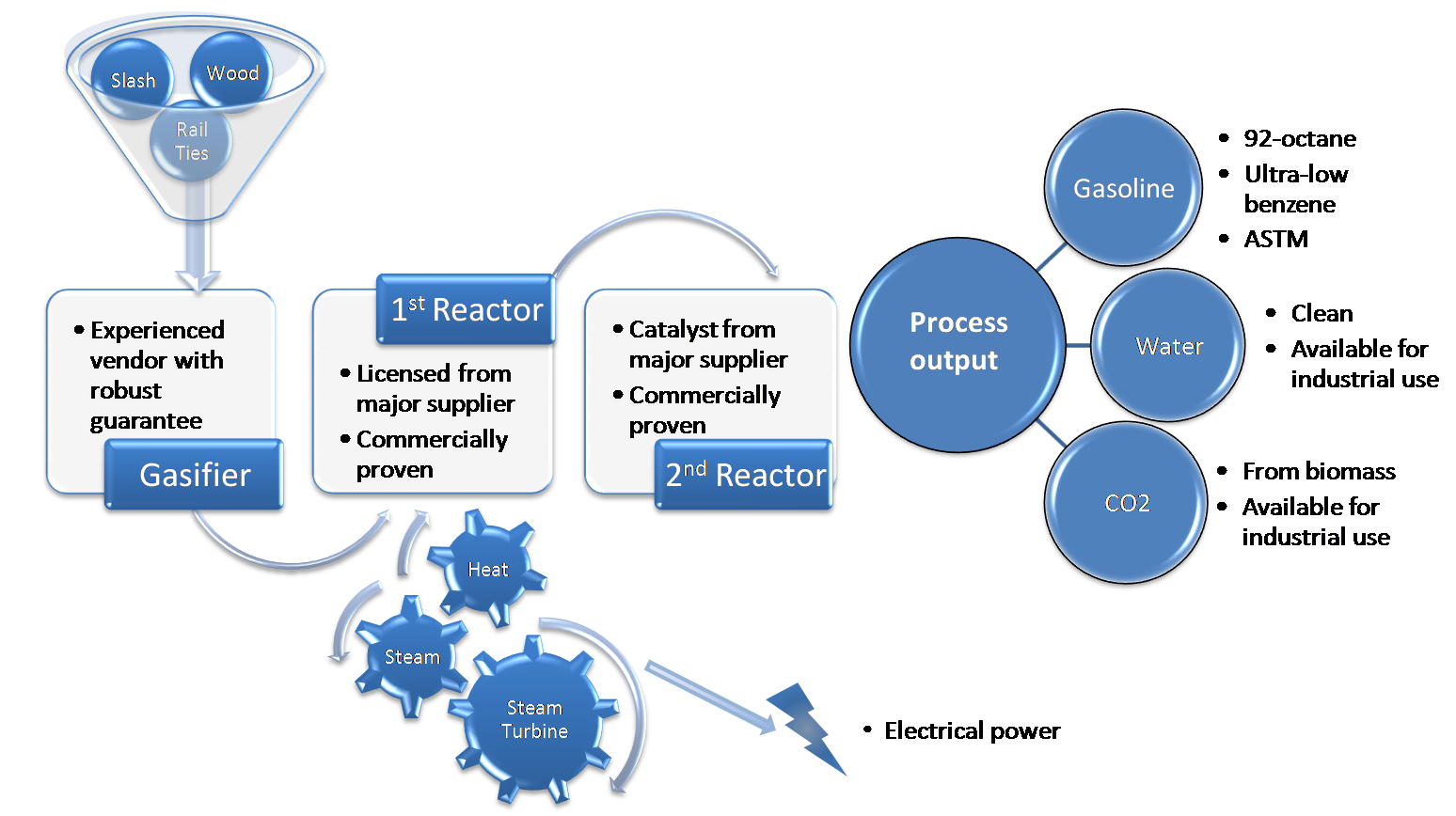
CORE’s patent-pending MKS (Melnichuk-Kelly-Stanko) Gasoline Synthesis Process is a thermochemical process combining gasification and catalysts to produce an essentially carbon-neutral 92 octane gasoline (Zero Fossil Input (ZFI) Gasoline), according to the company.

Incoming biomass is chipped and dried to the desired moisture content. The dried wood chips are fed into a gasifier where they are converted to a synthesis gas and inert ash. The synthesis gas is then processed through a series of catalytic steps, with the end products being gasoline and distilled water. Conventional heat exchangers and steam turbines are used throughout the plant to produce sufficient electricity to operate the facility.

The Houston, British Columbia demonstration plant will produce approximately 18 million gallons of gasoline, 6 million gallons of distilled water, and will generate its own electric power. _GCC
This approach is energy intensive, and suitable only where large quantities of biomass are availoable at low cost. Overall profitability will depend upon the ability of the operators to keep costs low, as well as ingenuity in marketing products and co-products.

The company claims that its process is profitable without government subsidies. But the company also seems to be angling for carbon credits of some type, and appears to be framing its process to fit into pre-existing government mandates.

Realistically, natural gas GTL processes should allow more profitable production of unconventional liquid fuels at today's low prices for gas, for most industrial regions.

The economics of biomass to fuels for remote areas and islands far off from mainland, may tip the balance toward the biomass approach in some cases, where biomass growth is prolific and fossil fuel access is exceptionally expensive.

Labels: ,

Sunday, September 25, 2011

Primus' Biomass-to-Gasoline Process to Cost $1.95/Gallon

Get Adobe Flash player
More information on Primus
GCC article about Primus' plans
Primus’s process is based on a proprietary variant of the ExxonMobil Methanol-to-Gasoline process, simplified to produce standard gasoline without need for separation or further treatment, the company says. The Primus process consists of three main steps:

Gasification of biomass (feedstock flexible) to produce a syngas;

CO2 separation and scrubbing of the syngas; and

catalytic liquid fuel synthesis using a four-stage catalytic system (the MTG variant).

Primus says that its gasoline is cost-competitive with fossil fuels without subsidies, utilizing carbon-efficient and high fuel-yielding non-agricultural biomass that does not compete with foodstocks.

A February 2011 report from the US Department of Energy’s National Renewable Energy Laboratory (NREL) conclude that gasoline produced via the methanol-to-gasoline (MTG) route (earlier post) using syngas from a 2,000 dry metric tonne/day (2,205 US ton/day) biomass-fed facility could have a plant gate price (PGP) of $1.95/gallon US ($0.52/liter). _GCC

The biomass is pelletised, then gasified. The syngas is converted to methanol, and the methanol is converted directly to gasoline, via Exxon Mobil's highly efficient MTG process -- as modified by Primus. More on MTG:
In the MTG process, dimethylether (DME), the dehydrated derivative of methanol, is reacted over a ZSM-5 zeolite catalyst, on which the chain growth of molecules is sterically hindered, thus allowing only production of gasoline and lighter material. The gasoline product from the MTG process has more than 51 compounds, similar to straight-run gasoline in a petroleum refinery.

This mixture is then separated using a process similar to that used in a gasoline refinery. The design utilized in the NREL model utilizes five distillation columns to separate the remaining gas, LPG, light gasoline, and heavy gasoline. The remaining gas is sent to the fuel combustor. The light gasoline continues without further treatment. The heavy gasoline could proceed through a durene isomerizer in order to eliminate the presence of the 1,2,4,5-tetramethylbenzenes by converting them to 1,2,3,5-tetramethylbenzenes. This stream would then be merged with the light gasoline. The two product streams are LPG and gasoline. _GCC

This is an entirely renewable biomass to gasoline process which is likely to impact the fossil fuels markets in good time. Perhaps the main obstacle to a large scale adoption of biomass to liquid fuels, is the current very cheap price of natural gas.

Taken from a previous article at Al Fin Potpourri

Labels: , ,

Sunday, August 07, 2011

Looking at Algal Energy

A new study from the University of Virginia compares 4 different energy-from-algae approaches by VKT -- vehicle kilometres traveled.
In this new study, reported in the ACS journal Environmental Science & Technology, Clarens et al. assess four algae conversion pathways resulting in combinations of bioelectricity and biodiesel:
  1. Anaerobic digestion of bulk algae biomass to produce methane-derived bioelectricity;
  2. Production of biodiesel from algae lipids with anaerobic digestion of residual algae biomass to produce methane-derived bioelectricity;
  3. Production of biodiesel from algae lipids with direct combustion of residual algae biomass to produce bioelectricity;
  4. Direct combustion of bulk algae biomass to produce bioelectricity.
_GCC
Images from GCC

...their results suggested that conversion pathways involving direct combustion for bioelectricity production generally outperformed systems involving anaerobic digestion and biodiesel production, and they were found to generate four and fifteen times as many vehicle kilometers traveled (VKT) per hectare as switchgrass or canola, respectively. _GCC

Among the many findings:

Algae EROI values computed in the study ranged from 0.65 to 4.10. Previously reported EROI for corn ethanol has been on the order of 1.25. It has been suggested, the authors noted, that the minimum sustainable EROI is roughly 3 but that values from 5 to 10 will be required to maintain quality of life in the absence of readily abundant fossil energy.

Direct combustion of algae to produce bioelectricity is seemingly more efficient than anaerobic digestion regardless of whether or not algae lipids are extracted to make biodiesel.

Selected algae systems dramatically outperform the terrestrial crop systems in terms of VKT production per hectare. Algae generates, on average, 4.2 times and 15.7 times more VKT than the switchgrass and canola systems, respectively.

Misalignment of system boundaries precludes direct comparison with corn ethanol, the authors note, but they estimate that the average algae VKT is roughly nineteen times greater than could be derived from corn ethanol (27,000 km/ha-yr) even when accounting for ethanol coproducts. 29

In terms of VKT, algae bioelectricity systems outperform algae combined biodiesel/bioelectricity systems.

Algae biodiesel and bioelectricity systems exhibit higher net energy use but lower water use and GHG emissions per km than their respective terrestrial benchmarks.

...the tremendous demand for transportation energy, increasing fuel prices, and a lack of mechanisms for monetizing environmental performance in the US make it reasonable to expect that algae’s excellent land use efficiency could render it financially attractive over the next several decades. For this reason, environmental and economic LCA studies will be key tools for improving the overall sustainability of algae-derived transportation energy systems. _GCC

Once again we see the benefits of cellulosic electricity -- or biomass to electric power -- when compared to most current methods of creating biofuels from biomass.

The authors of the study missed a prime opportunity to compare efficiencies from pyrolysis of algal biomass, and gasification of algal biomass via IGCC and CHP, with the 4 approaches analysed.

Anaerobic digestion of algal biomass to produce methane is unlikely to be economical for at least the next 50 years, as the global shale gas bonanza works its way through the markets.

One of the biggest problems with public perception of biomass energy and biofuels, is the expectation that if biofuels cannot replace all other forms of energy, then there is no use pursuing their production. That type of magical thinking, with its hair-trigger relapse to utter futility, is profoundly destructive.

There are no magic bullets. A wide range of approaches will have to be taken before humans can emerge from their fossil fuels Earth-bound economies to more sustainably abundant and widespread economies of the future.

Labels: , ,

Sunday, April 17, 2011

More on Algal Biomass, Microchannel Gas to Liquids, BTL

PetroAlgae

PetroAlgae is an algal fuels company aiming for the near-term production of fuels from algae, in addition to producing animal feed co-product and electrical power. PetroAlgae is taking the algal biomass approach initially, and will presumably convert later to an "algal oils to biodiesel" approach to fuels as the technology matures over the next 10 to 20 years. This is the approach that Al Fin algal scientists and engineers have been recommending, for early algal fuels production.
Through a new agreement with Haldor Topsoe A/S and its U.S. subsidiary Haldor Topsoe Inc., PetroAlgae will now use catalysts provided from the subsidiary's Houston headquarters to enhance the oils produced through its algae refining process that includes coking and pyrolysis.

The agreement will also allow PetroAlgae to test the algae biomass produced from its system in refinery cokers and “validate the commercial viability” of the process according to John Scott, chairman of PetroAlgae. _BiodieselMag

In a fascinating development, Oxford Catalysts has shipped a microchannel gas-to-liquids demonstration plant to Brazil, for use by Petrobras. The plant was assembled in a plant in Asia, disassembled for transport, and will be reassembled at a Petrobras refinery in Fortoleza, Brazil, over the next 4 months.
The integrated GTL demonstration plant incorporates the Group’s proprietary microchannel reactor and catalyst technologies for the key Steam Methane Reforming (“SMR”) and Fischer-Tropsch (“FT”) steps of the GTL process. The demonstration is fully funded and managed by the Group’s partners Toyo Engineering Corporation and MODEC, Inc., in collaboration with the Brazilian national oil company Petróleo Brasileiro S.A. (“Petrobras”) which is hosting the demonstration at its Lubnor refinery in Fortaleza, Brazil.

The GTL plant will be reassembled at the demonstration site, and will then progress to the pre-commissioning and commissioning stages. These are expected to be completed within four months. The demonstration plant is scheduled to start up in September, subject to successful commissioning and availability of the required utilities from Petrobras. Following start up, the demonstration will operate for approximately nine months. _OxfordCatalysts

KiOR is pushing ahead with its IPO, aiming for a $100 million max target for its US biomass-to-liquids technology.
$1.80 per gallon: KiOR says its technology, scaled up to oil industry size, can turn wood chips into “biocrude,” then ship it to existing oil refineries to crack it into gasoline or diesel fuel, at a price of $1.80 per gallon — without government subsidies. UPDATE: Crude oil is measured in 42-gallon barrels, which would set the cost of a barrel of KiOR crude at about $76 — and oil was trading at $106.25 a barrel on the New York Mercantile Exchange this morning, the lowest it’s been since March 30. As a rule of thumb, crude oil makes up about one-half to two-thirds of the price of a gallon of gas at the pump, which would price KiOR’s pump-ready output at roughly $2.70 to $3.60 per gallon. By way of comparison, conventional gasoline and diesel were $2.86 and $3.08 per gallon on the Gulf Coast as of March, and market prices for corn ethanol, biodiesel and sugarcane ethanol were $2.49, $4.78 and $3.50 per gallon, according to KiOR.
1,500 bone dry tons (BDT): That’s how much wood chip material KiOR will need to process every day to reach that super-low price of $1.80 per gallon. Its current demonstration plant, on the other hand, is set up to process 10 BDT per day and has been running since March 2010, which gives a sense of the scale KiOR is seeking to achieve in the space of a few years. _gigaom
KiOR's plans illustrate the near-term thermochemical BTL approach, using conventional wood chip feedstock. Other companies may choose a similar approach, but using other biomass feedstocks.

It is too early in the BTL game to know which feedstocks (other than micro-algae and macro-algae) provide the greatest amount of biomass on a reliable and sustainable basis. Entire industries will be required for biomass production, preprocessing, refining, distribution, and sales.

Almost the entire surface of the planet -- except polar regions -- is suitable for growing biomass -- both marine and terrestrial. As the best biomass feedstocks prove themselves over the next ten years or so, it will become easier to calculate the true potential for biomass to liquids fuels.

Labels: , ,

Friday, March 04, 2011

Assessment of Fischer Tropsch Hybrid CTL and BTL

Researchers from the US and China collaborated to assess the "well to wheels" model of production of diesel from combined coal and biomass gasification, using F-T synthesis plus power generation from syngas combustion. Abstract:
This study expands and uses the GREET (Greenhouse Gases, Regulated Emissions, and Energy Use in Transportation) model to assess the effects of carbon capture and storage (CCS) technology and cellulosic biomass and coal cofeeding in Fischer−Tropsch (FT) plants on energy use and greenhouse gas (GHG) emissions of FT diesel (FTD). To demonstrate the influence of the coproduct credit methods on FTD life-cycle analysis (LCA) results, two allocation methods based on the energy value and the market revenue of different products and a hybrid method are employed. With the energy-based allocation method, fossil energy use of FTD is less than that of petroleum diesel, and GHG emissions of FTD could be close to zero or even less than zero with CCS when forest residue accounts for 55% or more of the total dry mass input to FTD plants. Without CCS, GHG emissions are reduced to a level equivalent to that from petroleum diesel plants when forest residue accounts for 61% of the total dry mass input. Moreover, we show that coproduct method selection is crucial for LCA results of FTD when a large amount of coproducts is produced. _ACS_via_GCC
Technologies for carbon capture are still at a primitive and expensive stage -- which means that CCS should be omitted from early plant design and implementation. As it becomes economical to capture and use CO2 as a valuable co-product of the overall process, it will make more sense to implement CCS. Otherwise, the terrestrial and oceanic biosphere can make excellent use of whatever CO2 humans are capable of providing it.
...with the energy-based allocation method, fossil energy use of FTD is less than that of petroleum diesel, and GHG emissions of FTD could be close to zero or even less than zero with CCS when forest residue accounts for 55% or more of the total dry mass input to FTD plants. Without CCS, GHG emissions are reduced to a level equivalent to that from petroleum diesel plants when forest residue accounts for 61% of the total dry mass input. They also found that coproduct method selection is crucial for LCA results of FTD when a large amount of coproducts is produced.

The system boundary for the study is from wells to wheels (WTW), including a well-to-pump (WTP) stage covering the production and transportation of feedstock and the production, transportation, and distribution of fuel and a pump-to-wheel (PTW) stage covering vehicle operational activities.

In the FT process, solid feedstocks such as coal and biomass, are gasified to produce syngas, which is cleaned of CO2 and sulfur compounds and then send to FT reactors where a catalyst is used to convert CO and hydrogen into the desired hydrocarbon products. The CO2 may be vented or captured and sequestered (with the CCS technology). During FTD production, electricity could be produced from unconverted syngas, some of which could be exported to the electric grid as a coproduct. In addition to synthetic diesel FTD and electricity, FTD plants produce a mixture of hydrocarbons, the liquid portion of which is refined into finished FT diesel, naphtha (or gasoline).

There are two general designs for FTD production: recycling (RC) design and once-through (OT) design. In the RC design, unconverted syngas is recycled back for additional conversion, and the final tail gas is used for power generation. The OT design passes the syngas only once through a synthesis reactor and maximizes the power generation from the plant. _GCC

Simple gasification and power generation from syngas, via gas turbine, is the most direct and clean use for coal or biomass energy. Producing liquid fuels from syngas requires energy, thus reducing the overall efficiency. But given the huge infrastructure for use of liquid fuels, it makes economic sense to convert coal, gas, and biomass to liquid fuels -- as long as our goals are not twisted beyond recognition by the carbon hysterics and dieoff.orgiasts.

Labels: , ,

Sunday, February 13, 2011

Biomass to Gasoline at Costs of $1.95 / Gallon?

GCC

The US DOE National Renewable Energy Lab is reporting that a biomass-to-gasoline process utilising gasification with methanol as an intermediate, could be as economical as current bio-ethanol production.
A new report from the US Department of Energy’s National Renewable Energy Laboratory (NREL) concludes that gasoline produced via the methanol-to-gasoline (MTG) route (earlier post) using syngas from a 2,000 dry metric tonne/day (2,205 US ton/day) biomass-fed facility could have a plant gate price (PGP) of $1.95/gallon US ($0.52/liter).

This is a gallon ethanol equivalent on an energy basis (gee) price of $1.39/gallon ($0.37/liter). (Gasoline has a higher energy content than ethanol.) In comparison, based on analysis work completed at NREL, the predicted PGP for ethanol produced via the thermochemical and biochemical pathways are $1.57 per gallon ($0.41 per liter) and $1.49 per gallon ($0.39 per liter), respectively.

...the results from this preliminary evaluation indicate great potential for producing gasoline from biomass via thermochemical biomass conversion to syngas and the MTG process, and thus warrant a more detailed study. Future work areas of interest include obtaining better process information on the MTG section of the plant, especially equipment and operating costs; increasing the heat integration throughout the process; scale-up of the MTG fluidized bed reactor; testing the MTG reactor and catalyst with methanol from biomass-derived syngas; testing of the MTG fluidized bed reactor at higher pressure; and evaluating the possibility of selling raw MTG gasoline and refining it in an existing refinery.

—Phillips et al.
_More at GCC with links

The reason that Al Fin Energy puts so much focus on liquid biofuels, is because renewable liquid fuels will eventually place a price ceiling on petroleum fuels. Biomass to liquids (BTL) is a renewable process which can continue as long as the sun shines and biomass is produced. The greatest threat to BTLs is a new ice age. The greatest promise for BTLs is a warming climate, with higher temperatures and CO2 levels.

It is important for forward looking individuals to understand how much profit to expect from investments in expensive fossil fuel ventures, before a dropping price ceiling makes them unprofitable. Peak oil doomer nonsense -- and associated expectations of eternal profits from petroleum and fossil fuels -- will only break your bank.

Labels: , ,

Thursday, January 06, 2011

Stuart Staniford Serves Barbecue of Crow at The Oil Drum

Brian Wang points to a recent post by Stuart Staniford: New High of Liquid Fuel Production, at The Oil Drum. Given that "peak oil" was supposed to have occurred in either 2005 or 2006 (take your pick), more recent peaking in 2008 and 2010 could be seen as something of an embarassment.

Of course, true believers in peak oil will protest: "We were talking about crude oil, not all liquids and condensates!!!" Fair enough, I suppose, if a bit irrelevant to the doomer argument. After all, if alternatives can fill the gap, what is all the hoopla over "peak oil doom?"

Regardless, Brian Wang thinks that with the build-up of Iraqi oil, plus new non-OPEC oil, crude oil production itself may experience another peak before long. That would call for a double-crow bbq at TOD. Oh, but then the true believers would claim they had been talking about Saudi Arabian crude oil peaking, not global crude production. And so it goes, ad infinitum....

Here's the thing: With the steady buildup in unconventional fuels such as CTL, BTL, GTL, etc., "peak crude oil" starts to lose its sense of threat, and one wonders what all the peak oil societies, associations, conventions, and doomer dieoff clubs are all about.

Labels: , , ,

Tuesday, December 21, 2010

Austrian Microchannel BTL Plant to be Upgraded to Pilot Plant

GCC

The "microchannel" approach to Fischer-Tropsch BTL developed by the Oxford Catalysts Group and Velocys, will be upgraded from a demonstration plant to a new pilot plant in Gussing, Austria. The same technology can be used in small operations such as offshore oil rigs, for GTL conversion -- to enhance the economic value of natural gas production.
The pilot plant, designed for the small scale distributed production of biofuels via the Fischer-Tropsch (FT) reaction, will be operated jointly by SGCE and Velocys, Inc., the US-based member of the Oxford Catalysts Group.

PDF White Paper on microchannel F-T

The existing demonstration plant—which is jointly operated by the Oxford Catalysts Group and SGCE—incorporates an FT microchannel reactor comprising more than 900 full-length microchannels. This reactor has been performing effectively at Güssing since July 2010. The demonstration plant produces more than 0.75 kg of high quality synthetic FT liquids per liter of catalyst per hour and exhibits productivities 4 to 8 times greater than conventional systems. _GCC
Earlier AFE article providing more links and images

Biomass to liquids (BTL) is an extremely promising technology for remote locations, due to the ability to grow biomass virtually anywhere on land or at sea. Even on lunar or Martian colonies, biomass can be grown for production of chemicals, plastics, and other valuable products.

For larger scale synthetic fuels production on-planet, natural gas to liquids (GTL) and coal to liquids (CTL) is more economically productive than BTL.

Labels: , , ,

Friday, December 17, 2010

Biomass to Jet Fuel Using Microbial Lipid Fermentation

GCC

The US military's DARPA has awarded Logos Technology with a $17.5 million phase 2 award to produce jet fuel from biomass, using microbial lipid fermentation.
This contract is to demonstrate an end-to-end Lipid Fermentation Process (LFP) at scale for the commercially viable production, from cellulosic biomass, of Hydrotreated Renewable Jet (HRJ) spec jet fuel—a near term surrogate for JP-8 that can be readily commercialized.

HRJ is produced from renewable oils (lipids) by methods common in petroleum refining. Fatty acids and triglycerides are hydrotreated to remove oxygen, and the resulting paraffinic hydrocarbons are processed to yield a mixture of straight-chain, branched-chain, and cyclic paraffinic hydrocarbons with collective properties that are similar to those of conventional jet fuel.

Oleaginous yeast can produce lipids from the sugars resulting from the pretreatment and hydrolysis of biomass; certain fungi can also produce lipids, either via solid-state fermentation of biomass or from the biomass hydrolyzate.

This primary program effort is to consist of optimized process development and engineering along with regionally specific economic modeling to produce fuel, demonstrate process energy efficiency and support commercialization.

...This phase of the BioJET program requires the delivery of larger quantities of jet fuel with a projected cost of production of JP-8 at commercial scale implementation (50Mgal/yr) at less than $3.00 per gallon. _GCC
Al Fin bio-synthesists believe that the greatest value of current advanced biofuels research is to put a rough ceiling on future prices of hydrocarbon fuels. Peak oil doomsayers claim that liquid fuels will have no price ceilings when "peak oil" truly hits the fan.

But that claim has already been falsified by the fact that shale gas cost per BTU is well less than half the cost of crude oil per BTU. As efficiencies of conversion from gas to liquids improve, we will see the "price ceiling" effect of shale gas begin to affect markets. Something similar will begin to happen in about ten years, as more efficient biomass to liquids processes begin to scale up.

Like everything associated with energy these days, oil futures markets are heavily politicised, and infiltrated by persons whose behaviour is -- shall we say -- somewhat less than ethical. The fluctuations of oil markets are highly profitable to those who know how to put their fingers on the scale in a reasonably surreptitious manner. But the conversion of alternative and unconventional fuels to liquid hydrocarbons: GTL, CTL, BTL, kerogensTL, BitumensTL, etc etc, provides a multiple bypass to the oil commodities markets. Such alternative routes to fuel makes the work of the energy mafias and faux environmentalists much harder -- unless they can use bribed politicians to stop the alternatives and unconventionals.

Cross-posted to Al Fin

Labels: ,

Thursday, May 27, 2010

Award Winning Microchannel Fischer Tropsch BTL and GTL

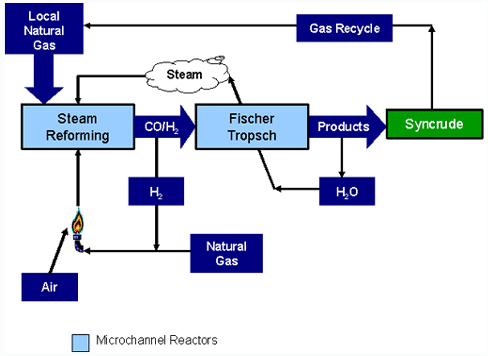
A British and Portuguese biomass to liquids (BTL) demonstration plant located in Austria and using US technology, plans to gasify woodchips to syngas, then convert the syngas to liquid fuels inside a micro-channel Fischer-Tropsch reactor. As illustrated above, the same technology can turn natural gas into liquid fuels.
The gas conditioning unit which purifies the syngas coming out of the gasifier has now been fully installed and pre-commissioned—with the required checks, system adjustment, equipment and system activation necessary to prepare the facility for operation now complete.

The next stages will include tests to confirm the stability of the coupled operation of the gas conditioning unit and the FT microchannel reactor. During the final phase, which is expected to begin in the summer, the performance of the integrated gas conditioning unit and FT microchannel reactor will be evaluated under a wide range of operating conditions. This will be followed by an extended steady-state run of at least three months. _GCC
More on Oxford Catalysts technology
Microchannel process technology offers process intensification, in the form of enhanced heat and mass transfer, to a wide range of chemical reactions. This paper describes the application of microchannel technology to the exothermic Fischer-Tropsch (FT) process, which converts synthesis gas into a petroleum replacement – synthetic crude or fuels. Synthesis gas to feed the FT unit can be derived from a variety of feedstock materials, including natural gas and biomass. By greatly reducing the size and cost of chemical processing hardware, microchannel process technology enables cost effective production of synthetic fuels from smaller scale facilities, appropriate for biomass and offshore natural gas resources. _PDFVelocysTechnologyPDF
The technology is also useful for converting excess natural gas to liquid fuels.
One of the technological features of the process is the use of the Microchannel Reactor, which Velocys is currently developing in the reforming reaction of natural gas, and FT reactions. By having the exothermic reaction and endothermic reaction proceed at the same time in the adjacent two microchannels, heat transfer between the two is promoted, thereby dramatically accelerating the catalytic reaction. As a result, the foot-print area of GTL facilities may be reduced to about one-sixth the conventional surface area. This enables the facilities to be equipped on Floating Production Storage and Offloading units (FPSO), offering a new tool in the development of offshore gas fields. _toyo
In other words, offshore gas fields could easily convert the gas to liquids for much easier storage and transport.

The microchannel FT reactors discussed above recently won an "XTL" award at the 10th annual XTL summit in London.

The small size of these GTL and BTL microchannel reactors should allow for even greater decentralisation in the production of liquid fuels from biomass and natural gas, and in the production of liquids from coal (via gasification).

Think of it as a fuels refinery in a shoebox.

Labels: , , ,

Monday, March 29, 2010

Gasification and Pyrolysis: Hot and Getting Hotter

Uhde's PRENFLO highly efficient gasification process is illustrated above. It will be utilised for the French Bio T fuel project. The gasifier operates above 2,000 degrees C and above 40 bar pressure (580 psi).
The PRENFLO Direct Quench (PDQ) process is an optimized design of Uhde’s PRENFLO PSG gasification process (steam generation) for chemical applications (e.g. ammonia, methanol, hydrogen, synthetic fuel) and IGCC plants with Carbon Capture and Storage (CCS), where hydrogen-rich syngases are required. It combines the technologically advanced dry feed system, multiple burners and membrane wall of the PRENFLO PSG process with a proprietary water quench system which saturates the raw syngas with water for subsequent gas treatment.

Capital-intensive systems, such as the waste heat boiler system, the dry fly ash removal system and the quench gas compressor, are therefore no longer required.

The PRENFLO PDQ gasifier operates at pressures of 40 bar (4 MPa, 580 psi) and higher and at temperatures above 2,000 °C. Gas temperature at the outlet of the gasifier/quench is 200-250 °C. Carbon conversion is greater than 99%, and typical composition of the raw syngas is more than 85 vol.% CO + H2, 6-8 vol.% CO2 and less than 0.1 vol.% CH4.

The PRENFLO PDQ process was selected for its suitability in processing a variety of feedstocks and in generating hydrogen-rich synthesis gases, such as for Fischer-Tropsch synthesis applications, by which diesel and kerosene can be produced. _GCC

On the pyrolysis front, a startup from U Mass, Amherst, Anellotech, aims to convert biomass into 5 hydrocarbon components of gasoline -- using "catalytic pyrolysis."
Anellotech's reactors perform a process called "catalytic pyrolysis," which converts three of the structural molecules found in plants--two forms of cellulose and the woody molecule lignin--into fuels. Ground-up biomass is fed into a high-temperature reactor and blended with a catalyst. The heat causes the cellulose, lignin, and other molecules in the biomass to chemically decompose through a process called pyrolysis; a catalyst helps control the chemical reactions, turning cellulose and lignin into a mix of carbon-ring-based molecules: benzene, toluene, and xylenes.

...Pyrolysis is also different from gasification, another process for using whole biomass. Gasification results in a mixture of carbon and hydrogen called syngas, which can then be used to make fuel. Pyrolysis, by contrast, turns biomass into liquid fuels in a single step. And while gasification can only be done economically at a very large scale, says Regalbuto, catalytic pyrolysis could be done at smaller refineries distributed near the supply of biomass. _TechnologyReview

It is the one-step promise of catalytic pyrolysis which may lead to an economic advantage for pyrolysis-based biomass-to-liquids processes over gasification.

In gasification, biomass is exposed to high heat, high pressure, and limited oxygen. The result is "syngas": a mixture of hydrogen, carbon monoxide, carbon dioxide, methane, and traces of larger hydrocarbons. This gas can then be refined to liquid fuels in a separate catalytic process.

Pyrolysis processes generally involve lower heat, less pressure, and no oxygen. The result is a liquid that can be refined to fuel, plus a solid carbon "biochar" (useful as a soil treatment) , and a small amount of gas. Again, in U Mass spinoff Anellotech's approach, the catalytic refining is combined with the pyrolytic transformation in "one step."

So there you have it: gasification vs. pyrolysis. Both are vying to be the first BTL approach to hit the big time. There will be plenty of biomass available for both or either, depending upon how the race ends.

Realistically: As long as cheap coal and cheap gas is available, either fossil fuel can be converted to liquid fuels more economically than biomass. Government mandates, tax breaks, and other incentives and regulations will have a lot to do with the near and intermediate term feedstocks for pyrolysis and gasification processes.

The advantage of BTL over CTL and GTL, is that you can grow biomass anywhere on Earth. Rich deposits of fossil fuels are not readily available everywhere on Earth. That fact may affect the pattern of BTL adoption across the third world.

Labels: , ,

Wednesday, February 24, 2010

Enerkem and Waste Management: Waste to Biofuels

Waste to biofuels just got a big boost from garbage giant Waste Management, in the form of a $51 million investment to Enerkem. Enerkem's biomass and waste to liquids process -- pictured above -- uses thermochemical processes to turn potentially large volumes of waste into clean and useful fuels, and high value chemicals.
Enerkem uses a thermochemical gasification process to produce a uniform syngas, which is subsequently converted into liquid fuels, such as ethanol, as well as biochemicals. The technology is able to process diverse carbon-based feedstocks, including sorted municipal solid waste, construction and demolition wood, as well as agricultural and forest residues. Enerkem’s technology can convert one tonne of raw material (dry base) into 360 liters (95 gallons) of cellulosic ethanol.

Enerkem’s gasification technology is based on a bubbling fluidized bed reactor with a front-end feeding system that is capable of handling fluffy material with no need to pelletize it. Slurries or liquids can also be fed into the gasifier through appropriately designed injectors. The gasification is carried out using air as a partial oxidation agent or using oxygen-enriched air, with the oxygen-enrichment level tailored to the desired composition of the synthetic gas. The presence of steam at a specific partial pressure is also part of the process...

...Waste Management, based in Houston, Texas, is the leading provider of comprehensive waste management services in North America. The investment in Enerkem complements Waste Management’s comprehensive waste services in the areas of recycling, landfill, waste-to-energy and landfill gas-to-energy. _GCC
This Biofuels Digest story provides a projection of the near-term growth in biofuels production across an array of approaches. Includes an interesting graph.

Clearly ethanol has a head start. But biomass to liquids and microbial fuels -- such as algal fuels -- are on the front burner and ready to take off.

Labels: , , , ,

Sunday, December 27, 2009

Choren, Air Liquide Team Up for French BTL

An ambitious new French BTL (biomass to liquids) project will be pushing the envelope of full-chain BTL production:
The Bure Saudron pilot will demonstrate a complete BTL production chain: gathering and conditioning of the biomass, gasification, gas processing, and conversion to synthetic fuel via the Fischer-Tropsch process. It is intended provide the experience necessary for the establishment of a BTL sector, both for process integration techniques and for the definition of a regional economic model. This will be the first production unit of its kind in France.

The pilot plant will use some 75,000 tonnes per year of forest and local agricultural residue to produce about 23,000 tonnes/year of second-generation biofuel (diesel, kerosene and naptha).

Currently, a limitation of BTL processing is the mass yield of the end products. The Bure Saudron project will experiment with a novel solution to increase process efficiency—the ratio of hydrogen to carbon monoxide generated during the synthesis stage of the fuel will be greatly enhanced by the external input of hydrogen. This innovation will be a world first, according to CEA.

This first phase involves the detailed design studies and is under contract with the CNIM group (Constructions Industrielles de la Méditerranée) as prime contractor, and in partnership with Air Liquide, Choren, SNC Lavalin, Foster Wheeler-France and MSW Energy.

Air Liquide will coordinate some of the technical engineering operations and process steps downstream, from gasification through final biofuel upgrading. Air Liquide will also provide oxygen and hydrogen. Oxygen is a required component of the gasification process, and the hydrogen will be used to enhance the quantity and quality of the synthetic fuel produced. Choren is providing the gasification technology. _GCC

The French BTL project intends to grow its own biomass and perform its own gasification and chemical synthesis. Other BTL projects aim to buy biomass from contracted providers or off the open market. It will take several years for the biomass market to develop and mature in terms of quality control and guaranteed delivery. Any carbonaceous mass will do -- as Oynklent Green [OTC:OYNK] very well knows. ;-)

Hydrogen is likely to prove useful in many ways to the biofuels enterprise. Hydrogen gas is intelligently used by Neste in making its advanced biodiesel product. Adding hydrogen gas to a biomass gasification process to increase yield is another use. The French will use excess nuclear capacity during off hours to produce the hydrogen for use in the above project.

Labels:

Older Posts