Friday, May 20, 2011

Biomass on Commodity Markets? More Biomass to Chemicals

Wood fuel, one of the oldest energy sources on the planet, could become the newest commodity market if it can overcome supply limits and green concerns as demand grows for renewable energy.

...utilities are burning biomass in ever greater amounts and now want price certainty and derivatives to manage their cost exposure in forward power sales, although European policymakers are mulling limits on subsidies for burning wood fuel given concerns about deforestation.

“It’s coming very fast,” said John Bingham, a director at consultants Hawkins Wright, referring to the development of an open market, and citing Eurostat data showing EU imports of wood pellets up 42% last year.

He saw increasing evidence of a larger scale market including big producers of wood pellets in Europe and North America and big intermediaries, such as Cargill and Gazprom, to balance large utility buyers. _FP
The article quoted above is looking only at wood pellet fuels for heat and power production. But wood is not the only biomass that can be pelletised. In order for all the various types of biomass pellets, tablets, briquettes, torrefaction products etc. to be featured on commodities markets, their quality characteristics will have to be well defined and standardised.

While converting biomass into combustion fuels is relatively uncomplicated, it is not the most economical or efficient use of the biomass. Converting biomass into high value chemicals returns a higher profit, and converting biomass into transportation fuels provides access to a wider marketplace. Here is one example of how biomass-derived sugars can be converted to chemicals and fuels:
(H2PO4)2 solid acid catalyst in an isobutanol-water (1.6:1/V:V) two-phase system to convert glucose to 5-hydroxymethylfurfural (5-HMF), an important green platform chemical with wide applications in the production of fine chemicals, pharmaceuticals, plastics and liquid alkanes.

Although fructose can be converted to 5-HMF with high yield via acid-catalyzed dehydration, fructose is costly.

With its low cost and wide supply, the conversion of glucose to HMF has attracted the interests of researchers. For gaining a high 5-HMF yield, the choice of catalysts is very important.
—Zhuang et al.
_GCC
As better methods of converting biomass to sugars come along, the cost of sugars will drop rapidly. At that point, industrial applications for the conversion of sugars into chemicals, fuels, plastics, and more... will expand in number very quickly.
ZeaChem, Inc., has signed a long-term binding term sheet with GreenWood Tree Farm Fund (GTFF), managed by GreenWood Resources (GWR), to supply hybrid poplar woody biomass for its first commercial cellulosic biorefinery.

The combination of GTFF’s existing tree farms in close proximity to the biorefinery, GWR’s world leadership in development and management of tree plantations, and ZeaChem’s highly efficient biorefinery technology will enable the supply of low-cost fermentable sugars used in the production of advanced biofuels and bio-based chemicals for years to come, it said. _BrighterEnergy

Labels: , ,

Wednesday, May 18, 2011

Can 60% of India's Transport Gasoline Come from Waste Biomass?

Transforming agricultural waste into biofuel in India could meet up to 59% of the country’s demand for transport gasoline while creating up to one million jobs, according to a new study by Bloomberg New Energy Finance, commissioned by enzyme company Novozymes. _GCC

It is important that societies do not push new forms of energy beyond their economic ability to support themselves. Too many mandates, rebates, taxes, regulations, punitive fees, and other top-heavy government incentives can be the "kiss of death" for any technology which is not economically ready for prime time.
India is the world’s 6th largest consumer of energy with current consumption of 17.3 billion liters (4.57 billion gallons US) per year of gasoline. Demand is expected to grow 8.5% every year till 2020. Assuming a barrel of crude oil costs US$100, India will spend US$19.4 billion on importing gasoline by 2020.

The Bloomberg study “Next-generation Ethanol: What’s in it for India’s commissioned by Novozymes was presented at event organized under the aegis of the Danish Embassy in India in cooperation with India’s Ministry of New and Renewable Energy. According to the report, biofuels from agricultural residues are an important existing alternative to liquid fuel which is environmentally sustainable and should be pursued aggressively.

By converting agricultural residues into fuel ethanol, India has the potential to reduce its dependence on imported petroleum. What’s more interesting is that this can be achieved without changing today’s agricultural land-use patterns or cultivating new energy crops. In addition, we already have the technology ready for deployment.

—Thomas Nagy, Executive Vice President, Novozymes
While the potential is high, the report states that issues like lack of policy implementation, absence of any incentive for collection of agriculture residue (only 25% of the waste is recovered from the fields) and requisite infrastructure need to be addressed for the optimum development of India’s advanced biofuel potential. _GCC
What would it take to obtain 25% or more of a society's transport fuel from biomass? It would take a lot of biomass, for starters. More than can be obtained merely from agricultural, forestry, or municipal waste. Dedicated terrestrial and marine biomass farms growing highly prolific biomass species would be necessary.

Better methods for harvesting, drying, and concentrating the biomass near the point of growth are mandatory. In other words, integrated infrastructures for local, regional, and central processing and distribution must be constructed at significant cost -- but in a scalable and modular manner, as markets grow.

Significantly better efficiencies for converting densified biomass to refined chemicals and proto-fuels would be required. Synthetic biological entities along with advanced nano-catalytics will likely be involved in lower temperature conversion to high energy fuels.

In the intermediate processes between today's thermochemical approaches (pyrolysis, gasification, torrefaction, etc.) and tomorrow's advanced low temperature synthesis of fuels, much better management of process and waste heat will be necessary, to conserve as much energy as possible.

More efficient ways of extracting hydrogen from biomass for hydrotreatment of proto-biofuels will be useful.

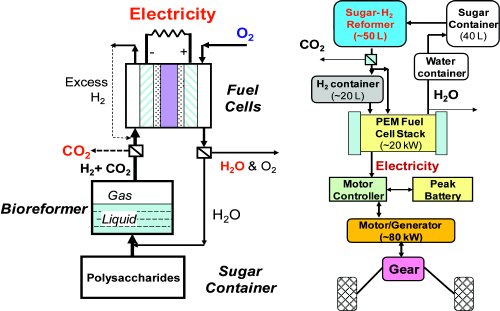
Don't forget fuel cells which can use biomass and biomass by-products -- such as sugars derived from biomass -- as fuels. Such non-combustion means of utilising biomass may well improve overall efficiency of biomass use on a large scale.

Whether a society derives 10% of its transport fuels from biomass or 80%, will depend upon its land and sea resources for biomass production, as well as its innate hydrocarbon resources and its ability to pay for imported hydrocarbon fuels.

Labels:

Tuesday, May 17, 2011

Why Bio-Energy Continues to Take a Backseat to Hydrocarbons

GCC
Society will require crucial transportation fuels for several more decades. Over that time period, synthetic fuels produced from renewable biomass will become more and more competitive with fuels derived from fossil fuel hydrocarbons. But for now, the infrastructure for biomass feedstock production and fuel processing is virtually nonexistent. And the economic justification for building and scaling that biomass fuels/chemicals infrastructure will require time to fall into place.
Researchers from the Stevens Institute of Technology, BASF Catalyst and Golden BioMass Fuels Corporation report on their investigation of an energy balance, in broad outline, for the production of a high-quality synthetic diesel from residual crop biomass via a Fischer-Tropsch route in a paper published in the ACS journal Energy & Fuels.
The particular process explored in the paper consists of:
harvesting surplus biomass (such as crop residue);
locally pyrolyzing the biomass into pyrolysis oil (PO), char, and noncondensable gas (NCG);
transporting the PO to a remote central processing facility;
converting the PO at this facility by autothermal reforming (ATR) into synthesis gas (CO and H2); and
Fischer–Tropsch (FT) synthesis of the syngas into diesel fuel.
...The team found that the process considered, in which a portion of the char and noncondensable gas are used to supply heat to the drying and pyrolysis steps and under the assumptions made, has an energy efficiency to liquid fuel on the order of 40%—i.e., 40% of the initial energy in the biomass will be found in the final liquid fuel after subtracting out external energy supplied for complete processing, including transportation as well as material losses.

...Using the process modelled, replacing ~15% of current petroleum consumption in the United States would require the gathering of biomass from a substantial portion of the land area of the major crop-producing states...
_GCC
ACS Abstract of biomass FT study

Due to the relatively low energy density of biomass, a large growing area must be devoted to producing biomass feedstock for whichever energy densification and refining process is chosen.

The study above is based upon a reasonable process, and probably represents nearly the state of the art for biomass to diesel conversion at this time. Local pyrolytic densification of biomass allows for more efficient shipping to a central gasification and F-T catalytic refinery. It would not be a bad method of producing diesel except for one thing: It is much more economical at this time to use either crude oil using conventional refineries -- or even coal or natural gas, using F-T approaches.

Fischer-Tropsch technologies are improving for the use of either gas or coal as gasification feedstocks. Here are a few items from recent F-T news stories:

Altona Energy has inked a cooperation agreement for application of Rentech's technologies in gasification of coal and biomass at its Arckaringa project located in South Australia. [Keep in mind that the biomass component would not be included except for reasons of governmental mandate, rebate, or other top-down incentive. The biomass component is not yet economic when compared to coal.]

Jacobs to Collaborate on Commercialisation of BP/Davy Fischer Tropsch

Completed semi-commercial demonstration of the low temperature Fischer-Tropsch technology at Mossel Bay gas-to-liquids plant

Oxford Catalysts Moving Toward Commercial Launch

And so on... Fischer Tropsch is an old technology which is being improved and adapted for a wide range of feedstocks and syngas mixtures. Using biomass with F-T and other thermochemical processes is necessarily a second choice, after hydrocarbons, due to the energy density factor. If governmental incentives, regulations, taxes, mandates, rebates, etc. become so topheavy as to shift the economics toward biomass, a wide range of societal and economic repercussions would necessrily follow -- not all of them ultimately for the better.

Over time, alternative means of producing scalable volumes of advanced liquid fuels from biomass are being devised. Some of these methods are likely to achieve economic competitiveness with hydrocarbons, as the incentives landscape shifts and alters. In the long run, F-T is unlikely to survive as a viable process except for production of certain high value chemicals which are difficult to produce bio-synthetically (or bio/nano-synthetically) at lower temperatures and higher efficiencies.

Liquid fuels will be important to society for some decades, and high value industrial scale chemicals will be important for much longer.

Labels: , ,

Monday, May 16, 2011

A. Niger Is an Industrial Slave and Workhorse, Other Microbes

GCC

Aspergillus Niger (A. Niger) is a fungus that contains industrial-strength enzymes capable of transforming much of modern industry. Global markets for potential products from A. Niger are priced well into the $billions. Improved capacity for breaking down polysaccharides into simple sugars alone -- for fermentation fuels and feedstock for sugar fuel cells -- can transform much of the world economy. Microbes have been around for over 3 billion years. They are hard workers with a lot of useful tools in their toolboxes.
A. niger is an industrial workhorse, with different strains efficient in producing polysaccharide-degrading enzymes (particularly amylases, pectinases, and xylanases) or organic acids (mainly citric acid) in high amounts. (As of 2007, the global market for citric acid was estimated to be approximately $1.2 billion with more than 500,000 tons produced annually by fermentation.) The production process involving A. niger is thus a well understood fungal fermentation process. _GCC

Japanese researchers aim to use synthetic biology to re-engineer protists, fungi, algae, and more, to overturn the established energy and industrial order. These scientists at the RIKEN Institute in Japan aim to give the Venter Institute a run for its money.

Most industrial uses of microbes utilise "pure cultures" of specific strains of microbe to avoid "contamination." But symbiotic groupings of microbes in the same reactor -- as well as "staged relays" of microbes using specific sequences of feedstock treatment -- may prove to be far more productive and economic than bioreactors built around isolated, pure strains.

Interestingly, symbiotic "microbial mats" may have been the prototypes for more complexed multi-cellular animals and plants which utilise specialised tissue types. Any industrial engineers contemplating the use of microbes in his industrial processes, would do well to consider the phenomenon of microbial symbiosis.

Labels:

Sunday, May 15, 2011

Nuclear News and Oddities

Nuclear News of note can be found at:

The 52nd Carnival of Nuclear Energy at ANS Nuclear Cafe

Brian Wang's Next Big Future Nuclear Update

Nuclear Street Nuclear Portal

Nuclear Town Hall

An interesting nuclear oddity popped up on the radar screen: An unconventional fusion researcher, Bodgan Maglich (inventor of Migma Fusion Cells), has re-emerged in connection with the recently announced Exyder Cell -- a 10" fusion neutron breeder which creates fissile Uranium 233 from fertile Thorium 232.
”India has 360,000 tons of thorium against only 45,000 tons of natural uranium… Installing one or two exyder type mini breeders to serve each nuclear power plant operating on Thorium/U-233 cycle would eventually render the power station self sufficient…” Computer simulation indicated that one Exyder module could economically produce 100grams/day, 35 kg/year of U-233, at electric energy cost of $50/Kg vs. $300/Kg for U-238. CANDU type reactor of 235 megawatt burns 10 Kg of U-233/year. “Even sub-engineering’ energy breakeven fusion systems which consume a net amount of electric energy to generate fissile U-233, can play a critical role in cutting the production cost.” _Businesswire
This use of fusion -- to create neutrons for use in breeding fissile fuel from fertile fuel -- may find common use in the future, if it is found to facilitate a more economical, safe, and sustainable nuclear fuel cycle.

Another potential approach to a safe "breeder-reactor" is the sub-critical reactor which is powered by a nuclear accelerator, and spallation neutrons. Both of these approaches (fusion-powered breeders and accelerator-powered breeders) may well also represent solutions to the nuclear storage problem and some potential proliferation problems (via re-cycling).

Thorium is more common globally than Uranium, and is distributed somewhat differently. This means that nations and regions which do not have abundant Uranium supplies, may well have plenty of thorium to fuel fission plants for hundreds of years.

Another approach to a Thorium cycle reactor, is the Molten Salt Reactor. Charles Barton at Nuclear Green covers the molten salt reactor regularly.

It is crucial to understand the energy density advantage of nuclear fuels and nuclear reactions. When one also understands the central role of abundant energy to the advancement of humans as a species and as a cosmic enterprise, one's short, intermediate, and long-term energy goals should be much clearer.

Labels: , ,

Saturday, May 14, 2011

Heat from Nuclear Fission and Decay: Using it More Wisely

SpaceflightNow via Brian Wang

Most electrical power is generated from heat: either combustion heat or the heat of nuclear fission and decay. I was disappointed many years ago when I first learned that nuclear power plants generate their huge production of power using primitive heat -- just like coal and gas plants. But as long as we are using heat, we may as well use it more efficiently and more ingeniously.

US NASA is proposing an advanced sterling radioisitope generator (ASRG) for powering space missions -- because the sterling engine provides greater efficiency for the limited amount of fuel allowed on weight-sensitive space missions.
...each ASRG creates between 130 and 140 watts of electricity with 1 kilogram, or about 2.2 pounds, of plutonium-238. More than four times more plutonium would be required to generate the same power in an existing RTG, according to the Energy Department.

Officials want to complete extensive ground testing and a low-cost flight demonstration before flying ASRGs on a multi-billion dollar flagship mission. _SpaceFlightNow_via_BrianWang

The same principle could be used for low power generators powered by "nuclear batteries" of various types, for remote location applications. Arctic and antarctic locations in particular cry out for low power nuclear battery applications, as would deep undersea locations.

Another way of using the heat of nuclear decay more efficiently is by making better use of waste heat from conventional nuclear power.
Nuclear desalination uses the excess heat from a nuclear power plant to evaporate sea water and to condense the pure water. Writing in the appropriately named International Journal of Nuclear Desalination, a team from India and Italy argue that despite public concerns, the low energy costs and convenience of this latter process make it the preferred option. _SD
Waste heat from many industrial sources is seriously underutilised. For nuclear power plants located along salt water estuaries and coastlines, the combination of power-production and nuclear desalination should have been implemented long ago.

Other uses for the waste heat of nuclear reactors include the production of more electrical power by a wide range of means, process heat for industry, and comfort space heating in winter.

Western societies are being squeezed into energy starvation by their well-meaning but stupid politicians, academics, and media personalities. Greater efficiencies from currently existing plants will be one way to survive this designed energy starvation. Many other inventions and workarounds will be required if humans are not to be herded like lemmings off the cliffs, by their lefty-Luddite green dieoff.orgiasts in charge.

Labels: , ,

Wednesday, May 11, 2011

More On the Rossi - Focardi LENR Device and Fallout

4700 watts of power from a small reactor of 50 cubic centimeters, may sound like a scam or a miracle energy. Yet this is exactly what happens in the device developed by engineer and physicist Andrea Rossi Sergio Focardi : the process is not yet clear, but the device works and produces clean energy at low cost. The reactor is now in its third iteration, but this time it was referred to the committee of the Swedish Skeptics Society where two scientists - the head of the Energy Committee of the Swedish Academy and the founder of the royal commission itself - were authorized to examine the entire apparatus, except the reactor containment. In their report states that "it is possible to identify any chemical reaction that produces 25kwh for combustion of any fuel in a container of 50 cubic cm, but not in this case: the only explanation is that something even stranger happens to your device, perhaps a new type of nuclear reaction. "

Rossi said that more than one hundred reactors from 4.4 kW are already in operation in four countries, and are in the hands of the experts are inspecting them in confidence. The same inventor has revealed that it is in the process of designing a much larger reactor (which will be operational as of October) made up of hundreds of smaller reactors, connected in series and in parallel. The installation will provide 1 MW of power to vaporize water that set in motion a turbine, just like in a nuclear reactor, only less expensive and much safer. The extraordinary thing is that the generator will not be bigger than a box of three x 2 x 3 meters, the nano-powder of nickel must be replenished every six months: _ildemocratico_via_Google translation to English
ildemocratico Rossi

The Rossi - Focardi device may be producing economic and political fallout far beyond the U. Bologna labs where the LENR experiments and demos were performed. Greece will be the first location for a large-scale (1 MW) demonstration plant using the LENR E-Cat devices. If the large-scale experiment works, Greece may decide to use its inside status with Rossi to get into the world-scale energy business -- and leave the European Union.
Whatever the veracity of the report by Der Speigel Online that Greece would like to “exit’ from the Euro Zone, if a factory in Greece has the rights to manufacture the biggest breakthrough energy technology since the burning of wood, and the government has confidence that it’s ready to be commercialized, these events would influence any decision to leave the Euro behind, and speculate on perhaps creating their own currency backed by profits of ECat manufacturing and licensing, estimated in the hundreds of trillions of dollars? [5]

Separated from the European Central Bank, the people of Greece could be able to keep this wealth derived from energy, close to its shores. Where over two-thousand years ago, the roots of modern science, math, and democracy first emerged, we may now see a next-generation energy technology that will extend globally, for the first time in history, the opportunity for all humans to be equally self-sufficient.

The reality is that once the technology is spread, the opportunity for a change in living arrangements will be immediate, and a boon to the entire planet. New and better devices will be developed with applications we cannot think of today; an entirely new service environment with new roles for humans to play. _ColdFusionNow
Rossi has to prove that his catalytic technology actually produces nuclear-scale energy. If he can do that, the global repercussions will be immense.

Labels:

Dieoff Energy Starvation vs. "Solving the Energy Problem"

An important difference in philosophy toward energy divides future oriented persons from faux environmentalist lefty-Luddite dieoff.orgiasts:
"If this machine [EMC2 Bussard IEC fusion device] works as we hope it will work, it will probably establish a firm technical foundation," he said. "People may say, 'It's a big jump and you shouldn't be doing this.' But every year that the energy problem doesn't get solved ... costs tens of billions of dollars. Sometimes waiting too long is not a good thing. If you look at the solutions, you might say, 'Can we afford to wait?'" _CosmicLog
CosmicLog

The energy starvation approach taken by Obama, lefty-Luddite faux environmentalists, and the European greens, aims to drastically reduce human agriculture and industry -- and consequently, the human population. But rational, forward-thinking groups and persons are working hard to "solve the energy problem." Such rational, future-oriented persons are the enemies of everything the modern political and environmental left is dedicated to.
Although fusion is the process behind the power of the sun and an exploding H-bomb, physicists have never been able to achieve a net energy gain in a controlled fusion reaction. But based on the experiments so far, Park thinks there's a chance that it could be done in a sufficiently large Wiffleball reactor, costing on the order of $100 million to $200 million. That sounds like a pretty good deal, especially in comparison with the $3.5 billion that's been spent so far on fusion research at the National Ignition Facility and the $20 billion expected to be spent on the international ITER fusion project.

...Don't expect weekly updates about EMC2's progress. "Currently all our funding comes from the Navy," Park said. "That's our customer. Our customer desired that we keep most of our progress confidential. ... They're somewhat concerned about making too much hype without delivering an actual product."

But if WB-8 and the follow-up studies are successful, the Navy won't stand in EMC2's way.

"Our understanding is they want us to be successful," Park said. "They want us to provide something for our sponsors. They also want us to do well commercially as well, as long as we remain US-owned and control the technology."_CosmicLog

Canada's BC-based General Fusion recently received a capital boost from Amazon's Jeff Bezos

Mainstream fusion approaches have been ongoing since World War II, but in practise have been bulky, overpriced, overstaffed, impractical, and probably never actually meant to accomplish more than milking research funds out of government coffers.

China is planning to mine Helium-3 from the surface of the moon to use as fuel in future nuclear fusion devices.

M. Simon's IEC Fusion Technology blog, and Brian Wang's NextBigFuture blog do a good job of following progress in IEC fusion and other alternative fusion technologies.

Nuclear energy (fusion, advanced fission, and other forms of nuclear energy not yet well-defined or developed) is the best approach to large scale reliable energy into the distant future. As the technology becomes more portable, humans will be able to carry their powerplants and "artificial suns" with them wherever they go.

But if you are like the greens who populate the Obama administration and governments/intergovernments of the western world, you want humans to slash energy production to the bare bone. The end result of such a reactionary lefty-Luddite policy would be a slow but accelerating return to a "dark ages" of science and technology, with an inevitable mass die-off of individuals at the margins. Not coincidentally, most current inhabitants of Earth are living at the margins.

Labels:

Tuesday, May 10, 2011

Obama, Putin, and Greens Aim to Kill Shale Gas Promise

US President Obama's gang of energy starvationists has been looking for an excuse to shut down the US shale gas revolution for years now. US shale gas has already foiled Russia's plans for the energy blackmail of Europe, and has opened the possibility for a vast new wealth of valuable hydrocarbons from South America, to the Levant, to China, to Europe. But the same gang of anti-energy thugs who engineered an ongoing de facto moratorium on US offshore drilling, now wants to shut down the technology which has kept US industry and the US economy's head barely above water. More on the world shale gas revolution:
The abundance of shale gas and other forms of unconventional gas discovered and extracted in the United States has prompted a new American energy boom and a global shale rush. It has also caused a dramatic drop in gas prices. Could the same happen in Europe?

At the European Union's energy summit in February, no other item on the agenda was as controversial as the impact of shale exploration. Despite protests from the green lobby, EU energy ministers agreed that the potentially game-changing nature of shale would be carefully considered in the next few months.

Unconventional gas is embedded in shale rock formations deep below the earth's surface. These geological strata hold vast deposits of shale gas. To exploit these resources, energy companies drill several kilometres deep into the rock and then horizontally in several directions. According to estimates of the International Energy Agency, supplies of unconventional gas could provide humankind with cheap and relatively clean energy for more than 250 years. _GWPF Benny Peiser
But the lefty-Luddite greens are not ready to call of their great energy starvation and human dieoff.orgy just yet. They have some solid connections within the research community, and people whom they can always call on for a bit of questionable research findings / loose associations. And we all know how easily the news media can confuse loose associations with true causation -- and create an instant crisis of world-ending proportions!
Since April, the findings of a shale gas study by Robert Howarth’s team at Cornell University, widely debunked for its “assumptions and inaccuracies” and, even though its authors admit it is based on “lousy” data, have been covered by eagerly awaiting media. The BBC’s “Shale gas ‘worse than coal’ for climate” is a classic example. The same cannot be said for The Shale Gas Shock report written by Dr Matt Ridley on behalf of the London-based Global Warming Policy Foundation (GWPF) which attracted a mere handful of journalists to its publication on May 4. While Howarth and co’s scientific ineptitude, as we shall see, makes fear-mongering headlines, the GWPF finding – at the opposite pole – finds shale gas to be “ubiquitous, cheap and environmentally benign”.

The Shale Gas Shock

For Ridley’s GWPF study, shale gas is not only proving to be “a revolution in the world energy industry”, but it promises to transform “world trade, geopolitics and climate policy”. Setting out an erudite history of shale gas and how it offers the world several more centuries of natural gas, point 22 of the report gets to the crux of the matter. “The key question about shale gas is not therefore whether it exists in huge quantities” (it demonstrably does), it is “whether it can be exploited on a large scale at a reasonable price”.

Ridley continues by scotching Bergman’s opinion that only around 10 percent of each shale gas field will prove recoverable, and that the current excitement merely amounts to another “speculative bubble”. Bergman concludes that US shale gas, for instance, may thus only last for seven years and not the 100 years+ widely projected. Ridley points out that Bergman’s audience “is investors, not consumers” and while he concedes Bergman may have a point that some investors in shale gas firms may get their fingers burnt, this will largely be because “their very success drives gas prices down” and/or because “volumes of gas are high”. In other words, the highs and lows of shale gas production would mirror that of any other extraction industry.

While we can expect “a shale gas boom in China”, with Russia being an “impediment” to development and not welcoming competition from shale gas, Ridley identifies Europe as particularly susceptible to exploitation opposition from “entrenched and powerful interests in the environmental pressure groups”. In the end however, “it will be a matter of whether over-borrowed European governments, businesses and people will be able to resist such a hefty source of new revenue and a clean energy source requiring no subsidy”. _A Tale of Two Studies
The informative shale gas report from Matt Ridley is available as a PDF download

A study from Duke University recently published in PNAS links "high" methane concentrations in water wells with oil shale fracking taking place very close nearby. And just like a Jack-in-the-box, US President Obama pops up with a somber expression to say that he may be forced to further energy-starve the American public, the American economy, and American industry -- but only for their own good!

The Duke study did not find toxic chemicals from the fracking process in the well water, and only those water wells which were extremely close to the gas wells were affected. No one knows whether there are any adverse health effects from the levels detected, and it is not known whether this association is widespread.

As long as Obama and the energy strangulationists can be held back from instituting devastating regulations and executive orders, it is likely that improved wellhead casings will put an end to what is a local phenomenon of questionable significance. But if the politicians and their hunchbacked fiends of dieoff.orgiasts are allowed to cut the throat of America's new energy cornucopia, the economic fallout will likely go on for decades.

Labels: , ,

Saturday, May 07, 2011

Sugar Fuel Cells, and Other Responses to Inflated Oil Costs

AzoCleanTech

Energy prices have been over-inflated since oil passed the $80 a barrel level, triggering a world-wide rush to develop alternative fuels and energy sources. One of the interesting ideas for new energy is the sugar fuel cell, where cheap sugars from biomass sources would power fuel cells of all sizes for a wide range of applications from hand-held consumer products to utility-scale power backup and load leveling.

Here we suggest an out-of-the-box solution - use of renewable biomass carbohydrates as a high-density hydrogen carrier. This new solution can efficiently address the above challenges for the transportation sector. Here we present the recent advances in cell-free synthetic pathway biotransformation (SyPaB), the roadmap of SyPaB from high-end to low-end applications, and its potential impacts.

A Sweet Solution to the Hydrogen Economy - Sugar as High H Carrier

Cellulosic biomass is the most abundant renewable biological resource (ca. 1 x 10¹¹ tons/year)3. Biomass is produced locally, and is more evenly distributed than are fossil fuels. Each year, the overall chemical energy stored in biomass by terrestrial plants is approximately 6-7 times the total human energy consumption. Also, renewable carbohydrates (e.g., cellulosic materials and starch) are less expensive based on energy content than are other hydrogen carriers, such as hydrocarbons, biodiesel, methanol, ethanol, and ammonia1. The use of a small fraction of low-cost renewable biomass for producing transportation fuels (e.g., cellulosic ethanol and hydrogen) provides benefits to the environment, economy, and national security3.

_Azo
Follow the link to the full article, with illustrations, links, and more detailed explanations and arguments.

On other alternative fuels and energy fronts:

Accelergy is moving ahead with construction of demonstration CBTL (coal and biomass to liquids) plant in Pittsburgh

Australian company Linc Energy is promoting its underground coal gasification and gas to liquids technology in the land down under. In situ underground coal gasification is suitable for difficult to mine coal of even the lowest quality. Syngas to liquids technologies are becoming more economical with better catalysts and process designs.

Offshore and other small-scale gas to liquids (GTL) is getting closer to feasibility, thanks to microchannel architecture reactors.

Powerful members of the US House of Representatives are beginning to push back against President Obama's policies of energy starvation. Besides promoting increase US offshore oil & gas production, congress is likely to promote coal to liquids and increased development of oil shales, heavy oils, and oil sands.

Advanced nations have multi-trillion dollar infrastructures devoted to mainly liquid fuels (and secondarily gaseous fuels). But if sugar fuel cells truly can provide a disruptive fast track technology to multi-scale, decentralised production of electrical power, then solid fuels may join the club. The more the merrier.

If Obama's Nuclear Regulatory Commission ever wakes up and realises that it has an important job to do besides preening before the mirror, nuclear power may begin to fulfill its immense promise as well.

Labels: , , ,

Thursday, May 05, 2011

Joule Unlimited Calculates Cost as Low as $20 a Barrel Diesel

GCC

Joule Unlimited has signed a lease agreement for a site in New Mexico, for production of its Helioculture microbial fuel. As reported here earlier, Joule reckons it can achieve photosynthetic yields sufficient to produce renewable diesel at costs as low as $20 a barrel, when taking subsidies into account. (abstract and link to full text PDF supporting Joule's yield calculations, via GCC)
Joule’s process, called Helioculture, combines an engineered cyanobacterial organism supplemented with a product pathway and secretion system to produce and secrete a fungible alkane diesel product continuously in a SolarConverter designed to efficiently and economically collect and convert photonic energy. The process is closed and uses industrial waste CO2 at concentrations 50–100 times higher than atmospheric.

The diesel process yields long-chain alkanes, the majority component of diesel fuel, as opposed to a low-percentage blendstock like biodiesel. As a result it can immediately drop in to the existing diesel infrastructure with no need for refining or chemical processing.

Joule’s production facilities will employ the next generation of the company’s novel SolarConverter system, which manages the direct, continuous process from photon capture to product synthesis and separation with efficiencies that are up to 50X greater than those of biomass-dependent processes. At full-scale production, Joule expects to deliver diesel and ethanol for as little as $20/bble and $0.60/gallon respectively, including current subsidies. _GCC

It is possible that the theory supports Joule's assertions, but theoretical yields can be different from actual yields. While microbial fuels are likely to provide fuels and high value chemicals for the intermediate to distant futures, in the more near term, biomass approaches using thermochemical and clever fermentation and catalytic processes are likely to capture the field -- in terms of renewable fuels.

Biomass-derived sugars will be far cheaper than sugars from cane or corn (maize). Thermochemical approaches (gasification, pyrolysis, etc) are relatively quick and easy, and when combined with F-T and other advanced catalytic syntheses, can produce significan volumes of high grade fuels and chemicals -- as long as sufficient supplies of biomass are assured.

Joule is one of many microbial (including micro-algae) fuels startups combining world-class research talent with substantial financial backing. But it will take years to learn to get around what are currently seen as iron-clad limitations in yield from photosynthetic approaches. Eventually, they will succeed, and the world will change as a result.

Labels: ,

Monday, May 02, 2011

Methane to Methanol to Gasoline at Competitive Prices

GCC

Methane to methanol to gasoline for $2.85 a gallon, including a healthy $1.45 margin? That is what is being claimed for a combined "Gigamethanol" and MTG (methanol to gasoline) plant proposed for Alaska. Converting all the North Slope gas to gasoline could produce almost 500,000 barrels per day.
... a plant would produce methanol from natural gas on the North Slope using the proposed GigaMethanol technology. The resulting methanol would be blended with crude and transported via the trans-Alaska oil pipeline to Valdez, where it would be extracted from the oil and processed via Methanol-to-Gasoline technology into gasoline.

In January, ICIS reported that Eastman Chemical reached an agreement to sell a mothballed Texas methanol and ammonia plant to Pandora Methanol, a subsidiary of Janus Methanol.

The plant will have a capacity of 850,000 tonnes/year of methanol and 250,000 tonnes/year of ammonia, according to van Wijk. ...Van Wijk at the time said the new plant might consider the methanol-to-gasoline MTG process pioneered by ExxonMobil.
Eastman originally bought the plant in 2007 for a $1.6-billion coal-gasification project, but called off the project in late 2009 due to high capital requirements, the narrow difference between petroleum and natural gas prices and uncertain US energy policy....

Costs for a 63,000 barrel (of gasoline) per day system would be approximately $5.2 billion, he said. Gasoline could be delivered from Valdez at $2.65 to $2.85 per gallon, including a $1.45 margin.

In addition to providing a market for North Slope gas, the mix of methanol in the pipeline flow would help prevent problems with ice forming in the line, van Wijk, a former Methanex executive, suggested. If the entire daily output of North Slope gas (4.5 billion cubic feet, bcf) were converted to gasoline, it would produce 450,000 barrels per day, he suggested. _GCC

This is a different approach from the Oxford Catalysts and Sasol approaches. But the claims for efficiency and economic viability are difficult to beat, if true.

While the proposal is meant to take advantage of Alaskan natural gas, the same approach could conceivably be taken with shale gas or any other large gas deposits located anywhere.

Labels: , , ,

Wednesday, April 27, 2011

Large, Lucrative Markets for n-Butanol and iso-Butanol from Biomass

Cobalt and others [ed: including Gevo and OPX] are hedging their bets. In addition to fuels, companies are also developing other products, such as biochemicals. Those products have higher price points that could create economic stability for the companies long before any big investments in biofuel production take place, Wilson said.

"This is a little company. Why take a molecule and turn it into $2 for fuels when you can turn it into a $5 chemical?" he said. _PaloAltoOnline
Gevo SEC Filing

Gevo Inc. is powering ahead with its renewable isobutanol product. Gevo's latest effort is a partnership with Mustang Engineering, LP, to produce jet fuel using isobutanol as feedstock.
Gevo, Inc., a renewable chemicals and advanced biofuels company, signed an engineering and consulting agreement with Mustang Engineering, LP for the conversion of Gevo’s renewable isobutanol to biojet fuel. This effort will focus on the downstream processing of isobutanol to paraffinic kerosene (jet fuel) for jet engine testing, airline suitability flights and advancing commercial deployment. (Earlier post.)

Gevo also announced that its “fit for purpose” testing at the Air Force Research Laboratory continues with a final report expected in June. Once completed successfully, the company will initiate jet engine testing with engine manufacturers. _GCC
Gevo competitor Cobalt Biofuels produces bio n-butanol (normal butanol), which is a straight chain 4 carbon alcohol, rather than the branched chain alcohol isobutanol, made by Gevo. Cobalt claims that its n-butanol product has access to even larger markets than does Gevo's isobutanol (see image at top).
The advantage of normal butanol is that you can take normal and isomerize it, but you can’t take an isomer and normalize it. So, with n-butanol, you have advantages as a platform for a wider variety of chemicals.

"For us, we like wood, bagasse and glycerol as feedstocks. We see costs there in the $60 per ton for wood biomass, $40 for bagasse and $20 for glycerol. Those change, but there's a significant enduring advantage compared to the cost of sugarcane or corn, which are well over $200 per ton. That’s lower than the cost of crude oil, but when you take into account the amount of energy you can access in corn or cane, the cost advantage can be minimal unless you have very high oil prices sustained for a very long time.


"The markets, for us," said Wilson, "are the $7 billion n-butanol market, for acetates, acrylates, and glycerol esters, where the current pricing is $2300 per metric ton. Compare that to diesel or gasoline, both under $1000 per ton. Also, we have the OXO derivatives, such as butyric acid or 2-ethyl hexanol. That's a $9 billion market trading at $2600 per ton. There are also the butene derivatives, such as isobutene, a $17 billion markt trading at between $1200 and $1500 per metric ton. There are paints, solvents, plasticizers, paint dyes, stabilizers, preservatives and more in those markets.

"The markets are very small, compared to the fuels markets, where you have $250 billion in jet fuel, $980 billion for gasoline and $1040 for diesel. Those are a great story, but its hard to make money, and the first goal of any company should be to make money. The cost of making petroleum-based butanol is around $1230 per metric ton. We can make it from corn at $1200 per ton, cane at $1170 per ton. But when we look at wood, our cost drops to $800 per ton; or $650 per ton from bagasse, or $380 from glycerol. _LowCarbonEconomy
OPX Biotechnologies has partnered with Dow Chemicals to produce specialty chemical products from biomass, locating their facility at the Dow plant to facilitate cost savings.
Over at OPX Bio, the market is acrylic acid, which is now at $8 billion and growing 3 to 4 percent per year. Acrylic acid is a key chemical building block used in a wide range of consumer goods including paints, adhesives, diapers and detergents. Later on, the company hopes to commercialize a new technology, converting syngas to fatty acid esters, in work funded by ARPA-E. Other partners will be signed by OPX to work that technology up to scale.

. Earlier this week, Dow Chemical and OPXBIO announced that the two companies are collaborating to develop an industrial scale process for the production of bio-based acrylic acid from renewable feedstocks.

Both CEOs agree that the path to cost competitive advanced biofuels runs first through the garden of renewable chemicals. Not only because they are sold at higher prices. They are made in smaller volumes. That means smaller commercial scale plants, lower capital costs, and faster returns for investors for who, time is money. Where fuel-centric companies are raising hundreds of millions for their commercial-scale plants, OPX, for example, is raising just $35 million in its series C round, which takes the company through completion of its demonstration-scale plant.

But there's one other advantage. That's the breadth of technical collaboration and opportunities to share cost on critical technologies. "That's where the Dow partnership comes in, said Eggert. "They are the largest acrylic acid producer from propylene, and have very strong chemical foundational knowledge, and the relationships in place for market development. Here's a benefit to us: neither Dow nor we feel that we need to raise and invest for the consuruction of a demon plant. Instead, we'll use standard contract fermenters to make hydroxypropionic acid, (3-HP), then Dow already has the bioacrylic conversion from 3-HP at pilot and demo scale."

Scale? For OPX, their 100 million pounds (equivalent of 14 million gallons) biorefinery is expected to be cost-competitive with 350 million pound propylene-based systems. The market price? 70 cents per pound, or right on $5 per gallon. _LowCarbonEconomy
You can see that the market for fuels is much larger than the market for chemicals, but that the profit potential for chemicals is much higher. A biofuels company can become profitable more quickly and at smaller scale -- with less debt -- by exploiting the renewable chemicals market first. This allows the company to develop more efficient, streamlined, and economical approaches to the higher-volume fuels markets without bleeding capital in the process.

Labels: , ,

Tuesday, April 26, 2011

A Resilient Grid of Small Modular Reactors

In reality a world free of nuclear power would be less secure. For the foreseeable future, neither fossil fuels nor renewable sources will be able to replace the 14 per cent of global electricity generated by nuclear reactors, without risking severe instability and shortages in energy markets. Put simply, energy security requires a diversity of sources, including nuclear. _FT_via_Arevablog
The world not only needs nuclear power, but it needs smarter forms of nuclear power. Small modular nuclear reactors (SMRs) offer far more versatility, safety, reliability, and affordability than the traditional 1 GW ++ nuclear reactor plant. They can be ganged together to provide whatever level of power production you want, or they can be networked into a decentralised, resilient grid.
A resilient grid of SMRs built in a distributed network would be much less susceptible to damage from natural disasters or man-made disruptions. If one SMR goes out of service, it doesn't create a regional blackout for everyone else in the utility's service area.

...The ARC-100 reactor design concepts contain intriguing safety measures which might benefit highly industrialized countries seeking a more resilient power grid. Similar benefits might come from other SMR designs including those that use conventional LWR designs. It depends in part on the pace of advancement in fuel cladding materials science.

The key idea is to find ways to avoid future consequences of having too much electrical generation capacity invested in a single site. This is especially important in areas where there is a potential for earthquakes, tsunami, and other natural disasters or man-made disruption. SMRs buried underground add the natural containment of that design paradigm to their protective envelope. _Dan Yurman Energy Collective
Many legislators in the US are calling modular reactors the wave of the future.

Small modular reactors have many applications besides electrical power generation:
The main applications of SMRs apart from electricity generation are desalination, process heating and district heating. SMRs are gaining importance in the global nuclear power industry; according to recent new reports, in the US's 2012 budget proposal, funds are said to be allocated to the development and deployment of SMRs. Despite the constraints, the SMRs enlist more key drivers for its deployment. SMR design is also considered as an alternative to replacing ageing fossil power plants of similar capacities across the world. _BusinessWire
SMRs are also likely to be key to the economical and clean unlocking of energy from oil sands, heavy oil deposits, and kerogen oil shales.

Interest in SMRs is growing, as more people begin to understand how vulnerable national and regional power supplies are -- to EMP attack, solar flares, computer hackers, etc. And unfortunately, the "smart grid" only makes it that much easier to shut the whole thing down remotely. A recent conference on SMRs in Columbia, South Carolina, drew 250 participants, and more individuals of influence are beginning to speak out about the US NRC's inability to facilitate a more rapid movement toward safer, more reliable, more economical, and more robust nuclear power infrastructures.

Labels:

Monday, April 25, 2011

Bio-Oils to Diesel, Jet Fuel, Gasoline via North Carolina State U.

GCC

Researchers at North Carolina State University have devised a refining method for converting triglycerides, or biofats, into drop-in fuels for diesel, gasoline, and jet (turbine) engines. The technology is being developed by a small startup, Avjet Biotech Inc.
The Red Wolf Process (RWP) consists of three main steps: hydrolysis, deoxygenation and hydrocarbon reforming.

Hydrolysis. The first step of the RWP uses the well-established Colgate-Emery reaction (hydrolysis via high-pressure, high-temperature steam) to cleave the three fatty acid chains from the glycerol backbone of the triglycerides. This is accomplished by separately pumping steam and the feedstock oil at high temperature and pressures into a Colgate-Emery reactor. Two product streams exit this reactor, free fatty acids (mixed with water) and sweet water (glycerol mixed with water). Water is removed from the free fatty acid (FFA) stream prior to the next processing step: deoxygenation.

Deoxygenation. The free fatty acid (FFA) and low concentrations of hydrogen are fed into a deoxygenation reactor. This reaction has two steps: 1) remove any degrees of unsaturation from the FFA; 2) catalytically remove oxygen molecules from the FFA. This reaction step results in a saturated, straight chained hydrocarbon with one less carbon than the reacted FFA (i.e. a C18 free fatty acid yields a C17 hydrocarbon). These n-alkanes are a common component of petroleum (which has a wider distribution of alkanes as well as other types of hydrocarbons). The n-alkanes derived using the RWP from the fat-containing oils are in the ranges needed for diesel and jet fuel.

Hydrocarbon reforming. This step converts the n-alkanes to the specifications necessary for jet, diesel and gasoline fuels. Two separate reactions (and reactors) are used to reform the n-alkane into the desired fuels: hydroisomerization and aromatization.


In the hydroisomerization reaction, the n-alkane is branched (no longer a straight chain). Within the hydroisomerization reaction, hydrocarbon cracking also occurs, which shortens the hydrocarbon branch size, which can be controlled to give the desired ranges for jet, diesel and gasoline fuels. Aromatization is a reaction in which the n-alkane is converted into aromatic (or cyclic) hydrocarbons. These aromatics formed are necessary to meet specifications for jet fuel and are also a common component in gasoline to raise the octane rating.

A parallel step to the fuel conversion is the separation of the by-product of hydrolysis, glycerol, from the sweet water. Then the glycerol is combusted to provide energy for the entire process. This step increases the energy efficiency of the process as well as minimizes waste streams.

Red Wolf says that modeling has shown economic viability for smaller plant sizes (10 MGPY and larger). Co-locating fuel processing plants near the feedstock-producing sites, rather than near oil refineries, is therefore advantageous in this schema. This mitigates transportation costs of both the feedstock and the produced fuel. Smaller plants require less land space and capital, and are optimized towards the most economical feedstock of the region. _More details and illustrations at GCC

The process above is not likely to bring high profits to developers and investors unless the price of oil remains inflated, as currently. If oil prices are driven to rise too quickly, too far, the resulting demand destruction and oil price crash will devastate all forms of alternative fuels production which rely upon the high price of crude in order to break even.

Labels:

Sunday, April 24, 2011

49th Edition of Carnival of Nuclear Energy @ Yes Vermont Yankee

Yes Vermont Yankee hosts this weeks edition -- # 49 -- of the Carnival of Nuclear Blogs. Excerpts below. Follow link to full carnival.

Fear of Radiation and Effects of Fear

In a first for the ANS Nuclear Cafe, four contributing bloggers do a group post on this subject. They ask whether improvements are needed in explaining the significance of the numbers to the public. The answer, as an outgrowth of media and public confusion related to the ongoing Fukushima crisis, appears to be a resounding "yes."

The contributors are Stewart Brand, ecologist; Cheryl Rofer, chemist; Steve Aplin, management consultant, and Mimi Limbach, public relations executive. Dan Yurman of Idaho Samizdat pulled the group together and wrote the introduction.

This post is a reprint of a 1998 paper written by Ted Rockwell. In light of the reminders of the 25th anniversary of Chernobyl - with outrageous claims of long term health effects - and the continued confusion about the evacuation zone around Fukushima it seemed important to share this work more widely. Radiation is something to be understood, not something to be feared. Its health effects have been widely and extensively studied for more than a century.

Shaping the Energy Debate: Brian Wang at Next Big Future
About a month ago, Brian Wang wrote an excellent post on deaths per TWh for different energy technologies. In these week's post, he notes that even Greenpeace is quoting his earlier post. With careful research and honesty, pro-nuclear bloggers are shaping the energy debate.

Fukushima

Some New Directions Post-Fukushima: Posted by Gail Marcus at Nuke Power Talk
In this post, Gail Marcus looks at the future of regulation and research after Fukushima. Emphasis will probably shift to research and regulation about the systems that led to the accident (back-up generation and fuel storage), but research on non-traditional nuclear designs will also get a boost. Pebble Bed reactors, for example do not use water for cooling.

Nuclear Fusion

Brian Wang examines the steady progress Lawrenceville Plasma Physics (LPP) is making toward nuclear fusion. LPP is solving one problem at a time, and Brian describes their latest advance.
_YVY

Brian Wang has more news about Helion Energy's fusion approach

Energy drives all other industry, and energy itself is driven by human psychology along with basic economics. Basic economics is reasonably well understood, but the human psychology of the coming quasi-suicidal Idiocracy -- and how things came to be this way -- is something the powers-that-be do not wish you to even think about.

Who is John Galt?

Labels:

Higher Oil Prices Seem to Prove Peak Oil Sceptics Right After All

Peak oil sceptics have been saying that if the price of oil rises high enough to offset the decline in the Obama dollar, that oil production would rise correspondingly. And so it seems to be doing:
The US Energy Information Administration (EIA) is reporting a new monthly peak in crude oil and lease condensates for January 2011 at 75.282 million barrels per day. This is 600,000 barrels more than July, 2008 (74.669 million barrels per day).

The IEA had reported a new peak in world oil supply (that includes other fuel liquids at 89 million barrels per day in February 2011)

These are important for the whole peak oil argument. World oil production is still slowly moving up. It is not declining yet. Claims of peak oil having already occurred in 2008 or 2005 are wrong. Even with Libyan oil production out, there could still be new highs in world oil production.

If world oil production keeps going up slowly to 2018-2025 then so what ?

It means more time for improved biofuels to be created. Algae biofuel or other kinds of synthetic fuel. _NextBigFuture

There are many reasons to be sceptical of the peak oil doomer spiel:
1. There remains considerable scope for further oil discoveries. For example, the Arctic is effectively unexplored and is opening up, and there remain unexplored areas elsewhere, especially in deep water and onshore. Furthermore, the technology-driven successes in exploiting shale gas in the US should now be repeatable in shale oil.
2. Putting new discoveries to one side, globally only circa 10% of existing oil discovered volumes have been brought onto production so there remains a considerable resource to be exploited.
3. Considering fields that are already in production, average global recovery factors are relatively low. Some industry experts place the number as low as 22%, others in the low 30’s. In either case, there is a considerable prize to be won by the use of improved recovery and enhanced recovery techniques. Some numbers illustrate this:
Shifting the average recovery factor offshore Norway from ~45% which is what it is today to their government’s target of 50% would add an extra 4 billion barrels or so.
Enhanced Oil Recovery using CO2 is capable of raising recovery factors offshore the UK by from 4 to 12%, resulting in from almost 3 up to 8 billion barrels of technical reserves. This is 60 to 160 times the most exciting discovery made in the UKCS last year!
An increase of 1% in the aforementioned global recovery factor would yield almost 90 billion barrels, equivalent to roughly 3 years consumption at current rates.
4. Some would argue that ‘Peak Oil’ will occur for economic reasons, specifically because the price of oil will rise so high that it will become too expensive to use.... _OilVoice
But the problem with the #4 argument is that as the price of oil rises, not only do new oil resources (deep sea etc.) become economical to exploit, but more alternatives to oil (GTL, CTL, BTL, and soon --- microbial fuels etc) become economical substitutes. As new resources and technologies come to bear -- on top of inevitable demand destruction -- the danger to oil markets becomes yet another price crash.

Peak oil religionists get hung up in "EROEI" and "exponentially rising global demand for oil" etc. without understanding all the drivers and inhibitors of demand, and without understanding all the dynamic economic and technological factors which affect EROEI. Consequently, many true believers peak oil tend to invest more than they can afford in long oil instruments, and when the inevitable collapse of the periodic bubble occurs, these invstors get hammered -- as in 2008.

Things are setting up for a repeat of the 2008 crash much more quickly than is comfortable for most observers. Blaming it all on the Obama - Bernanke fiscal and monetary policies would be unkind. They are only two men out of many individuals whose corruption is bringing about massive economic hardship for hundreds of millions of people in the developed world. Yet, if you could select any two persons most proximately responsible for the disaster that is developing, you would not go far wrong by choosing Oba-Bernie.

Labels: ,

Saturday, April 23, 2011

About Fracking, GTL Offshore, and CTL in West Virginia Hills

GWPF

Modern horizontal drilling combined with fracking, have unleashed untold energy wealth upon a previously unsuspecting world. So, naturally the faux environmental movement -- with a little encouragement from a much-inconvenienced Russian gas industry -- is pulling out the stops to demonise fracking and shale gas / oil. The Luddites are ratcheting up the anti-fracking, anti-energy hysteria almost as high as it will go -- but the anti-energy campaign of the Luddites is based upon the flimsiest of delusion. About fracking:
...the whole anti-fracking movement has its head where the sun doesn’t shine – and here are just ten reasons why.
  1. Hydraulic fracking has been around for 60 years. Developments made by U.S. engineers around 2008-9 have simply made the process much more commercially viable.
  2. Since fracking was introduced in 1949, over 2 million frack treatments have been pumped without a single documented case of treatments polluting a water aquifer.
  3. 90 percent of all gas wells drilled in the United States since 1949 have been fracked.
  4. The depth of most shale gas deposits drilled is between 6,000 and 10,000 feet – water aquifers exist at an average depth of 500 feet.
  5. Claims of ‘migration’ between the shale gas layers and water aquifers due to fracking or for any other reason, are patently absurd as the gas would have to pass through millions of tons of impermeable rock. If the rock was that porous, neither the water nor the gas would have been there in the first place. (As the hard data in fig. 1 from a study of 15,000 frac treatments in the Barnett Shale Field reveals plainly.)
  6. Fracture design engineers go to great lengths to avoid fracture growth of even 100 feet to prevent losing production.
  7. The new eco-horror genre flicks like Josh Fox’s Gasland, create impact by making outrageous claims which include suggesting “569 chemicals” are used in a single “toxic cocktail” frack treatment. The reality is that 99.5 percent of the treatment is water and sand. Much of the remainder is made up of a maximum of 12 or so harmless gelling agents, like Guar gum (used in ice cream making), and chemicals commonly used around the house.
  8. Domestic running water faucets being set alight with a match might wow gullible film audiences, but dissolved methane found in well water may well be biogenic (naturally occurring). As the largest component in natural gas, methane is not even regulated as it is not toxic and escapes naturally like soda bubbles.
  9. Hydraulic fracking procedures are heavily regulated and not, as often claimed by eco-activists, exempt from drinking water and other key regulatory laws.
  10. Concerns about using “excessive water resources” in the process are already being assuaged by new developments, including recycling water. And the U.S. Ground Water Protection Council confirms that drilling with compressed air is becoming increasingly common.
_EnergyTribune Peter Glover
Just when the lefty-Luddites thought that energy starvation was a "done deal," just when peak oil doomers thought we had reached the end game stage, and just when the Russians thought they had Europe over a barrel -- fracking shale oil and gas come along to spoil their little doom and power party.

Such deep disruptions of doom fantasies are much to be welcomed, at any time.

More on the Oxford Catalyst microchannel F-T GTL process being employed by Petrobras offshore in Brasil

West Virginia's Adams Fork Energy is to produce 18,000 barrels a day of premium grade gasoline, from West Virginia coal.

With the unleasing of the massive reserves of shale oil & gas, coal (CTL), and the coming clean and massive production of liquid fuels from heavy oils and oil sands -- the world may be ready to get its "second wind of energy." The world possesses several trillion barrels of oil equivalent in gas, coal, bitumens, methane clathrates, and kerogens. All that is needed is the right technology to turn them into prime liquid fuels.

Labels: , , , ,

Friday, April 22, 2011

Catalysts and Solvents: Making Everything Possible

While we like to dwell on more exotic technologies and scientific theories, it is the nuts and bolts of modern industry and industrial scale agriculture which keeps you safe, warm, dry, and well fed. Almost no one likes to think about catalysts and solvents, but the quality of those arcane, mundane, nitty-gritty ingredients of your hidden underworld, determines much of what you can do with yourself.

Some interesting developments in catalysts:

New, cheaper nickel-based catalysts may spark a fuels and chemicals revolution

Newer, cheaper, platinum-free catalysts may open the door to cheap fuel cells, and fuel cell automobiles

Cheap molybdenum catalysts may make electrolysis of water to hydrogen / oxygen cheap and practical

Nanotechnology advances add an extra dimension to progress in catalysts

Solvents are even more easily ignored in everyday discussion than catalysts -- except in the context of a faux environmental armageddon. But they are no less important to everyday life for all of that.

New ionic solvents likely to revolutionise oil sands industry -- making oil sands and heavy oils environmentally friendly and setting back peak oil decades.

Supercritical CO2 and steam are proving to be effective solvents for more and more processes.

The movement toward cleaner, cheaper, more sustainable and effective solvents is accelerating, just like the movement toward better catalysts. And those are just two of the basic foundations of modern life where marginal improvements can pay huge dividents in quality of life.

Paying attention to such things can provide amazing investment opportunities as well.

Labels: , , ,

Oil Price Spikes and Excess Volatility: Investors Always Welcome

Financial markets have always been subject to erratic swings in prices due to investor whims, notions, and panics. Commodities markets -- including oil markets -- have become more like equity markets in that jittery respect. Fast and powerful electronic trading platforms combined with a delusional mindset that says oil will always go up in price, biases oil markets in the upward direction. Particularly when the global economy is stuck in a stagnant funk thanks to generally dysfunctional policies of central banks and governments -- and big institutional investors are desperate for ways to increase portfolio asset value.
...supply, demand and geopolitical risks are no longer reliable tools for predicting commodity prices, and haven’t been since the early 2000s. At that time, two major trends converged and altered financial and commodity markets.

First, the advent of widespread Internet trading platforms radically increased the number of people with access to commodity markets, decreased the amount of time it took for an investment decision to impact the market and expanded the amount of money that could be applied to those markets. In particular, the creation of energy-indexed investment vehicles created additional demand for commodities by people who have no intention of ever taking delivery of the commodity.

Second, this technological evolution occurred just as America’s Baby Boomers, the largest generation in American history as a proportion of the population, approached retirement. For the most part, their children had moved away and their homes were paid for, while their earning power was the highest in their lives. Consequently, this demographic had large savings, and over the last 10 years those savings have become available for investment just as more options for investing it into commodities have opened up. Most of the developed world has a similar demographic bulge.

This created a problem for predicting prices. Industrial demand is fairly easy to predict, since it is based on — and highly constrained by — actual structural realities. If one has a good feel for an economy, one can reasonably predict whether economic activity is rising or falling and how industrial firms will react to that.

Not so with investors, who — almost by definition — trade on intuition as they seek to outthink the markets and each other. But perhaps most important, unlike the industrial world, the world of investors has no single or collective pulse to take. Even if there were, investors often respond to price shifts in a manner opposite to industrial players. Rising prices draw them rather than scare them away. After all, no investor wants to miss out on a winning trend. And so those investors have become the oil market’s price setters.

In any other market, the presence of a mass of new players would obviously have a distorting effect, but in the oil market, the inelastic nature of oil demand magnifies the investor presence. Since oil is so essential to modern life — needed for everything from transportation to making plastics, fertilizer or paint — industrial and retail demand for oil is actually fairly stable. The introduction of dynamic actors into a normally static system results in periodic and disproportionate price shifts....

...investors make the system sufficiently erratic that forecasting its activity, aside from noting that price crashes are inevitable, is largely impossible.

There is one final factor in play that is driving the markets, and in the past five years it has greatly magnified the role that investors play: an increase in the money supply.

Over the past six years, the global money supply has roughly doubled. There are any number of reasons to expand money supply, but the most relevant ones of late have been to ensure that there is sufficient credit to stabilize the financial system. However, governments have few means of forcing such monies to go in any particular direction. And since the entire purpose of professional investors is to shuffle money to where it will earn them the highest return, some of the money from an expanded money supply often finds its way into commodity markets. _Forbes
Conventional wisdom has long proclaimed that out of control futures markets cannot affect the real price of a commodity. In the distant past, that was approximately true. But modern traders have more sophisticated tricks up their sleeves than you would believe. And the largest of them are quite well connected with the political power structures in any advanced nation with significant financial markets.

Popular delusions of "peak oil" and "climate catastrophe" can only aggravate political and economic forces at the highest levels, leading to stacked dysfunction and snowballing misallocation in government policies and financial strategies.

Wildly fluctuating energy costs and periodic commodities crashes are nuisances, to be sure, and often impossible to ignore. Nevertheless, in terms of personal and group planning, it is best to treat such movements as distractions -- unless you have special insights into the particular swings that are taking place moment by moment on the global stage.

But beware. Almost everything you think you know, is wrong. Well, actually, everything you think you know is wrong, but I wanted to leave you with at least a little hope. ;-)

Labels: , ,

Biofuels Production of Over US$ 11 Trillion by 2050: IEA

In Washington, the International Energy Agency (IEA) said that it expects biofuels to generate $11-$13 trillion in production between 2010 and 2050, and the global share of biofuel in total transport fuel to grow from 2% today to 27% in 2050. _BiofuelsDigest
PDF IEA Report PDF

UC Berkeley is "all in" on the project. Not only is UCB an integral part of the Joint BioEnergy Institute, the school has also just launched the Synthetic Biology Institute for new research & development in biological engineering, and scale the advances up to industrial levels.

In the meantime, dozens of well-financed biotech companies, such as Joule Unlimited, are rushing ahead to develop custom microbes specifically tailored to produce specific fuels and high value chemical products. Joule is based in Cambridge, Massachusetts, on the opposite side of the US from UC Berkeley, in the middle of a competing high technology startup zone. Similar zones are located near Stanford U., around Austin, Texas, near La Jolla, California, and around dozens of other high tech startup zones across North America.

Clearly, if biofuels are to provide roughly 1/3 of global transportation fuels by the year 2050, a tremendous amount of feedstock will be required. Cellulosic biomass (both marine and terrestrial) will be one type of feedstock, as will waste streams of various types. All types of waste plastics, waste rubbers, waste papers and cardboards, waste foam packing etc etc will be routinely grabbed up by this growing industry, as valuable feedstock. Anything considered "garbage" or "waste" today is likely to be seen as a feedstock to be turned into high value product, by the time period of 2025 to 2050.

This will be simple economics, not an effort to "save Gaia."

Virginia Tech has recently licensed an open software tool tailored for synthetic biology safety. It is meant to monitor chemical reagent and biological agent acquisitions, to minimise the dangers of misuse of synthetic biology technologies, eg for terrorism.

Labels: , ,

Thursday, April 21, 2011

Stark, Simple Reality of Energy Density


MaterialEnergy Density (MJ/kg)100W light bulb time (1kg)
Wood101.2 days
Ethanol26.83.1 days
Coal32.53.8 days
Crude oil41.94.8 days
Diesel45.85.3 days
Natural Uranium5.7x105182 years
Reactor Grade Uranium3.7x1061171 years
__Source of table
It should be remembered, that the specific energy release from fission is many orders of magnitude larger than from chemical, mechanical or photoelectric processes (for example: O2 + C = CO2 yields 4.1 electron volts (ev) of energy, fission of a Uranium nucleus yields ~200 million electron volts), and thus it is not surprising that the resources besides Uranium, and some day Thorium, that a nuclear power plant requires (land, water, machinery etc), which do have substitution-value, are modest compared to other electrical energy sources. _Michael Natelson, Nuclear Engineer
Nuclear reactions may release from 10^6 to 10^8 more energy than chemical reactions.

Even LENRs (low energy nuclear reactions) such as claimed for the Rossi / Focardi E-Cat reactor could have much higher energy density than simple combustion reactions. That is why such a few grams of nickel may be able to release as much energy as many tonnes of coal.
This type of reaction, also called LENR_Low Energy Nuclear Reactions, belongs to the family of low energy nuclear reaction: it differs from the most famous hot reaction to extremely low values ​​of temperature and pressure at which it operates, with the support of a catalyst - such as palladium. In the case of 'E-Cat, were a few grams of hydrogen and nickel to fuse their nuclei, releasing energy (12 kW to 6 kW input) and a piece of copper as residue - in particular, is a proton' hydrogen into the core of nickel, copper turning. The scientific community, meanwhile, is now divided in accepting the Bologna experience as a real reaction to cold or some other phenomenon of nature is still unclear. _Italia (translated)
Clearly those who are trying to develop small modular nuclear reactors, small fusion such as Bussard or Focus Fusion, and LENRs such as the E-Cat, are all focused upon a much higher level of energy and power production than those who are necessarily stuck on coal, gas, and petroleum. Clearly bioenergy has a significant distance to go to compete with fossil fuels, but it is indefinitely sustainable, and provides necessary mobile liquid chemical energy for many applications. As for wind and solar, they have almost nothing going for them -- except for small, niche applications such as off-grid isolated locations.

Much better to face the stark and simple reality of energy and power density, and to work with that reality toward an abundant energy future. Anything less than that is a failure to comprehend the obvious.

Labels: , ,

Wednesday, April 20, 2011

Algal Cropping for Drylands Such as New Mexico and Israel

In the context of NMSU's multifaceted algal research agenda, the photobioreactor has a dual purpose, according to Lammers. Not only will it help answer major research questions about how best to raise algae in the southern New Mexico climate, it will assume an expanding role as a production facility.

The standardized algal biomass it generates will be used for research on algal oil extraction and fuel conversion technologies, as well as the development of algal co-products such as high-protein animal or fish meal and fish-oil replacements. "The economics of algae-derived fuel will be very difficult without generating revenue from every portion of the algae biomass," Lammers said. _PB.net
New Mexico State University is taking delivery of a new algal photobioreactor from Solix -- a Lumian AGS-4000. The university will use the new photobioreactor (PBR) to help achieve critical new research on dryland algal cropping for algal fuels. As noted above, some key breakthroughs will be needed on several fronts, in order to optimise the economics of algal fuels, co-products, and power.
Funds to purchase the system came from a recent $2.3 million U.S. Air Force grant; long-range operational costs will be covered by a $49 million Department of Energy grant that established the National Alliance for Advanced Biofuels and Bioproducts consortium.

The Solix BioSystems Lumian AGS4000 is an algae cultivation system with a 4,000-liter production capacity that allows faster and denser production of algae than open "raceway" systems. In the new photobioreactor, algae culture will grow in enclosed panels suspended in an open 61- by 11-foot water-filled basin. Control of various factors, such as temperature, carbon dioxide content and nutrient supply, is very precise and the panels are designed to optimize solar exposure. The result is a system that can accelerate the rate of CO2 absorption, and therefore the rate of algae growth, up to 10 times the rate of raceways and can produce up to three times the density of algae per liter of water.

... _PublicBroadcasting.net

There is a need for critical advances in algal growth, algal harvesting, energy extraction, and co-product / power production -- in continuous, closely integrated fashion. Drylands algal growth can utilise salt water, brine, or wastewater, and can take place year round.

PBR's will become more important as more specialised strains of algae are used, which must be kept separate from wild strains in the atmosphere which could easily interfere with growth, in an open raceway or pond.

Israel is another drylands area where algal research is on the fast track. In fact, any arid nation in relatively close proximity to bodies of salt water, should be ideal for algal cropping -- since algae can grow so well in salt water.
Most companies pursuing algae as a source of biofuels are pumping nutrient-laden water through plastic tubes (called "bioreactors) that are exposed to sunlight (and so called photobioreactor or PBR). Running a PBR is more difficult than an open pond, and more costly.

Algae can also grow on marginal lands, such as in desert areas where the groundwater is saline, rather than utilize fresh water.

Because algae strains with lower lipid content may grow as much as 30 times faster than those with high lipid content, the difficulties in efficient biodiesel production from algae lie in finding an algal strain with a combination of high lipid content and fast growth rate, that isn't too difficult to harvest; and a cost-effective cultivation system (i.e., type of photobioreactor) that is best suited to that strain. There is also a need to provide concentrated CO2 to increase the rate of production _PeaceCorpsConnect
As noted above, it is more efficient at this time to grow algae for biomass, rather than for oil. As a biomass crop, algae is unsurpassed, and can be grown over roughly 90% of the Earth's surface (land and sea). The facts that algae can clean wastewater, gobble CO2 from power plants, ethanol plants, and cement plants -- and provide fish and animal feed are additional advantages.

A recent study by the Pacific Northwest National Labs suggested that 17% of US oil imports could be replaced by algal fuels, using roughly 5.5% of the lower 48 states' land area. This is an admirably cautious report from PNNL, which has almost nothing to do with what the state of the art will be in 5 years, and ignores th potential for genetic engineering of algae to increase sunlight-to-biomass or sunlight-to-lipids efficiencies.

Using small modular nuclear reactor heat and power, large quantities of algal biomass and fuels could be grown virtually anywhere on the planet or off the planet -- including polar stations, undersea stations, mid-ocean seasteads, orbital space stations, or lunar colonies etc. Algae modified to provide high quality food and recycled water and air for humans, would be ideal components of semi-hermetically sealed environments and outposts.,

Labels: ,

Newer Posts Older Posts