Wednesday, March 30, 2011

Hydrogen has Very Low Energy Density; But H2 Still has Value

It is clear from the table of energy densities below, that the energy from a nuclear reaction such as fission far outstrips energy from chemical reactions such as combustion. But since it is neither practical nor safe to place a fission reactor in every household, every town, or every motor vehicle, there will always be a place for combustion reaction energy.

What fuels of combustion are most practicable, according to their energy density? The table gives us a few ideas. We will tend to avoid hydrogen gas for motor vehicles which require any significant range of travel, for example. For stationary applications -- such as fuel cell CHP generators and backup -- H2 can be valuable.

But an even greater value for H2 is for use in industrial processes, such as in turning low value bio-molecules into high value hydrocarbons [eg Neste], and in the refining of sour crude oil, among many other high-value processes. In other words, H2 production for the chemicals and fuel refining industries could become a lucrative enterprise.

Another common gas likely to grow in demand in the microbial fuels industry is CO2. Not dilute CO2 as in the measly 0.04% CO2 in the atmosphere. No. Clean, concentrated CO2 reagent grade, suitable to be fed to microbes and biomass crops (such as seaweed and giant king grass farms). Imagine getting rich from supplying H2 and CO2 to synth-fuels industries!
Source for the table of energy densities below
Material
Volumetric
Gravimetric
Fission of U-235
4.7x10¹² Wh/l
2.5x10¹⁰ Wh/kg


Boron
38,278 Wh/l
16361 Wh/kg


JP10 (dicyclopentadiene)
10,975 Wh/l
11,694


Diesel
10,942 Wh/l
13,762 Wh/kg


Gasoline
9,700 Wh/l
12,200 Wh/kg


$0.0814/kwh 11-2007
Black Coal solid =>CO2
9444 Wh/l
6667 Wh/kg


LNG
7,216 Wh/l
12,100 Wh/kg


Propane (liquid)
7,050 +/-450 Wh/l
13,900 Wh/kg


Black Coal Bulk =>CO2
6278 Wh/l
6667 Wh/kg


Ethanol
6,100 Wh/l
7,850 Wh/kg


hydrazine (Mono-propellant)
5,426 Wh/l
5,373 Wh/kg


Thermite Fe2O3(s) + 2Al(s) -> Al2O3(s) + 2Fe(s)
(mono fuel)
5,114 Wh/l
1,111 Wh/kg


Methanol
4,600 Wh/l
6,400 Wh/kg


Ammonia
4,325 Wh/l
4,318 Wh/kg


Sodium Borohydride

Theoretical Hydrogen battery

real is about 40% efficient

7,314 Wh/l theoretical

2,925 Wh/l real

7,100 Wh/kg theoretical

2,840 Wh/kg real


Liquid H2
2,600 Wh/l
39,000† Wh/kg


Hydrogen Peroxide 100%

(mono-propellant rocket fuel)

Often used at 30% or 90% and

correspondingly less dense.

when used, not all decomposes

consider this a maximum

1,187 Wh/l
813 Wh/kg


LiFePO4
970 Wh/l
439 Wh/kg
1000 ? method not specified..


Wood

Varies with

type of wood and

moisture content

700 +/-200 Wh/l
3154 +/-1554 Wh/kg


150 Bar H2
405 Wh/l
39,000 † Wh/kg


Secondary Lithium - ion Polymer
300 Wh/l ??
130 - 1200 Wh/kg


Secondary Lithium-Ion
300 Wh/l
110 Wh/kg


Primary Zinc-Air
240 Wh/l
1000Wh/l ??Best?
300 Wh/kg
440Wh/kg>


Dry ice sublimation
248 Wh/l
159 Wh/kg


Primary Lithium Sulfur Dioxide
190 Wh/l
170 Wh/kg


Nickel Metal Hydride

(not discounted for

high discharge rates)

100 Wh/l
60 Wh/kg


Wood pellets

(pelletizing energy subtracted?)

100 †† Wh/l

4,700 Wh/kg


Flywheel
210 Wh/l
120 Wh/kg


Ice to water
92.6 Wh/l
92.6 Wh/kg


Liquid N2
68 Wh/l
55 Wh/kg


Lead Acid Battery
40 Wh/l
25 Wh/kg
300

$1.58/kWh
Propane (Gas - 1 bar)
28.1 Wh/l
13,900 Wh/kg


Compressed Air
17 Wh/l
34 Wh/kg


STP H2
2.7 Wh/l
39,000 † Wh/kg


Boost cap
1.72 Wh/l
2.98 Wh/kg


Table Source

University of Washington scientists are devising ways to rev up H2 production using photosynthetic microbes.

As discussed previously, artificial photosynthesis methods (artificial leaves) also split water to produce H2 (and O2).

University of Minnesota researchers are using microbes to produce fuels with sunlight and CO2. In this case the microbes are splitting water to produce hydrogen, and fixing carbon from CO2 to build biomass and specific product. But the pathetically small amount of CO2 in the atmosphere will simply not do. They will need to buy lots and lots of pure CO2 -- perhaps from you?

BARD of Morrisville, PA, intends to hit the algal fuels market in a big and fast way! Assuming BARD spokespersons are honest in their claims, they will need a HUGE amount of CO2 to produce their algal fuels. Where will they get it? How much are they willing to pay?

Innovative Energy Inc. from the St. Louis, MO, neighborhood, manufactures gasifiers capable of taking any carbonaceous material and turning it into syngas -- to generate power and process heat. Of course, one of the components of syngas is H2. Tweaking the gasifier and feedstock can alter the composition of your syngas according to desired product -- for immediate combustion or for later use in catalytic synthesis of fuels and chemicals.

University of Connecticut researchers have developed continuous process reactors to quickly and efficiently separate glycerine from biodiesel in biodiesel processing plants. But of course a better way of making biodiesel (besides esterification) is via the use of hydrotreating with H2 -- if you have the H2!

Highmark Renewables Research of Canada is developing an anaerobic digester to be used in conjunction with multiple other bio-reactors for producing multiple bio-fuels. Of course, this is the way of the future in biofuels and bioreactor companies -- combine and conquer.

While you may not see the same company owning the full cluster of diverse and complementary bioreactors, you will begin to see more co-location of various types of bioreactors and feedstock pre-processing, processing, refining, and more sophisticated catalytic synthesis.

And always, you will find H2 and CO2 to be in high demand. Remember in the California gold rush, when the people who made the most money were those who provided the miners with both the dry goods and the wet goods which the miners needed and craved? Most of the miners themselves went bankrupt.

Let that be a lesson to you. ;-)

Labels: , , ,

Tuesday, March 29, 2011

"Artificial Leaf" Hype

Scientists today claimed one of the milestones in the drive for sustainable energy — development of the first practical artificial leaf. Speaking here at the 241st National Meeting of the American Chemical Society, they described an advanced solar cell the size of a poker card that mimics the process, called photosynthesis, that green plants use to convert sunlight and water into energy. _ACS
The problem with this announcement at the 241st ACS national meet is that the basic technology is decades old. An MIT scientist, Daniel Nocera, has apparently devised a new mix of catalysts -- including nickel and cobalt -- to facilitate the photonic separation of H2 and O2 from water. The device has run continuously for 45 hours without loss of output. Great things are expected...yada, yada, yada....
Placed in a single gallon of water in a bright sunlight, the device could produce enough electricity to supply a house in a developing country with electricity for a day, Nocera said. It does so by splitting water into its two components, hydrogen and oxygen.

The hydrogen and oxygen gases would be stored in a fuel cell, which uses those two materials to produce electricity, located either on top of the house or beside it. _ACS
Nocera suggests that his device might allow third world villages in Africa etc. to produce their own electricity. And yet the requirement for fuel cells -- still exorbitantly expensive -- will prevent all but the wealthiest villages from even thinking about taking that approach. How fortunate that Case Western Reserve researchers are using nano-tubes to reduce the cost of fuel cells by perhaps a factor of half.

It will be nice to achieve the cheap photonic splitting of water -- and further, the cheap splitting of CO2. Nature achieves both as starting points and no one issues a press release or makes announcements at national meetings.

When we finally do get cheap sources of H2, it is likely that we will use it in industrial processes, for the production of chemicals and fuels to substitute for petroleum and other fossil hydrocarbons. The "hydrogen economy" jive is another source of endless hype that has been oversold since at least the 1960s.

If Nocera and his academic kin truly wish to help the villagers of the third world, the best place to start would be in providing them ways to live more independently of bloody tyrants and dictators, and give them more property rights to their personal production. A permanent "smart drug" like NZT -- except longer lasting -- would also help the third world enormously, given the clear regional discrepancies in measured intelligence and intellectual achievement.

Labels: , , ,

Thursday, February 24, 2011

Off-Grid Local Power Generation Using Wastewater & Other Waste

Pilus Energy is converging digester, fermenter, scrubber, and other time-proven technologies into a single solution we call an electrogenic bioreactor (EBR). This transformative technology is the basis of the Pilus Cell™. The EBR harnesses genetically enhanced bacteria and harvests the direct current (DC) electricity, economically important biogases like hydrogen, isoprene, and methane from bacterial metabolism (cellular respiration) of organic molecules. _Pilus


Pilus Energy of Ohio is partnering with Horizon Fuel Cell Technologies of Singapore to provide a sustainable self-contained waste-to-electric power generation platform.
Ohio-based Pilus Energy has announced a strategic relationship with Horizon Fuel Cell Technologies in Singapore, to combine Horizon hydrogen fuel cells with Pilus Energy’s renewable hydrogen production platform.

The partnership will integrate Horizon’s PEM fuel cells with Pilus Energy's platform for renewable hydrogen production, to provide a unique turnkey, end-to-end solution to generate clean power at low cost.

Distributed or localized production of hydrogen can reduce reliance on external hydrogen supplies, and opens up the opportunity for self-sustainable power systems in remote, off-grid locations. Using waste or wastewater as feedstock for distributed bio-hydrogen production also offers a carbon-free solution for both urban and remote environments. _RenewableEnergyFocus

This combination of microbial hydrogen-from-waste plus fuel cell power generation, should allow for sustained power generation without need for relying on an outside source of fuel.

Labels: , , ,

Tuesday, November 09, 2010

Origin Hydrogen Harvester

Many advanced biofuels processes require additional hydrogen in order to complete the fuel synthesis. Origin Oil has developed a means of converting light energy to hydrogen using algae in its "multireactor" and "Hydrogen Harvester" technology. Photosynthetic organisms split water into oxygen and hydrogen in the course of producing carbohydrate. (carbon dioxide is also split to provide the carbon in carbohydrate) Depriving algae of Sulfur can divert them from producing carbohydrates and lipids to the greater production of hydrogen.
OriginOil researchers built a pared-down version of the company’s Hydrogen Harvester™ and tested many process variables and materials. They achieved hydrogen energy corresponding to a solar energy conversion efficiency of about 12 percent continuously for several hours on a partially clouded day. The sole energy input was the Sun. By comparison, commercial solar cells achieve conversion efficiencies between six and 20 percent.

Brian Goodall, OriginOil’s CTO, said: “Our experiments clearly demonstrate that this technology can generate renewable hydrogen at rates that matter to the global economy. These early rates compare well with those of the more mature solar cell industry, with the added benefit that the fuel, hydrogen, is readily storable. This is the first renewable source for today’s $39 billion hydrogen market.”

OriginOil officials admit the in-the-field efficiency might be less than the 12 percent achieved in the research system. However, since algae stores up energy during the day, it will continue to generate hydrogen throughout the night. Also, algae production facilities using a Hydrogen Harvester could be self-sufficient for refining. _DomesticFuel

This process can be very useful for a complete advanced biofuels plant. Some algal reactors can be dedicated toward producing lipids or pyrolysis / synthesis gas. Other algal reactors can be dedicated toward hydrogen production. The hydrogen can then be utilised to convert lipids to hydrocarbons, or to synthesise hydrocarbons from pyrolysis products or synthesis gas via catalytic processes.

Labels: ,

Friday, February 19, 2010

Coal to Gas, Coal to Hydrogen

Coal represents a massive energy resource to allow a smooth transition from a petroleum economy to a sustainable energy economy. Cleaner and more efficient means of using coal (and other unconventionals like oil sands, oil shale, heavy oil) will be necessary, as unconventional fossil fuels displace light, sweet crude in transportation and other energy uses. The clean gasification of coal is an important process for eliminating much of the pollution from coal combustion that is rampant in China and India at this time.
By adding a catalyst to the coal gasification system, GreatPoint Energy is able to reduce the operating temperature in the gasifier, while directly promoting the reactions that yield methane, (CH4). Under these mild catalytic conditions, less expensive reactor components are required, pipeline grade methane is produced, and very low cost carbon sources (such as lignites, sub-bituminous coals, tar sands, petroleum coke and petroleum resid) can be used as feedstocks.

Because hydromethanation is a catalytic process that does not rely on combustion, it does not produce the nitrogen oxide (NOx), sulphur oxide (SOx) and particulate emissions typically associated with the burning of carbon feedstock. Instead, the process captures nearly all of the impurities found in coal, petroleum coke and biomass and converts them into valuable chemical-grade byproducts.

The first step in the hydromethanation process is to combine the catalyst with the feedstock in such a way as to ensure that the catalyst disperses throughout the matrix of the feedstock for effective reactivity. The catalyst/feedstock material is then loaded into the hydromethanation reactor.

Inside the reactor, pressurized steam is injected to “fluidize” the mixture and ensure constant contact between the catalyst and the carbon particles. In this environment, the catalyst facilitates multiple chemical reactions between the carbon and the steam on the surface of the coal or biomass.

Compared to more conventional approaches to gasification and SNG production, the bluegas process eliminates the need for an external water gas shift reactor, a methanation reactor, and air separation plant.

The hydrogen will be used for industrial applications or combusted to generate near-zero carbon electricity. The SNG can be transported in the existing pipeline infrastructure and used as fuel in home heating, power plants or industrial processes. _GCC
Although hydrogen is an inferior fuel, it is quite useful in chemical processes of various types -- including the production of superior fuels using biomass, coal, and other carbon sources.

Labels: , , ,

Monday, November 23, 2009

Hydrogen Making the News

Brian Westenhaus has an interesting article dealing with producing hydrogen from algae. As Brian has often commented, the advanced biofuels movement is going to require a lot of hydrogen.

Cambridge Mass. startup Sun Catalytix has $3 million in venture capital to develop its catalysts for producing hydrogen from water using sunlight as an energy source. Some analysts see this as a good way of producing "fuel" for overnight generation of power at solar power plants.

Hydrogen is notoriously difficult to store safely, but Carnegie Institution scientists think they have discovered a means of hydrogen storage that might eventually be made safe and inexpensive.

Hydrogen will be particularly useful for fuel cell applications -- stationary rather than mobile -- and for catalytic production of biofuels from biological materials such as biomass and bio-oils.

For mobile fuel cell applications, methane and methanol fuel cells are likely to take the lead.

Labels:

Saturday, February 14, 2009

Hydrogen Argues for A Role In Future Energy

Hydrogen is the simplest and most prevalent element in the universe. The chemical combination of hydrogen with oxygen yields energy and water. But on Earth, free hydrogen is rare and must be manufactured, which costs energy, time, and money.

A country such as Iceland, with abundant hydroelectric and geothermal energy resources, might devote a portion of its electrical power to the electrolytic production of hydrogen from water. The hydrogen can then be used as gaseous fuel for fishing boats and long-haul ground vehicles. Such an approach may work for Iceland, since Iceland has abundant natural potential to generate electricity.

Other nations may have less natural electrical generation potential, but more biomass. The generation of hydrogen from biomass recently received a boost by a team from Virginia Tech, U. Georgia, and Oak Ridge.
Researchers at Virginia Tech, Oak Ridge National Laboratory (ORNL), and the University of Georgia have produced hydrogen gas pure enough to power a fuel cell by mixing 14 enzymes, one coenzyme, cellulosic materials from nonfood sources, and water heated to about 90 degrees (32 C).

The group announced three advances from their "one pot" process: 1) a novel combination of enzymes, 2) an increased hydrogen generation rate--to as fast as natural hydrogen fermentation, and 3) a chemical energy output greater than the chemical energy stored in sugars--the highest hydrogen yield reported from cellulosic materials. _SB
Hydrogen can also be produced from biomass by the production of syngas via biomass gasification. Gasification requires large amounts of energy, however. If the catalytic process above is a more energy-efficient way of producing hydrogen, it is worth pursuing.

Efficiency is at the heart of the decision. There is always an efficiency loss whenever energy is converted from one form to another. Using electricity to produce hydrogen which is later used to produce electricity involves inevitable energy losses with each conversion. Even the most efficient method of converting biomass to electricity will involve energy losses as well. Is hydrogen worth the trouble?

Hydrogen advocates point to the clean effluent of hydrogen fuel cells or hydrogen combustion: steam. What could be cleaner? But if you burn coal to produce the hydrogen in the first place, you are leaving out a big part of the picture.

Al Fin has advocated the use of solar energy to produce hydrogen to power fuel cells for when the sun is not shining, for off-the-grid 24 hour loads. But then, if electricity is what you want, better battery storage makes more sense. Another thing: it takes a lot of energy to produce photovoltaic cells, batteries, fuel cells, and other solar to electricity conversion equipment. Much of that energy will come from fossil fuels. So nothing is completely clean.

Nuclear energy could produce abundant hydrogen. But hydrogen is not the easiest material to store and transport safely. Rather than using hydrogen as the fuel, it might be smarter to use the hydrogen as a chemical reactant for manufacturing other fuels that store and travel more safely, and contain better energy densities than hydrogen. Which is what will probably happen long-term, once the giddy "hydrogen euphoria" wears off and the realities of safety, economics, and energy efficiencies begin to dawn on policy makers.

Labels:

Wednesday, July 30, 2008

Cheaper Splitting of Water to H2 and O2

Brian Westenhaus at NewEnergyandFuel describes a new and improved approach to splitting water into its constituent gases, H2 and O2. Using titanium dioxide nanotubes plus copper titanium nanotubes, the splitting is done cheaply and in an orderly fashion:
The clever innovation is a “photoelectrochemical” diode that does a “photolysis” of water. New words now. The diode part comes from the light entering on one side, doing one part of the job, continuing across the substrate and energizing the other side to do the other part of the job, a one way only process. A light wave thus stimulates the light facing side, which is titanium dioxide with a doping of iron soaking up the ultraviolet light in the 300-to 400-nanometer range. Passing over to the other side the light in the 400 to 885 nanometer range energizes the copper titanium side. The two materials thus use the full spectrum of the light segment of the electromagnetic spectrum.

The titanium dioxide layer produces oxygen and the copper titanium layer produces hydrogen. Very neat indeed. So when you hear its only 0.30% efficient one isn’t so disappointed as it’s from a very wide range of light, it’s a first effort, and very low cost. Grimes suggests that perhaps as high as 10% efficiency is possible as no optimization has taken place. But the proof of concept works; the materials and construction offer that the devices are photo stable so lasting a very long time.

The other outstanding point is the device separates the oxygen and hydrogen in the course of operation. Grimes’ process is far more sophisticated than just the innovative materials and construction. The building up process itself is quite interesting. In Grimes’ photoelectrochemical diode, one side is a nanotube array of electron donor material – n-type material – titanium dioxide, and the other is a nanotube array that has holes that accept electrons - p-type material – cuprous oxide titanium dioxide mixture. P and n-type materials are common in the semiconductor industry. Grimes has been making n-type nanotube arrays from titanium by sputtering titanium onto a surface, anodizing the titanium with electricity to form titanium dioxide and then annealing the material to form the nanotubes as used in other solar applications. He makes the cuprous oxide titanium dioxide nanotube array in the same way and can alter the proportions of each metal. _NEF
This is an early example of the clever use of the nanorealm to combat macro-stupidity in the everyday world.

Hydrogen has many uses in various industrial processes, and will be used more often in the renewable bio-energy field to process next generation biodiesels and renewable natural gas. If the splitting of water becomes efficient enough, photovoltaics/H2 fuel cells combinations may be a viable approach to 24 hour home energy. In fact, if the process is efficient enough, it may scale up to industrial levels of energy storage.

Hydrogen is not the best fuel for motor vehicles. Methanol, for example, is far better. But a clever innovator could probably think of at leas a million and one good uses for hydrogen, given the time.

Labels: ,

Saturday, July 19, 2008

Methanol Instead of Hydrogen for Fuel Cells

Methanol as fuel has a long history, going back to the early days of automobiles. Methanol will fuel internal combustion engines, and will have use in flex-fuel vehicles.

Methanol will have a particularly important role in future fuel cells. It will be used instead of hydrogen gas because it is safer and easier to handle. How much methanol can we make?
....a ton of wood would make between 165 to 185 gallons of methanol. The U.S. alone generates 240 million tons of wood waste each year, which would yield at least 39.6 billion gallons of methanol. U.S. paper mills could add another 9.3 billion gallons. The uncounted tons of trash and garbage would add still more. Methanol can be made from oil, natural, gas, coal and there remains more than half of the U.S. farm acreage that isn’t in production now that could add hundreds of millions of tons annually. Methanol can even be made from CO or CO2 with a hydrogen source made available.

Industry is aware; from 2004 to 2007 the world saw seven new methanol production plants start up making an additional 10 million metric tons of methanol – a 25% increase in world capacity.

....The Direct Methanol Fuel Cell known as DMCF is a technology well worth keeping an eye on. It can’t be too long until a new battle ensues between batteries and fuel cells. _NewEnergyandFuel
Methanol is a liquid at normal temperatures, easy to store in a regular fuel tank. It does not require special high pressure containment vessels and protection. Methanol fuel cells do not run at the high temperatures that hydrogen fuel cells do. While methanol micro fuel cells already power small consumer electronic devices, scaling methanol fuel cells up to drive automobile electric motors should be doable.

The roller coaster of oil prices has driven the world economies through peaks and valleys for too long. It is time for alternate fuels to come on the scene. Oil dictatorships such as Russia, Venezuela, Saudi Arabia, Libya, etc. have been given too much clout to affect world affairs.

The world still needs fossil fuels, along with expanded nuclear capacity. But it also needs a much larger variety of fuels, produced in a much wider range of locations.

Labels: , , ,

Saturday, October 21, 2006

A Better Biodiesel from NExBTL--This Sounds Good

A recent story from Green Car Congress highlights a fascinating new approach to producing biodiesel that appears to be much better than the conventional transesterification approach, and different from Fisher Tropsch.

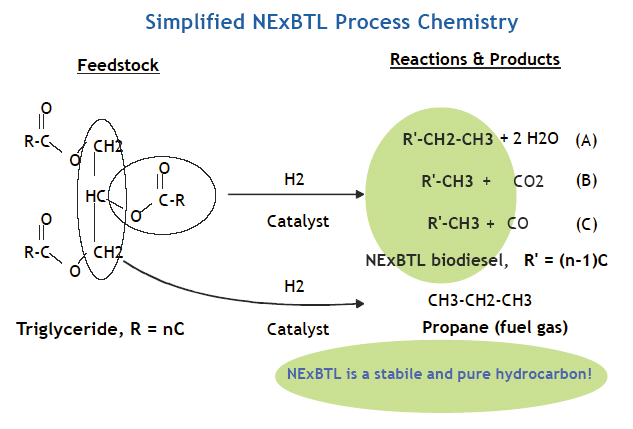
NExBTL's approach uses a high pressure hydrogenation of fatty acids from either plant or animal sources. It should also be able to use animal offal from meat processing plants and abbatoirs.

Neste Oil’s refinery-based proprietary NExBTL technology is based on the high-pressure hydrogenation of fatty acids. The product is a synthetic diesel fuel, free of oxygen and aromatic compounds. Side products include propane and gasoline. The process can use a flexible input of any vegetable oil or animal fat to produce a product with characteristics similar to Fischer-Tropsch output. (Earlier post.)

The NExBTL process is different than both the transesterification process used to produced fatty acid methyl ester (biodiesel) and Fischer-Tropsch conversion used in BTL projects.

The trial, to start in fall 2007, will last until the end of 2010 and will embrace around 700 buses and 75 waste trucks. The aim is twofold: to reduce urban emissions and promote the use of biofuels on the road.

Vehicles in the trial will use either a 30% NExBTL – 70% conventional diesel oil mix or 100% NExBTL. Between 5,000 and 10,000 tons of the biofuel will be used annually, equivalent to 15-30% of the fuel used by buses and waste trucks in the Helsinki region. The trial includes the option to test other fuels for comparative purposes.

This public transport trial in Greater Helsinki is an important step for us, as it is a large-scale, highly visible and highly credible public initiative to test the operational and emissions performance of a second-generation biodiesel. We believe that our biodiesel will enable urban transport emissions to be cut significantly.

—Kimmo Rahkamo, Neste Oil Executive Vice President, Components
The trial will require national public funding, and an application will be lodged for a tax concession on the biocomponent to be used. Alternatively, use will be made of incentives linked to biofuel legislation planned for introduction in Finland in 2008 or an investment grant to cover the logistics costs involved.


Porvoo Refinery in July 2006. Photo: Suomen Ilmakuva Oy
The first NExBTL production plant is currently under construction at Neste Oil’s Porvoo refinery. With a rated capacity of 170,000 tonnes/year, the facility is scheduled to come on stream in summer 2007.

Neste Oil intends to extend NExBTL biodiesel trials to public transport in other EU capitals in the future. Neste Oil’s Board of Directors has approved a strategy aimed at making the company the world’s leading producer of second-generation renewable diesel fuel. The company also has NExBTL joint ventures with Total and OMV.

Comment excerpt:
In terms of feedstock, this competes against fatty acid methyl esters (FAME), known colloquially as biodiesel. Pure FAME is subject to biological contamination. Even blended, FAME is more aggressive toward certain vehicle fuel system components (filters, seals, Bosch unit injectors etc.) than mineral diesel - the vehicle manufacutrer may requrie a relatively inexpensive retrofit. The cloud point is relaitively high, though work on additives is bringing it down so FAME blends can be used in mild winter weather.

The Neste process yields alkanes rather than esters, meaning it can more easily be used for winter diesel blends. Instead of highly viscous glycerol, the by-product is propane gas, which can be used as a feedstock for the steam reformer that yields the neccessary hydrogen.

More information and comments at the source.

As noted in the comment above, the new process should make biodiesel more useful for cold weather use.

Eventually the modern world needs to move away from combustion style energy production, due to the chemical byproducts of combustion, but for the time being biofuels that can substitute for petro-fuels--even in combustion engines--will be extremely useful.

Labels: , , , ,

Sunday, July 09, 2006

Like I Have Been Saying . . . . News from the Fuel Cell Forum in Lucerne


The annual fuel cell conference of the European Fuel Cell Forum was held in Lucerne, Switzerland, last week. Much of the sentiment from the conference in regard to hydrogen energy storage was compiled in this Reuters newsreport:

When environmentally friendly wind electricity is used to generate hydrogen, only one-quarter of the energy generated by the wind turbine is eventually used to move a car. The rest is lost during transport and energy conversion, said Ulf Bossel of the European Fuel Cell Forum, which held its annual fuel cell conference in Lucerne, Switzerland, last week.

"With hydrogen energy you only have 25 per cent efficiency to turn wind power to [car] wheel power," he said. It's much more efficient to transport that electricity directly into a car battery, via the grid, and use 90 per cent of its power."

Hydrogen is being discussed at the conference because it is one of the fuels for cells that can generate electricity and heat in an electrochemical conversion.

....Bossel said most renewable energy will be harvested as electricity through wind and solar power and should be used directly.

But he accepted that today's economy is based on fuels and cars will need some liquid fuel for long journeys, rather than recharging batteries every few hundred kilometres.

Even when this liquid energy is made from biomass, it makes sense to turn it into a biodiesel rather than hydrogen, said Wim van Swaaij, professor of thermo-chemical conversion at Netherlands' Twente University.

Biofuels are easy to handle, like today's fuels. Hydrogen, in its pure form, needs to be stored under high pressure which also consumes energy. Biofuels themselves contain hydrogen but in a much more stable form.

"Through steam reforming technology we can turn 40 to 50 per cent of the original fuel content in biomass into biofuel. The percentage is even higher for hydrogen, 50 to 60 per cent, but we will also have to store it and biofuels are the easiest and most efficient way to store it," Van Swaiij said.

The carbon particles in the biofuel will not make a net contribution to heating up the Earth through the greenhouse effect if the fuel is harvested from biomass, because the plants consume carbon dioxide as they grow, Van Swaaij added.

Bossel also said that producing hydrogen, either through electrolysis using nuclear or renewable electricity, or refined from biomass or fossil fuels, requires massive amounts of water. One kilogram of hydrogen requires nine litres of water.

In capitalist countries, the market will decide efficiencies based upon pricing--supply and demand--within the context of government regulation. We should all hope that government does not chase the wild albatross of hydrogen storage too much farther. Eventually nanotechnology and materials technologies may make hydrogen viable, economically. At present it would be smarter to bank on alternatives, such as batteries, supercapacitors, and biofuels such as bio-butanol and biodiesel.

Labels: ,

Monday, May 08, 2006

Progress in Hydrogen Fuel Cells

Hydrogen gas combines well with oxygen gas inside hydrogen fuel cells for efficient electricity generation. Unfortunately, hydrogen gas is unwieldy to carry in an automobile, and not very energy dense. Liquid fuels are much better fuel for transportation applications, than hydrogen gas. Using methanol or ethanol might be ideal if the proper catalysts could be found.

Scientists at Pacific Northwest National Laboratory and the University of Idaho have developed a highly efficient catalyst of multi-walled carbon nanotubes decorated with tiny particles of a platinum and ruthenium composite. Preparation is a key factor in determining the activity of a catalyst.

The researchers selected a process using supercritical carbon dioxide, which has the properties of a gas and a liquid. The supercritical fluid technology may result in products and processes that are cleaner, less expensive and of higher quality than those produced using conventional solvents.

The technology also is easily manipulated to allow a fine degree of control and is easily separated from the catalyst. Moreover, it is nontoxic, which could improve worker safety and reduce environmental impacts.

PNNL scientist Yuehe Lin will discuss “Pt and Pt-Ru/Carbon Nanotube Nanocomposites Synthesized in Supercritical Fluid as Electrocatalysts for Low-Temperature Fuel Cells” at NSTI Nanotechnology Conference, May 7-11, Boston.
Source.

Very clever to decorate carbon nanotubes with nano-particles of platinum and ruthenium. An excellent way to maximise surface area, what?

Labels: ,

Older Posts