Saturday, May 17, 2008

General Information on Crude Glycerin Byproduct

Excerpted from Renewable Energy Online:
Crude glycerol is not a valuable product and currently sells for about 1 to 2 cents per gallon. For every 100 pounds of biodiesel produced, 10 pounds of glycerol is also created.

...Traditionally, glycerin has been used to produce nitro-glycerin and soap. But crude glycerin can also be burnt, composted or fed to ruminants. Research on turning glycerin into an alternative to antifreeze is also within grasp.

Burning glycerin for heat and power can render positive effects, however, temperature is a significant concern. Burning [ed: crude] glycerin at temperatures between 200 and 300°C (392-572°F) emits toxic acrolein fumes so temperatures beyond 1,000°C (1832°F) are necessary.

As a sugar, glycerin can be a considerable addition to compost. This is a much simpler option. However, it is important to make sure the glycerin does not cut out oxygen and negatively affect pH, which harms the composting bacteria. Glycerin is also a liquid and therefore hard to contain. Since it can be harmful to ground and surface water, it is vital to prevent leakage.

...A third option is to feed the crude glycerin to ruminants. In actuality, there are no regulations that affect the use of glycerol as a feed additive. The overall consensus is that crude glycerol can comprise up to 15 percent of a ruminant animals diet and 15 percent of pelleted feed mix. Dairy cows are the exception where a study found the limit to be 1 to 5% with an improvement in energy balance when glycerol comprised 2% of their diet.

Assuming the crude glycerin is 80% pure glycerin, Brett Hess from the University of Wyoming thinks that crude glycerol should sell at 89% of the price of cornstarch. This would give it a price of 1 to 2 cents per pound or 10 times current market value. However in most cases, crude glycerin is 50 to 60% pure and thus should be discounted 33%.

The two other product options for glycerin, making hydrogen or propylene glycol, are still in the research phases. Since the process is complicated, when and if it becomes technologically mature, it will likely be done in centralized plants. This basically means small biodiesel producers will probably only need to invest in storage and sell their glycerin much like a lot of restaurants are selling their waste oil.

The other upcoming use for glycerin is propylene glycol. It can be used as a non-toxic anti-freeze, coolant, or deicer. Although petroleum based ethylene glycol is currently much cheaper, it remains a non-renewable resource that is highly toxic and as such is bound to lose popularity.


More information in the "resources" section here.

As the quantity of produced biodiesel is ramped up, it will be more important to find profitable uses for byproducts such as glycerin, which are up to 10% of biodiesel production by weight. If the value of crude glycerin is to go up between 5 and 10 times its current price, that would represent a significant price adjustment, and should be accounted for by all business interests contemplating using glycerin as a feedstock.

Labels:

Another Energy from Glycerin Approach

This article was originally posted at Al Fin:

Here is more information on the Cyclone external combustion engine that is set to power ten 1-MW electric generators. I call it a "hybrid" cycle engine, because it has features belonging to Rankine, Carnot, Diesel, and Stirling cycle engines.
The parties' plans are to power these industrial generators using a glycerol-based synthesis gas produced through Florida Syngas' proprietary plasma process called GlidArc™. Glycerol, the waste product of the bio-diesel industry, is a hydrogen rich, carbon neutral gas with its only waste products being hot water and useable heat. Under the agreement, Florida Syngas will design and build the synthesis gas converters, and Advent Power Systems will develop the engines and generator sets utilizing Cyclone's patented engine technology. Development of the equipment will be co-located in both Grant and Coconut Creek, Florida.___Source

The primary components of the engine include a condenser, steam generator and the requisite valves, cylinders, pistons, pushrods, main bearing, cams, and camshaft. Ambient air enters the engine through the intake blower, which circulates it through the condenser. According to Schoell, the flat-plate condenser �looks like a set of stacked record albums where air goes around the outside of the discs while the vapor on the inside is spun.� It is then directed through heat exchangers, and the air is pre-heated, enters the steam generator, and is mixed with atomized fuel that is also spun in the centrifuge.

...The power output is controlled by a rocker arm and cam design that opens and closes a needle valve in the head. This introduces high-pressure, high-temperature steam into the cylinder and provides the expansion force necessary to drive the pistons. Because it relies on the expansion of the fluid and not the expansive capacity of the fuel to create power, the Cyclone engine is fuel independent.___Autofieldguide

Whereas the old steam engine wasted most of its thermal energy (as much as 90%), the Cyclone Engine is highly efficient due to reheat and regeneration that recycle more than 30% of the heat generated from burning fuel. The engine operates at supercritical pressure (3,200 PSI) and temperature (1,100 degrees F) which makes the superheated steam behaves like a fluid rather than a gas so improving efficiency and making for a more compact engine. The overall thermodynamic efficiency is in the range of the Diesel engine (30-36%). The main advantages are: its capacity of using a wide range of fuels - gasoline, diesel oil, ethanol, kerosene, powdered coal, natural gas, etc.; continuous and complete combustion of fuel, creating less emissions than current gasoline or diesel powered internal combustion engines; high torque at start (700 ft/lb) which eliminates the need for a clutch and gearbox, simplifying the project and cutting down on power losses in transmission; the working fluid, water, is used to lubricate the engine, what avoids the long-standing problem of steam engines, the contamination of lubricating oil by water.___Wikipedia

Using glycerol-derived syngas for fuel is reasonable at this time, since glycerol is an inexpensive byproduct of biodiesel manufacture.

The Florida plans for 10 cyclone driven 1-MW generators, combined with the plasma syngas operation, demonstrates yet another "energy from garbage" approach. Forida appears to be in the vanguard of the advanced energy-from-garbage industry. That is unfortunate from the viewpoint of tourists who were hoping to see huge mountains of landfill dotting the Florida landscape in the near future. At this rate, Florida will be importing half the world's garbage before long--to use as fuel.

Cyclone Power Technologies

More Information on Cyclone engine operation

Labels: , ,

Friday, May 16, 2008

Fuel from Waste Glycerin? We'll See

There is enough waste glycerin produced in the US to produce "8 billion megawatts per year." So says XcelPlus Global Holdings, which intends to bring the new glycerin product called "Gly-Clene" to market.
Gly-Clene has the ability to power up turbine engines for electricity production or any other non-aircraft use associated with turbine engines. Gly-Clene can also be used to heat fluid bed reactors as it also performs well in oil gun furnaces as you can see in a soon to be released video linked on www.xcelplusglobal.com .

With the ever-increasing biodiesel production, the glycerin market grows as well. Subsequently, the fear of another glut has concerned biodiesel manufacturers, scratching their heads looking for a stable way to dispose of this by-product.

There is currently enough glycerin produced in the U.S. alone for Gly-Clene to produce 27,000 megawatts of electricity per day or over 8 billion megawatts per year[ed: wtf?] without even adding steam turbines to take advantage of the excess heat produced by the turbines. _EnergyDaily
Interesting, but a bit vague. A brief glimpse at the XcelPlus Global Holding website suggests that the company has ambitious goals in the field of bio-energy. Best to remain skeptical until we see more, however.

What do they mean by megawatts per day or per year? I doubt that what they say is what they mean. If they mean that there is enough excess glycerin so that using their product one could generate an average of 27,000 megawatts over a day, that would mean something--and it would be impressive. That would be roughly 27 new nuclear power plants worth of power. But we cannot know that is what they mean, without them being more clear.

Energy Daily should know better than to use inappropriate units which can only confuse the issue. As for the actual technology involved, we will just have to wait for more information to decide.

Labels: ,

Saturday, October 21, 2006

A Better Biodiesel from NExBTL--This Sounds Good

A recent story from Green Car Congress highlights a fascinating new approach to producing biodiesel that appears to be much better than the conventional transesterification approach, and different from Fisher Tropsch.

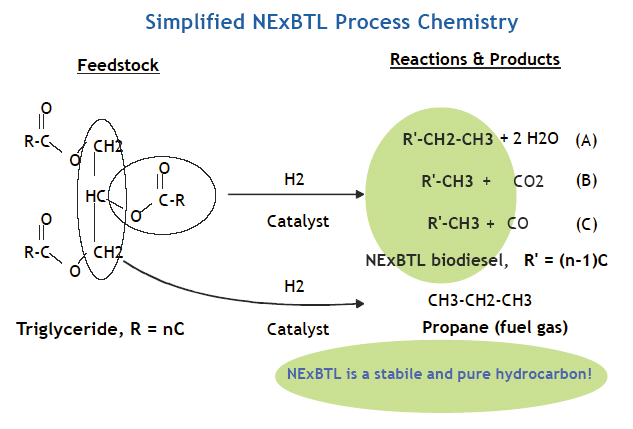
NExBTL's approach uses a high pressure hydrogenation of fatty acids from either plant or animal sources. It should also be able to use animal offal from meat processing plants and abbatoirs.

Neste Oil’s refinery-based proprietary NExBTL technology is based on the high-pressure hydrogenation of fatty acids. The product is a synthetic diesel fuel, free of oxygen and aromatic compounds. Side products include propane and gasoline. The process can use a flexible input of any vegetable oil or animal fat to produce a product with characteristics similar to Fischer-Tropsch output. (Earlier post.)

The NExBTL process is different than both the transesterification process used to produced fatty acid methyl ester (biodiesel) and Fischer-Tropsch conversion used in BTL projects.

The trial, to start in fall 2007, will last until the end of 2010 and will embrace around 700 buses and 75 waste trucks. The aim is twofold: to reduce urban emissions and promote the use of biofuels on the road.

Vehicles in the trial will use either a 30% NExBTL – 70% conventional diesel oil mix or 100% NExBTL. Between 5,000 and 10,000 tons of the biofuel will be used annually, equivalent to 15-30% of the fuel used by buses and waste trucks in the Helsinki region. The trial includes the option to test other fuels for comparative purposes.

This public transport trial in Greater Helsinki is an important step for us, as it is a large-scale, highly visible and highly credible public initiative to test the operational and emissions performance of a second-generation biodiesel. We believe that our biodiesel will enable urban transport emissions to be cut significantly.

—Kimmo Rahkamo, Neste Oil Executive Vice President, Components
The trial will require national public funding, and an application will be lodged for a tax concession on the biocomponent to be used. Alternatively, use will be made of incentives linked to biofuel legislation planned for introduction in Finland in 2008 or an investment grant to cover the logistics costs involved.


Porvoo Refinery in July 2006. Photo: Suomen Ilmakuva Oy
The first NExBTL production plant is currently under construction at Neste Oil’s Porvoo refinery. With a rated capacity of 170,000 tonnes/year, the facility is scheduled to come on stream in summer 2007.

Neste Oil intends to extend NExBTL biodiesel trials to public transport in other EU capitals in the future. Neste Oil’s Board of Directors has approved a strategy aimed at making the company the world’s leading producer of second-generation renewable diesel fuel. The company also has NExBTL joint ventures with Total and OMV.

Comment excerpt:
In terms of feedstock, this competes against fatty acid methyl esters (FAME), known colloquially as biodiesel. Pure FAME is subject to biological contamination. Even blended, FAME is more aggressive toward certain vehicle fuel system components (filters, seals, Bosch unit injectors etc.) than mineral diesel - the vehicle manufacutrer may requrie a relatively inexpensive retrofit. The cloud point is relaitively high, though work on additives is bringing it down so FAME blends can be used in mild winter weather.

The Neste process yields alkanes rather than esters, meaning it can more easily be used for winter diesel blends. Instead of highly viscous glycerol, the by-product is propane gas, which can be used as a feedstock for the steam reformer that yields the neccessary hydrogen.

More information and comments at the source.

As noted in the comment above, the new process should make biodiesel more useful for cold weather use.

Eventually the modern world needs to move away from combustion style energy production, due to the chemical byproducts of combustion, but for the time being biofuels that can substitute for petro-fuels--even in combustion engines--will be extremely useful.

Labels: , , , ,

Older Posts