Tuesday, July 24, 2012

Food vs. Fuels? No. Food vs. Everything!

The food vs. fuels debate is being framed in an artificially constrained manner, quite remote from the realities of both food and fuels.

First of all, things which are commonly considered food are being used for producing much more than just fuels. "Foods" are being used to make plastics, chemicals, automobile tyres, and much, much more.

But much more damning to those who engage in such artificial debates, is the fact that the concept of what constitutes "food" is undergoing a radical change. Synthetic foods and unconventional foods are likely to grow far more common as humans learn to live in a much wider range of habitats, where conventional foods may be harder to come by.

In other words, we are approaching an era when just about anything can be turned into food, and when food can be turned into just about anything.

Such a state of affairs clearly makes mincemeat out of any simplistic arguments such as "food vs. fuels."

Even today, only 15% of worldwide maize is used for human food. Most maize (almost 70%) is used for animal feed. Of all the other uses, the production of fuels must compete with a growing range of other economical industrial uses. Food vs. fuels indeed.

But in the future, the breakdown of uses for feedstocks which are often considered "food" is likely to grow far more complex and more difficult to pin down, from year to year.

In an era of dumbed-down schools, skankstream media, and idiocratic government, the most prominent arguments occupying the public sphere tend to be less than meaningful. But you do not have to allow your brain to decompose on such mental fodder. Try to look beyond the commonplace... try not to fight yesterday's wars or fight battles which were meaningless years ago, let alone today or tomorrow.

Labels: ,

Wednesday, November 30, 2011

Is Codexis [NASD:CDXS] the Next Apple (NASD:AAPL)?

It’s Apple 2002 promise, at Apple 2002 prices. Now, can Alan Shaw and team pull it off? At Codexis, they think so – do you think so? We’ll continue to watch the space closely. _altenergystocks
The case for Codexis looks interesting, in the intermediate run. Rather than to make biofuels from valuable cane sugar, Codexis intends to make high value chemicals and fuels from the leftover bagasse.

Codexis' argument is based upon possession of a large mass of free and renewable feedstock -- cane bagasse -- and a portfolio of advanced and economical cellulose-to-fuels and chemicals technologies it has been developing.
Sugarcane is 1/3 sugar, 1/3 bagasse and 1/3 tops and leaves, in round numbers. As mechanical harvesting brings the tops and leaves off the fields and into the mix, it can release the bagasse for higher value creation opportunities, than simply burning it to generate power, as happens today.

Given a 50-mile radius, says Shaw, there are opportunities for utilizing up to 60,000 metric tones of bagasse, per project, in the nearer term, and up to 100,000 MT in the future.

$600 billion, by the numbers

That bagasse is already paid for, aggregated at the mill. You can make $3 fuels or $6 chemicals from it, with feasible margins on either. Say, at 100 gallons per tonne. And there are more than a billion tonnes of bagasse available from the land that the Brazilian government has approved for cane cultivation. So, somewhere north of $600 billion in value, just in the bagasse.

Which is where the value really lies, says Shaw. The cane sugar, he says, is too exposed to the food markets and commodity speculation. But no one eats bagasse, and you need advanced technology to unlock the value. That’s a barrier to entry that preserves value, he says. _altenergystocks
And every year, roughly the same amount of bagasse becomes available at roughly the same price -- free.

Of course the $600 billion figure represents the potential value in all the bagasse in Brazil. But the first advanced technology company capable of profitably utilising the bagasse -- converting it to valuable chemicals and fuel economically -- is likely to move rapidly to gain access to a significant portion of this newly valued resource.

And there are a lot more countries in the world where sugar cane could potentially be grown, if it were worth a person's while to do so.

Can you imagine a situation where sugar cane were grown for the bagasse, with the sugar produced as a by-product? Such a thing would make the food for fuels debate seem almost ridiculous. Particularly if other waste biomass residues were to become utilised on a similar scale.

Labels: ,

Thursday, October 13, 2011

Can Biofuels Replace Petrofuels by 2030?

A new report from Pike Research forecasts the doubling of global biofuels value to $185 billion by 2021. More at GCC Logically, since such changes typically occur exponentially, one would expect another doubling by 2026 and yet another doubling before 2030 -- to a global biofuels value of near $800 billion. While that level of production is not large enough to replace petro-fuels, it is more than large enough to destroy the dreams of peak oil doom-disciples.

But is it logical to expect that type of growth in biofuels over the next 20 years? One of the largest obstacles to that rosy picture, is the fact that it will be generally cheaper to convert coal, gas, bitumen, kerogen, and methane hydrates to liquid fuels, than it will be to convert biomass to liquid fuels. As long as those feedstocks are readily available at cheap prices, large scale biofuels will likely depend on government regulations and mandates to be profitable.

What about the food vs. fuels debate? This question is easier to answer, and has always been something of a tempest in a teapot. Better methods of food production are spreading across the globe, which as long as third world birthrates do not balloon, will ease food pressures in the hungrier parts of the planet. Biomass for biofuels will come from a variety of sources, including specially designed and adapted energy crops, energy crops that are grown in seawater and on salty or marginal soils, and perhaps even crops that are grown inside cities themselves, on integrated high rise farms. Crop growing area will not be a problem, since algae can grow on roughly 80% of the Earth's surface -- and algae are the most prolific biomass crop known. More on algal biomass

The conversion from petroleum fuels to biofuels, synthetic fuels, and other unconventional fuels, is likely to be uneven and tumultous. As economic conditions change, levels of demand for fuels will change. As technologies for different types of fuel production develop, the economic benefits and costs will shift to favour different types of production. We should not expect to see a smooth, exponential growth in the production of biofuels between now and 2030. Instead, we are likely to see a very bumpy and uneven -- but significant -- level of growth in bioenergy and advanced biofuels.

Biofuels will not replace petrofuels, because there will be no need for total replacement. Such ideas are absurd on their face, and inconsistent with how real world economies of substitution work. In the absence of government interference, biofuels will have to compete with petro-fuels and synthetic fuels from unconventional hydrocarbons. These liquid fuels will have to compete with gaseous fuels and electrical systems for heat and transport.

If a long-awaited nuclear renaissance occurs, electrical systems of heat and transport will be given a huge boost, and will begin to take market share away from liquid and gaseous fuels.

It should be pointed out that government has been the enemy of safe, abundant, reliable energy. In particular, the energy starvation agendas of green-influenced governments in the US, Germany, and other western governments are causing undue economic hardship on their citizens -- and retarding the onset of a more abundant and prosperous future. In addition, these green-influenced government policies are worsening environmental conditions, rather than improving them, out of a misguided pseudoscientific carbon hysteria.

Labels: , , ,

Friday, November 05, 2010

Palm Still King of Oilseeds; Food vs. Biofuel Still Stupid Argument

Robert Rapier takes a good look at palm seed oil in Malaysia. Robert reports that palm yields about 5 tons of oil per hectare, although it requires about 4 kg of fertiliser per tree. Oil Palm is planted as a monoculture, often on converted rainforest. Brazil is often mentioned as having a rich tropical oilseed potential due to the vast rainforests there.

The issue of food vs. biofuels naturally came up in comments, with some commenters categorically declaring that it is "wrong" to use a food crop for fuel. The stupidity of that point of view is almost beyond belief, unless you consider how modern universities have become political indoctrination centers, rather than places to hone one's adult thinking skills on real world issues.

The choice of whether a farmer will sell his food crop to a food distributor / processing company, or will sell his crop to a biofuels maker, is an economic decision best left to the farmer. In fact the farmer had to plan well ahead to determine all the factors going into how much of what crop he would plant on which parcel of land. He made those decisions based upon his belief that a market for biofuels would be available when his crop is harvested.

Farmers could easily have done something -- anything -- different with that parcel of land. He could have grown fodder for livestock, or let the land grow a simple cover crop to regenerate its nutrients. He could have grazed livestock on the land, or developed it for construction.

Every decision down the line is an economic choice, based upon the farmer's needs and economic choices. Knowing that the market for biofuels exists, farmers are likely to plant more crop -- as long as the market price can support it. That is exactly what has happened in the US corn crop. More maize is being grown than would otherwise be the case, so as to supply the human food market, the animal food market, and the biofuels market -- trying to get the best available price in all three.

Every resource could conceivably be converted to food, some way or another. For example, you could tear down your house, fill in your swimming pool, tear up your tennis court, and otherwise convert your private property into food-growing area. For some reason, though, we rarely hear about the "homes vs. food" controversy.

If the world were really hard up for food, we could use dead human bodies as fertiliser for food crops, rather than wasting all that nutrient in cremation or burial. Does anyone talk about the "food vs. burial" controversy?

As far as fuels go, fossil fuels could easily be converted into fertilisers -- even into edible foods using edible yeasts and such. Do you hear a lot about the "petroleum vs. foods" controversy?

Some resources are more efficient at creating food than others. And certainly only a relative few individuals are truly good at producing abundant crops. It would be easy to produce far more food than humans could possibly consume, with most of it going to waste. But that would be a poor economic use of resources.

Smart farmers do not plan to waste resources, unless the government or other mafia-type protection group forces them to do so via incentives. If market conditions tell them that there is a relative shortage of fuel and a relative excess of food, they may well focus on producing crops for fuel that year. Having choices such as that is a good thing for farmers, and likely to help them stay in business longer than would otherwise be the case.

It seems that most of the people who dwell on "food vs. fuels" are also people who call themselves environmentalists or who belong to the dieoff.orgy cult. In reality, these dieoff.orgiasts don't want humans to have any energy at all -- food or fuels -- until 90% of humans die off. So we actually know their viewpoint before they even communicate.

Labels: ,

Thursday, June 11, 2009

Food Waste to Fuels

Humans in modern societies waste more food than they can imagine. But biofuels engineers and entrepreneurs are riding to the rescue, to turn what was once waste into useful fuels and energy.
Four ReFood plants already operating in Germany currently generate energy from food collected from 60,000 points across the country, using 14 logistics centres.

Like the German network, the British version will also use collection points located across the country, supported by the network of AD plants.

Anaerobic digestion involves organic wastes or energy crops being used to feed bacteria, which under controlled conditions generate a biogas that can be put through an internal combustion engine or burned to generate heat and power.

Mr Simpson said the ReFood technology was "very advanced" compared to other AD technologies available in the UK since it was designed around using food waste as a feedstock, rather than an adaptation of technologies using sewage sludge or farm wastes.

"As a result, the ReFood system is able to focus on recycling greater quantities of this type of material," he said.

Franz Bernhard Thier, a member of the board of Saria Bio-Industries, said: "ReFood has been operating on an industrial scale successfully in Germany for a number of years. We're delighted to be teaming up with PDM to bring both our areas of expertise together to create an offering that is really going to support food waste recycling and renewable energy generation in the UK." _bioenergy
While the uninformed debate over "food vs. fuels", more intelligent persons are looking into the future for ways to convert waste from an overabundance of food -- into energy and fuels.

Labels: ,

Thursday, October 09, 2008

More on Gasification, Plus Biofuels vs Foods Illusion

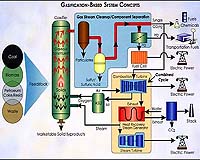
As mentioned previously, Exxon is pairing with Pratt & Whitney / Rocketdyne to develop efficient gasification technologies for clean coal technology and producing hydrocarbon chemicals and fuels from biomass.
"Gasification technology has the potential to help with many of our most pressing energy challenges and we are pleased to be involved in this important project, said Rich Pisarczyk, president of ExxonMobil Research and Engineering Company.

"Turning coal and similar energy sources into synthesis gas would allow these sources to be converted into a range of products, including chemicals, transportation fuels and power plant feedstock. Gasification also helps enable the adoption of carbon capture and storage and therefore reduces emissions from the use of coal and other heavy feedstocks.

Work has begun on pilot plants to test the technology at the Gas Technologies Institute in Des Plaines, Illinois, and the Energy and Environmental Research Center in Grand Forks, North Dakota. ExxonMobil is also cooperating with Pratt and Whitney Rocketdyne to assist in identifying potential interested parties for demonstration.

The collaboration takes advantage of ExxonMobil's technology leadership in the energy sector and Pratt and Whitney Rocketdyne's experience in rocket-engine development, with the goal of making real progress in gasification technology. _energy-daily
Meanwhile, the tired old debate of biofuels vs. foods continues among UN officials and other uninformed, self-important functionaries.
As a society’s wealth increases, its energy consumption rises far more quickly than its food consumption - in fact, food consumption eventually plateaus because people can only fit so much into their stomachs. This very fact is leading to a revolution — the result of which will be that, in the future, we will view fuel as a more important outcome from growing crops than food.

So, if biofuels are here to stay, how can the global community prevent millions of people from falling into famine due to competition of food land with biofuel land when biofuel land turns out to be more profitable? _gas2org
It is truly a debate for those who have nothing important to do with their time. People like college professors, government bureaucrats, political activists, and similar pseudo intellectual lightweights who get paid a lot of money for eating, drinking, and excreting.

In the real world, one does not think about feeding 9 billion or 10 billion people--now or in the future. In the real world, one sets about developing local and regional solutions for all parts of the world. Solutions which the people themselves can implement and operate, if possible. Trying to solve all problems for all people with one policy is the mark of an idiot.

Labels: ,

Wednesday, September 10, 2008

More Small Revolutions in Bioenergy

Synthetic bacteria that can produce ethanol.
"Our new microorganism, called TM242, can efficiently convert the longer-chain sugars from woody biomass materials into ethanol. This thermophilic bacterium operates at high temperatures of 60oC-70oC and digests a wide range of feedstocks very rapidly," said Paul Milner.

The scientists estimate that some 7 million tons of surplus straw is available in the UK every year. Turning it into ethanol could replace 10% of the gasoline fuel used in this country.
The debate about food vs. fuels has occupied a lot of small minds around the world. But there really is no debate--once you take account of the abundant resources of the sea and seawater.

What is the potential for algal biofuels?
"As a transport fuels feedstock, algae can produce up to 10,000 gallons of biodiesel feedstock per acre per year compared to soybeans at 50 gallons per acre and canola/rapeseed at 120 gallons per acre," said Will Thurmond, Chairman of Research and Development for the NAA and author of the Biodiesel 2020 study. _Source
The big drop in palm oil prices is fueling renewed biodiesel production in Southeast Asia. Unlike the great "food vs. fuels crisis" of last spring, no riots are taking place on this news--so it isn't news at all, according to the media.

Finding the most efficient and economical way of shipping fuels and feedstocks will help the fledgeling bioenergy industry find its way. In the early stages, the smallest margins can make the difference between profitability and extinction.

With bioenergy, one uses the feedstock that is at hand. In Louisiana's bayou region, sugar cane grows quite well. Cane is being used as feedstock for a new cellulosic ethanol plant in the bayou--while the technology of cellulosic breakdown is perfected.

The smart operators will make allowances for rapid shifts in feedstock prices and availability. Do not bet your farm on one crop or one bioenergy feedstock.

Bioenergy remains the best near-term renewable energy potential. Solar thermal is getting bigger, and will help--once energy storage improves, and the technology shakeout in the field takes place. The same applies to photovoltaics--although PV will take longer to hit large scale viability due to difficulties with electrical storage vs. heat storage. Enhanced geothermal will eventually be a huge resource--viable from Antarctica to the Arctic to undersea habitats to the remotest island. Others, such as OTEC, wind, tidal, wave etc. will find niche usefulness.

But ever since humans learned to control fire, bioenergy has occupied the community hearth of hearths. Fossil fuels are forms of bioenergy that take a long time to fossilize. So only nuclear energy--among the large power producers--is non-bioenergy.

Labels: ,

Saturday, August 09, 2008

The Promise of Algae vs. Peak Oil Doom

Algae doesn't think in terms of limits. A single-celled algae, gazing out across the Pacific Ocean, has only one thought: "That looks like a good place to spread out and grow!" In fact, algae thinks exactly the same thing about a wastewater pond, a brackish estuary, or a large freshwater lake. Algae was meant to grow fast, needing only sunlight, CO2, and a few nutrients from water--wastewater will do. Algae has never believed in peak anything.
• Algae can thrive in fresh, brackish, or seawater — and very little of that is required.

• There is no need for any soil, much less good soil, as algae grow hydroponically.

• With more than 20,000 known varieties of algae, species can be chosen for high lipid content (e.g., for diesel fuel) or high sugar content for distillation purposes.

• In desert climes it can be harvested on a day-by-day basis because it grows so quickly.

All it takes is sunlight, water, and carbon dioxide to provide the energy for arguably the most complex process we see in nature: photosynthesis. _Source
What about cellulosic biofuels? Is there a conflict between cellulosic fuels and algae biofuels?
.....the market for transportation fuels is big enough for cellulose and algae; they compete with petroleum, not with each other......extraction of fuel from algae depended on flat land, abundant water, sun and injections of CO2. _EcoWorld
At this time, algae biodiesel costs between $15 and $20 a gallon to produce. Dozens of research efforts are aimed at bringing the cost of production for algal biodiesel into the competitive range. The University of Virginia, University of Arkansas, Cal Poly, and other research institutions are rushing to make breakthroughs in the economic production of algal fuels. One particularly innovative approach to algal fuels is the use of algae as part of a three-pronged bio-energy-food eco-industry, combining a fish farm, algae production, and feed production.
Instead of having a waste stream [from the fish farm] that contaminates the environment or needs costly disposal, combining the Aqua-Sphere with algae production creates a second income stream by producing feedstock for biodiesel. Papadoyianis also sees benefits to the biodiesel industry as aquaculturists move into algae production. “The way I see it, buying a piece of land and constructing an algae facility and having a whole staff just to produce the algae will make your cost of production go way up,” he says. “We are looking at this as a secondary crop that doesn’t take a huge secondary investment. For a medium-sized operation you can basically use the same staff as you have for the fish operation.

The process could be diversified even further as the company develops a third product, an insect-based fish food it calls Ento-Protein. The product would replace food currently made from fish meal, which has more than doubled in price since 2006, and is made from insects grown on agricultural waste and industrial coproducts, including distillers dried grains from ethanol plants. Papadoyianis foresees using the algae cake remaining after the oil is extracted as another feedstock for the Ento-Protein operation. _Biodiesel
A two day conference dealing with algae as "the new oil" is coming up October 23-24 at the Woodlands, in Texas. More from the National Algae Association

Previously published at Al Fin

Labels: , ,

Wednesday, August 06, 2008

2nd Generation Biofuels: The Challenge

Australia's Commonwealth Scientific and Industrial Research Organisation (CSIRO) has issued a new report, "Future Biofuels for Australia", discussing second generation biofuels for Australia.
Two major conversion processing platforms exist:

1. enzymatic conversion - enzymes are added to pretreated plant material to depolymerise it to individual sugars which can be fermented to fuels
2. thermochemical - lignocellulose is heated to moderate or high temperatures to produce mixtures of chemicals which can be further transformed by catalysts or microorganisms, to fuels. _CSIRO
While Australia's biomass capacity may be modest next to that of North America, the tropics, or the Russian Steppe, its population is also relatively small. The objective is to meet needs, not to outdo everyone else in production.

"The European Biofuels Challenge" is a new free download discussing several aspects of the transition from 1st generation biofuels to 2nd gen fuels. It contains information on:
* First and second-generation biofuels
* Descriptions of the different types of biofuels currently in use
* Political and environmental reasons for the importance of biofuels
* Drivers and obstacles to the biofuels market
* Trends in the European market such as production heading to Eastern Europe
* The media backlash and furore over the food vs. fuel debate
* Sustainability criteria for biofuels
* Emerging new technologies
* Evidence of industry entrepreneurship
_Download PDF Report Free
The economics of various biofuels approaches are still being worked out. Lignocellulosic energy will eventually supercede fuels from 1st generation biofuel crops such as maize, soy, rape, etc. Whether lignocellulose can provide more economical yields than tropical oilseeds is yet to be determined.

Long-term, fuels from custom-designed micro-organism colonies in serial bioreactors will probably be competing with genetically engineered petroleum-trees and high-yield micro-algae.

1st generation, it is palm oil biodiesel, sugar cane ethanol, and maize ethanol that lead the pack.

2nd generation, it will be ligno-cellulosic alcohols, non-food oilseed biodiesels (along with palm), and perhaps marginally competitive algae biodiesels.

3rd generation, custom biologicals will be mass converting garbage, CO2, and biomass into custom fuels and proto-fuels, as well as even more valuable chemical products. Automobiles will be rapidly shifting to electric power.

By the 4th generation, most transportation loads will have converted to electrical sources of energy. Jet aircraft and spacecraft will be the main consumers of chemical fuels.

Paradoxically, the longer the Luddite US Congress waits to allow development of US oil, coal, nuclear, and unconventionals, the longer it will take to transition to the advanced 3rd and 4th generation biofuels.

Labels: ,

Friday, July 11, 2008

The Idiots are Bashing Biofuels Again

"The American farmer successfully produces both food and fuel," said Caupert, director of the National Corn-to-Ethanol Research Center at SIU's Edwardsville campus.

He said myths such as the increased use of natural space to produce ethanol, the waste of water growing corn and making ethanol and the injury to poor people caused by making ethanol are rampant and wrong.
__Bioenergy
Biofuels vs. food is a debate for the uninformed. Why? Because there is only a false dichotomy there, so no grounds for such a debate exists. Biofuels are the nearest-term substitute for liquid petro-fuels. If our moronic elected officials do not unleash the energy industry to produce oil-equivalent from coal, shale oil, shale gas, and oil sands, there will be nothing but biofuel to fill the need for liquid fuels to power a pre-existing infrastructure. An infrastructure will take decades to replace.

Smart people are starting to recognize the potential. Leaders in various industries, such as oil, chemicals, automobile manufacturing, power equipment manufacurers etc. are starting to look to biofuels for part of the answer to curren shortfalls and high prices.
"Agriculture can supply the solution, providing adequate resources for food, feed and fuel far into the foreseeable future," John Pierce, DuPont Applied BioSciences' vice president for technology, testified at a Senate subcommittee hearing.

Agricultural yields from existing acres will continue to increase in this country, he said. With much of the world lagging behind this country in agricultural productivity, there are dramatic opportunities to expand production globally by bringing modern farming practices to other parts of the world.
__Bioenergy
We are faced with political peak oil. Better political leaders would free up much of the energy locked in the ground by moronic lead brains such as Boxer and Pelosi. But bioenergy offers another--although slower--way to provide today's infrastructure with liquid fuels.

Building enough nuclear power plants will take years and decades. Getting the utility-scale storage that is needed to turn solar and wind into viable baseload power will take decades. Getting enhanced geothermal into position to provide 20% or more of electricity for N. America will take decades.

Converting coal to oil equivalent can be done now, if given the go-ahead by government. Scaling up use of Canadian oil sands and heavy oils could begin now. Increasing development of Bakken oil fields could begin now. Intensifying research and development of harvesting huge oil shale fields could begin now.

Biofuels is on the threshold of plentiful, clean and affordable fuel from algae, cellulose biomass, and synthetic biological forms. Before that, biofuels from cane, sorghum, cassava, jatropha, palm, pangomia, moringa, coconut, and a legion of other biofuel crops will be refined and developed to economical forms.

This is only the beginning of the transition. Biofuels are like a newborn baby with apparently unlimited potential. Babies are a huge drain on resources at first, but if they are raised well, they grow up to take up the load.

Labels: ,

Monday, May 05, 2008

Cellulose vs. Maize vs. Algae: Race to Bioenergy

It is easy to see that no matter how much maize the US chooses to grow, China will be happy to buy it all to use as livestock feed. Corn ethanol will be abandoned not because of food shortages--which have little to do with corn ethanol--but because cheaper feedstocks for producing ethanol (and butanol) are being developed. Chief among these cheaper feedstocks is cellulose from waste biomass. Some parts of the world are particularly prolific in growing cellulosic biomass, and in their own way these regions may one day be considered the "Saudi Arabias of Cellulose."
“I heard recently that the Southeast will eventually be known as the Saudi Arabia of cellulose,” Tiller said of the region’s ease in growing native switchgrass and other potential supplies of biomass that could be used for cellulosic alcohol production.

In 20 years of research, UT has found that switchgrass — a biennial crop that takes two or three years to reach maximum potential with minimal fertilizer even on marginal soils — in one year can produce six to 10 tons an acre compared to hay, which produces one or two tons an acre and requires substantially more fertilizer.

New research may bring that to 12 to 15 tons an acre in the next few years, Tiller said. Research also is looking at ways to more densely pack switchgrass in bales, convert it to pellets, or even alter it genetically to start breaking down soon after harvest....

Tiller explained that the process under study uses a “steam explosion” — forcing heat and steam into the biomass and then drastically relieving the pressure — to coax the sugars out of switchgrass and other biomass, making the biomass “explode like popcorn.”

A lignin byproduct can be used to make biodiesel, other oils, carbon fibers and plastics, depending on the most efficient use and market demand.

And the cellulose and hemicellulose — aside from going to the fermentation and distillation process to make ethanol — also can be used to make biodiesel and other products, depending on economics and demands. __Source
The US consumes 400 million gallons of gasoline a day. Current US ethanol production would only provide about two weeks worth of fuel for the US. Clearly the US needs to rapidly scale up biofuels production--but not using corn. China would clearly outbid ethanol producers for any amount of corn US growers want to grow.

Until cellulosic biomass can be more cheaply converted to alcohols, the US will need to look to Brazilian cane ethanol, and other cheaper feedstocks such as sweet sorghum. Eventually, algae and other monocellular organisms are likely to provide better and cheaper feedstocks for biodiesel and bio-alcohol fuels. But algae still has a number of problems that need ironing out.

H/T NextEnergyNews

Labels: , ,

Older Posts