Tuesday, September 30, 2008

Weyerhaeuser to Add Cellulose Processing to Mills

The vast North American lumber industry is a natural match to the cellulosic biofuels, chemicals, and electricity industries. A huge amount of cellulosic mass is wasted in the lumber industry for various reasons. That biomass can be converted to very valuable products. Forestry giant Weyerhaeuser is looking more closely at its options.
Lignol Energy Corporation, a cellulosic ethanol and biochemical company, has signed a Memorandum of Understanding (MOU) with Weyerhaeuser Company to explore the development of commercial applications of biochemical outputs from Lignol’s proprietary biorefining technology.

The parties have also agreed to evaluate the development of a commercial-scale Lignol biorefinery plant at or near a Weyerhaeuser mill site. The MOU excludes applications for transportation fuel. The initial scope of the MOU involves the testing of certain biomass feedstocks within Lignol’s facilities, including the company’s integrated industrial-scale biorefinery pilot plant located in Burnaby, British Columbia.

Lignol uses a modified solvent based pre-treatment technology for cellulosic biomass, originally developed by a former affiliate of General Electric, and then further developed and commercialized for wood-pulp applications by a subsidiary of Repap Enterprises Inc. The technology produces a clean pulp that converts biomass feedstock rapidly into fermentable sugars with high yield and lower enzyme costs.

The process also produces co-products with revenues that mitigate the costs of production and commodity risks, including a high-quality cellulose fiber with applications in certain specialty markets and high-purity lignin (HP-L Lignin), an organic compound that is differentiated from other types of lignins that are typically produced as by-products in the traditional Kraft pulp manufacturing process. _GCC
Most of the emphasis on cellulose by the forestry and paper industries has been on cellulosic ethanol and other liquid fuels, but cellulosic electricity and cellulose-derived chemicals may prove to be even more valuable in the long run.

Along the same lines, Choren and Norske Skog/Xynergo are cooperating on evaluation of Biomass to Liquids (BTL) in Norway.

Production of high quality jet fuel from vegetable oils is progressing nicely.

Big industry around the world is entering the biomass and biofuels arena. Earth is the only biological world that we have discovered. For a sustainable energy future, bio-energy will stand alongside nuclear fusion, solar, and geothermal as the cleanest and most reliable energy sources on this planet. Nuclear fission and oil equivalent from coal, gas, oil sands, oil shales, and heavy oils will provide the energy bridge we need to cross from here to there.

Labels:

Monday, September 29, 2008

Exxon-Mobil Looks at Gasoline from Coal

Synthesis Energy Systems (SES) has entered an agreement with Exxon-Mobil Research and Engineering to examine and develop gasoline from coal, via gasification produced methanol. The methanol approach is a competitor to the Fisher-Tropsch method of producing liquid hydrocarbon fuels from syngas.
This approach to converting coal to gasoline first gasifies the coal, then converts the resulting syngas to methanol for use by the MTG process. The conversion of methanol to hydrocarbons and water is virtually complete and essentially stoichiometric in the MTG process. The reaction is exothermic with the reaction heat managed by splitting the conversion in two parts. In the first part, methanol is converted to an equilibrium mixture of methanol, dimethyl ether (DME), and water.

In the second part, the equilibrium mixture is mixed with recycle gas and passed over a shape-selective catalyst to form hydrocarbons and water. Most of the hydrocarbon product boils in the gasoline boiling range.

ExxonMobil calculates that a feed of around 4.6 million t/year of coal can produce about 1.4 million t/a gasoline—about 36,000 barrels per day. Yield and capital costs are dependent on the coal quality: ash content, moisture content, sulfur and heating value. _GCC
If this process is a more economical producer of gasoline-from-coal than the F-T process, it may see a lot of use. The big obstacle to advanced energy from coal, oil shale, oil sands, heavy oils, and other sources (such as nuclear) is the Luddite US Congress--and the threat of a new Luddite administration in the White House if Obama/Biden are elected.

The fear of CO2 -- which has what plants need -- is one of many pseudo-environmental concerns that has wrapped frigid fingers of fear around the minds of western government leaders. So much so, that they flirt with disastrous and suicidal policies of energy starvation, which contribute to the inevitable economic hardships they cause by over-regulation, over-taxation, and rampant corruption. It is time for things to change, but unfortunately, these corrupt and fearful "leaders" are fixed in place--barnacle-like leeches.

Labels: , ,

Friday, September 26, 2008

Coal Polygeneration: Cleaner, More Efficient Coal

A new special report from Nexant provides information on the exciting new possiblities from the co-production of power,chemicals, or fuels using clean and efficient coal gasification technologies.
Advanced coal gasification technologies have raised the efficiency of coal conversion far above that of conventional coal combustion. As a result, these advanced technologies offer the promise of economically and environmentally acceptable uses of coal for chemicals and liquid fuels.

One of the more promising advanced development concepts is polygeneration from coal. Polygeneration involves the gasification (or conversion) of coal to produce synthesis gas (syngas) that can be simultaneously used for the generation of electricity and in the manufacture of chemicals and liquid fuels. This approach offers an integrated strategy for optimizing the value of coal.

In polygeneration from coal, electricity is produced in conventional integrated gasification/ steam turbine combined cycle (IGCC) systems, while commodity chemicals (methanol, ammonia, and their derivatives such as olefins and acetic acid from methanol and fertilizers from ammonia) or liquid fuels (methanol, diesel, dimethyl ether (DME), and gasoline) are produced via state-of-the-art chemical processes.

Since 2006, the unprecedented rise in prices of crude oil and other forms/sources of energy, along with a range of technology advances, has resulted in a significant favorable change in coal's potential investment economics. In the interim, despite price volatility, mid-2008 prices are still well above those in the first quarter of 2008. Thus, we observe that many petrochemicals can now be made very competitively on a full cost basis by using syngas made via polygeneration. Polygeneration-based syngas as a feedstock is demonstrating increasing competitiveness. _Nexant
The greatest obstacle to the use of clean, efficient coal polygeneration is the US Congress--particularly Nancy Pelosi, Barbara Boxer, Harry Reid, and their co-religionist US Congressional believers in the orthodoxy of carbon hysteria. Boxer, Pelosi, and their ilk have brought the US economy to the brink of disaster, and US energy supplies to a choking point. Religion and legislation should not be allowed to mix, but Pelosi and Boxer are mixing it up at a record pace.

If US voters decide in favour of the carbon hysteria orthodoxy in November, by giving Boxer and Pelosi's co-religionists complete control of the US government, they will have slit their own throats. Such a suicidal gesture will not be the end, but it will be the acceleration of some very bad times.

Labels: , , ,

Thursday, September 25, 2008

Gasoline Refineries Slowly Come Online, Long Term Oil Prospects Better Than Stated

R Squared Blog provides a rough timetable of Texas gasoline refinery recovery after Hurricane Ike. Short term shortages of refined petroleum products are likely so long as refinery capacity is overwhelmingly located in the direct path of violent storm systems.

As for oil itself, the long-term prospects are much better than the news media reports. Better means of exploration, discovery, and recovery will continue to expand proven reserves. With the addition of unconventional oil-equivalents such as oil sands and shale oil, oil reserves expand into the next century. With the use of ever increasing reserves of oil and gas via CTL and GTL, reserves of liquid fuel from fossils expands even further.

But if you then add the exponential improvements in development of algal biofuels, oilseed biofuels, a growing range of other biofuel crops, and improved methods of making liquid fuels from sunlight + atmospheric CO2, and you discover that the long-term prospects for liquid fuels are not only very good, but they are extremely good.

The news media is in the business of manufacturing crises and angst--to attract viewers and readers. Perennially frightened and anxious viewers and readers boost advertising revenue for media conglomerates. Reality is not what you read in the papers or see on the boob tube. It's a lot bigger, brighter, and more intense. To deal with reality requires thought, logic, wisdom, contemplation, and anticipatory vision. These are all things the media is lacking.

Labels:

Biomass to Electricity Backed by Energy Giants

Besides the biomass to electricity projects being backed by America's largest energy cooperative previously discussed at AFE, an even bigger North American cellulosic electricity play is being made by a cooperative venture between US and French energy giants.
Two of the world's largest energy conglomerates, France's AREVA and Duke Energy, yesterday announced at the annual meeting of the Clinton Global Initiative, that they will jointly develop biomass power plants in the United States. The joint venture will be called ADAGE Biopower, which will facilitate the development of biopower plants that will use wood waste and other biomass to produce electricity. The project comes at a time when Americans face soaring energy costs, when climate change is becoming a tangible problem, and when other renewables find it difficult to deliver power in a reliable manner.

The AREVA/Duke agreement is one of the first biomass-to-electricity partnerships in the United States between major energy companies. Biomass is already the largest renewables sector in the EU, but now it seems the green baseload power solution is crossing the pond in earnest (less than a week ago, America's largest cooperative power supplier announced a $1.5 billion investment in biomass).

According to the agreement, AREVA will design and build biomass power plants. Duke Energy Generation Services (DEGS), a commercial power business unit of Duke Energy that owns and develops renewable energy, will manage operations. For each project, ADAGE will negotiate power purchase agreements and fuel contracts, and secure suitable sites. Hence, ADAGE will provide customers a fully integrated solution.

This project comes at exactly the right time as Americans face soaring energy prices and look to meet rising electricity demand with green energy sources. The ADAGE biopower facilities will respond to our nation's need for new baseload energy alternatives. - Jim Rogers, Duke Energy CEO

AREVA is developing a 50 megawatt (MW) design for ADAGE, with the intent of maximizing standardization wherever possible and take advantage of a fleet approach. A 50 MW ADAGE biomass plant would provide electricity for approximately 40,000 households and would avoid 400,000 tons of carbon dioxide (CO2) emissions per year compared to coal.

AREVA has extensive experience in the biomass sector, having designed and built more than 100 biopower facilities in Europe, Asia and South America with capacity of more than 2,500 megawatts. We are delighted to partner with Duke Energy, which has a growing portfolio of renewable assets throughout the U.S. market, and tremendous experience in operating power plants. - Anne Lauvergeon, CEO of AREVA _Biopact
These plants will be in the 50 MW to 150 MW range, and will provide reliable baseload power--unlike wind and solar which are inherently unreliable in the absence of meaningful utility-scale electrical storage.

Labels:

Wednesday, September 24, 2008

Two Process Platforms for Bio-Synthetic Gasoline

Trace Process Left to Right
Trace Process Bottom to Top

These images come from Brian Westenhaus' posting today, which looks at the work of James Dumesic at University of Wisconsin and Randy Cortright of Virent Energy Systems.
When one looks at the two paths the similarity is quite interesting. While the process paths diverge, the basics and the chemistry look quite similar. This is good, sophisticated stuff, both at the beginning and at the process end, even though the steps between are different.

....Competition is great, but I wonder at this date if these two teams might be so close as too much intelligence is shared between them. May the cool heads rule, the money behind them get sensible and bring both to production letting the best technology win, or each finds it own best application. _NewEnergyandFuel
Apparently the two men co-founded Virents Energy Systems in 2002, but Dumesic left the company to work in his UW lab, to work on the platinum/rhenium process pictured above and discussed previously at AFE.

This simple look at two divergent approaches to the chemical creation of bio-synthetic gasoline should give the casual observor at least a glimpse into the feverish competition driving this important field.

Labels:

Tuesday, September 23, 2008

Ultrabattery: First In A Long Line of Advanced Non-Combusting Powerplants?

Australia's CSIRO (Commonwealth Scientific and Industrial Research Organization}, has developed a promising "ultrabattery" concept that combines a supercapacitor and a lead acid battery in a single unit. The ultrabattery is being developed for commercialisation by a Japanese battery maker and a US manufacturing company.
The exclusive sub-license agreement will see the UltraBattery distributed by East Penn to the automotive and motive power sector throughout North America, Mexico and Canada while Furukawa Battery Company will release the technology in Japan and Thailand.

Previous tests show the UltraBattery has a life cycle that is at least four times longer and produces 50% more power than conventional lead-acid energy storage systems. The technology is approximately 70% less expensive than the NiMH batteries currently used in hybrid electric vehicles (HEVs).

The UltraBattery’s PSOC (partial state of charge) and rapid charge/discharge cycle life is four times that of a conventional lead-acid battery. The ability to deal with PSOC pulse charge/discharge cycles overcomes a major difficulty for application in hybrid electric vehicles.

The technology is scheduled to be commercially available in the automotive market and for motive power applications throughout Japan, Thailand, North America, Mexico and Canada within two years. _GCC
The combination of lead-acid battery with a supercapacitor provides much better power density for acceleration, along with longer charge/discharge cycle life. The future addition of a fuel cell stack to the combo, would provide the high energy density for combustion free, long-range transport applications.

It is the ability to combine the special strengths of these different storage and non-combustion generation devices that will allow for a much smoother transition from the internal combustion engine vehicular fleet to an "all electric" vehicular fleet.

Labels: , , ,

Big Boosts in Oil Shale Production Possible

Worldwide oil shale reserves are in the multiple trillions of barrels of oil equivalent. The world's scientists are fighting energy obstructionists in the US Senate to develop this vital energy resource--and are showing progress.
The basics of releasing oil from oil shale is to heat the rock, either after mining in a retort, or in-situ via the use of electric heaters. (Earlier post.)

The easiest way to increase the efficiency of this method is to increase the thermal conductivity of the system or increase the reduction of the oil viscosity by using some additives. Metallic additives cause changes in the nature and the amount of fuel formed during in situ combustion.
—Hascakir et al. (2008)

Shalesim
Results from the in-situ heating simulations for oil shale (OS) samples. Click to enlarge. Data: Hascakir et al. (2008)

The researchers used oil shale samples obtained from different oil shale deposits in Turkey and added three different iron powders at three different doses were used. The experimental results were simulated using a commercial reservoir simulator, where the data required for field-scale simulation were obtained through history matching of production data and temperature distribution inside the core. They also simulated field-scale application of in-situ electrical heating .

Because iron powders help increase the thermal conductivity of the system, heat transfer was accomplished more efficiently, yielding increased oil production at laboratory conditions. Also, iron additives have a catalytic effect that increases the reaction speed. The chemical reactions between iron powders and shale oil help to break the chemical bonds by increasing the temperature and magnetic effect of iron powders on the reduction of oil viscosity, which caused an increase in the oil production after the addition of iron powders.
—Hascakir et al. (2008)

.... _GCC
More on this research from Brian Wang.

Labels:

Monday, September 22, 2008

Versatile Sorghum Can Grow in 80% of World

Sorghum is not yet well known as an energy crop, but it is being situated as an important ethanol feedstock across parts of Texas and the US mid-southwest.
“Sorghum, by nature, is drought tolerant,” he said. “That provides a unique opportunity.” Studies in West Texas show sorghum can produce significant tonnage on relatively small amounts of water.

“It’s also adaptable. Sorghum bicolor (the most common sorghum) will grow in 80 percent of the world.”

He said the sorghum genome has recently been sequenced, “the second cereal to be sequenced. We now have tools available (for enhanced research).”

....Sorghum offers an opportunity to deliver tons of biomass on a limited amount of water. Sorghum can withstand conditions with either limited water or too much.”

Lust said a new generation of researchers and entrepreneurs offers potential for improved opportunities for sorghum as a renewable fuels crop. “Increased acreage worldwide is another advantage. Sorghum can be part of an international solution to renewable fuels.”

He said an advanced definition of biofuels in the energy bill “makes sorghum unique. It also leaves a small carbon and nitrogen footprint. We’re just learning about the compositional analysis of biomass.

“New sorghums have the potential to be some of the great biofuels crops,” he said. “Sweet sorghum could double the gallons per acre when combined with cellulosic or ligno-cellulosic ethanol.” That’s accomplished by using the sweet sorghum sugar extraction for ethanol and then using the biomass for cellulosic conversion. _Source
As scientists learn which biomass crops do best on what land, and in particular crop rotations, farmers will be able to produce much more biomass than at present--just at the time when producers will be gearing up to produce more cellulosic electricity and cellulosic biofuels.

Labels: , ,

India Still Aims to Produce 20% of Its Diesel from Bio-fuels By the Year 2017

India's climate can support a large number of tropical oilseed crops that do not grow well in colder climates. The country is proceeding with ambitious plans to produce large portions of its liquid fuels from oilseeds within the next ten years. Jatropha is a main contender, but a number of other tropical oilseed plants are also being studied.
...jatropha oil is not the only source of biodiesel. The shrub has a more elegant rival in pongamia pinnata, or Indian birch, a silvery tree revered for its shady canopy and medicinal properties. Its crescent-shaped pods also contain seeds which can yield about 30% of their weight in oil, according to Roshini International Bio Energy, a firm based in Hyderabad. It has joined hands with the Andhra Pradesh government to plant the trees in three of Andhra Pradesh’s 23 districts. It is also venturing into neighbouring states and to Indonesia, Sri Lanka and Uganda. The goal, says Anil Reddy, Roshini’s founder, is “to plant 1 billion trees on this planet”, covering an area half the size of Denmark.

India’s enthusiasm for biofuel may seem odd only months after the country’s finance minister described conversion of food crops into biofuel as “a crime against humanity.” But D1-BP and Roshini point out that their favoured crops need not compete with food crops for land or water. Both are hardy plants that can grow on dry, stony soil. S.K. Kothari, Roshini’s technical director, says 150 acres of pongamia requires only as much water as a single acre of traditional crops.... _Economist
These crops require a lot of care in their early growth, and do not produce high yields until between 5 and 10 years of growth after planting. Farmers need to be patient.

But both jatropha and pongamia provide benefits beyond the oilseed. Farmers will need to learn to integrate the oilseed crops into an integrated system of multiple synergistic crops, and not rely on monoculture farming. If local farmers are unable to provide the necessary self-discipline to grow these crops, it is quite likely that large financial interests such as national and multi-national energy corps, will move in on the best land to grow the much needed alternative to petroleum.

Labels: ,

More on Sugar to Gasoline Unique Catalysts

The platinum-rhenium catalyst devised by University of Wisconsin scientists takes solutions of sorbitol or glucose in water at high temperatures and quickly converts them into an interesting oily mix of chemicals. This mix of chemicals is then passed over various catalysts to produce hydrocarbons.
In the first reactor, a sugar-water solution is passed over a platinum-rhenium catalyst at about 500 K. This strips five out of six oxygen atoms from the sugar, creating a mixture of various hydrocarbon compounds, such as alcohols and organic acids. The compounds form an oil-like layer that floats on top of the solution.

The oil is transferred to the second reactor, where it is passed over various solid catalysts, resulting in a range of hydrocarbon molecules that make up gasoline, diesel, and jet fuel. For instance, a copper and magnesium-based catalyst produces the hydrocarbons found in diesel and jet fuel. Gasoline contains hydrocarbons in which carbon atoms are connected in branched and ring-shaped structures, while carbon atoms in diesel and jet fuel form long, linear chains. The alcohols and organic acids in the oil from the first step could also be used to make plastics and industrial chemicals, Dumesic says.

...Whether or not biogasoline competes with its petroleum counterpart, it might still make more sense than making ethanol, Regalbuto says. One of the most expensive parts of producing ethanol is the energy-intensive distillation step, in which ethanol has to be separated from water. Hydrocarbons such as gasoline and diesel, meanwhile, float to the top, so they are easier and less expensive to separate. Plus, he says, "you're getting a fuel that's 30 percent more energy dense [than ethanol]. So it's cheaper to make, and it gives you 30 percent more gas mileage." _TechnologyReview
More from PlatinumToday:
"Most of the oxygen atoms are removed, leaving an oily mixture of alcohols, ketones, carboxylic acids and some cyclic compounds.

"These compounds are monofunctional - they only have one functional group, which makes them much more adaptable for subsequent conversion.

"Petroleum has a high energy density, and not all engines currently in use are suitable for conversion to run on ethanol."

Although the finding marks a significant step forward, Mr Dumesic also explained that it may be some time before the new system can be implemented commercially on a mass scale. _PlatinumToday
The main obstacles to widespread adoption of this technique are the need for better conversion of cellulose/hemicellulose to sugars, and the need to find less expensive catalysts that will accomplish roughly the same process as the rhenium/platinum catalyst and other specialty catalysts.

Close study of the nano-energetics involved at the active catalytic sites should yield alternative catalysts to make the process more economical. And the task of breaking down cellulose/hemicellulose into simple sugars is being simplified and made more economical almost daily. This catalytic approach to making bio-petroleum may very well prove competitive to the best of LS9, Amyris, or Craig Venter.

Labels: , , , ,

Sunday, September 21, 2008

Nice Bioenergy Links and Summaries

Lignocellulosic materials are the most abundant biomass available on earth. In the United States, one study showed that 1.2 billion metric tons (1.3 billion tons) of crop residue could be collected without decarbonating the soil. _Source
It is estimated that one billion tons of biomass are needed to replace 30 percent of current annual petroleum consumption in the United States alone. _Source
The use of biomass for both generating electricity and producing liquid biofuels is still in its infancy. The infrastructure is still being developed and tweaked for efficiency and yield. But scattered across North America, different local and regional constituencies are beginning to comprehend the distributed and decentralised promise of the abundant biomass of North America.
A $1 billion investment in at least two power plants will use leftover timber products - in abundant supply in Georgia - to generate electricity for nearly half the state's residents supplied by electric membership cooperatives.

Tucker-based Oglethorpe Power Corp, the nation's largest cooperative-owned electric generator, announced Thursday it will build two 100-megawatt plants to be fueled by the sawdust and wood chips from pine trees harvested for pulp and timber. Increased demand could prompt the utility to add a third plant by the planned 2015 start-up date. _Source
At this time, the choice appears to be between using food crops for fuel, or using non food crops and biomass, such as algae, jatropha, or lignocellulosic materials. That is a false dichotomy, parroted by people who know nothing about energy or agriculture. In reality, everything relating to bioenergy is a dynamic tradeoff heavily dependent on global economics, government decisions, climate effects on crops, etc etc.
The best energy crops may be those that are multipurpose and allow farmers to respond to market changes by combining food, feed, fiber, and biofuel product streams. Many advances have already been made with conventional plant breeding using molecular genetics and plant physiology to significantly improve crops. These technologies can also lead to significant improvements in bioenergy feedstocks.

In the future, engineered plants may be the solution to low- cost, abundant feedstocks. By tweaking plant genes, scientists can encourage production of more biomass or change a plant's cell wall composition so that it can be readily converted into biofuels or industrial products such as lubricants, inks, fabrics, or glue. ARS has 20 gene banks across the country that can be used to design, develop, and produce better energy crops.

....Because of the wide variation in biomass feedstocks and their impacts by geographic location, research is being conducted on many of these issues on a regional basis. Land grant and other universities, as well as ARS, are evaluating various crops for suitability and sustainability based on eco-region, genetic variation, and production economics. Some land grant universities have joined together in five geographical locations throughout the country to address regional biomass feedstock capabilities in terms of sustainable production for energy purposes. _Source
Only idiots such as Pelosi, Boxer, Reid, etc. try to dictate energy policy from a central golden throne. Those dunderheads cannot even legislate an offshore energy bill properly, without completely making a monumentally corrupt mess of it.

The sooner power is distributed from the central haven of fools called Washington DC to more regional and local control, the better.

Labels:

Friday, September 19, 2008

Bioenergy Gold Rush: Biomass, Algae, etc

The bioenergy gold rush is taking place in the laboratories and agricultural test fields of the world. The beneficiaries will be local and regional areas with the leadership and human capital capable of taking initiative and building the appropriate infrastructure in a timely fashion.

University of Wisconsin researchers have devised a new way of making bio-petroleum from sugars. This opens the way for a scaling up of production of bio-petroleums once cheap and economical sources of sugars are available--such as lignocellulosic derived sugars.

Algal biofuels remain tantalizingly out of commercial reach, although a Bill Gates investment in Sapphire Energy puts that firm over the $100 million mark in financing. Here is a brief summary of the state of the art in algal biofuels.

A large number of biomass crops are competing for "best biomass feedstock" including switchgrass and miscanthus. Camelina, sorghum, hemp, and a number of fast growing trees and shrubs are also in the running.

Gasification remains one of the frontrunners for efficient conversion of biomass to energy and fuels. Spanish researchers have devised an innovative method for BTG, or biomass to (syn)gas. From syngas, almost any type of liquid fuel can be synthesised.

Different biofuel and bioenergy crops grow best in different environments. Thinking small--on a local and regional scale--allows one to match resources with needs. Trying to solve all problems with one solution is foolish, and worthy only of lawyers , politicians, academics, and journalists.

Labels: ,

Thursday, September 18, 2008

Biomass to Grow Quickly Important

Different forms of biomass are competing to see which can outgrow the other. From fast growing poplars, to hemp, to eucalyptus, to the giant reed Arundo.

Scientists are better learning how to most economically and sustainably produce high yields of biomass feedstock for the growing numbers of biomass to fuel and biomass to electricity projects being created around the world.

Earth's biosphere is expandable far beyond current human understanding. By utilising marginal lands, desert lands using salt water tolerant crops, and ocean growing crops such as seaweed, humans can produce far more biomass feedstock than the pessimists of biomass currently estimate and model.

For liquid fuel purposes, better oilseed crops, specialised microbes, and algal oil may prove more economical and simpler than converting biomass to liquids--in the long run. But for purposes of electrical generation and CHP, biomass will be difficult to beat--once the local and regional infrastructure for densifying the mass and making it more transportable is created.

As always, nuclear power remains the best option for powering large metropolitan areas. But for most of the huge areas of Earth in between and surrounding large cities, biomass should be plentiful and suitable for CHP, power generation, and small to medium scale production of liquid, solid, or gaseous fuels.

Labels:

Canadian Oil Sands Production to Increase to Over 3 million barrels per day by 2015

The increase in bitumen production from Canadian oil sands will be from just over million bpd to just over 3 million bpd. US and Canadian pipelines and refinery capacity should keep pace with this expansion.
Strong growth in oil sands production during the past few years has been an important contributor to global supply and provided the US with the prospect of a secure source of supply from Canada. Bitumen production from Alberta's oil sands during 2007-15 will increase to 3.1 million b/d from 1.2 million b/d.

This outlook is based on an assessment of individual projects that are currently in production or likely to come on stream. It also anticipates delays to projected start-up dates and less than full utilization rates due to anticipated technical problems. _RedOrbit
More details at the source.

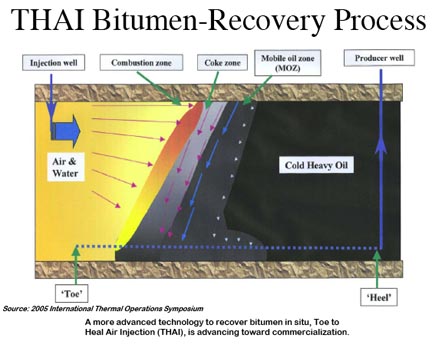
Advances in THAI extraction and other advanced in situ processes, may lead to even faster production increases from oil sands.

Labels: , ,

Wednesday, September 17, 2008

9 to 1 Energy Return from Sugar Beets?

Nova Scotian beet farmers expect big things from their beets-to-ethanol crop harvest this year.
Coles said sugar beets have twice the ethanol potential as corn and, for every unit of energy they put into producing the beets, they expect to get nine units of energy in return. He said there is a significant amount of cropland currently out of production and this initiative could help revitalize it. They hope to have 5,000 acres in active beet production next year and they’re moving toward 17,000 acres, although not all necessarily in Nova Scotia. Parts of our province could even produce winter beets, and ABC has several locations lined up to test such a crop. _checkbiotech
Interesting alternative to maize, and beets can be grown across a very wide range of climates, where sugar cane will not grow.

Labels: ,

More Oil from Canadian Oil Sands Coming Right Up

Trillions of barrels of oil equivalent sits in Canadian oil sands, waiting for better extraction methods. Brian Wang thinks this method may be what the oil doctor ordered. Better methods of extracting the trillions of barrels of oil equivalent sitting in US and Canadian oil shale are also in the pipeline.
If the Capri/Thai processes are successful then Canada's oilsands, other oilsands and heavy oil deposits around the world will have higher recovery rates using a more economic process and the oil will be upgrading in the ground to a higher and more valuable quality. This would be the technology that would crush peak oil for several decades and allow an orderly transition to a post oil world. The processes would enable trillions of barrels of oil to be economically accessed. In a few months the Capri process could be proven out and the energy world would be changed. Oil technology would change the world by unlocking the oilsand and heavy oil around the world. Trillions of barrels of oil would become economically feasible. It [will be a (AF)]world and game changer. _NextBigFuture
The profitability of oil shale and oil sands extraction processes depend upon oil prices being above $80 a barrel. With rapid advances in algal and biomass biofuels, along with more nuclear, better industrial heat recovery, higher efficiencies, and shifting to an electrical vehicle fleet, high oil prices for the indefinite future are a bad bet.

Previously published at Al Fin

Labels: ,

Hot Rocks Low Temperature Geothermal Update

Brian Westenhaus takes an interesting look at progress by low temperature geothermal company Raser.
Barely a year into the geothermal business the Raser idea is based on good working technology. They are using an off the shelf award winning heat pump from United Technologies set up to drive a generator instead of a motor driving the compressor as done successfully by Gwen Holdmann up in Alaska....Raser has reported some progress. But the avalanche of press releases that haven’t panned out to the liking of the stock-tracking people isn’t building a lot of confidence.

...Raser is saying that they have optimized the generators to run on source temperatures of between 200 to 300 degrees F. This is a range that works for much wider areas of geothermal resources than temperatures needed for full flash steam generation. Gwen Holdmann and UT have shown full function at 165 degrees.

...The project is in Beaver County Utah. On August 12 they took delivery of the first 50 generator units from UT and have announced they are all in place as of September 4th with the cooling towers and hook up to go. It’s expected that these 50 generators will output 10 megawatts continuous. That will be something, a sure start on growth, as reports have the capital cost approximating wind farm and solar thermal installations but with 24/7/365 output for a very different economic picture. Reports say that Raser has eight projects underway in Utah, New Mexico, Oregon and Nevada.

The design is for modular generators, so that one module can be maintained while others continue to operate. Modular building also reduces costs. Raser is estimating investment recovery in 12 to 18 months. _NewEnergyAndFuel
Very fast implementation, and very favourable investment recovery estimates. Are they just blowing smoke, or is this for real?

Bank of America subsidiary Merrill Lynch is backing Raser, and the proof of the pudding will happen quite soon. We will not be kept in suspense long.

Raser's stock price has been fluctuating wildly, which suggests that opportunity may be knocking for those with liquid investment capital.

Labels:

Tuesday, September 16, 2008

Flywheel Energy Storage at Supersonic Speed

Beacon Power Corp. says it has a better idea: massive rotating flywheels that store power like giant alkaline batteries spinning at twice the speed of sound. _BostonGlobe
Flywheel storage stores energy in kinetic form--rapidly spinning wheels, ready for almost instant tapping in case of power failure. But the problem with them is their lack of energy density: they simply cannot hold enough backup energy for more than a short period of time. Rotating energy is defined by its mass and rotational speed. Beacon's flywheels weigh 2500 pounds, but it is Beacon's higher speeds that pack the power:
Beacon Power flywheels are 2,500-pound cylinders made of carbon fiber and fiberglass, and bonded with epoxy. Each is mounted on bearings that generate a magnetic field to support the flywheel, so it floats inside its steel casing. Friction is almost nonexistent. When the flywheel is spun to its full speed of 16,000 revolutions per minute, it can store the energy for hours with little loss.

"The surface speed on this thing would be Mach 2," or twice the speed of sound, Capp said. But these flywheels don't generate a sonic boom, because they operate in a vacuum to reduce friction even more.

At the base of each flywheel is a motor-generator system like those found in hybrid cars. When electricity is added to the system, it acts as a motor, speeding up the rotation. To release power, the system acts as a generator, translating the rotation to electric power and feeding it into the grid....Each flywheel can store enough power to run a typical US home for a full day. But they cost $200,000 apiece, and while Capp hopes to cut the cost to $100,000, they're still far out of the average consumer's price range.

Instead, Beacon Power hopes to address a constant nuisance for electric utilities: precise regulation of power.

...Beacon Power plans to build storage arrays, with dozens of flywheels buried underground inside vaults made from concrete sewer pipes.

A standard shipping container stuffed with computers and power cables controls the array and links it to the electrical grid.

When there's extra power available, Beacon Power would buy it and use it to spin the flywheels. When the grid needs an extra burst of juice, the flywheels can convert the stored energy back into electricity, which is resold to the power network.

"You can almost think of it as recycling electricity," said Gene Hunt, company spokesman. Beacon Power would make its profit by charging a fee for its power regulation service.
Utility load leveling is an incredibly important task. Without utility-scale storage devices, power distribution can be extremely tricky and prone to errors.

In safety terms, it is a good idea for them to bury these massive speedy spinners underground in strong concrete vaults. I wouldn't want to be around when one of these giant tops explodes.

More at MarketWatch

Can you find the error in this NextEnergyNews article?
The company currently building a massive commercial scale system that is capable of storing 5 million watts of power.
Absolutely right! One can supply 5 mega watts of power, but one cannot store 5 mega watts of power. One stores mega watt hours, not mega watts.

Labels: ,

Monday, September 15, 2008

Peak Oil and Oil Price Tumble

If one is a loyal reader of The Oil Drum Blog, one pretty much believes whatever is written there--regardless of what the real world is doing. If oil prices go up, it is due to peak oil. If oil prices go down, it is due to peak oil. It really is all about peak oil, to a peak oil punkass (POP).

The same type of "one-explanation fits all" mentality is present in the Climate Catastrophy Orthodoxy. If temperatures rise it is global warming. If temperatures fall, it is global warming. It's all global warming to a holy warmer.

Being a true believer--in whatever cause--means not having to think for yourself. While such faith in the "daily talking points" provides ready explanations for the phenomena of the day, the ability of the person's brain to reason tends to atrophy.

Take the recent 7 month low in oil futures. To a POP, there is something wrong causing oil prices to behave against fundamentals. All types of surreal conspiracy theories--usually involving Bush, Cheney, and the evil neocons--rise to the surface to explain why the globe has not already run out of oil, and why cannibalism and utter debauchery have not taken over the entire Earth yet.

Certainly oil production has not gone up that much to explain the drop. But oil consumption has dropped on several fronts, for several reasons. And the big boost given oil futures by speculators on the up side can have a matching depressant effect on prices on the down side.

One has to wonder how POPs are investing these days. With all of that "insider knowledge" that the price of oil is going above $500 a barrel any day now, why are they not making a veritable killing in the futures market? Blaming the evil neocons for the "inexplicable" behaviour of prices can only satisfy the true believers for so long. What dark conspiracies will bubble up from the subconscious next, to explain the real world's utter duplicity?

Follow the charade yourself, at links such as the one above. It is not as if POPs had any insight into their behaviour--at least not enough to be a bit more discrete.

Peak Oil, when stripped to its basics, is utterly trite and worthless in terms of predicting economic phenomena in a timely and meaningful way. For POPs, however, it is important to always believe that one knows a secret that others are too stupid to comprehend. That is fine with me.

But in the real world, to make money on markets and exchanges--as well as in business--it pays to leave one's ideologies and wishful thinking at home.

Labels: ,

Newer Posts Older Posts