Monday, December 10, 2012

Canadian Shale: The Next Big Bonanza

Just when you thought most of the shale action was taking place south of the 49th parallel, drillers are starting to place horizontal wells inside rich Alberta shale deposits. Canada is the number one go-to source for America's oil imports. And the northern neighbor is getting ready to shift into a higher gear of production, with the rise of shale oil & gas in huge Alberta deposits.
According to a recent study from the Energy Resources Conservation Board of Alberta, the province could be sitting on 3,324 trillion cubic feet (TCF) of natural gas, 58.6 billion barrels of gas liquids, and 423.6 billion barrels of oil that have yet to be explored. Compared with the 2,214 TCF of reserves for the entire United States, Alberta alone could be the richest source of natural gas on the planet.

These new discoveries are enough to fuel current American demand for oil for 50 years, with enough natural gas for 130 years! What also makes these findings astounding is that many of these shale plays are found on the Alberta/British Columbia border, and the B.C. estimates were not included in the report. _Alberta Shale

And while Canada's tight oil & gas production is likely to pick up steam, don't forget the trillions of barrels of oil equivalent in Canadian oil sands. Oil sands production is getting cleaner and cheaper -- which means that US President Obama needs to get on the ball and dump his attitude of arrogant energy snobbery toward Canada. Lifting the arbitrary ban on the Keystone XL pipeline would be an acceptable first indication of good faith on Obama's part.

“We have so many resources, we don’t just need access to one of these markets, we need all of them,” Alberta Energy Minister Ken Hughes said in a recent speech in Calgary.

Plans to ship Alberta oil as far east as Saint John, N.B., are gaining momentum with the recent backing of several provincial premiers. Joe Oliver, Canada’s Natural Resources Minister, said the Eastern option would enable refineries to purchase Western Canadian oil at a considerably lower price, create jobs and possibly even reduce the price of fuel. _National Post
Canada is poised to explode on the world scene as an important energy supplier -- and not just to the US. Obama had best get his priorities straight, or his legacy will be as a laughing stock.

Labels:

Monday, June 18, 2012

Energy Cornucopia in Paradise

Apache Corp. has discovered a massive natural gas field in British Columbia -- perhaps the largest discovery of gas on the North American continent. This discovery is just one of many, helping to hold the North American price of natural gas down. The planned Kitmat LNG terminal on the British Columbia coast is meant to ship this abundance of gas to more profitable Asian markets.
One of three companies planning a $4.5-billion liquefied natural gas terminal at Kitimat on Thursday announced an "outstanding" new shale gas discovery in British Columbia's remote and largely unexplored Liard Basin. The find by Apache Corp. is estimated to contain enough gas in itself to justify doubling the size of the Kitimat terminal it's proposing with partners Encana Corp. and EOG Resources. The company is calling it the best and highest quality shale gas reservoir in North America, based on the volume of gas three test wells are producing. Apache, the second largest U.S. independent oil and natural gas producer by market value, said the tests suggest it has 48 trillion cubic feet of marketable gas within its Liard Basin properties. By way of comparison, all companies active in the Horn River Basin, one of three other major shale gas basins that are in B.C., have marketable gas of 78 trillion cubic feet, giving one company alone a natural gas find that is twothirds the size of the entire Horn Basin. One well alone produced 21 million cubic feet of gas a day over a 30-day period, the company said. _Canada.com

Brian Westenhaus has more information and analyses.

Brian Wang is also keeping his eye on this discovery

Natural gas prices are very low in North America, due to very efficient methods of gas production, and due to a relative abundance of newly accessible tight gas.

But as natural gas is increasingly used to substitute for crude oil in a wide range of applications -- from transportation fuels to polymers to chemicals to LNG and more -- the cost of gas will rise with growing demand.

Labels: ,

Wednesday, April 25, 2012

Canadian Oil & Gas Coming On Strong

Canada's growing oil & gas production is driving the economy. The recent elections in Alberta reflect the oil sands' growing importance.

Image via NBF


The slideshare presentation below provides an extended look at near to intermediate term developments in Canada's oil & gas industry.


h/t Brian Wang


Canada and Australia are developing into two powerhouse energy and mineral exporting nations of the Anglosphere. Being blessed with abundant resources, the rule of law, ample human capital, and relative proximity to large markets, these two countries should have long and prosperous futures -- at least to the mid-century mark. This is true as long as they can avoid ruinous policies of carbon hysteria and energy starvation, and as long as they can develop and maintain sound immigration policies.

Labels: ,

Monday, March 19, 2012

Canada as Energy Superpower II

In an earlier blog post, Canada as Energy Superpower?, we looked at Canada's growing energy clout on the world stage. And finally, years later, the rest of the world is beginning to understand the kind of energy punching power that Canada brings to the world stage.
Canada's aim is to counterbalance Opec by pumping more oil...and catering to Opec's best customers in China and other fast-growing economies.

"It's going to have geopolitical implications," says Mr Oliver. "The future energy supply is going to be profoundly affected by what are now called unconventional sources. The influence of Opec on a relative basis is likely to decrease. And I think overall this is going to be positive for the West." _National
But oil is not the only rich energy resource which Canada can bring to the marketplace. Canada has vast uranium resources, is rich in coal, possesses large reserves of natural gas, and may have more gas hydrates than all its other hydrocarbon resources put together (PDF). To top it off, Canada is very well endowed with hydro-power -- currently the cheapest and most reliable of the renewables.

South Africa's Sasol -- in many ways the world leader in the Fischer Tropsch approach to coal to liquids (CTL) and gas to liquids (GTL) -- is acquiring significant assets in Canada, with an eye toward a future where unconventional liquids are more important than at present. Other energy companies, some based in Europe and Asia, are starting to think along the same lines, and are grabbing up Canadian energy assets when they can.

Whether the near and intermediate future of world energy is based on oil, natural gas, nuclear power, coal, or unconventional liquids, Canada is well positioned to supply an economically significant proportion of global energy needs.

More:
Excess Canadian crude oil produced from oil sands is expanding at a rate of one million barrels a day every five years. The more that's produced, the less of a market there will be for oil from Venezuela and some other OPEC member countries with similar-quality oil, requiring them to either curtail production or lower prices. Even if oil prices rise in the medium term, we expect 2020 prices to be no more than $85 per barrel, compared with today's prevailing global price of $125.

The economic consequences of this supply-and-demand revolution are potentially extraordinary._WSJ_via_GWPF

Labels:

Monday, January 30, 2012

Can Canada Leverage Its Hydrocarbon Wealth to Create An Abundant Future Based Upon Advanced Energy Sources?

Canadians are understandably upset at the US in general, and at US President Obama in particular. Obama's abrupt and corrupt killing of the Keystone XL pipeline sent an unfriendly message of contempt and disregard to the US' neighbors to the north.

While the US Republican Congressional members are attempting to devise a way to approve the Keystone XL pipeline's completion and border crossing, Canadians are forced to contemplate other markets for their increasingly valuable oil sands product. After all, oil sands production has been ramped up in anticipation of cheap & ready pipeline transport to the south, all the way to refineries on the Gulf of Mexico. With the destruction of that rational plan by the congenitally feckless Obama, China is forced to look to China and India as alternative markets:
While the media fixates on the political spin around the Obama government's rejection of TransCanada's Keystone XL pipeline, there's another, more important element to this story that has been grossly underplayed:... in Asia...demand for energy of all kinds will continue to soar, according to BP's 20-year forecast....

``By 2030 China and India will be the world's largest and third-largest economies and energy consumers, jointly accounting for about 35 per cent of global population, GDP (Gross Domestic Product) and energy demand,'' the report says.

``Rapid economic development means industrialisation, urbanisation, and motorisation. Over the next 20 years China and India combined (will) account for all the net increase in global coal demand, 94 per cent of net oil demand growth, 30 per cent of gas and 48 per cent of the net growth in non-fossil fuels.''

No, that's not a typo. Let me repeat that: over the next 20 years, BP says China and India will account for 94 per cent of the net worldwide increase in oil demand. _Canada.com
The author goes on to warn of Canada's dependency on the US as an export market, at a time when US consumption of imported oil continues to decline.

Canada itself needs to also think about what kind of energy infrastructure it wishes to build for itself, using the oilsands wealth as a springboard. In the medium and long-term, advanced nuclear fission (and later, fusion) technologies make the most sense. Canada has rich ore resources for production of nuclear fuels, and with rational recycling and breeding technologies, the resource could last almost indefinitely, in practical terms.

Wisely, Canadian utilities are beginning to look toward building their nuclear infrastructure:
Utilities in Canada are expressing interest in the Westinghouse AP1000 pressurized waterreactor (PWR) and the Westinghouse Small Modular Reactor, a 200 MWe class integral PWR currently under development that is suited for smaller electrical grids, distributed generation, and process heat requirements. _Power-Eng
In an attempt to create a more sustainable oil sands industry, engineers are looking for ways to substitute geothermal heat in place of natural gas, for the production of oil sands. The key factor is industrial heat, which can be provided in multiple ways.

Al Fin energy analysts prefer the use of gas-cooled nuclear reactors for long term in situ production of oil sands, oil shales, heavy oils, and for even more unconventional fuels such as coal to liquids (CTL) and gas to liquids (GTL). Canada is rich in several hydrocarbon resources which could be economically converted to high quality fuels and high value chemicals, using process heat from gas cooled nuclear reactors.

All of these projects will require significant capital, which can be at least partially provided from export profits derived from sales of oil sands. The key issue is to convert a modern-day source of export wealth into a long term foundation for energy abundance, industrial sustainability, and commercial viability.

Neither large-scale wind power nor big solar power are rational foundations for a prosperous Canadian future, as both of these green approaches are inherently unreliable, expensive, intermittent, difficult to manage, and lead to exponential increases in customer energy bills.

Labels: , ,

Wednesday, August 31, 2011

Keystone XL Pipeline Fights Faux Environmentalist Energy Starvation

The Keystone XL pipeline is meant to carry oil sands crude all the way from Canada to the US Gulf of Mexico coast refineries and terminals. This pipeline will provide deepwater access to Canada's oilsands, as it ramps up in production.

The US State Department has issued a final environmental impact statement, finding no significant environmental impacts from the pipeline. The bureaucratic process for approval of the pipeline is far from exhausted, however. The Obama agenda of energy starvation has barely begun to sink its fangs into Canada's oilsands, US coal, US offshore oil, US kerogens, US nuclear etc. -- despite the risk to the US economy of shutting down virtually all reliable forms of energy.

As for the Keystone XL and other oilsands pipelines -- Most analysts believe that it is the price differential (about $25) between North American oil prices and global oil prices which is driving various pipeline routes to the sea.
Will the pipeline connection to the Gulf Coast simply be a conduit for Canadian oil to be trans-shipped to foreign markets and capture more favorable world pricing? If so, how does that help America?

Or will the flow of 500,000 to 900,000 barrels a day through the Keystone XL pipeline to the Gulf Coast be sufficient to bring down bulging inventories of stranded, land-locked oil in Cushing, Oklahoma and eliminate, or at least substantially reduce the huge price spread between Brent and West Texas Intermediate?

If it doesn’t, and the over $25-per-barrel spread between U.S. domestic oil prices and world oil prices persists, new pipelines will be built in Canada to provide a more direct connection to global oil markets.

One way or another, it is oil price differentials, not James Hansen’s concerns, which will ultimately determine the flow and direction of oil from Canada’s tar sands. _Globe&Mail

Faux environmentalism is little more than a primal desire to return to a pre-industrial global state. Since such a return would inevitably result in the dieoff of several billion human beings, faux environmentalism is a thinly veiled yearning for a massive reduction of the human population to less than 10% of current levels.

Energy starvation of the developed world is the quickest route to this dieoff. By shifting from reliable forms of energy such as nuclear, coal, gas, etc. in favour of unreliable forms of energy such as big solar and big wind, faux environmentalism is apparently trying to bring about massive poverty, hunger, hardship, disease, and death. Think of that the next time you are solicited by Greenpeace, the Sierra Club, or World Wildlife Fund.

Labels: , , ,

Saturday, August 06, 2011

US Gas for Canadian Oil

Energy and Capital

Canada needs US natural gas to help produce its bitumen oil sands. As oil sands production ratchets up from 1.5 million barrels per day to 5 mbpd by 2020, Canada's demand for US gas should continue to rise.
The emergence of shale gas over the last six years has fueled our hopes that we'll be able to safely transition away from our oil addiction.

Not only do we have an abundance of it trapped in the various shale formations across our country, but developing that resource is inevitable, because we're not the only ones counting on that future supply...

You see, it's not just the United States that's depending on U.S. gas production. Remember Canada's trouble with peak natural gas?

It turns out natural gas exports to Canada have doubled in just five years!

We may be relying heavily on an ever-increasing amount of Canadian crude to meet our oil fix, but Canada's natural gas troubles will only worsen as production from the oil sands grows to more than five million barrels per day in the coming decade. (Natural gas plays a vital role in the extraction process of deeply-buried bitumen.)

Remember, more than three-quarters of Alberta's oil production comes from oil sands operations.

As if that weren't enough, Canada isn't the only country crossing her fingers for more U.S. natural gas. South of the border, Mexico is also relying more on our supply.

U.S. exports to Mexico have also jumped significantly. Prior to 2000, we barely exported any natural gas to either Canada or Mexico. Today's a different story.

Just like Canada, Mexico can't get enough of it...

Last year, natural gas production from the Marcellus averaged 1.3 Bcfe/d. By the start of 2011, production was around two billion cubic feet per day. And this is only the beginning.

Within the next eight years, production is expected to jump more than 775% to 17.5 billion cubic feet per day. In the process, it'll add at least 250,000 jobs and tack on over $20 billion in revenue to Pennsylvania's economy.

We're also expecting the drillers to have a field day. Even though natural gas prices have been lackluster since crashing in 2008, drilling more than doubled in 2010. There are more rigs drilling the formation than ever before...

_EnergyandCapital

Canada has plenty of shale gas too, but for now it is more lucrative to produce oil than gas, given current price spreads. Once the nascent gas to liquids (GTL) industry revs up, prices should slowly converge, and gas will become a more lucrative product.

Cross-posted from Al Fin blog

Labels: , ,

Friday, December 24, 2010

Gas to Liquids (GTL) Coming to Canada via South Africa

Sasol figures that the natural gas needed for a gallon of diesel, plus operating costs, comes to about $1.50 a gallon. In comparison, a gallon of diesel made from crude oil now costs more than $2, even before refining, and many forecasts are for the price of oil to go higher.

...A barrel of oil has historically cost one to two times as much as the equivalent amount of energy from natural gas. But right now, vast supplies of natural gas from shale formations in North America have driven prices down, so oil is triple the price of the gas equivalent.

The new ratio creates “a very attractive economic option,” said Lean Strauss, senior group executive at Sasol. _NYT_via_EnergyTribune
South Africa's SASOL learned to create synthetic diesel back during apartheid days, when the rest of the world refused to trade with South Africa. Now, SASOL intends to bring its synthetic diesel technology to Canada, to turn the "shale gas bonanza" into a veritable GTL financial gusher.

More from NYT (via EnergyTribune) and Business Daily:
Diesel and jet fuel are usually made from crude oil. But with oil prices rising even as a glut of natural gas keeps prices for that fuel extraordinarily cheap, a bit of expensive alchemy is suddenly starting to look financially appealing: turning natural gas into liquid fuels.

A South African firm, Sasol, announced Monday that it would spend just over 1 billion Canadian dollars to buy a half-interest in a Canadian shale gas field, so it can explore turning natural gas into diesel and other liquids. Sasol’s proprietary conversion technology was developed decades ago to help the apartheid government of South Africa survive an international oil embargo...

The Sasol process cooks a hydrocarbon, either coal or natural gas, into a fuel gas made of hydrogen and carbon monoxide. Using a patented process that involves cobalt catalysts, it converts that gas into a mix of liquids: 80 percent diesel fuel, 15 percent naphtha and 5 percent liquid propane.

...with the huge spread between oil and gas prices, and predictions of oil topping $100 a barrel next year, the conversion technology could be a “a money-maker for whoever is a first mover in that space.” _NYT
It is a question of cheap, reliable feedstock supplies combined with an efficient industrial process and a good market for liquid fuels. At this time, SASOL has access to cheap, plentiful feedstock AND a good market for liquid fuels. They will now have to prove the industrial ability to economically convert cheap, plentiful shale gas into more valuable liquid fuels.

It is a wise move for SASOL to develop such a plant in North America, with ready access to competent engineers, technologists, and craftsmen, as well as easy access to the US energy market.
[SASOL], which announced a 50% acquisition of a stake in Canadian shale gas company Talisman Energy for R7,1bn on Monday, is also exploring for shale gas in SA’s Karoo basin, although any production is at least 10 years away. "It’s a long shot, but it could be a game-changer," Mr Haan said. Reuters _BusinessDay

Labels: , ,

Thursday, December 23, 2010

Canada as Energy Superpower?


Canada Energy 2006

Oil, coal, gas, unconventional hydrocarbons -- you name it, Canada has it. In addition, Canada has rich mineral resources, including uranium. Canada even has a large hydropower resource to call upon to supply between 15% and 20% of its energy. For the next 20 years, at least, Canada will be in a comfortable position in terms of energy economics. Just don't let the carbon hysterics botch it all up.
As Peter Boag, president of the Canadian Petroleum Products Institute, noted recently in his presentation to the Senate standing committee on energy, environment and natural resources that gasoline and diesel -- fossil fuels -- will still be needed and make up the lion's share of how Canadians transport themselves and their goods for the foreseeable future. The same applies to the rest of the world. That's due to simple physics: "They store large amounts of energy in a relatively small space and are therefore ideally suited for transportation use," said Boag in his presentation.

...Even the International Energy Agency, in its recent forecast looking ahead to worldwide energy use 25 years from now, forecasts that even for its most radical carbon replacement plan and most hopeful energy efficiency plans, many of the technologies needed are not yet available and that many others require substantial refinement and cost reductions.

So by 2035, traditional sources of energy will still make up the vast bulk of energy usage -- and this despite the IEA's urging for governments to spend trillions over the next decades on alternative energies and hoped-for technological breakthroughs. _Sun

The US Obama regime has been working behind the scenes to shut off imports of Canadian oil sands to the US -- using the carbon hysteric's rationale. But reality has already over-ruled the Obama regime on more than one occasion, and is likely to do the same on this particular point.
Giant oil sands pipeline in the works

nuclearfaq.ca

Labels: ,

Tuesday, June 29, 2010

Canada Will Supply Uranium to India's Nuclear Renaissance

India expects to have 12 new reactors running by 2020, consuming an extra 1,500 tonnes of uranium per year. Other projects are expected, making India’s civilian nuclear sector worth $25-billion to $50-billion over the next 20 years. Dr. Chaitanyamoy Ganguly, the President of the small Indian division of Cameco (TSX: CCO), the world’s largest uranium miner, said Canada could soon be exporting 2,000 tonnes of uranium to India annually. Canada has some natural competitive advantages over other countries in the Indian market because many of India’s reactors are already based on Canadian CANDU technology and because Australia has refused to sell uranium until India signs the Nuclear Non-Proliferation Treaty. India has also signed civil nuclear cooperation agreements with the USA, Russia, France, UK, Argentina, Kazakhstan, Mongolia and Namibia. _UraniumInvestNews

The deal with Canada also includes co-operation in the fields of nuclear waste management and radiation safety.

"The Civil Nuclear Co-operation Agreement that we have signed breaks new ground in the history of our co-operation in this very important sector," Mr Singh told reporters at the signing ceremony with his Canadian counterpart, Stephen Harper, in Toronto.

"It reflects the change in international realities and will open new doors for mutually beneficial co-operation in nuclear energy," he added.

The contribution of nuclear energy is expected to rise from a mere 3% today as India embarks on a substantial expansion of nuclear power reactors over the next few decades.

Coal still accounts for more than 50% of India's energy use.

The agreement marks a turning point for Canada, which stopped nuclear co-operation with India in 1974 after India used plutonium from a Canadian reactor to build an atomic bomb.

India's nuclear isolation ended after it signed a landmark agreement with the US in October 2008. _BBC

India is currently holding nuclear talks with Japan, with the aim of importing Japanese nuclear technology. If India's economic expansion is not to die in its infancy, it will need a lot of energy for commerce, industry, and civil infrastructure.

In that regard, much of Asia is united in seeing the need for a rapid expansion of nuclear energy.
Uranium Prices

The uranium market has continued to demonstrate limited activity over the short term with spot prices unchanged at $40.75 per pound. The demand side has been described as discretionary and lackluster at best with two transactions reported, although they had previously been negotiated. The price spread between willing buyers and willing sellers continues to narrow with only $0.50-$0.75 now separating the two and activity at a virtual stalemate.

Conferences

This week presents industry stakeholders with 2 unique opportunities for a comprehensive outlook on the nuclear power market. A small modular reactor conference is scheduled for June 28 and 29 in Washington, focusing specifically on the issues related to the development and licensing in the U.S. Overlapping this conference in London will be the 5th Annual European Nuclear Power conference providing attendees with a comprehensive outlook of the European nuclear power market, highlighting opportunities and debating the challenges faced.

Fears surrounding security of supply, fossil fuel price volatility and increasingly tighter climate change goals at the international level are being manifested in a global resurgence of nuclear power. If aging infrastructure remains neglected, it is widely predicted that demand will outstrip supply long-term. The ability to create a stable and significant clean energy has firmly placed nuclear power back on the table for policy makers and utilities alike. For uranium investors these conferences should inspire actions and intentions which can have direct implications on uranium price targets and supply demand fundamentals. _UraninumInvestingNews

The absurd anti-nuclear faux environmentalist deadlock cannot continue indefinitely. When the western world finally wakens out of its suicidal daze, demand for fissile and fertile fuels will skyrocket.

Labels: ,

Saturday, May 15, 2010

Canada, US, Each Has 100 Years of Gas Reserves

Canada Has 100 Years Worth of Natural Gas:
Canada has enough natural gas in place to maintain current production for nearly a century, according to a study released on Wednesday.

The Canadian Society for Unconventional Gas estimates there are between 700 trillion and 1,300 trillion cubic feet of recoverable gas reserves in conventional and unconventional plays such as shale, tight sands and coal-bed methane... _EconomicTimes_via_EnergyTribune


US has 100 years worth of shale gas
...the United States possesses a total resource base of 1,836 trillion cubic feet (Tcf). This is the highest resource evaluation in the Committee’s 44-year history. Most of the increase from the previous assessment arose from reevaluation of shale-gas plays in the Appalachian basin and in the Mid-Continent, Gulf Coast and Rocky Mountain areas.

“The PGC’s year-end 2008 assessment reaffirms the Committee’s conviction that abundant, recoverable natural gas resources exist within our borders, both onshore and offshore, in all types of reservoirs,” said Dr. John B. Curtis, Professor of Geology and Geological Engineering at the Colorado School of Mines and Director of the Potential Gas Agency there, which provides guidance and technical assistance to the Potential Gas Committee. _mines.edu

Exploration for shale gas and other unconventional forms of natural gas has just begun, globally. As Europe, China, India, and other countries and regions begin to develop their respective unconventional gas and other fossil fuel reserves, the oil dictatorships in the Persian Gulf, South America, and Russia, will lose significant income.

Labels: , ,

Thursday, January 14, 2010

Canada Gots the Big Pipes


What good is trillions of barrels of oil-equivalent, if you cannot get the crude to the refinery or the market? Several pipeline projects address this concern, including the Keystone Pipeline, the Alberta Clipper Project, and the Enbridge Expansion.  (via New Energy and Fuel)


These pipelines transport crude oil from oilsands to refineries in Illinois and Oklahoma.
Canada is also host to pipelines that transport Alaskan natural gas south to markets.

New refineries are also to be built in Alberta and Saskatchewan, to serve the Canadian market.

With millions of billions of barrels of crude waiting to be used -- to soften the transition to a more sustainable energy economy -- Canada is not just sitting around twiddling its thumbs, like a certain government in Washington DC seems to be doing.  Get all the details on these projects from Brian Westenhaus.

Labels: ,

Tuesday, August 18, 2009

Small Nukes for Rural Canada

Small nuclear reactors have proven their ability to provide reliable heat and power over several decades -- using a number of different designs. Now a venture company is forming a private corporation to provide small nuclear reactors to isolated communities across Canada.
Western Troy's CEO, Rex Loesby, commented, "As we worked through the feasibility process for our MacLeod Lake Project, we evaluated a number of electric power options. One option is a small nuclear reactor. We found there are a number of small reactor designs in operation and under development around the world and there looks to be an opportunity to work with one or more of these reactor designs to develop the technology specifically for remote communities and mine sites in Canada. Some of these small reactor designs have operated for decades without safety issues, nuclear reactors do not release carbon emissions, and there are communities and mines in remote locations throughout Canada that would benefit greatly from clean, safe, and relatively low cost electric power."

...Rex Loesby commented further, "What started out as an engineering exercise quickly grew into an idea that could be revolutionary for the development of northern communities and resources in Canada. We have begun to see this as much more than a commercial venture, but an opportunity for Canada to lead the world in clean energy development for remote sites." _Source
Small nuclear reactors are a natural fit for remote arctic and antarctic communities (as well as mid-ocean and outer space outposts). Providing ample quantities of electric power and heat, small nuclear reactor / generator installations provide the basis for local and regional development of all types -- including agriculture and mining.

Faux environmentalists oppose nuclear energy of all types, without understanding exactly what it is they are opposing -- or what they are forcing people to accept in its place. These faux enviros are in the process of completing the devastation of the US economy -- and would like to do the same thing to Canada.

So far, Canadians have been too smart to allow the faux's to gain an absolute upper hand.

Labels: ,

Tuesday, May 26, 2009

How To Save Canada's Forestry Industry

Governments and forestry executives have been coming to grips with the knowledge that they need to make major changes if they want to save an industry that accounts for 300,000 jobs and 12 per cent of Canada's manufacturing GDP. Traditional forestry is closely tied to a limited number of other industries - when the housing market collapsed, so did logging, for example. Falling demand for newsprint has hit pulp mills.

That's why forestry companies are interested in bioenergy, which has a more diverse base of potential customers. _Bioenergy
Canada grows a lot of trees. But Canada's forestry business lost $8 billion last year, and stands to do no better in the future unless Canada is willing to try something new -- bioenergy.
Bioenergy is harnessed by converting wood waste into a gas or liquid, which is then turned into electricity or biodiesel.

It's of particular interest in Western Canada, because it's one of a limited number of commercial uses for wood infected by the pine beetle.

Technology already exists to use gasified wood biomass to power the electrical grid and heat buildings, and liquefied wood biomass could one day be used to power cars, said Weedon.

"It could be a very interesting and exciting new form of energy."
Since large numbers of trees die and are killed far away from highways and navigable waterways, portable harvesters and processors must be developed which can be moved from temporary location to temporary location in order to harvest the bounty of energy that is now going to waste.

The profits to be made from conversion of waste forestry biomass to bioenergy are less than can be made from oil sands, shale gas, heavy oils, and other Canadian energy resources. But as improved processes are developed for retrieving waste biomass, and for increasing cultivation of biomass crops (some of them genengineered), bioenergy solutions will provide economic opportunities for communities and regions that are currently without likely economic prospects.

Labels: ,

Thursday, September 18, 2008

Canadian Oil Sands Production to Increase to Over 3 million barrels per day by 2015

The increase in bitumen production from Canadian oil sands will be from just over million bpd to just over 3 million bpd. US and Canadian pipelines and refinery capacity should keep pace with this expansion.
Strong growth in oil sands production during the past few years has been an important contributor to global supply and provided the US with the prospect of a secure source of supply from Canada. Bitumen production from Alberta's oil sands during 2007-15 will increase to 3.1 million b/d from 1.2 million b/d.

This outlook is based on an assessment of individual projects that are currently in production or likely to come on stream. It also anticipates delays to projected start-up dates and less than full utilization rates due to anticipated technical problems. _RedOrbit
More details at the source.

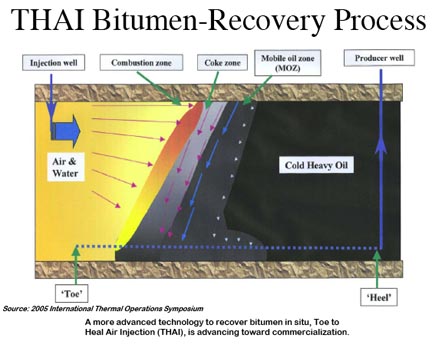
Advances in THAI extraction and other advanced in situ processes, may lead to even faster production increases from oil sands.

Labels: , ,

Wednesday, September 17, 2008

More Oil from Canadian Oil Sands Coming Right Up

Trillions of barrels of oil equivalent sits in Canadian oil sands, waiting for better extraction methods. Brian Wang thinks this method may be what the oil doctor ordered. Better methods of extracting the trillions of barrels of oil equivalent sitting in US and Canadian oil shale are also in the pipeline.
If the Capri/Thai processes are successful then Canada's oilsands, other oilsands and heavy oil deposits around the world will have higher recovery rates using a more economic process and the oil will be upgrading in the ground to a higher and more valuable quality. This would be the technology that would crush peak oil for several decades and allow an orderly transition to a post oil world. The processes would enable trillions of barrels of oil to be economically accessed. In a few months the Capri process could be proven out and the energy world would be changed. Oil technology would change the world by unlocking the oilsand and heavy oil around the world. Trillions of barrels of oil would become economically feasible. It [will be a (AF)]world and game changer. _NextBigFuture
The profitability of oil shale and oil sands extraction processes depend upon oil prices being above $80 a barrel. With rapid advances in algal and biomass biofuels, along with more nuclear, better industrial heat recovery, higher efficiencies, and shifting to an electrical vehicle fleet, high oil prices for the indefinite future are a bad bet.

Previously published at Al Fin

Labels: ,

Saturday, September 06, 2008

Can Canada Neutralise Russia's Energy Blackmail?

Russia has never hesitated to act the bully whenever it was in a position to do so. Putin's invasion and ethnic cleansing in Georgia was just the latest in his attempts to control all energy flowing westward to Europe from the Caspian and central Asia. Is it possible that meek and mild Canada might play a significant role in neutralising Putin's bombastic threats of a new and dangerous cold war?
A new Cold War looms, many are concluding, financed by Russia’s new found energy wealth and fueled by appeasement. Is the free world doomed to decades of hostility due to Europe’s energy vulnerability?....Alberta’s might as an energy power is now based largely on the ongoing development of just seven oil sands projects, most of them on the ultimate scale of 300,000 to 400,000 barrels of oil a day. Add three or four projects from Alberta on that scale to produce another 1.2 million barrels of oil per day and Europe’s entire oil dependence on Russia can be eradicated. A democratic peace-promoting country would have come to Europe’s rescue, providing not just oil but the steel needed in Europe’s spine.

....With oil now at $100 per barrel and production costs about $10 a barrel and expected to fall further, the profitability of oil sands is immense. No subsidies can be justified, economic or environmental.....Clean coal has the same emissions profile as natural gas, and it is getting cleaner still.
Oil sands are following the same route to rehabilitation. They still consume too much water, but less than half as much as before.

...Alberta’s oil sands represent one of the planet’s largest reservoirs of energy — some 2.5 trillion barrels of crude bitumen from which 300 billion barrels are estimated to be available, an amount that rivals the reserves of Saudi Arabia. They need to be developed properly: cleanly, to protect the environment, and quickly, to promote peace and stability. _NationalPost
Only political fools would shut down oil sands, shale oil, and clean coal on the basis of "climate change" or other delusions. But political fools abound in both Canada and the US. It is long past time for the people to wake up the corrupt politicians in provincial, state, and national government who have been hanging the populace out to dry for so many years.

In the US, Pelosi, Boxer, Salazar, Reid, etc. etc. need to be hoisted on their own petards, dunked in hot tar, coated in feathers, and run out of town on a rail. Canada could perform similar actions on its own corrupt politicos who want to starve the country of energy and energy income.

Political peak oil is alive and well in North America. But the time may be approaching when it will become necessary to kill it off--at least for a few election cycles.

Labels: , ,

Thursday, May 10, 2007

Peak Oil: Meet Saskatchewan Oil Sands

Alberta does not have all the oil sands in Canada. Saskatchewan comes in for her fair share.
Industry and Resources Minister Eric Cline is hoping new regulations that came into effect Monday will encourage more exploration of Saskatchewan's oilsands and oil shale resources.

"If we had more companies operating up there ... then that would dramatically alter the situation,'' Cline said Monday.

The new regulations have been developed after consultation with the industry and other jurisdictions, and are an update of regulations approved over 40 years ago.

....Oilsands were identified in the province in the 1970s in an area north of the Primrose Lake Air Weapons Range, but there has been limited interest until the last few years.

Exploration for oil shales in the Hudson Bay area of the province was conducted 40 years ago, and the area has seen renewed exploration by industry recently.

Meanwhile, the first company to explore and develop oilsands resources in northwestern Saskatchewan in 40 years is stepping up development of its Axe Lake discovery, near La Loche.
Source

Meanwhile, several giant oil sands development projects are getting started in Alberta.
This summer, as many as 7,000 construction workers will be on the site of Canadian Natural Resources Ltd.'s Horizon project, which features an oil sands mine and upgrader north of Fort McMurray. The expansion of Royal Dutch Shell PLC's Athabasca mine and its Scotford upgrader near Edmonton employ about 2,000 workers right now, with a peak of more than 6,000 next year.

An upgrader is a sprawling industrial facility where bitumen, a mixture of sand and oil, is put through searing processes where the sand is stripped away from the oil and the low-grade crude is upgraded into synthetic oil. Total plans to use a method that's called delayed coking, a widely employed and proven process.


Skilled construction workers such as welders, ironworkers, electricians, pipefitters, millwrights, and other skilled workers will be getting paid a lot of money in various oil sands, shale oil, and coal projects over the next two or three decades. After 20 to 30 years, I suspect the transportation industry will be using more biofuels and electrical energy than fossil fuels.

If you know a poverty stricken English or History major working for minimum wage and struggling to make payments, you might tip them off--tell them to learn a useful trade!

Labels: , , ,

Older Posts