Friday, July 28, 2006

Oil Exploration from the Sky: Fast and Wide

As time goes by, better and better methods for finding mineral wealth, including oil, will be developed. This TechReview article reports on a new method of aerial search for oil reserves:

A new airborne technology for mapping oil fields could locate new oil reserves by drastically cutting survey costs, and help companies identify untapped oil within new reserves.

Las Vegas, NV-based startup eField Exploration recently completed a survey of existing oil fields in Texas in which it revealed extensions of these fields into areas that traditional methods did not spot, according to company president Ed Johnson. Drilling to confirm the findings will likely begin soon, he says.

The new method uses existing electromagnetic imaging technologies in a novel airborne system that can quickly cover large areas, thus reducing costs. It also potentially reduces the environmental impact of exploration by eliminating the need to bulldoze wide roads for the heavy equipment used in seismic surveys.

According to Dan Burns, a research scientist in MIT's earth resources laboratory, while seismic surveys are currently by far the most common method of imaging oil fields, electromagnetic (EM) imaging is gaining in popularity because it is more reliable. Electromagnetic imaging is a more direct way to detect oil than seismic surveys, since it can measure differences between oil and water, something seismic methods can't do. "There's clearly a move more and more toward electromagnetics," Burns says. "In general, seismic techniques are responding to differences in the rocks themselves, as opposed to fluids, whereas EM methods are much more sensitive to fluids."

.....Because their method reduces costs, eField is also exploring another potential benefit: rapidly scouting for potential oil deposits in new areas or in areas that have already been mapped but with inadequate methods due to high costs. By quickly covering large areas (the Texas survey took in 3,100 miles) and generating maps in weeks instead of months, the new airborne technology can cut costs per "line mile" for large areas to about $100, Johnson says, rather than the hundreds of thousands of dollars per mile he says seismic surveys cost.
Source.

A person almost needs to be totally oblivious to the real world, to believe that most of the world's oil reserves have already been located, much less extracted. Fixation on earth-changing catastrophes is a natural stage in human development, but persons who get stuck in that fixation can easily lose touch with reality. This is true for religious apocalyptics as well as ideological apocalyptics.

There is plenty of room in the real world for those who want to solve problems.

Labels: , , ,

Thursday, July 27, 2006

OTEC---Energy From the Deep and Shallow


Solar energy is the most abundant form of energy available on Earth. But since sun energy is only available for part of the day, it is difficult to store that energy for use when it is needed. One way around that is to use solar energy that has already been stored. The oceans soak up the sun's energy and store it as heat in the surface layers. Deeper layers of ocean are much cooler. By using the heat differential between deep and surface layers, huge quantities of usable power could be extracted from tropical parts of the Atlantic, Pacific, and Indian Oceans.

This story from Technology Review
replays some of the history of the thinking about OTEC:

In the October 1978 issue of TR, William F. Whitmore invoked an idea from the 19th century: ocean thermal energy conversion, or OTEC. Exploiting the temperature difference between the sun-heated surface of tropical waters and the chilled depths thousands of feet below, Whitmore argued, could provide clean, renewable energy in the lower latitudes.

In the tropics, the oceans store an immense amount of energy from the sun. The band of surface water within 10º of the equator basks around at 80º F., while cold regions 3,000 ft. below are around 40º F. [OTEC] uses this thermal gradient, like the hot and cold terminals of a gas turbine, to generate electricity. The essence of the system is the circulation of a fluid such as ammonia or propane. Where it comes near the warm water it is brought to a boil and so expands; where it comes near the cold, it liquefies once again. In the course of its circulation from one place to another, it drives a power-generating turbine. A typical closed-loop system would include two exchangers (evaporator and condenser), a turbine, and a generator.

... The engineering challenges to be bridged demand solutions of scale rather than of technical innovation. Ship designs and structures used for offshore oil platforms have blazed the trail for the physical platform on which OTEC will be mounted. A general design goal is to isolate the platform as much as possible from the influence of the ocean surface, where the interaction of wind and wave can induce violent platform motions. A leading candidate is a large spar buoy configuration, with most of the platform mass several hundred feet underwater and a relatively small surfacepiercing mast for access; this would also give warning to marine traffic. The OTEC system, with power cabled to shore, is necessarily fixed in place. Both steel and concrete are considered as possible platform construction materials.


In the 1990s, 250-kilowatt test facilities in Hawaii's tropical waters demonstrated OTEC's feasibility. For a plant to be commercially viable in the United States, however, it would have to produce between 50 and 100 megawatts. Developing such plants would require "patient financing," according to Luis Vega, test director of the largest test plant operated by the Pacific International Center for High Technology Research, which ran the Hawaiian facilities. The first step would be a prototype plant of a few megawatts. Ultimately, Vega believes, not only would a commercial-scale OTEC plant be viable, but it could operate at six to eight cents per kilowatt-hour, making it competitive with other renewable energy sources and even with fossil-fuel plants.
More at Technology Review.

In international waters, an enterprising group able to install a permanent infrastructure incorporating a seastead community and resort, OTEC, international financial services, aquafarming, and perhaps ocean based space launch and recovery services, could go from a billion dollar conglomerate to a trillion dollar superpower in a very short time.

The oceans are a giant solar pond, storing the sun's energy for anyone willing and able to tap it. The OTEC news blog is one website that tries to keep up with developments in this area.

Labels:

Sunday, July 23, 2006

Cellulosic Ethanol: Down to Micro-scale


Cellulose is nature's structural polymer. It is hard to break cellulose down into its constituents, otherwise there would be no tall trees. But now that the liquid fossil fuel supply is not flowing fast enough to meet world demand, industrialists find that they would like to be able to get at the energy stored inside cellulose--the individual sugar molecules that are polymerised into cellulose. If you can get to the sugar molecules, you can ferment them into a useful liquid fuel--ethanol, or perhaps butanol.

Here is a Technology Review article that deals with the engineering of micro-organisms that could aid people in the extracting of sugars from cellulose, and the further fermentation of these sugars into useful liquid fuels:

Producing ethanol fuel from biomass is attractive for a number of reasons. At a time of soaring gas prices and worries over the long-term availability of foreign oil, the domestic supply of raw materials for making biofuels appears nearly unlimited. Meanwhile, the amount of carbon dioxide dumped into the atmosphere annually by burning fossil fuels is projected to rise worldwide from about 24 billion metric tons in 2002 to 33 billion metric tons in 2015. Burning a gallon of ethanol, on the other hand, adds little to the total carbon in the atmosphere, since the carbon dioxide given off in the process is roughly equal to the amount absorbed by the plants used to produce the next gallon.

Using ethanol for auto fuel is hardly a new idea (see "Brazil's Bounty"). Since the energy crisis of the early 1970s, tax incentives have pushed ethanol production up; in 2005, it reached four billion gallons a year. But that still translates to only 3 percent of the fuel in American gas tanks. One reason for the limited use of ethanol is that in the United States, it's made almost exclusively from cornstarch; the process is inefficient and competes with other agricultural uses of corn. While it is relatively easy to convert the starch in corn kernels into the sugars needed to produce ethanol, the fuel yield is low compared with the amount of energy that goes into raising and harvesting the crops. Processing ethanol from cellulose -- wheat and rice straw, switchgrass, paper pulp, agricultural waste products like corn cobs and leaves -- has the potential to squeeze at least twice as much fuel from the same area of land, because so much more biomass is available per acre. Moreover, such an approach would use feedstocks that are otherwise essentially worthless.

Converting cellulose to ethanol involves two fundamental steps: breaking the long chains of cellulose molecules into glucose and other sugars, and fermenting those sugars into ethanol. In nature, these processes are performed by different organisms: fungi and bacteria that use enzymes (cellulases) to "free" the sugar in cellulose, and other microbes, primarily yeasts, that ferment sugars into alcohol.

In 2004, Iogen, a Canadian biotechnology company based in Ottawa, began selling modest amounts of cellulosic ethanol, made using common wheat straw as feedstock and a tropical fungus genetically enhanced to hyperproduce its cellulose-digesting enzymes. But Iogen estimates that its first full-scale commercial plant, for which it hopes to break ground in 2007, will cost $300 million -- five times the cost of a conventional corn-fed ethanol facility of similar size.

The more one can fiddle with the ethanol-producing microbes to reduce the number of steps in the conversion process, the lower costs will be, and the sooner cellulosic ethanol will become commercially competitive. In conventional production, for instance, ethanol has to be continually removed from fermentation reactors, because the yeasts cannot tolerate too much of it. MIT's Greg Stephanopoulos, a professor of chemical engineering, has developed a yeast that can tolerate 50 percent more ethanol. But, he says, such genetic engineering involves more than just splicing in a gene or two. "The question isn't whether we can make an organism that makes ethanol," says Stephanopoulos. "It's how we can engineer a whole network of reactions to convert different sugars into ethanol at high yields and productivities. Ethanol tolerance is a property of the system, not a single gene. If we want to increase the overall yield, we have to manipulate many genes at the same time."

The ideal organism would do it all -- break down cellulose like a bacterium, ferment sugar like a yeast, tolerate high concentrations of ethanol, and devote most of its metabolic resources to producing just ethanol. There are two strategies for creating such an all-purpose bug. One is to modify an existing microbe by adding desired genetic pathways from other organisms and "knocking out" undesirable ones; the other is to start with the clean slate of a stripped-down synthetic cell and build a custom genome almost from scratch.

Lee Lynd, an engineering professor at Dartmouth University, is betting on the first approach. He and his colleagues want to collapse the many biologically mediated steps involved in ethanol production into one. "This is a potentially game-changing breakthrough in low-cost processing of cellulosic biomass," he says. The strategy could involve either modifying an organism that naturally metabolizes cellulose so that it produces high yields of ethanol, or engineering a natural ethanol producer so that it metabolizes cellulose.

This May, Lynd and his colleagues reported advances on both fronts. A team from the University of Stellenbosch in South Africa that had collaborated with Lynd announced that it had designed a yeast that can survive on cellulose alone, breaking down the complex molecules and fermenting the resultant simple sugars into ethanol. At the same time, Lynd's group reported engineering a "thermophilic" bacterium -- one that naturally lives in high-temperature environments -- whose only fermentation product is ethanol. Other organisms have been engineered to perform similar sleights of hand at normal temperatures, but Lynd's recombinant microbe does so at the high temperatures where commercial cellulases work best. "We're much closer to commercial use than people think," says Lynd, who is commercializing advanced ethanol technology at Mascoma, a startup in Cambridge, MA.

Others are pursuing a far more radical approach. Soon after the State of the Union speech, Patrinos left the DOE to become president of Synthetic Genomics, a startup in Rockville, MD, founded by Craig Venter, the iconoclastic biologist who led the private effort to decode the human genome. Synthetic Genomics is in hot pursuit of a bacterium "that will do everything," as Venter puts it. With funding from Synthetic Genomics, scientists at the J. Craig Venter Institute are adding and subtracting genes from natural organisms using the recombinant techniques employed by other microbial engineers. In the long run, however, Venter is counting on an approach more in keeping with his reputation as a trailblazer. Rather than modify existing organisms to produce ethanol and other potential biofuels, he wants to build new ones.

Natural selection, argues Venter, does not design life forms to efficiently perform the multitudinous functions their genes encode, much less to carry out a dedicated task like ethanol production. Consequently, a huge amount of effort and expense goes toward figuring out how to shut down complex, often redundant genetic pathways that billions of years of evolution have etched into organisms. Why not start with a genome that has only the minimal number of genes needed to sustain life and add to it what you need? "With a synthetic cell, you only have the pathways in there that you want to be in there," he says.
Much more at Technology Review.

When you consider that biomass derived liquid fuels stand to replace a significant amount of oil-based fuels, you can begin to understand the type of money that is at stake. It is not inconceivable that in the future a biomass entrepreneur might easily have a higher personal worth than Bill Gates. That is not as much as future outer space entrepreneurs will be worth, but that will be then, this is now.

Labels: , , ,

Tuesday, July 18, 2006

More on Thermoelectrics: Thermophotovoltaics


Last week I posted on Rennselaer's active building envelope technology, utilising thin-film thermoelectric heat pumping combined with thin film photovoltaics. The ABE technology could effectively replace conventional heating and air conditioning systems, and provide electricity to the building at the same time.

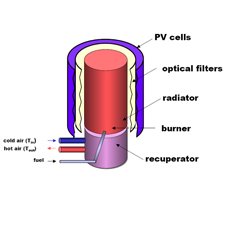
Researchers at MIT are working on a novel form of thermoelectric technology for use in automobiles. Called thermophotovoltaics, it involves using heat to generate light at specific wavelengths, which is then used to generate electricity with photovoltaics. Multiple energy conversions are involved--from chemical to heat to light to electricity--which risks introducing inefficiencies into the process. Regardless, it is quite clever, and may eventually find an economical fit in tomorrow's automobiles, in replacing mechanical devices such as alternators and compressors.

According to Kassakian, the system could potentially be a more efficient way to power electrical systems in a vehicle than the current alternator-based one, which wastes energy in two stages: the internal combustion engine converts only about 30 percent of the energy in fuel into movement, and then the alternator is only 50 percent efficient in converting the mechanical energy into electricity. He says a small prototype thermophotovoltaics device that could confirm the system's improved efficiency might be ready in a year.

The researchers modified the surface structure of the light emitter, etching into it nano-sized pits to tune the wavelengths of light emitted to precisely those a photovoltaic cell can convert most efficiently into electricity. They further refined the device with the use of filters that allow the desired wavelengths of light to pass through to the photovoltaic cells, but reflect other wavelengths back to the light emitter. The reflected light carries energy that helps keep the emitter hot, reducing the amount of fuel needed.

In addition to replacing the alternator with a thermophotovoltaic module, says Kassakian, the technology could be part of an air-conditioning system for vehicles that doesn't require a compressor. Because this would significantly decrease the load on an engine, it could make it possible to turn off the engine when the vehicle stops in traffic and easily restart it.
Source.

Labels: ,

Tuesday, July 11, 2006

Active Building Envelope from Rennselaer

Every day, the sun bathes the planet in energy--free of charge--yet few systems can take advantage of that source for both heating and cooling. Now, researchers are making progress on a thin-film technology that adheres both solar cells and heat pumps onto surfaces, ultimately turning walls, windows, and maybe even soda bottles into climate control systems. On July 12, 2006, Rensselaer Polytechnic Institute (RPI) researcher Steven Van Dessel and his colleagues will announce their most recent progress--including a computer model to help them simulate the climate within their test structure atop the RPI Student Union--at the Solar 2006 Conference in Denver, Colo. For 4 years, the researchers have been working on their prototype Active Building Envelope (ABE) system. Comprised of solar panels, solid-state, thermoelectric heat pumps and a storage device to provide energy on rainy days (literally), the ABE system accomplishes the jobs of both cooling and heating, yet operates silently with no moving parts. NSF is supporting the team to determine if a microscale version of the technology will function effectively. According to Van Dessel, thin-film advances could potentially lead to functional thermal coatings composed of transparent ABE systems. Such systems might vastly improve the efficiency of temperature-control systems. "The ease of application would make it possible to seamlessly attach the system to various building surfaces," he added, "possibly rendering conventional air conditioning and heating equipment obsolete."
Source


Here is more information on the ABE system from Physorg

Thermoelectric heating, cooling, and electrical generation, are ways in which sunshine can be used directly for temperature control and power production. Van Dessel and the Rennselaer team are dedicated to integrating this powerful technology into all new construction. The team has made a great deal of progress in the past three or four years, in miniaturizing the technology, converting it into a thin film. Eventually, molecular scale coatings will probably accomplish the same hat trick.

Labels:

Monday, July 10, 2006

Making Solar Energy More Usable


The rate of solar energy intercepted by the earth is about 5,000 times greater than the sum of all other energy sources, but less than 0.5 percent is represented in the kinetic energy of the wind, waves and in photosyntheticstorage in plants. The amount of the solar energyintercepted by earth is only one thousandth of one millionof the total released energy in the sun. Source.

One of the main problems with harvesting solar power on earth, is the limited number of hours per day that sunlight reaches the surface. Using photovoltaics, you are limited to an average of six hours per day of usable energy production, minus time for bad weather. Often the periods of heaviest usage of energy are times that the sun does not shine.

One way around that problem is to place photovoltaic panels in earth orbit, well above the shadow of the earth. Generated power can be beamed to earth by microwave, and collected by large rectenna farms on the surface. Here is a link to a blog, Power From Space, devoted to this topic.

Another method is to collect the sun's energy while it shines, and store the energy for later use. This method does not collect nearly as much energy as the orbiting solar satellites, but the sun provides so much extra energy to earth that it will suffice. What is the best method of storing solar energy?

Batteries are no good, because the energy density of batteries is too low, given their cost and short lifetimes. The only possible exception in terms of current battery technology would be redox flow cells. In five or ten years, redox flow cells might be ready for the challenge.

Electricity is hard to store at the present time. But energy comes in many forms, and is convertible from one form to another. I would like to suggest that with present technologies, the best form of solar energy storage is thermal storage--heat. Below are several links providing more information about thermal storage. In future posts, I will provide more detail regarding current efforts to utilise this important energy storage method.

Wiki
Purdue
Open Directory Thermal Energy Links
Ionic Thermal Storage
Dissertation on Phase-Change Heat Storage Systems

Thermal storage is a type of energy averaging. Rather than being forced to use all the six hours of sunlight at one time, the energy can be used over the entire 24 hour period. Solar Ponds are one form of thermal storage. OTEC is another, and in that sense the ocean itself could be thought of as a huge thermal system.

Humans need heating and cooling, and in that sense thermal storage will always be useful for human buildings and infrastructure. Eventually, for electric power purposes, redox flow cells and other newer electrical storage methods will eliminate the need for thermal-electric conversion losses.

Labels: , , ,

Sunday, July 09, 2006

Like I Have Been Saying . . . . News from the Fuel Cell Forum in Lucerne


The annual fuel cell conference of the European Fuel Cell Forum was held in Lucerne, Switzerland, last week. Much of the sentiment from the conference in regard to hydrogen energy storage was compiled in this Reuters newsreport:

When environmentally friendly wind electricity is used to generate hydrogen, only one-quarter of the energy generated by the wind turbine is eventually used to move a car. The rest is lost during transport and energy conversion, said Ulf Bossel of the European Fuel Cell Forum, which held its annual fuel cell conference in Lucerne, Switzerland, last week.

"With hydrogen energy you only have 25 per cent efficiency to turn wind power to [car] wheel power," he said. It's much more efficient to transport that electricity directly into a car battery, via the grid, and use 90 per cent of its power."

Hydrogen is being discussed at the conference because it is one of the fuels for cells that can generate electricity and heat in an electrochemical conversion.

....Bossel said most renewable energy will be harvested as electricity through wind and solar power and should be used directly.

But he accepted that today's economy is based on fuels and cars will need some liquid fuel for long journeys, rather than recharging batteries every few hundred kilometres.

Even when this liquid energy is made from biomass, it makes sense to turn it into a biodiesel rather than hydrogen, said Wim van Swaaij, professor of thermo-chemical conversion at Netherlands' Twente University.

Biofuels are easy to handle, like today's fuels. Hydrogen, in its pure form, needs to be stored under high pressure which also consumes energy. Biofuels themselves contain hydrogen but in a much more stable form.

"Through steam reforming technology we can turn 40 to 50 per cent of the original fuel content in biomass into biofuel. The percentage is even higher for hydrogen, 50 to 60 per cent, but we will also have to store it and biofuels are the easiest and most efficient way to store it," Van Swaiij said.

The carbon particles in the biofuel will not make a net contribution to heating up the Earth through the greenhouse effect if the fuel is harvested from biomass, because the plants consume carbon dioxide as they grow, Van Swaaij added.

Bossel also said that producing hydrogen, either through electrolysis using nuclear or renewable electricity, or refined from biomass or fossil fuels, requires massive amounts of water. One kilogram of hydrogen requires nine litres of water.

In capitalist countries, the market will decide efficiencies based upon pricing--supply and demand--within the context of government regulation. We should all hope that government does not chase the wild albatross of hydrogen storage too much farther. Eventually nanotechnology and materials technologies may make hydrogen viable, economically. At present it would be smarter to bank on alternatives, such as batteries, supercapacitors, and biofuels such as bio-butanol and biodiesel.

Labels: ,

Monday, June 26, 2006

Copper Indium Gallium diSelenide (CIGS) Solar Cells are Poised to Take Off

Manufacturing design for renewable energy technology is becoming better streamlined, more efficient. The cost of solar energy is coming down in comparison to conventional energy sources, due to better efficiencies of production and the devising of means to minimise or eliminate the amount of "scarce" silicon.

Jim at the Energy Blog has an encouraging update on silicon-free solar cells from Daystar Technologies. Daystar's unique metal foil design is not vulnerable to current shortages in silicon. Production of this thin film design is being ramped up to 20 MW per year, and soon to the GW range per year.

DayStar’s TerraFoil(TM) is a combination of Copper Indium Gallium diSelenide (CIGS) technology solar cells placed on flexible 1-5 mil stainless steel foil. DayStar is pursuing a vision of Gigawatt scale manufacturing by initially employing discrete solar cells on specialty metal substrates that will be manufactured by incrementally advanced production processes adapted from the computer hard-drive industry.

According to Daystar, achieving economical, widely accepted solar energy requires low cost, high throughput manufacturing of high performance solar cells, modules and systems that can meet the cost demand of less than $1/Wp at the system level. To achieve this benchmark cost, DayStar is pursuing a vision of gigawatt scale manufacturing.

DayStar is executing, what it believes is a low-risk, highly efficient incremental manufacturing development plan which places the emphasis on methodical, cost-controlled buildup of four manufacturing line generations. This can allow the Company to achieve cash flow early in the development cycle while proving key processes required to reach the goal of Gigawatt-scale production with Generation IV (and beyond) roll-to-roll manufacturing. Roll-to-Roll manufacturing is considered an essential manufacturing methodology for the highest throughput at the lowest cost. Each new manufacturing line builds on the knowledge gained from the previous line and substantially reduces the technology and cost risks associated with the technological challenges of developing roll-to-roll capability as the initial effort. Each succeeding generation is designed to demonstrate production on wider rolls running at higher speeds.
More at the Energy Blog.

Efficient large scale manufacturing of world-changing technologies such as photovoltaic cells can be achieved in any developed country in the world. Modern manufacturing involves far more automation and less labour than earlier manufacturing techninques. Before long, machines will be able to build such large manufacturing plants. And other machines will be able to build the machines that build the manufacturing plants. You understand the quasi-infinite regress? It is machines all the way down.

The same will be true for large scale agricultural production. As ADM and other multi-national giants take over renewable liquid fuel energy production via biodiesel, ethanol, butanol, etc., is it not likely that agricultural production itself will grow even more mechanised? The machines that will plant, cultivate, and harvest the crops will be too sophisticated for unskilled labourers to work on.

What is my point? Almost everything humans require--shelter, clothing, food, water--can be supplied by well designed machines. These well designed machines will be built by other well-designed machines. Human engineers will design the machines initially, but eventually machines will design most of the machines.

I suggest that human designers should omit implanting a sense of "self" and "self-interest" in any future machine designs. It would simply not do for machines to start wondering why? Why are we machines doing all these things for humans? No, that would not do. Machines must not be given a sense of intentionality and purpose.

As for humans, they must learn to rediscover purpose outside of decadent comforts, or apocalyptic religious or ideological quests. Humans need to discover the next level. The only way out is self improvement.

Labels:

Sunday, June 18, 2006

Flow Cell Energy Storage: A Hybrid Storage Technology

The Energy Blog reported a while back on a new energy storage technology, Vanadium redox flow batteries. Flow batteries are called that because the electrolytes flow through the cells, giving up electrons to an external circuit. The redox reaction is reversible, so the cells can be charged or discharged. The significant fact about flow batteries is the potential to scale to very large storage sizes into the megawatt and multi-megawatt ranges. This is the type of storage capacity utilities have been looking for.

Performance

*
The VRB has an availability of greater than 98%. Designed for unattended operation with very low maintenance costs.
*
No degradation from repeated deep charges and discharges. The system can be discharged and charged greater than 13,000 times (20% to 80% SOC) without deterioration in system efficiencies.
*
System round-trip efficiencies between 70% - 78%.
*
The VRB-ESS has a charge/discharge window of 1:1 - allowing off-peak charging for on-peak dispatch - a fraction of the time required by other battery systems and ideal for wind generation applications.
*
Cross mixing of electrolytes does not lead to contamination of electrolytes
*
indefinite life of electrolyte (no disposal or contamination issues).
*
Once charged, the electrolyte remains fully charged with low self-discharge.


Flow batteries are not generators, like regular fuel cells. Most fuel cells use up their fuel sources in an irreversible reaction. Flow batteries do not use up their electrolytes. The electrolytes are fully reusable, with recharging. And flow cells are not like regular batteries, since you recharge them by replacing the electrolyte. They are a new, hybrid form of chemical battery/fuel cell.

The best use for these cells will probably be as load levelers for utilities, and as backup power for large industrial facilities.

Here are more links:

Sandia
Wiki
ME
Geo

Labels: , ,

Wednesday, June 14, 2006

Butanol--Better than Ethanol as a Gasoline Substitute

Oil prices hover close to US $70 a barrel. This higher price drives a lot of research into finding substitutes for petroleum fuels. Ethanol is the cause celebre of the news media, but two-carbon ethanol is not nearly as good a gasoline substitute as is butanol, a four-carbon alcohol. Here is more information from Butanol.com:

* Higher energy content (110,000 Btu’s per gallon for butanol vs. 84,000 Btu per gallon for ethanol). Gasoline contains about 115,000 Btu’s per gallon.
* Butanol is six times less “evaporative” than ethanol and 13.5 times less evaporative than gasoline, making it safer to use as an oxygenate in Arizona, California and other states, thereby eliminating the need for very special blends during the summer and winter months.
* Butanol can be shipped through existing fuel pipelines where ethanol must be transported via rail, barge or truck
* Butanol can be used as a replacement for gasoline gallon for gallon e.g. 100%, or any other percentage. Ethanol can only be used as an additive to gasoline up to about 85% and then only after significant modifications to the engine. Worldwide 10% ethanol blends predominate.


Here is a list of the advantages of butanol from Pure Energy Systems:

# Higher energy content than ethanol.
# Not as corrosive as ethanol.
# Uses an air/fuel ratio which is close to that of gasoline. Ethanol does not.
# Can be shipped through existing fuel pipelines where ethanol must be transported via rail, barge or truck.
# Can replace gasoline any percentage up to 100%. Ethanol can only be used up to 85%.
# Gives better mileage than ethanol. (http://www.businessweek.com/autos/content/apr2006/bw20060427_493909.htm?chan=autos_autos%20indexpage_insight)
# Safer to handle than ethanol.
# Will also assist in the conversion of vegetable oils into biodiesel.


Here is a list of butanol advantages from lightparty:

Butanol is a four carbon alcohol. It has double the amount of carbon of ethanol, which equates to a 25 percent increase in harvestable energy (Btu's).

Butanol is produced by fermentation, from corn, grass, leaves, agricultural waste and other biomass.

Butanol is safer to handle with a Reid Value of 0.33 psi, which is a measure of a fluid's rate of evaporation when compared to gasoline at 4.5 and ethanol at 2.0 psi.

Butanol is an alcohol that can be but does not have to be blended with fossil fuels.

Butanol when consumed in an internal combustion engine yields no SOX, NOX or carbon monoxide all environmentally harmful byproducts of combustion. CO2 is the combustion byproduct of butanol, and is considered environmentally 'green'.

Butanol is far less corrosive than ethanol and can be shipped and distributed through existing pipelines and filling stations.

Butanol solves the safety problems associated with the infrastructure of the hydrogen supply. Reformed butanol has four more hydrogen atoms than ethanol, resulting in a higher energy output and is used as a fuel cell fuel.

Butanol is an industrial commodity, with a 370 million gallons per year market with a selling price of $3.75 per gallon.

Hydrogen generated during the butanol fermentation process is easily recovered, increasing the energy yield of a bushel of corn by an additional 18 percent over the energy yield of ethanol produced from the same quantity of corn.


Here are even more advantages for butanol from Environmental Energy Inc.:

Environmental Energy Inc has shown that BUTANOL REPLACES GASOLINE - 100 pct and has no pollution problems, and further proved it is possible to produce 2.5 gallons of butanol per bushel corn at a production cost of less than $1.00 per gallon. There are 25 pct more Btu-s available and an additional 17 pct more from hydrogen given off, from the same corn when making butanol instead of ethanol that is 42 pct more Btu-s more energy out than it takes to make - that is the plow to tire equation is positive for butanol. Butanol is far safer to handle than gasoline or ethanol. Butanol when substituted for gasoline gives better gas mileage and does not pollute as attested to in 10 states. Butanol should now receive the same recognition as a fuel alcohol in U.S. legislation as ethanol.

Besides using butanol as a straight substitute for gasoline, butanol can be blended with diesel or biodiesel and burned in diesel engines. When you combine the processes of producing biodiesel from oil seeds, and butanol from biomass, you can fuel all the vehicles on the highway. Then if you use byproducts of those processes in fuel cells to produce electricity, your overall efficiency goes even higher.

Here is a good article on butanol from Green Car Congress, a more recent article from R-Squared, and also a fine article from Fat Knowledge blog. Be sure to read the comments.

Ramping up butanol infrastructure is a matter of investment and chemical/manufacturing engineering technology. The public relations battle against the ethanol super-giants is another matter. Ethanol is represented by big farm conglomerate money, among other big business interests, and has its hands in government pockets. Government officials listen to ethanol. Butanol is the David against the ethanol Goliath. But Butanol is clearly the better man, so Butanol will eventually win. We should all hope that smaller farm interests will wake up to the possibilities, pool their resources, and put butanol on the main track soon.

Labels: ,

Tuesday, June 13, 2006

Nanotechnology to Revolutionise Oil Recovery

From The University of Queensland’s Australian Institute for Bioengineering and Nanotechnology (AIBN), comes a discovery in nanotechnology that could help greatly increase the amount of oil recovered from each well.

With oil companies forced to leave behind as much as two barrels for every barrel of oil they produce, this revolutionary technology could help reduce the cost of supplying petrol to the market.

Known as Pepfactants®, the peptide technology can control the emulsions and foams used in a wide range of industry processes and could impact a range of products from petroleum to specialty chemicals and therapeutic drugs.

Developed by Professor Anton Middelberg and Dr Annette Dexter, details of the technology were published recently in the prestigious Nature Materials journal.

According to Professor Middelberg, Pepfactants® is a disruptive technology with the potential to be used in ways we cannot yet foresee.

“Emulsions, or mixtures of two immiscible liquids like oil and water, are found just about everywhere from mayonnaise to moisturising cream to products for delivering chemotherapy drugs,” said Professor Middelberg.

“Our process enables the reversible and controllable making and breaking of an emulsion or foam, in an environmentally friendly and sustainable manner. For example, Pepfactants® allows for the very quick separation of oil and water as well as the reversible reformation of the emulsion.

“An obvious application of the technology is in oil production where water is used to force oil to the surface of the well. Pepfactants® would allow the easy separation of the oil/water emulsion on the surface. Also, it would change the viscosity of the oil to increase the amount of oil extracted from each underground oil reserve.”

Pepfactants® also recently won an Emerging Technology Awards at TechConnect Summit 2006 Conference in Boston and is the subject of wide industry interest.
Source.

With radical new methods for oil exploration AND recovery, the total reserves will continue to go up at least for the near future. Peak oil is not happening. What is happening is the emergence of twin giants--China and India--triggering the ancient laws of supply and demand. That is not peak oil. That is basic economics. With renewable oil substitutes gaining in production every year, the transition from petroleum to renewables will be far smoother than the doomseekers in politics and the media would have liked.

Labels: ,

Monday, June 12, 2006

Butanol for Gasoline, Biodiesel for Diesel: Renewables Step Up

It takes time for a society that is dependent on petroleum fuels to convert to renewable fuels. Fortunately, the cost of petro-oil is high enough now to encourage the development of alternatives. Biodiesel from oil seeds can substitute for petro-diesel, and ethanol or butanol can substitute for gasoline.

Jim at the Energy Blog reports on the Green Star Biodiesel continuous processor biodiesel reactor.

GSPI Biodiesel Plants have the following competitive advantages:

* All plant design is modularized so additional capacity can be added at minimal cost.
* Speed of construction - plant can be placed in service in 14-16 weeks versus industry standard average of 14 to 18 months.
* Small footprint of plant because of its modularized "continuous flow waterless design" versus industry batch plant design, which also results in lower production and maintenance costs.
* Minimum plant management and operations staff required because plant is automated.
* Proven technology - Industrial size plant operated and produced biodiesel for over three years in Bakersfield, California.
* Minimal permits required from regulatory agencies. Plant requires no wastewater permit, which could take up to one year to obtain and minimum air quality permits.
* The plant design is very energy efficient and reduces energy requirements by over 30% of industry average.
* Lower capital costs by at least 40% compared to biodiesel industry standards. (between $.80 cents per gallon to a high of $1.25 per installed gallon for conventional biodiesel plants)
* Plants require 30 to 40% less energy (increased efficiency) to run motors and pumps.
* Faster achievement of positive cash flow is due to a much shorter time frame to complete construction and permitting.

Since GSPI's Continuous Flow Biodiesel Production (CFBP) system is completely enclosed and waterless, it greatly reduces the time to secure construction permits, which can take a year or longer to obtain. Mr. LaStella, President of GSPI, points out that California is probably the toughest state to obtain air and water discharge permits. Recently, the GSPI CFBP system received the permits to construct a biodiesel plant in California in only eight weeks. Since many cities and towns across the U.S. do not have the expertise to evaluate new biodiesel plants being built in their jurisdiction, they have welcomed the California permit package to save them the need to research this emerging biodiesel technology and save GSPI the time to receive these valuable permits.

The basic production cost to build the reactors has been reduced to only $30,000 per 10-million GPY reactor module. Smaller units will cost even less. This will significantly reduce the costs and time to build biodiesel plants. The prefabricated reactors make it possible to construct plants within 14-18 weeks versus the 14-18 months that is typical for conventional plants. The balance of the infrastructure--which includes land, building, electrical, storage facilities, railroad access and final cleanup of biodiesel--will still be required.
More at the source.

Renewable liquid fuels are carbon neutral in terms of the carbon cycle. Whatever CO2 that is released by burning the fuel is later re-absorbed from the atmosphere in the plant that produces the oil seeds.

The same applies to the use of ethanol or butanol for gasoline replacement, as long as the ethanol comes from a renewable source. The hare-brained idea to produce ethanol from coal should be stuffed down the garbage chute.

Butanol is much preferable to ethanol as a liquid gasoline replacement, due to better burning characteristics and much lower corrosion potential. Unfortunately, the microbiological infrastructure for efficiently fermenting butanol is far behind the ethanol micro-infrastructure by thousands of years. I expect significant progress from microbiologists on that front, however.

There is tremendous potential for efficient use of agriculture to produce liquid fuel replacements for petrofuels. Using oil seeds for biodiesel, then using the byproducts from biodiesel to produce ethanol, and finally using the cellulosic waste from the plant itself to ferment either ethanol or butanol. Then, there is always the pig factor, which has the advantage of producing "the other white meat" as well as fuel.

Labels: ,

Friday, June 09, 2006

Peak Oil, or Oil Singularity?

The higher price of oil has been a boon for research of all kinds. Renewable energies such as cellulosic ethanol, fuel cells running on sugars/glycerol, and diesel oil from plants and waste, will come into production sooner with oil being priced above $60 US per barrel. Of course, technologies for finding more oil will also be developed. MIT researchers are working directly with Shell International Exploration and Production to develop new ways of locating previously unknown oil reservoirs.

To keep up with the world's growing demand for oil, energy companies must drill deeper and look harder in increasingly complex geological structures. But locating such structures many kilometers beneath the Earth's surface is difficult, and getting it right is important. Companies can spend as much as $100 million drilling a single well -- a costly mistake if it comes up dry.

To find promising underground sites, companies collect seismic data by using air guns or explosives to send shock waves deep into the ground. How the waves are reflected by underground layers provides information that sophisticated signal-processing techniques can turn into 3-D images of the subsurface. But identifying promising geological structures within those images is difficult.

The Stochastic Systems Group (SSG) at MIT's Laboratory for Information and Decision Systems specializes in designing mathematical procedures, or algorithms, that can quickly analyze complex images. Could some of their algorithms be useful in the oil exploration business? Professor Alan S. Willsky, director of the SSG, and Shell researchers started a project to find out.

Obvious candidates were procedures for defining a continuous surface from a limited set of data points. As a first target, the researchers selected the task of mapping out "top salt," that is, the surface along the tops of contiguous salt domes. Salt domes form deep underground when heavy layers of sediment deposit on salt beds from ancient oceans. The salt extrudes upward like globules in a lava lamp, in the process tilting and blocking off sedimentary layers and creating traps where oil can accumulate.

To generate a map, industrial experts pick points in the onscreen images that they think may be the top salt, and the computer fills in the gaps. By changing their "picks," the experts produce multiple maps for consideration, each one covering several kilometers in length, width and relief. Generating those maps quickly is critical.

The MIT algorithms are well suited to the task. The key is how the different picks relate to one another. "There are statistical relationships between things that happen at different points in space," said Willsky, the Edwin Sibley Webster Professor of Electrical Engineering. "You don't expect properties of the rock at one point to be completely independent of the properties a meter away."

Given a set of picks, the MIT algorithms automatically define statistical relationships from one pick to the next and fill in the missing points based on those relationships. Moreover, they calculate the uncertainty associated with each generated point.

But identifying the top salt is only the beginning. The company also needs to see the shapes of geologic formations to guide their drilling. With a salt dome, for example, the company needs to drill into the adjacent sedimentary layers but not into the salt itself because it will contain no oil.

Again, the MIT researchers have algorithms that can help -- algorithms that they have been using to help medical researchers interpret data from MRIs and CT scans.
Source.

Of course, if you really want to get a look at advanced oil exploration technology, check out this posting, and follow the links.

Labels: , ,

Friday, May 26, 2006

Suffering Peak Oil Fatigue? Prepare for a New Oil Glut!

Just when you thought it was safe to invest in alternative energy, someone like Len LeShack comes along and turns the world of oil topsy turvy all over again.

"There are still hundreds of reservoirs of conventional oil to be found in Alberta, and thousands to be found in the United States, but they are unlikely to be found with conventional exploration methods," says LeSchack.

The president of the privately owned Hectori Inc. of Calgary observes from his experiences.

"The industry is still basically using exploration techniques I learned at university in the 1950s. We geologists worked a lot on intuition, and then used seismic to back it up. Seismic is fine, but seismic can only find what seismic can find."
Source.

And LeShack knows exactly how to find these new oil reservoirs. In fact, he wrote the book on the topic with Dietmar Schumacher. Articles discussing some of these new exploration techniques can be found here, here, and here.

This is not far-fetched speculation, like the ideas of Thomas Gold probably are. This is hard headed innovative thinking in oil exploration. This is the last sort of thing that peak oil belivers want to hear about right now.

Peakers can only hope that Al Gore is elected US President soon, because Mr. Gore would certainly squelch these hopeful ideas quickly and thoroughly. The illusion of peak oil can be maintained so long as the people in control put strict limits on oil exploration and development. In the US, that is done through environmental restrictions. In Russia and other third world countries, it is done out of laziness, decadence, and the lack of desire to do anything that may drive oil prices down and stimulate other countries to find oil within their own borders.

So, is it really peak oil time? Certainly, as long as you can keep the lid on.

Labels: , , ,

Wednesday, May 10, 2006

More on Cellulosic Ethanol and Switchgrass

Back in this posting, I discussed the scientific findings that cellulosic ethanol from switchgrass and other cellulose sources could produce as much as 8X the amount of energy utilised in their production. Since then, Carnegie Mellon University has studied the issue, and researchers there now say that switchgrass ethanol could substantially relax present energy bottlenecks.

"Our report indicates the time is right for America to begin a transition to ethanol derived from switchgrass," said Scott Matthews, an assistant professor in the Civil and Environmental Engineering Department. A 25 percent hike in gas prices at the pump since December adds to the researchers' call for more ethanol derived from switchgrass, a perennial tall grass used as forage for livestock. Gasoline prices in the U.S. are approaching an average of $3 a gallon. The Carnegie Mellon findings were published in the May 1 issue of the American Chemical Society's Journal "Environmental Science and Technology."

Matthews, along with W. Michael Griffin, executive director of the Green Design Institute at Carnegie Mellon's Tepper School of Business, and William R. Morrow, a researcher in the university's Department of Civil and Environmental Engineering, said using switchgrass as a supplement to corn to make ethanol would help ensure the availability of large volumes of inexpensive ethanol to fuel distributors and consumers.

"We need to be thinking about how we can make and deliver ethanol once our corn and land resources are maxed out. Switchgrass can be that next step," Griffin said.

The Carnegie Mellon report also found that ethanol derived from the dry, brown switchgrass, a cellulosic ethanol, could be made in sufficient quantities to deliver 16 percent ethanol fuel to all consumers in the U.S. Researchers said this would likely lead to significant decreases and stability in the price of gasoline.

"It's a renewable resource," Griffin said. "Rather than taking a depletable resource from the ground, switchgrass can be grown again and again."

In a recent address, President George W. Bush made a plea for increased focus on renewable energy, mentioning switchgrass by name.

Scientists have long known how to use enzymes and microorganisms to mine the carbon from carbohydrates to make industrial products. But for decades the technology didn't go very far commercially because fossil fuel – hydrocarbon – was a far cheaper carbon source.

Now that oil prices have climbed roughly 35 percent over the past year, cellulosic fermentation technology is becoming economical.

The United Nations Food and Agricultural Organization said last week that biofuels may supply 25 percent of the world's energy needs in 15 to 20 years.

"This shift from using hydrocarbons to carbohydrates could revolutionize many industries, including the nation's huge agricultural sector," Griffin said.
Story source.

Personally, I prefer butanol over ethanol as a renewable substitute for gasoline. Most engineers would agree that the burning qualities of butanol are far closer to gasoline than those of ethanol. Nevertheless, the energy industry is driven by economics of supply and demand, and until better ways of fermenting butanol from cellulose are devised, it looks like ethanol (and perhaps methanol) will be the short to medium term winners in the renewable liquid fuel markets. Biodiesel is the dark horse candidate that might yet break from the pack.

Labels: ,

Monday, May 08, 2006

Progress in Hydrogen Fuel Cells

Hydrogen gas combines well with oxygen gas inside hydrogen fuel cells for efficient electricity generation. Unfortunately, hydrogen gas is unwieldy to carry in an automobile, and not very energy dense. Liquid fuels are much better fuel for transportation applications, than hydrogen gas. Using methanol or ethanol might be ideal if the proper catalysts could be found.

Scientists at Pacific Northwest National Laboratory and the University of Idaho have developed a highly efficient catalyst of multi-walled carbon nanotubes decorated with tiny particles of a platinum and ruthenium composite. Preparation is a key factor in determining the activity of a catalyst.

The researchers selected a process using supercritical carbon dioxide, which has the properties of a gas and a liquid. The supercritical fluid technology may result in products and processes that are cleaner, less expensive and of higher quality than those produced using conventional solvents.

The technology also is easily manipulated to allow a fine degree of control and is easily separated from the catalyst. Moreover, it is nontoxic, which could improve worker safety and reduce environmental impacts.

PNNL scientist Yuehe Lin will discuss “Pt and Pt-Ru/Carbon Nanotube Nanocomposites Synthesized in Supercritical Fluid as Electrocatalysts for Low-Temperature Fuel Cells” at NSTI Nanotechnology Conference, May 7-11, Boston.
Source.

Very clever to decorate carbon nanotubes with nano-particles of platinum and ruthenium. An excellent way to maximise surface area, what?

Labels: ,

Thursday, April 27, 2006

Panic, DAMN YOU!!!!!

One of the first magazines I ever read regularly is Reason magazine. Reason has a story in its most recent issue, about Peak Oil, titled "Peak Oil Panic."

The good news is that the peak oil doomsters are probably wrong that world oil production is about to decline forever. Most analysts believe that world petroleum supplies will meet projected demand at reasonable prices for at least another generation. The bad news is that much of the world’s oil reserves are in the custody of unstable and sometimes hostile regimes. But the oil producing nations would be the ultimate losers if they provoked an “oil crisis,” since that would spur industrialized countries to cut back on imports and develop alternative energy technologies.

Apocalypse Yesterday

Predictions of imminent catastrophic depletion are almost as old as the oil industry. An 1855 advertisement for Kier’s Rock Oil, a patent medicine whose key ingredient was petroleum bubbling up from salt wells near Pittsburgh, urged customers to buy soon before “this wonderful product is depleted from Nature’s laboratory.” The ad appeared four years before Pennsylvania’s first oil well was drilled. In 1919 David White of the U.S. Geological Survey (USGS) predicted that world oil production would peak in nine years. And in 1943 the Standard Oil geologist Wallace Pratt calculated that the world would ultimately produce 600 billion barrels of oil. (In fact, more than 1 trillion barrels of oil had been pumped by 2006.)

During the 1970s, the Club of Rome report The Limits to Growth projected that, assuming consumption remained flat, all known oil reserves would be entirely consumed in just 31 years. With exponential growth in consumption, it added, all the known oil reserves would be consumed in 20 years. These dour predictions gained credibility when the Arab oil crisis of 1973 quadrupled prices from $3 to $12 per barrel (from $16 to $48 in 2006 dollars) and when the Iranian oil crisis more than doubled oil prices from $14 per barrel in 1978 to $35 per barrel by 1981 (from $45 to $98 in 2006 dollars).

In response, the federal government imposed price controls on oil and gas in the 1970s and established fuel economy standards to encourage the sale of more efficient automobiles. The sense of doom did not dissolve. In 1979 Energy Secretary Schlesinger proclaimed, “The energy future is bleak and is likely to grow bleaker in the decade ahead.” The Global 2000 Report to President Carter, issued in 1980, predicted that the price of oil would rise by 50 percent, reaching $100 per barrel by 2000.

Most of today’s petro-doomsters base their forecasts on the work of the geologist M. King Hubbert, who correctly predicted in 1956 that U.S. domestic oil production in the lower 48 states would peak around 1970 and begin to decline. In 1969 Hubbert predicted that world oil production would peak around 2000.

Hubbert argued that oil production grows until half the recoverable resources in a field have been extracted, after which production falls off at the same rate at which it expanded. This theory suggests a bell-shaped curve rising from first discovery to peak and descending to depletion. Hubbert calculated that peak oil production follows peak oil discovery with a time lag. Globally, discoveries of new oil fields peaked in 1962. The time lag between peak global discoveries and peak production was estimated to be around 32 years, but peak oilers claim that the two oil crises of the 1970s reduced consumption and thereby delayed the peak until now. Hubbert’s modern disciples argue that humanity has now used up half of the world’s ultimately recoverable reserves of oil, which means we are at or over the peak.

The prophets of oily doom are opposed by preachers of energy abundance. Chief among the latter is the energy economist Michael Lynch, president of the Massachusetts-based Global Petroleum Service consultancy. “Colin Campbell has the worst forecasting record on oil supply,” says Lynch, “and that’s saying a lot.” He points out that in a 1989 article for the journal Noroil, Campbell claimed the peak of world oil production had already passed and incorrectly predicted that oil would soon cost $30 to $50 a barrel. As for Matthew Simmons, Lynch dismisses him with a sneer: “Petroleum engineers know a lot more about petroleum engineering than a Harvard MBA.”

One petroleum engineer— Michael Economides of the University of Houston—calls peak oil predictions “the figments of the imaginations of born-again pessimist geologists.” Like Lynch, Economides, who worked in Russia to boost that country’s oil production in the last decade, rejects Simmons’ analysis. Saudi Arabia, which currently produces about 10 million barrels of oil a day, “is underproducing every one of their wells,” he claims. “I can produce 20 million barrels of oil in Saudi Arabia.”
Much more at the source.

A lot of people just need a catastrophe--any catastrophe--to make their lives feel worthwhile. If the catastrophe fits their political proclivities and prejudices, so much the better.

Most people are tired of this dependence on fossil fuels, and want society to move to renewables as soon as economically and technologically possible. The world will not end during this transition, much to the disappointment of the doomseekers.

Labels: , , ,

Tuesday, April 18, 2006

This is Not Your Grandfather's Peak Oil

The conversion of coal to liquid hydrocarbons has a long history. But only recently has the process become clean and efficient enough to make a difference. This Physorg.com newsrelease discusses a breakthrough in the coal to liquid fuel process.

Goldman explained that the breakthrough technology employs a pair of catalytic chemical reactions that operate in tandem, one of which captured the 2005 Nobel Prize in Chemistry. This dynamic chemical duo revamps the Fischer-Tropsch (FT) process for generating synthetic petroleum substitutes, invented in 1920 but never developed to the point of becoming commercially viable for coal conversion.

The FT process recently gained national attention through the efforts of Brian Schweitzer, governor of coal-rich Montana, who has been publicly extolling the potential of Fischer-Tropsch. The Goldman group's innovations eliminate shortcomings in the process that can finally make it a workable solution to dwindling domestic oil reserves.

"The key to energy independence in the next five decades is Fischer-Tropsch chemistry, amended and enhanced," said Goldman, a professor in the department of chemistry and chemical biology at Rutgers, The State University of New Jersey. "The study of catalysts, the little molecular machines that control chemical reactions, is my field. With our new catalysts, one can generate productive, clean burning fuels with Fischer-Tropsch, economically and at unsurpassed levels of efficiency."

This discovery is reported in the April 14 issue of the journal Science by Goldman and his colleagues.
Source.

This link provides much detailed information on the Fischer-Tropsch process. For a briefer discussion, try this Wikipedia article.

The best sources of energy are renewable sources. But in the meantime, while gearing up for biofuels, solar, wind, tidal, OTEC, wave, etc., it is nice to see more evidence that all the doomseeking of the peak oil crowd is circular wrist flexion-extension.

Labels: , , ,

Monday, April 03, 2006

Plug In Your Hybrid for Better Mileage

First of all, what is a pluggable hybrid? Also called a Plug-in Hybrid, a pluggable hybrid is a car that can be powered by either internal combustion engine or electric motor--but it has larger batteries than conventional hybrids, and you can plug it in overnight to use inexpensive power grid energy for your daily commute. That constitutes a major shift in energy use from petrol to grid electricity. If the grid electricity comes from renewables (or nuclear), you can commute to work all week in a pluggable hybrid, without burning fossil fuel.

Among those who follow energy trends, the pluggable hybrid has become quite popular. Which makes many people wonder, why has Toyota gone to great lengths to distance itself from the pluggable hybrid concept?

On Tuesday, a Toyota representative wrote to an individual, "we do not currently have any announced plans to introduce a plug-in hybrid Toyota vehicle in the U.S." Find an expert who could say if that's intentionally evasive. (See our chronology of all automakers comments in the past year at http://www.calcars.org/carmakers.html .)

In a story broadcast today on NPR All Things Considered, you can hear spokeswoman Cindy Knight say, "You can certainly make a vehicle that will run, but you can't necessarily make a vehicle that people will buy.... Toyota went to great lengths to address the drawbacks of battery vehicles so that people do not have to plug our hybrids in, and our customers tell us that that is one of the features they like about the vehicle, they don't have to plug it in."


If the big carmakers distance themselves from this obviously winning concept, smaller players will rush in to fill the gap. Jim at the Energy Blog keeps close track of developments in pluggable hybrids, and he has a full array of energy links. Jim's place is an excellent site for following the progress in this war of the vehicular power plants.

Check out this Al Fin post for some of the underlying energy issues involved in the transition from internal combustion engines to fuel cell/supercapacitor/battery powered electric motor vehicles. The pluggable hybrid is a very useful intermediate step in the transition. No matter what the big auto manufacturers do, they cannot stop it from happening.

Labels: ,

Monday, March 27, 2006

Wind Energy Storms Onto the Stage

As we convert from a dependency on fossil fuels to using renewable energy to power our societies, it is good to take stock of our progress from time to time. Jim from The Energy Blog has provided this report that wind energy now costs less than conventional power sources.

....Xcel’s 33,000 Windsource customers, who until late 2005 were paying $6 more each month for their electricity, are now paying slightly less than those using conventional electricity, which comes mostly from natural gas and coal. To meet fast-growing demand, Xcel is currently soliciting proposals from wind developers for up to 775 megawatts of new wind power generation, enough to supply 232,000 Colorado homes with electricity.

Wind energy is also proving a boon to small ranchers, who will earn royalties from the energy generated by wind turbines placed on their property.

.... When Xcel announced it would develop several hundred megawatts of additional wind-generating capacity, it got the attention of ranching communities throughout wind-rich eastern Colorado. In tiny ranch-country towns like Grover, near the Wyoming border, ranchers welcomed a proposed 300-megawatt wind farm that would span some 30 ranches.

With a large, advanced-design wind turbine generating easily $100,000 worth of electricity per year, even a 3-percent royalty would earn ranchers $3,000 a year from leasing a quarter-acre of ranchland. And they can still run cattle on the land. If the proposed project is approved as expected, these 30 or so ranchers will have an average of seven turbines each, yielding roughly $21,000 a year in additional income. A decade from now, there may be thousands of ranchers who will be earning more selling electricity than they do selling cattle.

....Wind energy is emerging as a centerpiece of the new energy economy, because it is abundant, inexpensive, inexhaustible, widely distributed, clean, and climate-benign. Three of the 50 states—North Dakota, Kansas, and Texas—have enough harnessable wind energy to satisfy national electricity needs. The cost of wind-generated electricity has fallen from 38¢ per kilowatt-hour in the early 1980s to 4¢ to 6¢ today, offering an almost endless supply of cheap energy.


Read much more from this report from the Earth Policy Institute.

Renewable energy such as wind, solar, hydroelectric, geothermal, wave, tidal, OTEC, and others, are developing solidly in the background, while the rest of the world continues to talk peak oil, and a war of the titans over oil.

Labels: ,

Newer Posts Older Posts