Monday, July 30, 2012

Waste to Energy: Micro-Channel Fischer Tropsch

Sierra Energy plans to build a municipal waste to liquid fuels plant in Northern California, based upon the scalable microchannel Fischer Tropsch technology developed by Velocys / Oxford Catalysts.

The microchannel FT technology can affordably convert any carbonaceous form of matter -- from biomass to coal to natural gas to municipal waste, etc. -- to high quality diesel fuel and other high value chemicals.
The waste-to-liquids process involves two main operations: production of a synthesis gas (syngas) using a gasifier; followed by FT synthesis. The resulting FT product can then be upgraded via hydrocracking and fractionation to produce a range of liquid hydrocarbon fuels. The fuels produced can be directly substituted for conventional fuels, and are generally of higher quality than those derived by conventional means.

In the commercial demonstration, which will be hosted by SacPort Biofuels, the gasification will be carried out using Sierra Energy’s proprietary FastOx waste gasification process. The FT synthesis will be carried out using Velocys’ microchannel FT reactor technology. Sierra Energy intends to use this commercial demonstration as the basis for the design of a turn-key, waste gasification system called the FastOx Pathfinder.

The FastOx gasifier is a simple derivative of the blast furnace, specifically designed to convert waste; waste is fed into the top of the gasifier while oxygen and steam are injected into the bottom. The injection of oxygen and steam is one of Sierra Energy’s patented innovations. The waste passes through four reaction zones as it descends in the gasifier:
Drying occurs when the hot syngas produced at the bottom of the gasifier rises and passes through the waste in the top zone of the unit, drying the waste as it passes.

Devolatization is where the majority of the organic matter is driven off into syngas.

Partial oxidation occurs when carbon-containing materials in the waste react with the injectors. This reaction creates high temperatures in the range of 4,000 °F, allowing for the thorough conversion of remaining carbon into syngas.

Melting of inorganic compounds results from the high temperatures occurring in the partial oxidation zone. These compounds collect at the bottom of the unit and are continuously removed as inert stone (slag) and recycled metals.
_GCC

While California's government is attempting to promote this nifty technology for waste to liquids, a more economical use at this time would be on offshore oil platforms and at stranded gas wells -- to reduce the level of natural gas flaring and to make economical use of stranded and offshore gas.

This technology would also work well for decentralised biomass to liquids (BTL) production on a local and regional level -- once the infrastructures for collection and densification of biomass are developed.

Labels: , , ,

Friday, June 01, 2012

Interesting New 57% Efficient Solid Oxide Fuel Cell

Fuel cells can burn a wide range of fuels: from hydrogen to biomass to methane to diesel. They are also more efficient than internal combustion engines. This makes them practical for both stationary power generation facilities, and for mobile power generation in electric-powered vehicles. Below we have republished two excerpts from stories reporting on important developments in solid oxide fuel cell (SOFC) design and development, which makes SOFCs more efficient and practical.
GCC

Researchers at the Pacific Northwest National Laboratory report on a highly efficient, small-scale solid oxide fuel cell system featuring PNNL-developed microchannel technology in combination with adiabatic, external steam reforming and anode gas recirculation. The heat and water required for the endothermic reforming reaction are provided by the recirculated anode gas emerging from the SOFC stack. They refer to this as adiabatic steam reforming because external heat sources, such as a combustor or an electric-resistance heater, are not necessary to support the reaction.

The new fuel cell system achieves up to 57% efficiency—significantly higher than the 30 to 50% efficiencies previously reported for other solid oxide fuel cell systems of its size—according to a study published in this month’s issue of the Journal of Power Sources. The pilot system generates about 2 kW of electricity; the PNNL team designed it to be scaleable to produce between 100 and 250 kW. _GCC
NewEnergyandFuel

The PNNL SOFC system has been streamlined to make it more efficient and scalable by using PNNL-developed microchannel technology in combination with processes called external steam reforming and fuel recycling. PNNL’s system includes fuel cell stacks developed earlier with the support of Department of Energy’s Solid State Energy Conversion Alliance.

The big numbers for the efficiency of this small SOFC system is the use of a PNNL-developed microchannel technology in the system’s multiple heat exchangers. Instead of having just one wall that separates the two gases, PNNL’s microchannel heat exchangers have multiple walls created by a series of tiny looping channels that are narrower than a paper clip. This increases the surface area, allowing more heat to be transferred and making the system more efficient. PNNL’s microchannel heat exchanger was designed so that very little additional pressure is needed to move the gas through the turns and curves of the looping channels. Even more interesting is the second unique aspect of the system – it recycles the heat. _NewEnergyandFuel
SOFCs using heat recycling fuel reformers, should eventually be able to use a wide range of carbonaceous fuels -- including biomass. So much for the collapse of civilisation when crude oil is abandoned as a primary fuel.

More on biomass fuel cells (PDF)

Here is a "kinder, gentler" way of turning biomass into energy. As we have predicted, the conversion of cellulose to energy and fuels is likely to follow a rough trajectory over various processes. The "brute force" thermal and thermochemical approaches are more practical initially. As better organisms and enzymes are engineered, the biological approach is likely to grow more efficient. Finally, as nanotechnological bio-mimics improve, the greater robustness of inorganic nanotech-catalysts should facilitate their use in place of more fragile bio-based catalysts. In the background, the movement of more advanced societies to safe, clean, reliable, and affordable gen III and gen IV nuclear reactors at various scales, is likely to increase the energy and fuel production choices of societies almost exponentially.

Labels: , , ,

Tuesday, September 13, 2011

OxfordCatalysts' Microchannel Technology Wins 2011 Chemical Engineering Award

Microchannel technology developed by the Oxford Catalysts Group was named as the winner of the Kirkpatrick Chemical Engineering Achievement Award at the ChemInnovations conference and exhibition in Houston, Texas on 12 Sept.


The UK group’s modular synthetic fuel technology - which enables the small scale and economic production of synthetic fuels via gas-to-liquids (GTL), biomass-to-liquids (BTL) and coal-to-liquids (CTL) via the Fischer-Tropsch (FT) reaction - includes microchannel FT combined with a new highly active FT catalyst and steam methane reforming (SMR) reactors.
_The Engineer
The Velocys / Oxford Catalyst microchannel technology for scalable GTL, BTL, and CTL, has won previous engineering awards, and is likely to win more in the future. By bringing Fischer-Tropsch technology down to a size and cost which can be implemented for offshore and stranded GTL, the microchannel devices are likely to have a slowly building evolutionary impact on liquid fuels production from an unexpected source.

The fact that the devices can also convert biomass and coal to liquid fuels is an added advantage, which will eventually bring the cost of F-T plants down from the $billion range into the $ hundreds of thousands range.
It is designed for use in the smallscale distributed production of biofuels, and as practical way to transform associated and stranded gas via GTL into high quality synthetic crude. This opens up the possibility of carrying out GTL offshore.

According to Oxford Catalysts, the technology could also make it possible to use the GTL process to convert North America’s abundant shale gas resources into diesel and jet fuels.

The Kirkpatrick Chemical Engineering Achievement Award recognises noteworthy chemical-engineering technology commercialised anywhere in the world during the two years prior to a given award year.

Jeff McDaniel, commercial director at the Oxford Catalysts Group said the award recognised “the environmental and commercial significance of our activities in GTL and BTL. _The Engineer

Labels: , ,

Monday, June 20, 2011

North American Shale Oil Bonanza Attracts GTL Technologies

...a major exploration and production company is seriously considering the possibility of incorporating microchannel FT reactors into a planned 5,000 -15,000 barrel per day (bpd) GTL facility onshore in North America designed to convert shale gas into finished synthetic fuels...The shortlisted technologies will be subjected to further evaluation as part of a major high-budget engineering study that will last for several months. The results of the study will be used to select the project’s technology providers. _Engineer

Oxford Catalyst's microchannel F-T technology for converting gas-to-liquids (GTL) is one of the frontrunners to be intensively studied for shale gas to liquids operations onshore in North America.

The technology is already being adopted for offshore applications in Brazil.

PDF presentation on Velocys / Oxford Catalyst's microchannel F-T technology
Microchannel FT reactors developed by Velocys and using a new highly active FT catalysts developed by Oxford Catalysts exhibit conversion efficiencies in the range of 70% per pass, according to Jeff McDaniel, Oxford Catalysts director of commercialisation.

“The high efficiency and modular nature of our microchannel FT reactors makes them particularly useful for this type of application because capacity can be easily increased by simply ’numbering up’ or linking together additional FT reactor modules,” said McDaniel. _Engineer

Labels: , ,

Monday, April 04, 2011

Tiny Microchannel Fischer-Tropsch Reactor Can Make 6 BPD!

While several R&D groups around the world have shown the potential of microchannel reactors for process intensification, only Velocys has been successful in developing the technology for industrial scale applications. This effort, begun in 1998, spanned several key scale-up steps, and recently culminated in fabricating the manufacturing test device shown in Figure 6. If operated, this reactor would have a nominal capacity of 1,000 liters/day or 6 barrels/day (bpd). _VelocysPDF
Velocys PDF White Paper

There are commercially operating oil wells which produce less than 6 barrels per day. For a tiny microchannel F-T reactor to produce that amount is remarkable. Learn more about Velocys' technology from their PDF white paper.

More: The Velocys microchannel F-T reactors can convert natural gas to liquid fuel on virtually any scale. Given that 5% of the world's natural gas production is flared (via GCC) -- burned or released into the atmosphere -- there is a lot of profit waiting to be made through such a device. Approximately 1 billion barrels of oil equivalent worldwide per year, potentially.

Microchannel design is hitting theoretical engineering like a freight train, and is beginning to impact commercial design and development as well -- for a wide array of applications. The scalability of the microchannel approach should cause most persons to eventually see industrial and power plants in a much friendlier way.
A microreactor or microstructured reactor or microchannel reactor is a device in which chemical reactions take place in a confinement with typical lateral dimensions below 1 mm; the most typical form of such confinement are microchannels.[1] Microreactors are studied in the field of micro process engineering, together with other devices (such as micro heat exchangers) in which physical processes occur. The microreactor is usually a continuous flow reactor (contrast with/to a batch reactor). Microreactors offer many advantages over conventional scale reactors, including vast improvements in energy efficiency, reaction speed and yield, safety, reliability, scalability, on-site/on-demand production, and a much finer degree of process control. _Wiki
Oregon State University engineers have developed a surface mount adhesive that will allow for much cheaper and speedier assembly of low to medium temperature microchannel reactors than previously possible.

Researchers at the National Institute of Standards and Technology (NIST) and the Polytechnic Institute of New York University, are developing a continuous process microchannel reactor for scalable polymer synthesis.

One use of microchannel heat exchangers already in use is the microchannel cooling system for computer processors. Microchannel designs allow for particularly efficient heat exchange -- which can be utilised for powering chemical reactions such as Fischer Tropsch, or for more mundane cooling purposes.

Other uses for microchannel reactors include high throughput analysis of samples, the experimental emulation of enzyme systems and living tissue systems, and a combination of synthesis, purification, and analysis of product in a single package. More practical uses of this technology are on the way.

Labels: ,

Tuesday, March 08, 2011

A Methane Bonanza: What To Do With All the Gas?

A wealth of unconventional methane is exploding onto the energy scene, much to the dismay of dieoff doomers, Russian energy tsars, and carbon hysterics. But what is the world to do with all this methane -- which is difficult to transport, and cannot be easily used within the liquid fuels infrastructure?

The answer would seem to be to convert the gas into liquids, but what is the most economical way to do that? Liquified natural gas (LNG) is difficult and expensive to handle, Fischer-Tropsch gas to liquids (GTL) is likewise expensive and requires costly chemical plants (although microchannel FT architectures may alter the equation). What to do, what to do?

German researchers at Max Planck Institute for Carbon Research in Mulheim are trying to develop better ways of converting gaseous methane to liquid methanol -- which would open a world of economic possiblities.
Methanol is a useful starting material for many chemical syntheses, including fuels; it can also be added to conventional fuels to power fuel cell or used in combustion engines. Conventional processes for producing methanol from methane involve detours (synthesis gas), are complex and energy-intensive, and require high temperatures and pressures. By contrast, the enzyme methane monooxygenase does the job gently and efficiently. However, this is a very complex enzyme that cannot easily be produced and used in an artificial environment....
In contrast to time-consuming protein engineering, the present approach simply requires the addition of an appropriate chemically inert perfluoro fatty acid to the enzyme, thereby triggering a catalytically activating effect which originates from specific guest/host interactions in the binding pocket. A shift from an inactive low-spin state to a catalytically active high-spin state and a decrease in the effective volume of the binding pocket appear to be the crucial factors as shown by UV/Vis difference spectra as well as a theoretical analysis based on MD simulations and docking experiments.

The present approach not only allows methane to be oxidized with notable enzyme activity, but also opens the door for using perfluoro carboxylic acids, which can be expected to bind to most CPYs, to influence the catalytic profile of monooxygenases as catalysts in the functionalization of more complex organic compounds, including the control of regio- and stereoselectivity.
—Zilly et al.
_GCC
The dynamics of enzymes and how they work their semi-selective magic, is an area of frantic study. But as noted here recently, nanotechnological catalysts are likely to eventually take over for most biological enzymes, for high volume synthesis of potentially toxic chemicals such as hydrocarbons.

Labels: , ,

Tuesday, December 21, 2010

Austrian Microchannel BTL Plant to be Upgraded to Pilot Plant

GCC

The "microchannel" approach to Fischer-Tropsch BTL developed by the Oxford Catalysts Group and Velocys, will be upgraded from a demonstration plant to a new pilot plant in Gussing, Austria. The same technology can be used in small operations such as offshore oil rigs, for GTL conversion -- to enhance the economic value of natural gas production.
The pilot plant, designed for the small scale distributed production of biofuels via the Fischer-Tropsch (FT) reaction, will be operated jointly by SGCE and Velocys, Inc., the US-based member of the Oxford Catalysts Group.

PDF White Paper on microchannel F-T

The existing demonstration plant—which is jointly operated by the Oxford Catalysts Group and SGCE—incorporates an FT microchannel reactor comprising more than 900 full-length microchannels. This reactor has been performing effectively at Güssing since July 2010. The demonstration plant produces more than 0.75 kg of high quality synthetic FT liquids per liter of catalyst per hour and exhibits productivities 4 to 8 times greater than conventional systems. _GCC
Earlier AFE article providing more links and images

Biomass to liquids (BTL) is an extremely promising technology for remote locations, due to the ability to grow biomass virtually anywhere on land or at sea. Even on lunar or Martian colonies, biomass can be grown for production of chemicals, plastics, and other valuable products.

For larger scale synthetic fuels production on-planet, natural gas to liquids (GTL) and coal to liquids (CTL) is more economically productive than BTL.

Labels: , , ,

Thursday, May 27, 2010

Award Winning Microchannel Fischer Tropsch BTL and GTL

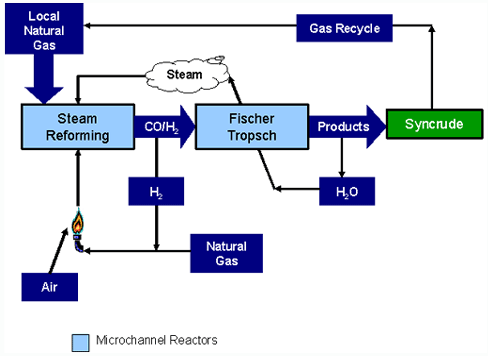
A British and Portuguese biomass to liquids (BTL) demonstration plant located in Austria and using US technology, plans to gasify woodchips to syngas, then convert the syngas to liquid fuels inside a micro-channel Fischer-Tropsch reactor. As illustrated above, the same technology can turn natural gas into liquid fuels.
The gas conditioning unit which purifies the syngas coming out of the gasifier has now been fully installed and pre-commissioned—with the required checks, system adjustment, equipment and system activation necessary to prepare the facility for operation now complete.

The next stages will include tests to confirm the stability of the coupled operation of the gas conditioning unit and the FT microchannel reactor. During the final phase, which is expected to begin in the summer, the performance of the integrated gas conditioning unit and FT microchannel reactor will be evaluated under a wide range of operating conditions. This will be followed by an extended steady-state run of at least three months. _GCC
More on Oxford Catalysts technology
Microchannel process technology offers process intensification, in the form of enhanced heat and mass transfer, to a wide range of chemical reactions. This paper describes the application of microchannel technology to the exothermic Fischer-Tropsch (FT) process, which converts synthesis gas into a petroleum replacement – synthetic crude or fuels. Synthesis gas to feed the FT unit can be derived from a variety of feedstock materials, including natural gas and biomass. By greatly reducing the size and cost of chemical processing hardware, microchannel process technology enables cost effective production of synthetic fuels from smaller scale facilities, appropriate for biomass and offshore natural gas resources. _PDFVelocysTechnologyPDF
The technology is also useful for converting excess natural gas to liquid fuels.
One of the technological features of the process is the use of the Microchannel Reactor, which Velocys is currently developing in the reforming reaction of natural gas, and FT reactions. By having the exothermic reaction and endothermic reaction proceed at the same time in the adjacent two microchannels, heat transfer between the two is promoted, thereby dramatically accelerating the catalytic reaction. As a result, the foot-print area of GTL facilities may be reduced to about one-sixth the conventional surface area. This enables the facilities to be equipped on Floating Production Storage and Offloading units (FPSO), offering a new tool in the development of offshore gas fields. _toyo
In other words, offshore gas fields could easily convert the gas to liquids for much easier storage and transport.

The microchannel FT reactors discussed above recently won an "XTL" award at the 10th annual XTL summit in London.

The small size of these GTL and BTL microchannel reactors should allow for even greater decentralisation in the production of liquid fuels from biomass and natural gas, and in the production of liquids from coal (via gasification).

Think of it as a fuels refinery in a shoebox.

Labels: , , ,

Thursday, October 01, 2009

Biomass to Liquids, Next Gen Biofuels

Biomass to liquids is becoming a force to be reckoned with in the energy field. Led by companies such as TRI, Rentech Inc., Velocys, CHOREN, Flambeau River Biofuels/Johnson Timber, AP Fuels and World GTL, BTL is also backed by huge oil and chemical companies. BTL companies have formed an organisation, the Low Carbon Synthetic Fuels Association (LCSFA) to promote the new, vitally important industry.
Specifically, the LCSFA represents the Biomass-to-Liquids (BtL) industry. One of the cleanest and most proven advanced biofuels, BtL is produced through the gasification of renewable biomass and the subsequent conversion of the gasified biomass using the Fischer-Tropsch (F-T) synthesis process. The renewable fuels produced are predominantly synthetic diesel and jet fuel, which are nearly identical to current crude oil-derived fuels, although significantly cleaner.

BtL fuels rely on an established synthesis technology (F-T) which can be brought to market quickly, unlike many other advanced biofuels, which remain in the research and development or “pre-commercial” stages. BtL fuels can be produced from abundant, non-food organic materials such as wood waste from urban recycling programs, paper mills or forestry residues, without increasing land use. Moreover, BtL fuels are fully compatible with the existing fuels infrastructure, enhance engine performance, and reduce emissions. _BusinessWire
BTL is an example of a next-gen biofuel -- biofuels not dependent upon food or prime croplands for production. Other types of next-gen biofuels include cellulosic ethanol and algal / microbial biofuels. Big companies such as DuPont, BP, Shell, Chevron, Exxon / Mobile, Dow, Eni, Petrobras, Conoco / Phillips, Neste, and others who do not wish to be left behind.
Other liquid alternative fuel developments and technologies cropping up include, among others, biobutanol, biogas, biomass-to-liquids, pyrolysis oil, Fischer-Tropsch diesel, gas-to-liquids, and hydrogenation-derived renewable diesel (HDRD).

For HDRD, US-based Valero Energy announced this month that it planned to build a 135m gallon/year renewable diesel facility using animal fats and waste grease in Louisiana through a JV with animal fats producer Darling International.

The schedule for the facility was not disclosed, but the companies said they were seeking a loan guarantee for the proposed JV from the DOE. Other oil firms involved in similar projects include US-based ConocoPhillips and Syntroleum, Finland's Neste Oil, Petrobras of Brazil, and Italy's Eni in JV with US technology firm UOP.

HDRD is usually produced by hydrocracking natural oils and fats, alone or blended with petroleum, in an oil refinery. Gasoline can be also produced using a similar refining process, according to the DOE. _ICIS

Labels: ,

Friday, August 15, 2008

Local and Regional Scale Biofuels Refineries

Al Fin has always promoted bioenergy on the local and regional scales. Biomass and biofuels crops are ideal for meeting the economic and energy needs of localities and regions. New technology from Oxford Catalysts seems ideal for the use of local bioenergy refineries:
With approximately one tonne of biomass required to produce one barrel of liquid fuel, the transportation of biomass to a large-scale, centralized plant poses a challenge to the economics of biomass-to-liquids production. One approach being taken to address this is the development of small-scale Fischer-Tropsch reactors to convert the waste on a distributed basis locally rather than at large collection centers.

Microchannel reactors—compact reactors featuring channels with diameters in the millimeter range—are potentially the best candidates for this job. They enable more efficient and precise temperature control, and the small diameter channels dissipate heat more quickly than conventional reactors with larger channel diameters in the 20-30 mm (i.e. inch) range so more active catalysts can be used. As a result, microchannel reactors can exhibit conversion efficiencies in the range of 70% per pass.

Microchannel reactors are designed for economical production on a small scale. A single microchannel reactor block might produce up to 50 barrels (bbls) of liquid fuel/day. Conventional FT plants, in contrast, are designed to work at minimum capacities of 2,000 bbls/day, and function well and economically at capacities of 30,000 bbls/day or higher. They exhibit conversion efficiencies in the range of 50% or less per pass. _GCC
Eventually, the infrastructure for large scale biomass to biofuels conversion will be built to meet national and international needs. But for the next few decades, the small-biorefinery niche will present huge opportunities for local investors, farmers, foresters, and entrepreneurs. A bioenergy industry grown from the bottom up is the type of empowerment that should suit rural communities in both the developed world and the third world.

Labels: , ,

Older Posts