Saturday, June 02, 2012

Triple Cycle Power Generation Gets 70% + Efficiency

Start with a solid oxide fuel cell (SOFC). Use the waste heat from the SOFC to drive a gas turbine. Then use the waste heat from the gas turbine to drive a steam turbine. Et, voila! A triple cycle power generation system that can achieve over 70% in fuel to power efficiency.

Mitsubishi Heavy Industries Ltd. is developing the necessary technologies to put such a system together.

GCC

In a triple combined cycle power generation system, an SOFC power generation system is placed before the GTCC system. By generating power at three stages—the fuel cell, gas turbine, and steam turbine—the resulting fuel cell combined cycle (FCCC) system achieves outstanding efficiency in generating power from natural gas. The FCCC system is expected to achieve the world’s highest power generation efficiency exceeding 70% (LHV) for several hundred MW class power generation and over 60% (LHV) efficiency for several tens of MW class power generation.

MHI sees FCCC triple combined cycle power generation as a revolutionary technology that will result in 10% to 20% improvements in power generation efficiency over existing natural gas-fired power generation systems. The company plans to pursue development based on the results of the basic technologies study, with the ultimate goal of commercializing the technology. _GCC
The idea is to milk as much power out of natural gas (and eventually methane hydrates) as possible. Japan desperately needs to improve efficiency in generation, transmission, and utilisation, in the aftermath of a rash governmental decision to shut down reliable nuclear plants.

Triple cycle power generation is also likely to be used with new generation nuclear power plants, which operate at even higher temperatures than SOFCs. Additional power gen cycles can be added to the cascade at either end, depending upon the starting temperature.

In fact, even with SOFCs, an additional power gen cycle could be added at the low end below the steam turbine cycle, utilising the lower temperature waste heat from the steam turbine.

There are many uses for waste heat besides generation electrical power. And we have only begun to discover a few of them.

Labels: , ,

Friday, June 01, 2012

Interesting New 57% Efficient Solid Oxide Fuel Cell

Fuel cells can burn a wide range of fuels: from hydrogen to biomass to methane to diesel. They are also more efficient than internal combustion engines. This makes them practical for both stationary power generation facilities, and for mobile power generation in electric-powered vehicles. Below we have republished two excerpts from stories reporting on important developments in solid oxide fuel cell (SOFC) design and development, which makes SOFCs more efficient and practical.
GCC

Researchers at the Pacific Northwest National Laboratory report on a highly efficient, small-scale solid oxide fuel cell system featuring PNNL-developed microchannel technology in combination with adiabatic, external steam reforming and anode gas recirculation. The heat and water required for the endothermic reforming reaction are provided by the recirculated anode gas emerging from the SOFC stack. They refer to this as adiabatic steam reforming because external heat sources, such as a combustor or an electric-resistance heater, are not necessary to support the reaction.

The new fuel cell system achieves up to 57% efficiency—significantly higher than the 30 to 50% efficiencies previously reported for other solid oxide fuel cell systems of its size—according to a study published in this month’s issue of the Journal of Power Sources. The pilot system generates about 2 kW of electricity; the PNNL team designed it to be scaleable to produce between 100 and 250 kW. _GCC
NewEnergyandFuel

The PNNL SOFC system has been streamlined to make it more efficient and scalable by using PNNL-developed microchannel technology in combination with processes called external steam reforming and fuel recycling. PNNL’s system includes fuel cell stacks developed earlier with the support of Department of Energy’s Solid State Energy Conversion Alliance.

The big numbers for the efficiency of this small SOFC system is the use of a PNNL-developed microchannel technology in the system’s multiple heat exchangers. Instead of having just one wall that separates the two gases, PNNL’s microchannel heat exchangers have multiple walls created by a series of tiny looping channels that are narrower than a paper clip. This increases the surface area, allowing more heat to be transferred and making the system more efficient. PNNL’s microchannel heat exchanger was designed so that very little additional pressure is needed to move the gas through the turns and curves of the looping channels. Even more interesting is the second unique aspect of the system – it recycles the heat. _NewEnergyandFuel
SOFCs using heat recycling fuel reformers, should eventually be able to use a wide range of carbonaceous fuels -- including biomass. So much for the collapse of civilisation when crude oil is abandoned as a primary fuel.

More on biomass fuel cells (PDF)

Here is a "kinder, gentler" way of turning biomass into energy. As we have predicted, the conversion of cellulose to energy and fuels is likely to follow a rough trajectory over various processes. The "brute force" thermal and thermochemical approaches are more practical initially. As better organisms and enzymes are engineered, the biological approach is likely to grow more efficient. Finally, as nanotechnological bio-mimics improve, the greater robustness of inorganic nanotech-catalysts should facilitate their use in place of more fragile bio-based catalysts. In the background, the movement of more advanced societies to safe, clean, reliable, and affordable gen III and gen IV nuclear reactors at various scales, is likely to increase the energy and fuel production choices of societies almost exponentially.

Labels: , , ,

Monday, June 13, 2011

Complementary Uses for Waste Heat and Cryogenic Storage

Leeds Engineering

The scheme pictured above is from the University of Leeds Engineering. The process involves using low cost off-peak power to cool air to liquid cryogen. During peak load hours, the cryogen is combined with waste industrial heat to generate peak load power in a turbine.
Oregon State Engineering

The above schema comes from Oregon State University Engineering, depicting a process for turning waste heat into mechanical power for cooling. Heat-to-cooling efficiencies of up to 80% are claimed. The OSU process combines micro-channel heat exchange with an organic rankine cycle turbine to drive the refrigerant compressor. If used to generate electric power from waste heat, efficiencies of only 15% to 20% are claimed.
Leeds Engineering

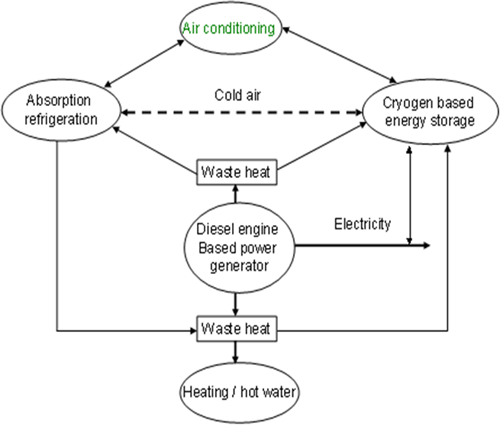
The schema above is from the University of Leeds Engineering. It depicts a combined use of waste heat from power production for either cooling -- using absorption refrigeration -- or for assisting in the generation of electric power using cryogenic storage.

It is easy to see how the OSU micro-channel / organic rankine cycle process might be used in such a trigeneration scheme, substituting for the absorption cooling in the scheme above.

The purpose of combining different processes together -- as in either CHP or IGCC etc -- is to achieve higher efficiencies and more economical production.

While the above waste heat retrieval processes are more efficient than thermoelectric conversion, they are less suited for mobile uses due to their greater complexity. But for use on industrial and utility scales, such processes are likely to prove as useful for integration into total power schemes as the emerging flow cell batteries.

An advantage of the cryogenic storage approach is that whenever a relative excess of electricity persists over an extended time, the cryogen can be separated into liquid N2 and liquid O2 and sold for a profit.

Labels: , , ,

Saturday, April 24, 2010

Using Waste Engine Heat to Cool Your Car

GCC

Sorption Energy is a UK company aiming to commercialise vehicle air conditioning systems based upon adsorption heat pump technology. The Sorption units will operate on the waste heat from normal engine operation, rather than parasitising mechanical power from the actual engine output. Sorption aims to save 10% or more of fuel costs during warm weather by this method.
The operation of adsorption heat pumps and refrigerators is based on the ability of porous solids (the adsorbent) to adsorb vapor (the adsorbate or refrigerant) when at low temperature and to desorb it when heated. Adsorption heat pumps thus use an adsorbent chemical rather than a mechanical compressor, and are driven by heat rather than mechanical work.

The systems often use natural refrigerants such as water, ammonia or methanol; Dr. Critoph and Sorption Energy prefer ammonia as a refrigerant and active carbons as the adsorbent.

Adsorption heat pumps are cyclic in operation and require a condenser, expansion valve and evaporator similar to those used in conventional compressor-driven systems. However, the compressor is replaced by the adsorption system.

The basic system consists of two linked containers, one of which contains the solid adsorbent (the generator). The other is the combined evaporator and condenser or receiver in which the refrigerant is evaporated and condensed.

At low temperature and pressure, the adsorbent contains a high concentration of refrigerant, while the receiver contains only refrigerant gas. When the generator is heated, the refrigerant is desorbed, raising the system pressure. Refrigerant condenses in the receiver, rejecting heat and producing a useful heat output if the system is to be used as a heat pump. Here, the evaporator is located outside the building and extracts energy from the surrounding air, transferring it back to the system and eventually to the condenser and generators for use in the dwelling.

Cooling the generator back down to its initial temperature completes the cycle and causes the adsorbent to readsorb the refrigerant. The system pressure is reduced and the liquid refrigerant in the receiver evaporates, absorbing heat. This produces the useful cooling effect if the system is to be used as a refrigerator. Here, the evaporator is used to extract heat from the space to be cooled. The heat from the condenser and the generator cooling is typically dumped outside.

Although the heating and cooling provided by a single generator is discontinuous, it can be made continuous by operating two or more generators out of phase. _GCC
Sorption is a spinoff from University of Warwick, UK, and utilises some significant breakthroughs in adsorption heat pump technology developed at Warwick which improve the efficiency of the system appreciably, and makes the actual devices much smaller and more manageable for small vehicles such as cars. The Sorption devices are based upon an activated carbon / ammonia pairing using a highly compact plate heat exchanger using nickel brazed shims and spacers.

Here is an analysis from USC / CSULB looking at the use of adsorption heat pumps in mass transit vehicles in the Los Angeles area.

This type of heat pump has been used on board satellites, and on shipping containers. They can be driven by any type of heat source, including solar heat. For automobiles, the use of waste engine heat to drive the heat pump is reasonable, and could result in significant savings during summer months. The heat pump could be used for heating the vehicle during cold weather, of course, but conventional automobile heating systems already utilise waste engine heat to keep car occupants warm.

The possibility of using this technology for domestic home and apartment heating purposes is being considered as well -- contingent upon finding an economical and reliable heat source to drive the system, and absolute proof that any system using ammonia as a refrigerant would be safe for household use. Methanol is an alternative coolant.

Cross-posted to Al Fin

Labels: ,

Saturday, February 20, 2010

Better Recovery of Energy from Waste Heat

A research team from Australia, India, and the US has created working thermocells capable of harvesting electrical energy from waste heat below 130 C, using carbon multi-walled nanotube electrodes.
These electrodes provide high electrochemically accessible surface areas and fast redox-mediated electron transfer, which significantly enhances thermocell current generation capacity and overall efficiency. The team showed efficiency of thermocells with MWNT electrodes to be as high as 1.4% of Carnot efficiency—3-fold higher than for previously demonstrated thermocells.

Research on utilizing low-grade heat from sources such as industrial waste streams, geothermal activity, and solar heating has focused on using solid-state thermoelectrics and Stirling engines to harvest low-grade waste heat as electrical energy. However, the researchers note, despite much progress over the past decades, current thermoelectric energy conversion technology is not very cost-effective and is constrained by physical and material limitations, while Stirling engine technology is disadvantaged by high initial cost and problems with long-term reliability.

...Hu et al. developed carbon nanotube (CNT)-based thermocells that utilize the ferri/ferrocyanide redox couple and electrodes made from carbon-multiwalled nanotubes (MWNT) buckypaper and vertically aligned MWNT arrays. The buckypaper is made by a filtration process that is analogous to that used for making ordinary paper.

They found that the performance of MWNTs as thermocell electrodes supersedes that of conventional electrode materials, including platinum foil and graphite sheet. With a hot-side temperature of 65 °C and a temperature difference of 60 °C, they achieved a maximum output power of 1.8 W/m2 in a stagnant cell, corresponding to an efficiency relative to the Carnot cycle efficiency of 1.4%. _GCC


In other news, Raytheon has awarded a second-phase work order to Cyclone Power Technologies:
Pursuant to the work order, Cyclone will be developing preliminary designs, specifications and test parameters on a compact 10 hp (7.5 kW) external combustion engine for use in various power applications.

The proposed Cyclone engine would be designed to run on both traditional fuels and a monopropellant called Moden Fuel, which can combust in the absence of oxygen. (Moden Fuel was originally developed by James R. Moden, Inc. to power US Navy torpedoes.)_GCC
The US defense department is also looking into using the Cyclone engine to power autonomous robots that would be capable of powering themselves from biomass and other waste carbons.

Labels:

Tuesday, April 07, 2009

Recovering Waste Heat

One of the largest opportunities for improving energy efficiency is the recovery of waste heat for productive use and transduction to other useful forms of energy. The key is to match the recovery method with the application.
Key to making heat recuperation viable is understanding the nature of the energy involved. The temperature distribution of waste heat depends largely on the type of industry. For example, 95% of the waste heat in the electric power industry has a temperature below 150 Celsius...In contrast, 45% of the waste heat in the chemical industry can be up to 50 Celsius above this.

Plant operators usually look at thermal energy in terms of simple enthalpy - the heat content - and conclude that capturing heat of low temperature is not viable for powering other processes....Zhang and Akiyama, however, suggest that exergy - the ability of the waste heat to do useful work - should also be taken into consideration when planning an energy-saving strategy from the viewpoint of quality of energy.

They point out that high-temperature waste heat, with an adequately large exergy value exists in many manufacturing industries. For example, slag and exhaust gases from steelmaking reside at well over 1000 Celsius, representing a powerful energy source.

They explain that latent heat storage, chemical storage, and thermoelectric conversion could be used as effective ways of recovering waste heat, either individually or in combination. _energydaily
The ability to utilise marginal levels of heat -- whether industrial, solar, or geothermal -- will open up vast new worlds of energy generation. More clever transducers of heat to other forms of energy will multiply the available quantities of energy worldwide by a substantial factor.

Labels: ,

Thursday, January 08, 2009

Thermoelectrics Revolution

Most of the energy from combustion processes such as an automobile's engine, is lost as heat. It seems a lot of waste to pump or dig fuels from the ground, only to lose most of the energy to the atmosphere as waste heat. Consequently, around the world engineers, scientists, and technologists are scrambling to find better ways to re-capture the huge mass of energy that is going missing every year.

Thermoelectrics is a growing and revolutionary method of redeeming waste heat to electricity -- analogous to photovoltaics except converting heat to electron flow rather than light. Brian Westenhaus brings us up to date on Nextreme Thermal, a company at the forefront of efficient thermoelectric conversion.
The thermoelectric field is gathering momentum and increasing efficiency. Many manufacturers are attending to this technology, as it requires no moving parts so the durability and miniaturization prospects look quite good.

For many heat producing power generation kits the excess heat is a nuisance, expensive to dispense with and money simply lost into things like rivers, the atmosphere and simply radiated away warming anything nearby which can be even more expense. From huge power installations generating electricity to automobiles thermoelectric on to microelectronics, thermoelectric conversion should find welcoming places. In the U.S. and Europe automakers from GM to BMW express enthusiasm for the technology to add to the electric output and reduce fuel requirements.

...The breakthrough product seems to be the Thermal Copper Pillar Bump (CPB) design that has applications in electronics where the technology can be used to cool and recover heat back into power. A highly desired goal is application in PC data centers where the operating costs for power to cool the electronics exceeds the power to process the data.

How good have they managed to get? A temperature difference of 60ºC has been achieved across the 60 µm (0.06 mm) high Nextreme CPB by running an electrical current through it. The Nextreme CPB demonstrated maximum power pumping capabilities exceeding 150 W/cm2. When subjected to heat the Nextreme CPB has demonstrated the capability to generate up to 10 mW of power per bump.

150 W/cm2 . . . That seems like a lot of power from a differential of 60ºC. Things are coming along faster than I had expected. _NewEnergyandFuel
Here is another look at the growing field of thermoelectrics, from Brian Wang.

More efficient retrieval and use of waste heat amounts to an energy revolution in its own right. Consider it but one more important piece in the puzzle problem to provide abundant energy to the growing needs of the future.

Cross posted at Al Fin

Labels: ,

Sunday, September 14, 2008

Cogeneration, CHP, Heat Recovery

A typical coal plant has an efficiency in the low 30% range, meaning 65% or more of the energy is wasted. CHP can improve the plant efficiency to the 60%-80% range._Source
Excess heat production in US industry could potentially provide up to 20% of the nation's electrical power. For now, most of that energy goes into the atmosphere and is lost. With increased heat recovery methods, that heat will be converted to useful power. Some new plants, such as a Hormel meat processing plant in Texas, and other new plants are beginning to salvage waste heat for useful purposes--including electric power.
More than half of the energy potential in traditional power generation goes up the stack as waste heat. In contrast, the UTC Power fuel cell power system converts heat exhaust into heating and cooling, turning potential waste into useable energy. While central powerplants achieve conversion percentages in the lower 30s, the PureCell® system can attain energy conversion efficiencies up to 90 percent. High system efficiencies translate into greater fuel utilization, thereby conserving natural resources and energy. _Source
Here is more on co-generation, or Combined Heat and Power (CHP):
Any place energy is wasted, there's a chance to capture it and do useful work. The scale of waste heat in a steel mill, cement plant or silicon plant makes the potential obvious, but there are a few other types that take a sharper eye.

The heat from a power plant, instead of being lost in a cooling tower or surrendered to the atmosphere, can be used for local heating via underground hot water or steam pipes to nearby businesses, homes or industry. There's a limit on how far the heat can travel, hence the name, district heating. Once more common, today in the US this is mostly limited to college campuses and a few old downtown neighborhoods.

Anytime there is a pressure drop in a pipe, a backpressure turbine generator can capture the lost energy. For example, long distance natural gas pipelines operate at high pressure and when the pressure is reduced for local distribution, some of the significant energy originally used to pressurize the pipe can be recovered. This is sort of like regenerative braking for gas lines. An investment of $8 to $10 billion could capture 6.5 GW, another bargain at $1,250 to $1,500/kW. Steam pipelines are more numerous and have even more potential. The college campuses with district heating mentioned above could also be producing some fuel-free power where ever the steam pressure is reduced from transmission pressures to the pressure used in buildings.

Many industrial processes have leftover gas or create some low quality gas that can be burned. Quite often, this is simply flared ( that is, burned ) at the top of a smokestack. I watched flaring gas coming off steel mill blast furnaces for years as a kid in Gary, Indiana without knowing what it was. In any event, I was awed by 15 foot high tongues of flame dancing on top of a 300 foot high stack. Other sources are oil refineries, auto painting plants, carbon black plants and ethanol refiners.

One more advantage of CHP is that the electricity usually doesn't have to travel far and rarely requires new transmission lines. Unlike many large utility plants sited far away from population centers, most CHP installations are already where there are people and power demand. _Co-Generation
Technically, co-generation is the combined generation of useful heat and electricity. CHP is an equivalent term. Heat recovery, on the other hand, can refer to the retrofitting of heat recovery technology to previously wasted process heat, to yield electric power and/or other productive energy from waste heat. The distinction may seem too fine after the fact, but is quite meaningful at the design stage.

Labels: , ,

Sunday, June 15, 2008

Heat Recovery: 20% of US Electrical Energy Possible Without Burning Any More Fuel

...it’s estimated that energy recovery systems installed in the U.S. industrial facilities could produce up to 20 percent of the country’s electricity needs without burning any additional fossil fuel. Source
Recovering electrical energy from industrial waste heat is a growing enterprise. Gigawatts of energy are escaping into the atmosphere as waste heat, when they could be recovered and turned into much needed electrical power--to power the new electric vehicle fleets and to empower economic growth.

China Energy Recovery Inc. is taking advantage of this valuable niche in China and Southeast Asia and Africa.
China Energy Recovery Inc. has announced the completion of two major waste-heat recovery systems in China, as well as plans for others in Malaysia and Congo. The company has also identified business development potential in the emerging biofuels industry that runs parallel with heat generation.

...The energy recovery systems installed by CER in China are capable of generating approximately 14 megawatts of electricity and nearly 27 megawatts of directly usable heat energy through the capture and harnessing of waste-heat, the company said in a press release. The Malaysian project is intended for a biofuels combustion system with a planned production of 3 megawatts of electricity and 2.9 megawatts of heat energy, according to the company.

Qinghuan said CER has extensive experience in installing and operating systems in various industries, such as steel manufacturing, cement, paper mills, and petro-chemical. “Our systems have proven effective under extremely demanding circumstances and in many different types of industries,” he said. “We’re looking forward to these opportunities to expand our services into new regions and to further demonstrate to the global community the advanced solutions for heat energy recovery CER has achieved.” __Biomass
The ability of a society to make productive use of waste is a good measure of its level of evolution.

Labels: ,

Monday, June 02, 2008

Recovery of Waste Heat Biggest US Renewable

The US government has estimated that waste heat recovery could easily become the largest source of renewable energy in the country. Combustion generators are rarely more than 30% efficient in doing work or generating electricity. Most fuel used in combustion goes to waste heat and emissions--entropy. Although the US Congress is asleep at the wheel, savvy entrepreneurs and engineers are busy designing ways to tap into that huge potential resource of waste heat recovery.
"ElectraTherm has unlocked the power of recycling the largest source of renewable energy in the U.S. - waste heat," said ElectraTherm CEO Richard Langson. "This technology has the power to increase electrical output at every fossil fuel burning power plant without burning oil, gas or coal, and without further pollution or damage to the environment."

...ElectraTherm estimates that its units have a subsidy-free payback period of three years or less, and company officials claim "the implications on the world stage of a modular, scalable (50-500kW output) unit making electricity from unused, accessible heat are huge."


The company's patented Twin Screw Expander enables the ElectraTherm Green Machine to do its work. The expander is one-tenth the cost of a turbine as the energy block, according to ElectraTherm. Since the energy block generally constitutes 30 to 40 percent of the cost of an organic Rankine cycle (ORC) system, the ElectraTherm Green Machine will cost approximately 30 percent less than turbine ORC systems.


The unit operates without gearboxes or the high end electronics required to synchronize a turbine to a generator. Inline process lubrication eliminates oil pumps, filters, separator tanks, parasitic loads and maintenance issues usually associated with lubrication. ElectraTherm officials say the technology reduces maintenance and extends the life of the ElectraTherm Green Machine compared to turbine-based energy solutions. __EC__via__NEN
In other energy news, a Kentucky inventor claims to have devised a way to make gasoline from coal for a cost of US $1.15 a gallon.
"We can make this the equivalent of 25 dollars per barrel of oil, which will come out about $1.10 gasoline at the pump,".

If companies buy it, the idea could take 20 years to become reality at pumps. The U.S. Department of Energy wants to make sure it won't pollute the atmosphere. __NEN

Labels: , ,

Older Posts