Sunday, July 10, 2011

U. Minnesota Researchers Merge Fungal and Bacterial Enzymes in E. Coli for Synthesis of Commodity Chemical Isobutyric Acid

Researchers at the University of Minnesota led by Prof. Kechun Zhang have engineered a synthetic metabolic pathway using fungal and bacterial enzymes in E. coli to enable the direct biosynthesis of isobutyric acid from glucose. _GCC
GCC
Combining enzymes from multiple microbes gives researchers and engineers a far wider range of reactions to work with, for synthesis of high value chemicals from biomass sugars. They can either combine the enzymes in a single organism using gene insertion techniques, or they can design bioreactors which contain multiple organisms which act on the substrate either in sequence or simultaneously.

U. Minnesota researchers designed a special E.Coli which contains both fungal and bacterial enzymes. This allows the complete synthesis of isobutyric acid to take place using only one type of organism -- a simpler arrangement in many ways.
Isobutyric acid is a high-volume commodity chemical used in the production of fibers, resins, plastics, and dyestuffs, and is used as an intermediate in the manufacture of pharmaceuticals, cosmetics, and food additives. Isobutyric acid also can be further converted to methacrylate (i.e., methacrylic acid - MAA) and methyl methacrylate (MMA) which are commodity chemicals used in the production of plexiglass (polymethyl methacrylate plastics), adhesives, ion exchange resins, textile size, leather treatment chemicals, lubrication additives and crosslinking agents.

Making methacrylate via traditional chemical synthesis techniques usually begins with either natural gas or crude oil as the feedstock. The biological pathway uses renewable sugar feedstock instead of petroleum based feedstock.

The researchers have filed for a patent on the technology, and the University of Minnesota is seeking commercialization partners. _GCC

Although cheap natural gas prices will retard the commercial implementation of such processes, this is the proper time to perfect the technologies. As natural gas prices inexorably rise due to increasing conversion of methane to liquid fuels for transportation and fuel cell use, alternative feedstocks for chemical and plastics production will then already be available to substitute economically for natural gas and petroleum.

Labels:

Saturday, July 09, 2011

Brillouin Approach to LENR: Working With Los Alamos Labs

1 Aug 2011 Caution to Readers: LENR technology is unproven, let alone the underlying science. If it is eventually found that a commercially useful amount of excess heat is generated by LENR devices, there will still be a significant "shaking out" period of time before it is clear which developers of the technology will be successful in the long run. Before investing in any of the ventures claiming to produce significant amounts of excess heat via LENRs, be sure to evaluate the companies and the technologies thoroughly. The blog postings at Al Fin Energy dealing with approaches such as LENR, Blacklight Power, etc. are not meant as investment advisories.
The newest device began operating in October of last year and is a pressurized nickel-hydrogen system that has allowed superior calorimetry measurements. According to the Early Phase 2 Data Report, this cell generated excess heat output greater than 100% in February of this year.

... Brillouin Energy is fielding calls from new investors and will now be working with Los Alamos National Lab LANL to replicate Brillouin’s work. First, a confirmation report from a nationally recognized lab, and then the funds. _CFN_via_NBF
Brillouin Energy

Robert Godes of Brillouin Energy discusses his company's LENR technology, and the ways in which it is superior to the Rossi/Focardi approach which is being commercialised by Defkalion in Greece.
CFN You are also using nickel-hydrogen system for your reactor. How does your design and process differ from Andrea Rossi’s?

REG The IP [Intellectual Property] I filed in 1995 includes some aspects of what Rossi is doing, but there are problems in trying to move the technology he is developing into production. He may have trouble meeting his deadline for the 1MW reactor as it could be difficult transferring the technology to other licensees for production.

He had a smiler problem with a potentially great technology doing direct thermal to electrical conversion. The manpower needed to produce and tweak Rossi units will limit profit margins. He would have a much easier time doing small units consisting of single devices for consumers, but insurance companies will not allow home use due to safety issues. The safety issues with the Rossi device will not likely have to do with radiation. Brillouin Energy Corp. (BEC) technology will be more reliable making it the market winner. Safety issue #1: we use the hydrogen out of ordinary water (H2O) in the form of water.

The technology BEC is developing will be easier to manufacture and transfer to licensees for market penetration and get approval for commercial and consumer use. I have significant experience in moving products from engineering to production with involvement in some products being produced at more than 100K units / year.

We only started working with the pressurized unit in Q2 2010. However we have already identified a large number of the variables that need to be controlled and how to control them. When we start production I expect it will be a much smoother ramp up than what Rossi is facing right now. _ColdFusion_via_NBF

Godes suggests that Andrea Rossi's device is successful at producing excess heat via LENR's (low energy nuclear reactions), but he feels that the Rossi / Focardi approach is technologically inferior to the Brillouin approach, and is unlikely to be ultimately successful in the marketplace -- when forced to compete against more efficient and reliable alternative LENR devices.

Once Brillouin's technology is confirmed by Los Alamos labs, Godes should have no trouble acquiring investors for the company.

Brillouin Energy Power Point Overview download

Labels:

Friday, July 08, 2011

LS9 Tests 2nd Generation Microbial Biodiesel in Brazil

Microbial biofuels and renewable chemicals company LS9 is working with Brazilian vehicle manufacturer and engineering firm, MAN Latin America to test LS9's 2nd generation biodiesel product.
LS9 UltraClean Diesel overcomes a number of the challenges of first-generation biodiesel, including high cost of production, poor oxidative stability, and/or poor cold flow. In April 2010, the fuel was officially registered with the United States Environmental Protection Agency (EPA) so it can be sold commercially in the United States.

LS9 modifies the ACP pathway in bacteria to produce renewable hydrocarbon fuels and chemicals with optimized properties, including UltraClean Diesel and surfactants, which LS9 is commercializing with one of its strategic partners, Procter and Gamble. _GCC

French startup Global Bioenergies is moving ahead with its microbial production of isobutene -- an important feedstock for high value chemical production. The product is made from plant sugars.

OPX Biotechnologies is developing the microbial production of renewable bio-acrylic. Acrylic from petroleum is an $8 billion annual market, globally. OPXBio is working with Dow chemical in developing microbially produced fuels and chemicals.

Choren Industries GmbH -- producer of 2nd generation biofuels from wood products via gasification -- has declared insolvency in connection with its German Freiberg plant. The company intends to consult with new investors soon.
A series of biofuel companies have declared insolvency in recent years after the German government changed course on biofuels, taxing the green fuels and scaling back previous incentives. _Reuters _ via _GSS
Choren's difficulties point out the danger of relying upon governmental incentives -- which are always subject to the whims of corrupt and small minded politicians.

Fuels markets are very volatile due to many factors, and newcomers such as biofuels -- lacking the huge infrastructure at all levels which petroleum fuels enjoy -- will have to swim against the current for a number of years yet. The high value chemicals markets, on the other hand, offer a ripe and juicy opportunity for clever and efficient companies in many sectors -- including biotechnology startups and more established industrial entities who wish to partner with renewable chemicals startups.

Labels: , ,

Thursday, July 07, 2011

Canadian Company Dynamotive Takes Pyrolysis to Australia

Dynamotive Energy Systems is taking its method of fast pyrolysis and bio-oil upgrading to Australia, where it will be used to turn plantations of mallee (a type of eucalyptus) into bio-fuels, some suitable for use in aviation.
Pyrolysis oils present several challenges to overcome as they are typically high in water, solids and acids and do not meet the specifications of fossil fuels. Dynamotive R&D developed a process to upgrade pyrolysis oil that can potentially overcome these challenges and could provide an economically viable path to upgrade bio-oils to mobile fuels. _GCC

Dynamotive's process is continually being refined, and consists of a two-step basic approach:
Stage 1 (Hydroforming)
The first stage is hydro-reforming of biooil:
Stabilize it;
Render it miscible with hydrocarbon liquid;
Cause phase separation of the water in the BioOil;
Lower its viscosity;
Lower its corrosivity and;
Lower its oxygen content from ~50% in the raw biooil to around 10%.

Once BioOil is put through the Hydroforming process it becomes a product designated UBA. However, UBA still contains ~ 10% oxygen. It is not a pure hydrocarbon and needs further treatment to convert it to motor fuel grade products. The hydro-reforming reaction was carried out in an autoclave.

Stage 2 (Hydrotreating)
The second stage involves a conventional hydrotreatment over a commercial catalyst. Commercial hydrotreating catalysts are available that can steer the product towards diesel/gasoline/jet fuel etc. at somewhat higher severity conditions. _Dynamotive
Clearly everything revolves around the economics of the process. Stage 1 treatment can turn pyrolytic bio-oil into a partial substitute for fuel oil in stationary machinery. In order to turn the bio-oil into transportation fuels for land, sea, or air vehicles, hydrotreatment (stage 2) is required -- which adds another level of expense.

Clever chemical and industrial engineers are learning better ways to get the hydrogen used for hydrotreating from biomass waste itself, just as the non-condensing gases from the pyrolysis process are used for process heat to save fuel costs.
Pyrolysis can feed into multiple product lines, or it can be used as a pre-processing stage to facilitate inexpensive transport to a gasification and catalytic synthesis facility. Going the latter route adds further layers of expense to the process, but much higher value products can be created using more sophisticated synthetic processes.

It is the versatility of pyrolysis which is likely to place it close to the center of a building biomass to fuels infrastructure.

Labels: ,

Gallery of Small Fusion Startups

Bussard IEC Fusion

Bussard inertial electrostatic confinement fusion (EMC2 Fusion) involves an electrostatic plasma confinement to achieve fusion. The history and development of the concept is explained in a video reached via the link above. The Bussard IEC has been financed almost entirely by the US Navy. EMC2 is based near Santa Fe, New Mexico.
Dense Plasma Focus Fusion

Lawrenceville Plasma Physics is based in New Jersey. The dense plasma focus approach uses a special pulsing "spark plug" to ionise a gas, and to form a plasmoid "pinch," with the emission of high energy photons, ions, and fusion neutrons.
HyperV

Hyper V Technologies utilises a spherical array of mini railguns to accelerate plasma beams into a central target of deuterium or deuterium-tritium, to achieve fusion (hopefully).
TriAlpha

TriAlpha is an Irvine, California venture, which has been fairly successful in the venture capital game. TriAlpha is a bit secretive with non-investors, but you can read their patent for yourselves. The concept seems to involve the highly sophisticated evolution from an earlier colliding beam fusion approach.
General Fusion

General Fusion is a small startup headquartered near Vancouver, BC. The compression of plasma to achieve fusion is accomplished by a coordinated spherical plasma compression, using pneumatics and advanced switching.
Helion

Helion Energy is located in Redmond, Washington. It is based on a principle of "colliding plasmas," and like all the rest of the small fusion approaches, it is a long shot.

Fusion reactors can be prolific neutron generators, and could be utilised for the transmutation of nuclear wastes into harmless compounds. They could also generate a number of differen highly energetic particles and high energy photons, and used for a number of purposes -- including as space propulsion. Another potential product of fusion reactions is heat. But what is most desired from fusion reactors is abundant, cheap, clean electrical power.

The energy from fusion is higher than the energy from fission, so that less fuel is required to generate equivalent energies. Fusion is generally safer, with less radioactive waste remaining to be disposed of.

Many billions of dollars have been spent by governments in a vain attempt to master the power of the stars on a more human scale. If one of the small startups manages to achieve with $millions what huge government budgets of $billions could not achieve, a revolution would have been ignited which would likely not stop with just cheap, clean, abundant energy.

Previously published at Al Fin Potpourri

Labels: ,

Wednesday, July 06, 2011

Nuclear News

Carnival of Nuclear Energy #59 at Yes Vermont Yankee (h/T Brian Wang)

Nuclear News Update from Dan Yurman

Critically important article by Dan Yurman exposing how the US NRC is obstructing the rational evaluation and licensing of new reactor designs

Small modular reactor designer NuScale is revving up for renewed activity, with new financing coming in. NuScale was stalled in its quest to build SMRs when its initial financing entity -- through no fault of or involvement by NuScale -- was caught in a pyramid scheme and prosecuted.
NuScale is already putting that episode behind it and is ready to promote its SMR design again. Unfortunately -- due to Obama NRC obstructionism -- NuScale may be forced to go overseas for licensing and production, like TerraPower and Hyperion.

Labels: ,

Rapid Pyrolysis Fuels, Chemicals, Food etc. from Waste

Ensyn Technology

Ensyn Technology has been producing fuels and chemicals from wood since 1989, and continues expanding.

A new Alberta plant will convert wood waste from a sawmill into pyrolysis oil, using Ensyn's fast pyrolysis process.
The RTP technology has multiple proven applications and has been commercially demonstrated in a number of industrial sectors. In addition to renewable fuels, RTP liquids are a source of numerous chemical products, including food ingredients and resins, over 30 of which have already been commercialised. RTP also is being applied in the petroleum industry for heavy oil upgrading under the name “HTL” by Ensyn’s strategic partner, Ivanhoe Energy Inc., where it is providing a revolutionary step-change in economics and competitive advantage. At the core of each of these applications is the same platform RTP technology. _Ensyn

The conversion of wood and agricultural waste into high value fuels and chemicals is an economic activity which will have to compete with many other approaches to fuels, chemicals, and energy production. But over time, waste to energy processes will become more efficient and cost-effective, while most competing feedstocks and approaches are likely to grow ever more expensive.

Cheap methane from shale deposits will likely delay many waste to energy projects for a number of years. But there will also be companies such as Ensyn which find niches of opportunity within which to operate profitably. When fossil fuel prices begin once again to edge upwards, Ensyn and other opportunistic innovators will already be in position to expand.

Labels: ,

Tuesday, July 05, 2011

Fuels from the Sea: Micro-Algae and Macro-Algae

Marine ecosystems are an untapped resource that account for over 50% of global biomass and seaweeds themselves are capable of producing more biomass per square metre than fast growing terrestrial plants such as sugar cane. _Daisy Brickhill

On the micro-algae front, scientists from the U. of Western Ontario have discovered a way to increase the growth of algae by almost a factor of 4. They did this using magnetic fields!
Wankei Wan, a professor of biochemical engineering at the University of Western Ontario, thinks he's found a potentially significant way to stimulate algae growth.

Wan and a team of research students built a small raceway pond - a tabletop pond shaped like a racetrack, that is - and began growing a common type of single-celled algae called Chlorella kessleri.

They measured the pace of algae growth and oil production. They then changed the set-up such that the algae in the pond were circulated through an area exposed to static magnetic fields.

What they observed, which is described in an upcoming research paper, surprised them.

The magnetic field exposure “almost quadrupled the biomass and lipid (oil) production rate in raceway ponds,” according to the paper.

Wan's team also noticed the magnetically stimulated algae produced dramatically more antioxidants, such as Astaxanthin - often used as a food supplement.

In an interview, Wan said the algae behaved differently depending on the strength of the magnetic fields and length of exposure to them. The researchers noticed that growth would increased steadily as field strength grew. Then, once peak growth was reached, there would be a steep decline.

This suggested to Wan that there is a “sweet spot,” that might vary depending on the type of algae being grown. _CheckBiotech


On the macro-algae front, scientists at Aberystwyth University have found that kelp contains higher levels of carbohydrate at the peak of summer. They suggest that this may be the best time to harvest kelp for biofuels production.
Collecting monthly samples of kelp from the Welsh coast researchers used chemical analysis to assess the seasonal variability. Their results, which will be presented at the Society for Experimental Biology Annual Conference in Glasgow on the 4th of July, showed that the best month for biofuel harvest was in July when the kelp contained the highest proportions of carbohydrate and the lowest metal content.

Kelp can be converted to biofuels in different ways including fermentation or anaerobic digestion producing ethanol and methane or pyrolysis, (a method of heating the fuel without oxygen) which produces bio-oil. The chemical composition of the seaweed is important to both of these processes.

Research into biofuels has focused on terrestrial plants; however these have the serious drawback of the conflict between using land to grow food or fuel. Marine ecosystems are an untapped resource that account for over 50% of global biomass and seaweeds themselves are capable of producing more biomass per square metre than fast growing terrestrial plants such as sugar cane. _DaisyBrickhill

The assumption of the researchers is that the kelp will be used in the fermentation of ethanol or anaerobic fermentation of methane -- which may not be a wise assumption in the long run. Gasification or pyrolysis of macro-algae depend far less upon the chemical constituents and far more upon absolute biomass. It is those thermochemical approaches which are better positioned to take advantage of the prolific nature of marine aquaculture. Macro-algae can produce up to 6 harvests per year, depending upon local conditions.

Labels: , , ,

Monday, July 04, 2011

Mark Lynas Emerges from Green Coma to Promote Nuclear Power

Solving many of the world’s most critical environmental challenges will, in some cases, involve doing the exact opposite of what most environmentalists want. _MarkLynas
Prolific author and slowly recovering Green Mark Lynas, has published a piece in the Daily Mail promoting nuclear power for Britain. Lynas is beginning to awaken from the deep green coma which has enveloped so many academics, politicians, celebrities, journalists, and others of the dysfunctional and parasitic class. From his DM piece:
Atomic energy, while far from perfect, is an essential option to combat two looming problems: climate change, caused by man-made carbon emissions, and a growing ‘energy gap’ by which Britain generates far less electricity than it needs, sending fuel bills soaring.

Surprisingly, nuclear power may be more environmentally friendly than many types of renewable energy, such as wind and solar power. Wind turbines can kill birds and bats, while solar power, if employed on a grand scale, will take up a lot of land space.

Also, as much as Greens are enthusiastic about solar electricity, in cloudy countries such as ours it is extremely inefficient and expensive. Nuclear power, on the other hand, is one of the cheapest ways of producing electricity, and it is much safer than many environmentalists would have us believe.

The objection of environmentalists to nuclear power — fears about the dangers of nuclear waste and the cost of decommissioning it — are overblown, which explains why many people don’t like the Greens.

A report from the Government’s Climate Change Committee last week outlined aims to get 40 per cent of our electricity from nuclear by 2030, producing an equivalent proportion of energy from renewable sources, such as wind and solar power.

But for this to happen and for Britain to have any chance of meeting its ambitious carbon-reduction targets, Green groups need to stop scare- mongering about atomic power and blocking plans for nuclear plants.
_MarkLynas_DailyMail
More on Lynas' article from Anthony Watts

Is the UK government tilting at windmills?

Mark Lynas in The Times, Semptember 2008, just 1 month after his revelation on nuclear power

Part of What the Green Movement Got Wrong

Wherever politics gets involved, logic and rationality fly out the window. So it is with energy policy, climate policy, and virtually anything else governments meddle in. The US founding fathers had the right idea when they tried to restrict government powers to a very limited number and extent. But good ideas can only prevail for a limited time when up against a historical headwind of corruption and impending Idiocracy.

Labels:

Saturday, July 02, 2011

NYTimes Shoots Self in Foot -- Loses All Credibility On Shale

You're Ian Urbina, a senior New York Times reporter. In February and March you write that hydraulic fracturing, a method of natural gas extraction, is contaminating Pennsylvania drinking water. Your accusations are subsequently disproved by government tests.

What do you write next?

You write a three-part series in the Times saying that shale gas production is "inherently unprofitable" and a giant Ponzi scheme, as well as loosely-regulated by the Securities and Exchange Commission. _RCM

Unfortunately for the NYT, its latest 3-part hit piece on shale gas is no more meaningful in the real world than its earlier, discredited piece on fracking.
CNET

Why do NYTimes editors persist in trying to discredit the only hopeful bit of economic news to come out of the US during the entire Obama presidency? Perhaps we should follow the money trail, to see who may be pulling the NYTs strings?
Last weekend the New York Times published a front-page article raising serious questions about the true scale and economics of the production of natural gas from shale, invoking the specter of another asset bubble. To say that this created a buzz would be an understatement. Yet while the article addressed important concerns, it mischaracterized the overall situation by conflating the fortunes and prospects of individual companies with the long-term viability of exploiting the underlying resource. Even if some prominent shale-focused companies were to fail, that wouldn't alter the quantity of shale gas in the ground. It also wouldn't change the fact that shale gas accounted for more than 15% of domestic US natural gas production in 2009 and is expected to supply at least 25% by 2035, even in the most pessimistic shale gas scenario included in the Department of Energy's 2011 Annual Energy Outlook. Comparisons to Enron or the Dot-Com bubble make little sense when the shale gas bonanza has shifted the fundamentals of physical supply and demand, irrespective of its effect on the equity values of companies in this sector.

...I wouldn't be surprised to learn that that the paper's editors, like many in environmental circles, find the development of this resource to be an unwelcome diversion on the path to a lower-carbon future. After all, while natural gas emits much less greenhouse gas than coal over its lifecycle, particularly for electricity generation, it certainly emits much more than wind, solar and geothermal power. Many renewable energy projects have struggled to compete with the low cost of gas-fired power generation that shale gas helped bring about. Ultimately, the price of natural gas lies at the heart of both the concerns raised in Sunday's story and the worries of many environmentalists that cheap gas could delay the shift to renewables by many years--although I would remind them that gas-fired power also looks very helpful for enabling the grid to accommodate more renewables. _GeoffreyStyles

Sure, faux environmentalists, investors in shady and unreliable big wind and big solar developments, and peak energy doomers all have a natural hatred for abundant sources of energy. But Russian national gas companies, middle eastern national gas companies, and other corrupt concerns from Venezuela to Africa also stand to lose from the development of North American shale. Unfortunately for all of them, all the signs point to abundant long-term, safe and clean production for shale gas and liquids.
For natural gas, the stars are aligned for it to play a far more substantial role in the world energy mix, according to a pair of reports this week.

The Massachusetts Institute of Technology today published its report on natural gas, which it characterized as an abundant and reasonably priced resource able to act as a bridge to a low-carbon future. The International Energy Agency released its own study (PDF) Monday, where it said natural gas is poised to enter a "golden age." _CNET


Peak oil doomers and faux environmental energy starvationists gloat over high decline rates in some shale gas fields. But those decline rates are just part of the highly profitable business, and developers factor that information into the equation before they begin.
Major producers routinely share detailed production data that show first-year decline rates of 80 percent in some fields. This isn’t a revelation: Unconventional wells tend to exhibit high initial production rates, but many still prove profitable despite high decline rates. _InvestingDaily
NYTimes debunked on shale by Energy In Depth
Another look at NYTimes shenanigans on shale from Master Resource blog
A cross-section of informed responses to NYTimes disinformation on shale

Bonus feature -- Mr. Fox's Gasland Follies (via Energy In Depth)

Gasland director hides full facts from Not Evil Just Wrong on Vimeo.

Labels: ,

Friday, July 01, 2011

Hey Peak Oil! Chew On These Ethylene Crackers!

The price of oil has fluctuated near the $100 a barrel range for months now, while the equivalent amount of natural gas has sold around the $25 mark. Technologies which can turn natural gas products into valuable subtitutes for petroleum are likely to make a lot of money on this price relationship. And that is exactly what Shell Oil and Dow Chemical are counting on, as they build their new and expensive ethylene cracking plants in the US.

Ethylene crackers help facilitate the turning of heavier components of natural gas into ethylene, which can be used to make plastics and other high value products. Geoffrey Styles has more:
Deciding to build an ethylene cracker, a facility that turns the heavier components of natural gas into one of the basic building blocks of the petrochemical and plastics industry, in such a location is a big vote of confidence. It suggests that Shell has concluded that the current uncertainties facing shale gas development are very likely be resolved without undermining shale's capacity to produce large quantities of gas at relatively low cost, and that shale developers will find ways to resolve concerns about fracking, methane emissions, and other issues both with the affected communities and with state and national regulators.

These projects also suggest at least two other things. First, as the Reuters article noted, they represent sizable wagers on the relationship between the global price of oil and the US price of natural gas. I've commented before on the extraordinary divergence between the two, with oil bouncing around the $100 per barrel mark and US natural gas selling for the energy equivalent of $25 per barrel. A company would be unlikely to make a long-term investment like this if it thought gas and oil were likely to move back into parity any time soon. Even if gas prices eventually recover to around $6 per million BTU, as suggested by current long-dated gas futures, that's still the equivalent of less than $40/bbl--an oil price we haven't seen since the worst stretch of the global recession and financial crisis in early 2009.

And that leads to the last implication I draw from this news: these investments are bets on the health of the US economy. If the economy were headed for a protracted period of slow or no growth, adding petrochemical capacity here would be too risky, rather than putting it in the Middle East, where gas is even cheaper and the growing markets in Asia are much closer. That doesn't' mean that our problems of high unemployment, high indebtedness, and gaping federal, state and local budget deficits aren't extremely challenging, but it provides at least one modestly positive sign among the many ominous ones that are routinely amplified by the basic nature of the news media business. _Geoffrey Styles_via_EnergyTribune
I would not be too hopeful for the near term health of the US economy, based upon these developments. The more likely implication to draw from Shell's and Dow's gamble is that the big money expects US President Obama to be defeated in his re-election campaign of 2012, due to the disastrous effect his policies have had on the American economy, American energy supplies, and American society as a whole.

More on ethylene cracking furnaces:
Within the ethylene plant, the pyrolysis or ethylene cracking furnaces are the key elements for the production of basic materials such as ethylene, propylene, butadiene for the plastics industry. Depending on usage and the required product distribution, Linde Pyrocrack technology can achieve optimum running times with high yields and high selectivity.

The base materials [feedstocks] used are saturated hydrocarbons, mainly ethane, propane, butane, LNG, naphtha and gas oil. The conversion of saturated to unsaturated hydrocarbons takes place in cracking pipes at inlet temperatures of 500 – 680°C and outlet temperatures of 775 – 875°C in a pressure range of 1.5 – 5 bar. To increase the ethylene/propylene yield and to minimise coke formation through accidental crack reactions, this conversion takes place in the presence of water vapour. _Ethylene Cracking Furnaces

Labels: , ,

Thursday, June 30, 2011

A Fascinating Look at Possible Utility-Scale Thermal Storage

Efficient and economical utility-scale energy storage would provide power grids much greater stability and versatility. Here are excerpts from an intriguing look at future prospects for thermal grid storage from Intelligent Utility:
The molten-salt heat-of-fusion thermal storage initiative has potential in the nuclear power industry. Nuclear power stations operate optimally when the reactors and steam lines remain at constant temperature, with steam lines also operating at near constant pressure. To achieve such an objective, owners of nuclear power stations may sell off-peak power at bargain-basement prices or even pay outside utilities to take the excess off-peak nuclear-electric power. Such operation also enhances prospects for cost-competitive and viable energy storage.

At geographic locations where pumped hydraulic or compressed air storage is unavailable, thermal storage may become a potentially attractive option. Steam lines may carry off-peak thermal energy from nuclear reactors to molten salt-based thermal energy storage installations. The useful life expectancy of thermal energy storage technology greatly exceeds that of various chemical battery storage technologies that offer 4,500 to 5,000-deep-cycle recharges and discharges. Over the long-term, thermal energy storage may be cost-competitive against grid-scale chemical battery storage.

High Temperature Storage:

While older generation, heavy-water nuclear reactors operate at temperatures that are comparable to molten-salt heat-of-fusion stored thermal energy installations, modern light-water nuclear power station operate at higher temperature. The reactors are cooled by helium that transfers the heat to boilers at a temperature near the melting point of aluminum. At such temperatures, boilers may raise super-critical steam capable of producing power at over 40% thermal efficiency.

Instead of using molten aluminum for thermal storage, there may be scope to use molten mixtures of naturally occurring metallic oxide ores that melt near the same temperature. The mineral ore cryolite (Na3AlF6) melts at 900°C to 1000°C and may be mixed with bauxite hydrate (Al2O3.H2O) to reduce melting temperature to near that of a helium-cooled nuclear reactor. Other variations of aluminum fluoride contain potassium (NaK2AlF6) or lithium (Li3AlF6) and may used in thermal storage material.

Some naturally occurring bauxite ores such as diaspore and bhoemite contain hydrogen [AlO (OH)] while other variations contain sodium (NaAlO2) or lithium (LiAlO2). There are numerous possible mixtures of bauxites and cryolite ores that can melt at temperatures that are near the operating temperature of newer generation, light water nuclear technology. Alternative thermal energy storage systems may be based on alternative a compound between the heat of decomposition and heat of formation.

When heated, several metallic carbonates such as calcium carbonate (CaCO3) will decompose and release carbon dioxide (CO2), leaving the metallic oxide calcium oxide (CaO). Unglazed calcium oxide may be reacted under pressure with carbon dioxide to produce the metallic carbonate and release massive amounts of heat. The temperature of the heat of formation of some metallic carbonates is sufficiently high to raise super-heated steam and/or super-critical steam. At some locations, it may be possible to storage massive volumes of compressed carbon dioxide in subterranean caverns and the metallic oxides in above ground silos.

Several compounds that are hydrates release water vapor (H2O) when heated. When some dehydrated compounds encounter water and/or steam, there is either a heat of reaction or a heat of formation as a hydrate is formed. The heat of reaction/formation may occur at a sufficiently high temperature to generate steam that may drive turbines and electrical generating machinery. Banks of insulated and pressurized accumulators may hold saturated water to produce the steam needed to sustain the heat of formation operations.

During off-peak hours, special piping systems may transfer heat from the reactors to thermal storage. During peak periods, stored heat would raise steam to drive turbines and electrical machinery to meet market demand for electric power. During off-peak periods, it may be possible to flow minimal amounts of steam through the piping system to maintain constant temperature and pressure in steam lines connected to the thermal storage system. Such operation may reduce thermal stress problems caused by thermal cycling of thermodynamic components.

...There is scope to combine ultra-high-temperature thermal energy storage with compressed air energy storage. Compressed air may be super heated to over 1000°C (1800°F) and drive a multi-stage turbine engine system that include reheat capability and exhaust heat recovery, along with preheating of the incoming compressed air. The super heated compressed air may energize turbines that drive electrical machinery during peak demand periods, while diverting the power normally allocated to driving turbo-compressors to instead drive electrical generating equipment.

Depending on final exhaust temperature, there may be scope to use the exhaust heat to sustain the preheating requirements for a Rankin-cycle engine or to sustain the operation of thermal seawater desalination during peak periods. As with steam-based power systems, there may be scope during off-peak periods to flow a small amount of super heated compressed air through the piping systems, to minimize problems related to cyclic thermal stresses in the thermal components.

Conclusions:

Future thermal energy storage would likely cover the temperature range from the sub-freezing point of water to ultra-high temperatures of some 1000°C. Heat-of-fusion technologies offer greatly extended useful service lives and cost-competitive long-term costs. While compact thermal energy storage systems are possible, most such systems would likely be built on a large scale that involve massive volume. Most future research into thermal energy storage may involve high-temperature systems that generate steam and energize air turbine engines. _IntelligentUtility
The excellent article by Harry Valentine should be read in full at the link above.

One omission from the fine overview of future thermal storage methods, is the cryogen method being developed at the University of Leeds. Such cryogenic energy storage methods extend the temperature range considerably on the low end, with concomitant potential for greater efficiencies.

Labels: , ,

Hey Peak Oil! Gevo Makes Renewable Jet Fuel!

Scientists and engineers are learning to substitute renewable feedstocks in place of petroleum for a wide range of products. Big oil, big chemicals, and big business, along with a lot of independents, are firmly on board this substitution program, which is not likely to run out of funding or skilled human participants.
Gevo’s renewable jet.
Gevo has developed and demonstrated the technology to convert isobutanol into aliphatic and aromatic hydrocarbons using known chemistry and existing refinery infrastructure:


Isobutanol produced from starch or biomass is dehydrated over an acidic catalyst to produce isobutylene, which is then further reacted to product mixtures of longer chain aliphatic hydrocarbons.


A portion of this material is reacted separately to form high density aromatic compounds.


Hydrogen gas, a byproduct of the aromatization reaction, is used to remove unsaturated bonds in the aliphatic material.


The hydrocarbons then are blended in proportions that can meet all ASTM standards for fuels: isooctane is a dimer of dehydrated isobutanol and is a major component of the premium value alkylates, a key gasoline component; a trimer of the isobutylene (dehydrated isobutanol) is a jet fuel blend stock; a polymer of four and five isobutylenes can make a diesel blend stock.


Our kerosene is the same as that produced from butylenes; it’s the same old kind of kerosene, made from C4 building blocks. People have not had the paradigm of having exact drop-ins; we come along and the whole system is set up to make sure [the renewable fuel] actually works. But this is the same old kerosene.


—Patrick Gruber
Gevo’s proposition for the market is that it can cost-effectively produce and purify isobutanol to serve as the feedstock for this established process.


In April, Gevo signed an engineering and consulting agreement with Mustang Engineering, LP for the conversion of its renewable isobutanol to biojet fuel. This effort will focus on the downstream processing of isobutanol to paraffinic kerosene (jet fuel) for jet engine testing, airline suitability flights and advancing commercial deployment. _GCC
It's alright to invest some of your assets in preparation for a collapse that may never come. A waste and a misallocation, perhaps, but in many ways a sensible precaution. But try not to make doom your entire raison d'etre.

For a fascinating look at how humans substitute one resource for another, when the earlier resource is in short supply, read this free online book. It may help to free you from the grips of a religion of doom that does nothing better than waste your time and energy.

Labels: , ,

Wednesday, June 29, 2011

Important Article on Rossi LENR Project

Brian Wang links to an important background report at New Energy Times, which provides some important perspective on Andrea Rossi's recent LENR project.

Anyone who has been following this story should read the NET Report, in order to fill in some blanks and round out the background for the ongoing saga.

Keep in mind that even a person with a somewhat slippery past can stumble into an important and viable project. Nothing in the report above proves that Rossi's device cannot produce "excess energy." But it is likely that anyone considering investing in the Rossi LENR will be even more skeptical and cautious, once having read the report.

Labels:

A Brief Overview of Thorium Energy

For humans to enjoy a clean and abundant energy future, they will need to move to energy from nuclear reactions -- which means nuclear fission, for now. Thorium is the main alternative to uranium as a large-scale nuclear fuel. Here are some basic facts about thorium:
Thorium is a naturally-occurring, slightly radioactive metal discovered in 1828 by a Swedish chemist, Jons Jakob Berzelius, who named it after Thor, the Norse god of thunder. The silvery white metal is found in small amounts in most rocks and soils, where it is about three times more abundant than uranium. Typical garden variety soil commonly contains an average of around 6 parts per million (ppm) of thorium.


Applications
Thorium oxide, also called thoria, has one of the highest melting points of all oxides at 3300°C. When this oxide is heated in air, thorium metal turnings ignite and burn brilliantly with a white light. Because of these properties, thorium has found applications in welding electrodes, heat-resistant ceramics, light bulb elements, lantern mantles and arc-light lamps. Glass containing thorium oxide has a high refractive index and dispersion and is used in high quality lenses for cameras and scientific instruments.
Sources and geographical distribution

The most common source of thorium is the rare earth phosphate mineral, monazite, which may contain up to about 12 percent thorium phosphate; however, the average is closer to a 6-7 percent range. Monazite is found in igneous and other rocks but the richest concentrations are in placer deposits, concentrated by wave and current action with other heavy minerals. World monazite resources are estimated to be about 12 million tonnes, two-thirds of which are in heavy mineral sands deposits on the south and east coasts of India. Australia is estimated by the USGS to host approximately 24 percent of the world’s thorium reserves. A large vein deposit of thorium and rare earth metals have been discovered in the Lemhi Pass region of Idaho and Montana.
Going nuclear
Although not fissile itself, thorium has started to reemerge as a tempting prospect to employ as fuel in nuclear power reactors. Thorium 232 will absorb slow neutrons to produce uranium 233, which is fissile (and long-lived). The irradiated fuel can then be unloaded from the reactor, the uranium 233 separated from the thorium, and fed back into another reactor as part of a closed fuel cycle. Alternatively, uranium 233 can be bred from thorium in a blanket, the uranium 233 separated, and then fed into the core.
The use of thorium-based fuel cycles has been studied for about 40 years, but on a much smaller scale than uranium or uranium/plutonium cycles. Basic research and development has been conducted in Germany, India, Japan, Russia, the UK and the USA. China and India have been among primary catalysts in research efforts to use it. Test reactor irradiation of thorium fuel to high burn-ups has also been conducted and several test reactors have either been partially or completely loaded with thorium-based fuel.
Thorium can be used in Generation IV and other advanced nuclear fuel cycle systems.
China has been working on developing the technology for sodium cooled fast reactors which are a type of liquid fluoride thorium reactors (LFTRs). The advanced breeder concept features a molten salt as the coolant, usually a fluoride salt mixture. This is hot, but not under pressure, and does not boil below about 1400°C. Much research has focused on lithium and beryllium additions to the salt mixture. In mid-2009, AECL signed agreements with three Chinese entities to develop and demonstrate the use of thorium fuel in the Candu reactors at Qinshan in China. _UraniumInvesting
The best ongoing source for information on thorium energy is Kirk Sorensen's blog "Energy from Thorium".

Kirk is featured in the introductory video below. You can click on the YouTube icon on the video below to watch the vid at YouTube, and to find links to several related videos -- some of them well over an hour in length.

Another blog dedicated to the molten salt reactor is the Nuclear Green blog.

Here's more on thorium, from a piece in Popsci from last summer:
An abundant metal with vast energy potential could quickly wean the world off oil, if only Western political leaders would muster the will to do it, a UK newspaper says today. The Telegraph makes the case for thorium reactors as the key to a fossil-fuel-free world within five years, and puts the ball firmly in President Barack Obama's court.


Thorium, named for the Norse god of thunder, is much more abundant than uranium and has 200 times that metal's energy potential. Thorium is also a more efficient fuel source -- unlike natural uranium, which must be highly refined before it can be used in nuclear reactors, all thorium is potentially usable as fuel. _Popsci

Another basic overview on thorium

An overview of thorium by Wired magazine

More 6July11: A debate about the promise of thorium, including discussion of the topic of subcritical accelerator-driven thorium nuclear reactors

Labels:

Tuesday, June 28, 2011

Nuclear Carnival and News

The founder of the Carnival of Nuclear Energy, Brian Wang, hosts the 58th Carnival of Nuclear Energy at NextBigFuture. Here are excerpts:
1. TVA's basis for building Bellefonte - The New York Times cites critics calling it a "salvage heap," but ignores the utility's success in completion and restart of Browns Ferry in 2007. What gets TVA in the game is that it has something no other nuclear utility planning to build will get for a long time. What it has on its hands is a 1,200 MW reactor pressure vessel. That's right, there's no waiting for years for Japan Steel Works to make one. It's right there in Alabama, right now, which is what gets TVA in the game. The NYT seems to have overlooked that fact.

2. Associated Press nukes the NRC - A national wire story, the first of two, alleges the Nuclear Regulatory Agency has undermined safety at aging reactors. Is it true? A nuclear engineer with impeccable credentials says not so fast. John Bickel, who holds a PhD in nuclear engineering, says, "I had hoped for more insight from a prestigious organization such as AP. Their article entitled: "US nuke regulators weaken safety rules" is pretty sloppy and indicative of the fact AP failed to research much of what they have written about."

3. Rod Adams at Atomic Insights - The battle for the atom is heating up again

The initial conditions of our current fight to defend and expand the safe use of atomic energy are far different from those that faced the people engaged in the earliest battles against a well organized opposition to nuclear technology development. We have a much better chance of success now than we did then – and there are several reasons why that is true.

One condition that is vastly different is the ability of nuclear professionals to have their voices heard. No longer are most people who understand nuclear energy isolated in small communities with few media outlets.

Another thing that is different about the fight over using atomic energy now, compared to the fight that happened in the late 1960s through the 1990s is that the opposition has a much less capable base of leaders.

The groups organized against nuclear energy today are no longer led by world renowned scientists, though they do have some media celebrities with spotty professional histories and puffed up resumes.

...10. Banri Kaieda, Japan minister for economy, trade and industry, has now said that for nuclear to remain one of Japan's key energy sources, "It is indispensible to obtain lessons we should learn from the accident in order to present a general image of nuclear safety measures and to put such measures into practice." He added that it is also important to "clarify the actual situation of the accident" at Tokyo Electric Power Co's (Tepco's) Fukushima Daiichi plant.

A shortage of electricity would be the greatest obstacle to economic recovery in Japan following the huge earthquake and tsunami in March, according to the country's industry minister. He said that this makes local permission for restarting Japan's nuclear power plants essential.

Twenty units, with a combined generating capacity of 17,705 MWe (or 36.2% of total nuclear capacity) were not operating as they had been shut for periodic inspection, while another two units had been shut for unplanned inspections or equipment replacement. It is not yet known when these units will be restarted.

11. If ongoing negotiations with a foreign sponsor are successfully completed then Terrapower, Traveling Wave Reactor will be developed overseas says Roger Reynolds, TerraPower's technical adviser. China, Russia, India and France have talked to TerraPower. TerraPower design employs a high-temperature, liquid metal core cooling technology suited to a breeder reactor with "fast" neutron activity, rather than today's predominant reactors whose water cooling systems slow neutrons. TerraPower wants to partner with countries that are actively pursuing fast, breeder reactor technology.
_NBF
The game-changing aspect of small modular reactors (SMRs)

Is the technology of Low Energy Nuclear Reactions (LENR) the "new fire?" Something of a "rah! rah!" article, but an indication that a groundswell of excitement over the unproven technology being touted by Andrea Rossi and Defkalian may be building.

An important article from this blog you may have overlooked: Can TVA save the US nuclear industry from Obama's Nuclear Regulatory Commission (eg Jazkco)

At the farther limits of physics, scientists are studying the conditions necessary for a "phase change" from ordinary matter to a "quark-gluon plasma" state. There will probably be no immediate energy technology spinoffs from this research. But then, one never knows.

Labels: ,

Monday, June 27, 2011

Small Fusion Projects Run as Dark Horse Candidates

Small fusion startups like General Fusion, Focus Fusion, Helion, etc, may be some of the few hopes to reverse the dominant mood of energy scarcity and starvationism of our times. General Fusion is a small company near Vancouver, BC, that hopes to achieve fusion using "glorified jackhammers", with the assistance of Los Alamos National Labs.
"ITER and NIF are expensive and they take lots of energy," says Wurden. "We think there is a cheaper solution between the two."

...General Fusion aims to achieve net gain fusion experimentally in 2012. By 2018, it plans to complete a power plant prototype that would generate 100 megawatts, enough to power about 100,000 homes.


"We would like to be in a commercial stage of being able to take orders and build power plants by the end of the decade," said Michael Delage, General Fusion VP of business development. _CNN

General Fusion's founder, Michel Laberge, invented the oddball fusion concept 10 years ago, when he quit his day job to try to change the world.
A decade ago, it was Laberge's self-described mid-life crisis that brought him to a career crossroads. Despite success designing technology for printing direct mail materials, he remained unsatisfied. "I was cutting the forest and burying you under junk mail," he remembers. "I said, 'What am I doing here?'"
Laberge took a chance and left Creo to chase his longtime fascination with fusion.


"I had fusion on the brain," he recalls. "I sat at home on my couch for about six months, to the great despair of my wife, calculating all sorts of fusion schemes." Eventually, Laberge had his "aha" moment: a precision controlled piston that hammers giant shock waves into a magnetized sphere -- slamming atoms together hard enough to fuse and create energy.


The idea triggered investments in Laberge's young company, first from family and friends, then from venture capitalists including Amazon.com founder Jeff Bezos. So far, funding has totaled $32.5 million. _CNN
$32.5 million is not much compared to the many billions already spent on ITER, NIF, and other big fusion schemes. But more and more, it seems that the big schemes are meant more for milking large amounts of funds from the world's governments for as long as possible, rather than the actual creation of a beneficial technology.

That is unfortunate. Since the nuclear disaster at Fukushima, Europe has backed away, and China has backed away, from planned nuclear expansion, and both seem to have embarked on a futile quest for more wind and solar power.

Around the world, government energy planners are at a loss when seeking replacement energies for fossil fuels -- should those fuels' supplies begin to run short. And no wonder, since it is the alarmism and obstructionism of other agencies of government, non-governmental agencies, and inter-governmental agencies, which is preventing the large scale development of abundant sources of energy.

As more and more forms of abundant and reliable energy are blocked by institutions of government, inter-government, and non-government (big lobbies and interest groups), science is forced to the extremes of research and development in a quest to find forms of energy which the extremists in power cannot possibly shut down. Good luck with that.

But small-scale fusion and small modular fission reactors are two approaches to abundant energy which could conceivably be built in emerging nations outside the reach of the government - faux environmental coalition of corruption. Once these approaches are proven and put into mass production, the energy starvationists of the world will be literally on the run.

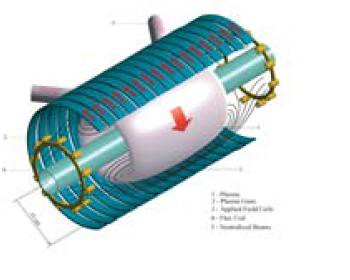
A description of the General Fusion approach (see image above):
The outside of the spherical tank will be studded with approximately 200 pneumatic pistons. These pistons will impact the tank, inducing a spherical acoustic compression wave in the liquid metal that will travel to the centre of the sphere. As the acoustic wave travels through the lead and focuses towards the centre, it will become stronger and evolve into an intense shock wave. When the shock wave arrives in the centre, it will rapidly collapse the vortex cavity and the plasma confined within it, creating thermonuclear conditions in the process.

The pneumatic pistons will be controlled by a system that times their impacts precisely to create a symmetrical compression shockwave in the cavity. The control system will adjust the timing of individual piston impacts to control the shape of the cavity as it collapses; compensate for physical and thermal effects and variations within the generator; and, adjust for changes over time as equipment wears and parameters vary. _General Fusion

Labels:

Friday, June 24, 2011

Terrapower, Other Small Nuclear Reactors Forced to Move Overseas

"Right now, the regulatory environment here in the U.S. means that it would take decades just to certify the design," he said at a U.S.-China energy summit last year. "By partnering with the Chinese, they can move ahead and commercialize the technology around the world when it is proven," Huntsman said. _NYT
The nuclear licensing process for new reactors in the United States has grown so cumbersome and expensive -- and the US NRC under Obama has become so obstructionist toward new nuclear power -- that some of the newest and most promising new, scalable reactor startups are looking overseas for development and manufacture.

Last year Hyperion Power announced plans to manufacture its small modular reactor (SMR) in the UK, and now Terrapower -- backed by Bill Gates -- is negotiating with potential partners in France, India, China, and Russia, to build its cutting edge breeder reactor technology.
"We've had conversations with the Chinese, the Russians, the Indians, the French," Reynolds said in an interview. "We have an aggressive schedule where we think it is important to get something built and accumulate data so that we can eventually build them in the U.S. Breaking ground in 2015, with a startup in 2020, is more aggressive than our current [U.S.] regulatory structure can support."

In addition to its unique fuel cycle, the TerraPower design employs a high-temperature, liquid metal core cooling technology suited to a breeder reactor with "fast" neutron activity, rather than today's predominant reactors whose water cooling systems slow neutrons. TerraPower wants to partner with countries that are actively pursuing fast, breeder reactor technology. "That isn't here right now," he said, referring to the United States. _NYT_via_NBF
A number of different approaches to scalable nuclear fission have been proposed by US companies, but under President Obama the regulatory climate toward all forms of reliable energy production is extremely bleak. Hence the interest in building the revolutionary, safe, new, scalable designs overseas in an energy-friendly climate.

More on SMRs:
No bigger than a double-wide trailer and built in a factory for a fraction of the cost of a large nuclear plant, the small modular reactor (SMR) is an environmentally friendly and cost-effective way to help meet growing demand for electricity.

SMRs have the potential to replace older coal plants and to provide a hedge against volatility in natural gas prices. And while solar and wind are attractive energy sources, both produce power only intermittently and require back-up power in the event the weather is not cooperating.

Established nuclear-energy companies engaged in the development of SMRs include Westinghouse, General Electric, General Atomics and Charlotte-based Babcock & Wilcox. But the field also includes some smaller start-ups such as NuScale Power in Oregon, Hyperion Power Generation in New Mexico and TerraPower, based on the outskirts of Seattle and established with support from Bill Gates.

...In contrast to a conventional nuclear plant, SMRs could be added one at a time in a cluster of modules, as the need for electricity rises. The cluster's costs would be paid for over time, softening the financial impact. The modules could be factory assembled and be delivered by rail to an existing nuclear plant site. In such a configuration, one SMR could be taken out of service for maintenance or repair without affecting operation of the other units.

Most SMRs would be situated beneath the ground to provide better security. Typically they would operate for many years - possibly decades - without refueling and produce far less waste than conventional reactors.

Significantly, almost all of the SMR development is being done with private financing. Companies are using their own resources to develop the small reactors, without government support from mandates or subsidies of the sort that renewable energy sources now require. An SMR designed by Babcock & Wilcox would generate 125 megawatts, using conventional light-water reactor technology. The Tennessee Valley Authority is considering deploying six of the Babcock & Wilcox modules at its Clinch River site near the Oak Ridge National Laboratory.

Another SMR on the drawing board would be an advanced, sodium-cooled "fast" reactor producing just 25 megawatts - enough electricity to power a rural community or a military installation. Hyperion Power Generation has formed a partnership with the Savannah River National Laboratory to build a sodium-cooled reactor as part of a clean energy park near Aiken, S.C. _Newsobserver

Eventually the energy starvationists who have entrenched themselves in Washington DC will be forced out, and their current premises fumigated and disinfected with fresh, rational, and optimistic thinking regarding an abundant energy future.

Labels: ,

Thursday, June 23, 2011

Neste's NExBTL Synthetic Diesel Looks to Algae by 2020

NExBTL

Neste Oil's NExBTL process produces one of the best synthetic diesel products available worldwide. It is based upon the hydro-treating of fats and oils from a wide range of animals and plants. Now Neste is looking at algal oils as feedstock -- hoping to spur economic production of high yield algal oil by the year 2020.
The five-year AlgaePARC project, launched on 17 June in the Netherlands, is being coordinated by Wageningen University and Research Centre and will involve 18 corporate partners. The focus will be on developing technologies and processes for growing microalgae on an industrial scale as a raw material for use in fuel, food, and chemical production.

A similar project, Solar Bio-Fuels Consortium, will be launched this summer in Australia. Coordinated by the University of Queensland, this will bring together seven companies and research institutions working in the field of algae-related research. The three-year project will study various techniques for growing algae and optimizing conditions to achieve high oil yields.

Our goal is to expand the range of raw materials we use for producing NExBTL renewable diesel, and algae represent one of the most promising materials here because of their excellent potential oil yields. The key practical challenge lies in scaling up output to industrial volumes, and we hope that these two new projects will result in new ways of overcoming this challenge.
—Markku Patajoki, the Head of Neste Oil’s Biotechnology Group

Studies have shown that algae species that produce and store lipids represent a potential source of raw material for NExBTL renewable diesel. Algae grow rapidly and one hectare of cultivated algae could yield as much as 30 t/a of oil. Algae oil is also an excellent alternative in terms of sustainability, as it does not compete with food production for supplies of potable water or land. The suitability of algae oil for use in the NExBTL process has already been confirmed.

The straightforward nature and flexibility of the NExBTL process gives us a definite advantage in terms of algae research, as we know precisely the type of properties that we need. Research on new raw materials such as algae is a long-term effort, however, and you cannot expect to get results overnight.
—Pauliina Uronen, Algae Research Project Manager at Neste Oil
_GCC

Neste's approach to BTL depends upon a ready and cheap lipid feedstock which can be hydrotreated to produce synthetic hydrocarbon. It is more straightforward than Choren's BTL process which utilises gasification of biomass and catalytic synthesis from syngas. But without cheap lipid feedstocks, Neste can be priced out of future BTL markets. That is why Neste is pushing high-yield algal oil development: Because micro-algae can be grown over roughly 80% of the planetary surface, using salt water, waste water, and brackish water. And micro-algae can yield from 10,000 gallons per acre of oils and up, using land or water surface not suitable for growing food crops.

The target date of 2020 is realistic, although it will likely be closer to 2030 before high-yield algal production is ready to displace a significant amount of petro-diesel and petro-gasoline.

Labels: , ,

Defkalion to Build Factory in Northern Greece

Brian Wang brings more news about Defkalion -- the Cyprus based Greek company meant to build Andrea Rossi's E-Cat LENR devices and auxiliary power production apparatus for a 1 MW Athens plant.
Defkalion Green Technologies has taken the Andrea Rossi E-Cat and created its products around it. Our products produce heat only – not electricity. Our current product line ranges from kW units (5 - 30kW) to MW units (1.15 - 3.45 MW). The actual E-Cat forms only the kernel of our products; it is the black-box so to speak. Building around the ECat, we have developed a complex unity of machinery and electronics that comprise the overall product, which we have named Hyperion.

Area A is the E-Cat and consists of:
• Metal tube(s) charged with Nickel and catalysts where the reaction with
hydrogen occurs inside to produce heat ranging from 5 up to 30KWh/h.
• A thermally closed circuit (typically glycol) to drive the produced heat out of the
module which cools the tube. This is integrated with a cooling liquid circulatorpump
(inverted- controlled by unit’s electronics) in area C.
• A sealed (isolated thermal and led) internal box
• An electric radiator to heat the tube which starts the reaction consuming less
than 0,5kW/h _NBF
Images and more details at NBF link above.

PDF from Defkalion contains broadest inforamation available so far regarding the company's plans.

Labels:

Newer Posts Older Posts