Wednesday, November 10, 2010

Big Wind Bubble Nears Bursting Point

From Spain to Denmark to the UK to the US, wind developments are being canceled and wind turbine factories are down-sizing or closing altogether. The best intentions of politicians and faux environmentalists can not make big wind into a reliable or affordable source of needed electrical power. Taxpayer subsidies are being squandered on a form of energy which can only fail, in the foreseeable future.
New US wind turbine installations have slowed significantly this year, compared to 2009, and the decline is having consequences. Among other fallout, Suzlon is mothballing a four-year-old wind turbine factory in Minnesota and laying off the remaining 110 workers, due to a lack of new orders. While the industry pins most of the blame for the slowdown on insufficiently aggressive federal energy policies, it suddenly occurred to me to wonder whether wind power, like housing, might have been caught up in an investment bubble that has finally popped, somewhat belatedly.

... _EnergyTribune
If not for massive government subsidies, grants, mandates, counter-productive regulations, and other promotions, big wind power would be in a world of hurt. But as already debt-ridden governments pour more and more good money into bad energy policy, the end-game is coming into view -- and it does not look very pretty. Eventually, the money squandered on big wind projects is borrowed money, which can never be paid back. As unredeemable bonds and loans accumulate, powerful submerged stresses and undercurrents build, which threaten to break out into open conflict.

Ironically, in the end the "Green Industry" may end up promoting the "War Industry", which is just the kind of paradox that good intentions typically generate.

Labels:

Tuesday, November 09, 2010

Big Wind Crash & Burn: Bad for the Grid, Bad for the Economy

Orders for new wind turbines to fall 93% in UK for 2013 The UK was to have been the largest offshore wind producer. Now it looks like resources will have to be put to more reliable forms of power production. Wind power is apparently an expensive luxury for brainless ne'er-do-wells.

World's biggest maker of wind turbines must lay off 3,000 workers due to low demand

In fact, "Green Jobs" are in jeopardy all over, due to many factors -- including the belated realisation that big wind power sucks an economy dry, and wreaks havoc on a power grid.

The high cost of wind energy threatens the existence of many wind developers who jumped into the business with the best of intentions, and highest of hopes.

But some folks never seem to learn . . .

Big wind is a big sideshow of the great carbon hysterics' carnival and crusade. If people catch on to the hollow nature of carbon hysteria, the reasons for wasting scarce resources on big wind just crash and burn.

Labels:

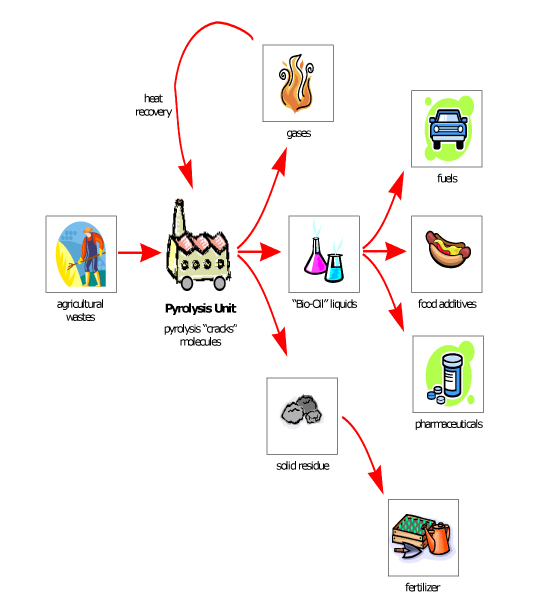
Distributed Pyrolysis Units Could Form Regional Economic Cores

Source

Pyrolysis is the heating of carbonaceous material in the absence of oxygen. When biomass is pyrolysed, the resulting products include bio-char (solid carbon), pyrolysis gases, and pyrolysis liquids (or pyrolysis oil).
Source

Locating pyrolysis units in local areas of high biomass production allows for the early conversion of high-bulk / low-density biomass to a lower-bulk / higher-density pyrolysis oil which is easier to transport + a bio-char which can be used to help fertilise local and regional crops and replenish soil carbon.
Agri-Therm Portable Pyrolysis Unit

Agri-Therm is developing a portable pyrolysis unit that could be transported to local areas of high biomass production, for local and regional conversion, pre-processing, and energy densification (by volume).

Pyrolysis oil can be fired in fuel oil furnaces, or co-fired with coal. It can also be further refined to high value fuels, chemicals, and more.

Some of the densification benefits of pyrolysis can also be obtained by solid biomass compression, torrefaction, and gasification -- although handling pressurised gas is often more difficult than handling liquids.

Local creation of valuable fertiliser and soil supplement is a decided plus for pyrolysis in agricultural regions.

Labels:

Origin Hydrogen Harvester

Many advanced biofuels processes require additional hydrogen in order to complete the fuel synthesis. Origin Oil has developed a means of converting light energy to hydrogen using algae in its "multireactor" and "Hydrogen Harvester" technology. Photosynthetic organisms split water into oxygen and hydrogen in the course of producing carbohydrate. (carbon dioxide is also split to provide the carbon in carbohydrate) Depriving algae of Sulfur can divert them from producing carbohydrates and lipids to the greater production of hydrogen.
OriginOil researchers built a pared-down version of the company’s Hydrogen Harvester™ and tested many process variables and materials. They achieved hydrogen energy corresponding to a solar energy conversion efficiency of about 12 percent continuously for several hours on a partially clouded day. The sole energy input was the Sun. By comparison, commercial solar cells achieve conversion efficiencies between six and 20 percent.

Brian Goodall, OriginOil’s CTO, said: “Our experiments clearly demonstrate that this technology can generate renewable hydrogen at rates that matter to the global economy. These early rates compare well with those of the more mature solar cell industry, with the added benefit that the fuel, hydrogen, is readily storable. This is the first renewable source for today’s $39 billion hydrogen market.”

OriginOil officials admit the in-the-field efficiency might be less than the 12 percent achieved in the research system. However, since algae stores up energy during the day, it will continue to generate hydrogen throughout the night. Also, algae production facilities using a Hydrogen Harvester could be self-sufficient for refining. _DomesticFuel

This process can be very useful for a complete advanced biofuels plant. Some algal reactors can be dedicated toward producing lipids or pyrolysis / synthesis gas. Other algal reactors can be dedicated toward hydrogen production. The hydrogen can then be utilised to convert lipids to hydrocarbons, or to synthesise hydrocarbons from pyrolysis products or synthesis gas via catalytic processes.

Labels: ,

The Age of Oil: Just Beginning? Soon to End? Or Both?

Petroleum is thought to have originated mainly from the remains of sediments of photosynthetic organisms which sedimented from ancient seas, and were heated and compressed by geological processes. Assuming that to be true, it is interesting to note that photosynthetic organisms originated almost 3.5 billion years ago. From the chart above, one can note that the Oxygen concentration of Earth's atmosphere rose markedly at about the same time as the origin of cyanobacteria (2.8 gya), eukaryotes (2 gya), and algae (1 gya), respectively.

The higher the oxygen level the higher the rate of sedimentation of photosynthetic organisms, presumably. Note that such sedimentation began to occur nearly 3 gya. Also note that the vast majority of petroleum which humans have begun to tap into, originated roughly 100 mya or more recently. I think you will agree with me that the Proterozoic Era (2.5 gya to about 540 gya) is likely to have been extremely prolific in the sense of laying down organic carbon in sediments.
Now, observe the Tethys Sea in the image (see Tethys Ocean). The Tethys Sea (Ocean) opened about 250 mya and closed about 10 mya. Most of the modern world's known oil and gas reserves lie in the sediments which once underlay the Tethys water masses. Much of this oil and gas is of fairly recent origin, geologically speaking, although some dates back to the early Triassic (250 to 200 mya). It only takes a hundred thousand years or so to make petroleum by natural means, depending upon local geology.

Now, I know you are saying to your computers, "But Al, if we are only beginning to tap a very small fraction of all the oil that has been deposited, where is all the rest of the oil?"

To which I reply, "Where do you think it is? Floating beyond the orbit of Pluto?" No, seriously, a lot of things can happen to oil deposits over time. Some can seep into oceans and be eaten by microbes. Some can be turned into various types of gas, and escape or be adsorbed by minerals. But most of it is likely to have been buried in the constant geologic upheaval of the planet's layers of rock.

The Japanese and Chinese have recently begun finding significant deposits of oil and gas within volcanic rock. Oil geologists are beginning to look beneath undersea volcanic deposits for submerged oil fields of great potential. The Russians have been finding significant petroleum beneath deep igneous and metamorphic layers for many years. The history of oil formation goes back over ten times farther than almost all of the oil humans have retrieved or located so far -- although drops of bitumen has been found in rocks dated between 2.6 and 3.2 gya.
Australian expert in petroleum geology, Associate Professor Colin Ward of the University of New South Wales, says it's not surprising that algae and other simple life forms existed during this early stage of the Earth's history.

What is significant, is that there are now signs they were producing oil.

"He's found good evidence that the processes that generate oil were active in a very early history," he says.

Rasmussen's discovery may have implications for exploration, Ward says.

"It focuses attention back on very old rocks as a possible places to look for more oil and gases," he says. _Source
So why do I say that the age of oil may be ending soon? Because while it takes 100,000 years (plus or minus) to make petroleum by natural processes, it only takes a matter of weeks -- from start of algae crop to harvesting and processing -- using modern methods. Yes, modern oil made this way is very expensive, but that is because we have just begun learning to create it. Within 20 years, Al Fin energy experts assure me that microbial fuels and energy will be fully price-competitive with petroleum, and rapidly scaling to match production within 30 years.

You may hear a lot of talk about "peak oil" in certain circles. The most likely kinds of peak oil you will see are "political peak oil" from bad energy policy or political conflict, and "peak demand" -- when consumers choose other forms of energy and fuel than petroleum. Peak demand can also occur from economic, or other forms of collapse, which we hope does not occur.

The beginning of oil, the end of oil. Mayhaps both.

Previously published at Al Fin

Labels: ,

Monday, November 08, 2010

Diesel from Waste Plastics Scales Up in UK and Ireland

STA UK is gearing up to build 10 new waste plastic to diesel plants in the UK. The first plant is to be built in Port Laoighise, Ireland. The process utilises pyrolysis (heating in absence of oxygen) of waste plastics, with fractional distillation of the pyrolysis gases to purify the diesel.
Plastic waste is continuously treated in a cylindrical chamber and the pyrolytic gases condensed in a specially-designed condenser system to yield predominantly straight chain aliphatic hydrocarbons with little formation of by-products. These hydrocarbons are then selectively condensed and cleaved further catalytically to produce the average carbon chain length required for distillate fuel.

The plastic is pyrolized at 370 ºC-420 ºC and the pyrolysis gases are condensed in a 2-stage condenser to produce a low-sulfur distillate. (Pyrolysis is a process of thermal degradation in the absence of oxygen.) _GCC

On the biofuels front, Butamax (a partnership between BP and DuPont) has opened a production laboratory in Sao Paolo, Brasil, to develop scalable and efficient means of producing bio-butanol from sugar cane. Butanol is a simple four carbon alcohol which can be added to either gasoline or diesel, substituted for gasoline without modification in modern gasoline engines, and pumped through ordinary pipelines without additional concern about corrosion (unlike ethanol).

The problem with the production of butanol is that current micro-organisms cannot tolerate more than a few per cent concentration of butanol, and die off before they can produce appreciable yield. So either Butamax will have to develop hardier organisms, or they will need to find an efficient way to pull the butanol out of solution as quickly as it is produced. Additional solutions to the problem might include a staged platform of multiple microbes or "pseudo-microbes" (catalytic platforms which perform the essential synthesis operations of the microbe without the cells). Each stage might perform a separate step in the synthesis process, with each stage adapted to its own set of reactants and products to minimise toxicity for that particular stage.

Labels: , ,

Sunday, November 07, 2010

Surprising Look at Oil Resources from an Environmentalist

Stanford professor Steven Gorelick is an environmental professor of Earth science, whose predictions are markedly different -- and far more reality-based -- than those of fellow Stanford professor Paul Ehrlich.

Here is a sampling of Gorelick's ideas:
With all the advances in renewable energy, why should we even care if the planet is about to run out of oil? It seems like we would be better off without it.

In my view, like it or not, we will be using oil for a long time. Oil makes possible the transportation of people and products. Currently, most vehicles run on liquid fuel derived from oil and cannot take advantage of energy alternatives, although this is changing. In the meantime, there is no doubt that oil presents challenges related to our environment, economy and security.

Regarding whether or not we are running out of oil, estimates of the world's oil reserves have continually increased over the past 50 years, and global reserves are at an all-time high. From that perspective alone, the world is not running out of oil. Therefore, I don't believe it makes sense to assume that running out of oil will somehow solve the environmental problems associated with oil use.

Even if we won't run out of oil, isn't it possible that production will peak at some point and then drop off as oil becomes more difficult to extract?

The world may very well go through a peak in oil use, but a peak and decline is far more likely to reflect a decrease in oil demand rather than production choked by perilously low global availability of oil. The line between conventional liquid oil and unconventional oil, such as that derived from Canadian oil sands, will blur. Beyond that, major consuming nations will likely shift away from using conventional oil for transportation as concerns grow over security, stability and the environment. Based on the history of other nonrenewable Earth resources, it is likely that the world will move away from oil long before our global oil resources are exhausted. _PO

There is more at the link above.

While Al Fin energy specialists think that microbial fuels will eventually fill in for petroleum most admirably, Mr. Gorelick's optimism concerning electricity-powered transportation will also be important for specific transport niches, in time.

Labels:

Saturday, November 06, 2010

ARPA-E Looking At Direct "Light to Fuels" Engineering of Organisms

The US Department of Energy has its own ARPA, called ARPA-E. The agency will be holding a workshop in Arlington, VA, on 2 December 2010 with an optional session on 3 December. The goal is to use advanced tools of genetics and photobiophysics to create organisms (presumably microbes) which have been optimised to create liquid fuels directly from sunlight -- skipping the lignocellulosic biomass step.
Specifically, ARPA-E is interested in exploring interdisciplinary project opportunities that combine genomic information, genetic engineering, classical genetic selection, and photobiophysics for:

Increasing productive light absorption. How can organisms be engineered to better use the available solar resource for significantly enhanced production of biofuels? Topics may include: expanding the photosynthetically active spectrum, altering the photoprotective response, tailoring the structure and composition of organisms to better capture light, and the introduction of light-powered proton pumps.

Altering organism metabolism to increase the energy captured as liquid fuels. After light energy is captured, how can the ideal biological system for the production of biofuels be created? Topics may include: capture of high-energy intermediates, alternatives to RuBisCO carbon fixation, bypassing photorespiration, and redirecting resources towards optimal fuel production.

Applying novel genetic selection strategies to optimize fuel production strains. How can novel selection or screening strategies be employed to favor increased liquid fuel yields? Topics may include: development of stable symbiotic co-cultures that increase fuel production, adaptation of production organisms to stresses that favor overproduction of fuel molecules, and sexual selection strategies based on increased energy yields.

Special attention will be directed towards identifying low-cost, scalable strategies to develop highly efficient photosynthetic systems quickly, without requiring extensive, basic, R&D. In general, ARPA-E supports projects that have a high degree of technical or execution risk, beyond the range of typical government R&D funding. _GCC

The Al Fin Advanced Research Projects Agency, ARPA-AF, projects that in ten years direct microbial fuels will be competitive with petroleum fuels. But it will require roughly another ten years for microbial fuels to scale to the size of a medium sized petroleum company. It is good for ARPA-E to help to stimulate research in this area, as long as they know that microbial fuels would have been developed anyway, probably just as quickly.

But times are tough all over, and every tiny branch of the US government will soon have to justify its very existence, as the reality of spending cuts comes to Washington DC at long last.

Labels:

Friday, November 05, 2010

Palm Still King of Oilseeds; Food vs. Biofuel Still Stupid Argument

Robert Rapier takes a good look at palm seed oil in Malaysia. Robert reports that palm yields about 5 tons of oil per hectare, although it requires about 4 kg of fertiliser per tree. Oil Palm is planted as a monoculture, often on converted rainforest. Brazil is often mentioned as having a rich tropical oilseed potential due to the vast rainforests there.

The issue of food vs. biofuels naturally came up in comments, with some commenters categorically declaring that it is "wrong" to use a food crop for fuel. The stupidity of that point of view is almost beyond belief, unless you consider how modern universities have become political indoctrination centers, rather than places to hone one's adult thinking skills on real world issues.

The choice of whether a farmer will sell his food crop to a food distributor / processing company, or will sell his crop to a biofuels maker, is an economic decision best left to the farmer. In fact the farmer had to plan well ahead to determine all the factors going into how much of what crop he would plant on which parcel of land. He made those decisions based upon his belief that a market for biofuels would be available when his crop is harvested.

Farmers could easily have done something -- anything -- different with that parcel of land. He could have grown fodder for livestock, or let the land grow a simple cover crop to regenerate its nutrients. He could have grazed livestock on the land, or developed it for construction.

Every decision down the line is an economic choice, based upon the farmer's needs and economic choices. Knowing that the market for biofuels exists, farmers are likely to plant more crop -- as long as the market price can support it. That is exactly what has happened in the US corn crop. More maize is being grown than would otherwise be the case, so as to supply the human food market, the animal food market, and the biofuels market -- trying to get the best available price in all three.

Every resource could conceivably be converted to food, some way or another. For example, you could tear down your house, fill in your swimming pool, tear up your tennis court, and otherwise convert your private property into food-growing area. For some reason, though, we rarely hear about the "homes vs. food" controversy.

If the world were really hard up for food, we could use dead human bodies as fertiliser for food crops, rather than wasting all that nutrient in cremation or burial. Does anyone talk about the "food vs. burial" controversy?

As far as fuels go, fossil fuels could easily be converted into fertilisers -- even into edible foods using edible yeasts and such. Do you hear a lot about the "petroleum vs. foods" controversy?

Some resources are more efficient at creating food than others. And certainly only a relative few individuals are truly good at producing abundant crops. It would be easy to produce far more food than humans could possibly consume, with most of it going to waste. But that would be a poor economic use of resources.

Smart farmers do not plan to waste resources, unless the government or other mafia-type protection group forces them to do so via incentives. If market conditions tell them that there is a relative shortage of fuel and a relative excess of food, they may well focus on producing crops for fuel that year. Having choices such as that is a good thing for farmers, and likely to help them stay in business longer than would otherwise be the case.

It seems that most of the people who dwell on "food vs. fuels" are also people who call themselves environmentalists or who belong to the dieoff.orgy cult. In reality, these dieoff.orgiasts don't want humans to have any energy at all -- food or fuels -- until 90% of humans die off. So we actually know their viewpoint before they even communicate.

Labels: ,

Another High Value Chemical from Biomass: Farnesene

Tate and Lyle PLC is partnering with Amyris Inc., to produce farnesene from biomass sugars, to serve as a platform for production of high value chemicals and fuels. Amyris has developed a scale-up plan for production of bio-diesel from biomass sugars, with fairly ambitious near-term goals:
Amyris applies industrial synthetic biology to genetically modify yeast to produce defined molecules via fermentation for use as renewable chemicals and transportation fuels. The company is focusing on Brazilian sugarcane as its primary feedstock. According to UNICA, the Brazilian Sugarcane Industry Association, sugarcane is the lowest cost feedstock to produce renewable products at scale and using it enables us to leverage the established Brazilian infrastructure.

Common to both the Amyris process and the sugarcane-to-ethanol process is the use of fermentation. Amyris plans to establish production capacity taking as input the same sugar source that is routinely processed by existing sugar and ethanol mills and directing it to customized fermentors, where it will be combined with genetically engineered yeast. _GCC
As noted above, early pilot production will be based upon sugar feedstock from cane. As better methods are developed for producing sugars from bagasse and other cellulosic biomass, the sugar feedstock will necessarily shift to the most economical one -- depending upon availability at particular locations. Likewise, as yeasts are made better able, genetically, to handle a variety of sugars, the most economical sugar feedstock is apt to shift.

Labels: , , ,

Thursday, November 04, 2010

More on Biomass to 5 Chloromethyl Furfural as Production Platform

A few days ago we looked at a method using ionic liquids plus catalysts to create 5 HMF as a platform for creation of fuels and chemicals. Here Professor Mark Mascal looks at using aqueous hydrochloric acid plus an organic solvent for digestion of cellulose into 5 CMF, with 5 HMF as an intermediary.
In a second reaction module, CMF is processed through one of two product manifolds. One of these, called "furanics" maintains furan ring of CMF intact, and the other, called "levulinics," is based on derivatives of levulinic acid (Figure 2). Both paths provide access to a variety of fuels, renewable polymers, and specialty chemicals. _azocleantech

One area of particular interest is in the context of processing of oilseed or algae feedstocks for the production of biodiesel. Using the above-described reactor technology, the product is a hybrid lipid/carbohydrate-based fuel consisting of a blend of fatty acid and levulinate esters. Using safflower seeds as a model, we have been able to increase the yield of fuel by 24%. This is accomplished by converting both the lipid and the carbohydrate content of the seeds into fuel. Not only is more biodiesel created in the process, but the blending of fatty acid esters with levulinate esters improves the fuel's cold-flow properties. _azocleantech
A general summary of the products in the CMF derivative portfolio is shown in Figure 4. Biofuels include substituted furans, tetrahydrofurans, and levulinate esters. These renewable fuels span the volatility range from diesel to gasoline, and are less toxic, more biodegradable, and cleaner burning than hydrocarbons. _azocleantech
A growing number of research teams are looking at these HMF and levulinic acid derivatives in the hope of devising a profitable industrial scale process for conversion of cellulosic biomass to useful fuels. This approach is a refreshing change from the excessive focus on ethanol as biofuel. Clearly a wide range of renewable biofuels and biochemicals will prove far more useful than a two chain alcohol best known for its ability to relax human inhibitions.

Information on DMF fuel specifications here

Labels:

Molten Salt Reactors: Requirement for Fissionable Starting Material

Thorium 232 is a fertile element in abundant supply within the Earth's crust. Thorium can be jump-started into a fissionable fuel, U 233, with enough neutron bombardment. Thorium needs a quantity of fissionables -- as neutron donors -- to start the initial fission reaction. More from Brian Wang:
Molten salt reactors require anywhere from 500 kg to upwards of 5 or more tonnes per GWe plant (whether one runs a more thermal neutron spectrum or a more fast one). 1500 kg is considered typical. Any molten salt reactor can start on bomb grade or reactor grade Plutonium (roughly the same amount needed as U233). Plutonium is expensive to isolate and of finite supply in spent fuel (600 to 1000 tonnes worldwide?) Any MSR can also start on highly enriched uranium U235 (i.e. old weapons supply). HEU (Highly enriched uranium) is also limited and would be very politically unattractive to be shipping around. Potentially the simplest startup fuel would be Low Enriched Uranium (LEU is under 20% U235 and useless for weapons) because we can produce this in great amounts (we already do) but this is where I have to qualify my answer.

There are two main classes of molten salt reactors that produce all their own fissile fuel after startup, the better known Single Fluid design has everything in one fluid has a very hard time starting on LEU but Oak Ridge National Labs proposed such a design in the late 1970s (DMSR Breeder). Another way to run is called Two Fluid which has separate salts for the fissile U233 and fertile Thorium (which greatly simplifies the removal of fission products). In this design, favored by many these days, startup on LEU is fairly straightforward. You simply run LEU in the central fuel salt for a few years while building up and saving U233 produced in the thorium blanket salt. Once you have enough U233 saved up, you remove (and sell) any remaining LEU in the fuel salt and replace it with your saved up U233 and from then on run on the pure Thorium to U233 cycle.

....startup fissile requirement is not a roadblock to building thousands of GWe of molten salt reactors like it is for something like metal cooled fast breeders that need ten to twenty times as much starting fissile material. _NextBigFuture_quoting_DavidLeblanc
David Leblanc's 11 page paper giving more details via Brian Wang

Labels: ,

US Biomass Potential from Grass Crops Looking Good

Researchers from the University of Illinois have looked at the economic potential for grass crops in the US midwestern region. Brian Westenhaus has more:
Switchgrass is large prairie grass native to the Midwest; miscanthus, a sterile hybrid, is widely cultivated in Europe as a biofuel crop. Others such as sweet sorghum could be competitive and the waterborne organisms such as algae also could get competitive. But right now the grasses have the mass potential.

The UI team wanted to determine whether biofuel grasses could be viable cash crops in the U.S. and to explore how this viability varies by location.

...The researchers found that, in general, the yield is very high for miscanthus – up to three times higher than switchgrass in the Midwest. Even through switchgrass is native to the region; it doesn’t grow well in higher latitudes like Minnesota or Wisconsin because it has poor tolerance for cold temperatures. For both grasses, yield varies considerably throughout the Midwest, generally lower in the north and much higher in the south.

Heads up – most notably, for the southernmost counties – much of southern Illinois and nearly all of Missouri – the model predicts greater production of grasses than of current corn and soy crops. This could be a key factor in farmers’ decisions to cultivate biofuel crops. Should the model hold with some real world applications the energy zone using the large grasses is getting the early boundaries. _NewEnergyandFuel
This is just the beginning of the back and forth between scientific and economic studies of biomass crops and real world experimentation and scaling up of biomass crops.

Biomass can be converted to fuels, chemicals, plastics, and directly to electric power. It is only a question of finding the most economical ways of growing and processing this biomass. Real world experience will both cooperate with and battle against academic studies in the search for the best way of producing and using biomass.

Labels:

Wednesday, November 03, 2010

BP-Funded EBI Tries to Dampen Algae Enthusiasm

The Energy Biosciences Institute -- funded by a $500 million grant from oil giant BP -- has released a "technoeconomic" report meant to cast a discouraging pall over the future of algal biofuels, chemicals, and plastics production. It is easy to see why BP might want to hold off the coming deluge of algal fuels -- at least for another few decades. There are still a lot of profits to be made in the old-fashioned crude oil business, once the lords of energy starvation are finally removed from office.

It is also true -- as the report states -- that growing pure algal monocultures for oil extraction is a difficult and costly enterprise, likely to require several more breakthroughs before becoming profitable and capable of scaling to industrial size. But did the report actually address the relevant and likely timeline for the early and middle evolution of algal energy, fuels, plastics, and chemicals? It does not appear that the authors of the report even came close to a realistic assessment of the likely evolution of algae for energy, fuel, plastic, or chemicals. Here's one look at EBI's report:
A new report from the Energy Biosciences Institute (EBI) in Berkeley projects that development of cost-competitive algae biofuel production will require much more long-term research, development and demonstration. In the meantime, several non-fuel applications of algae could serve to advance the nascent industry.

'Even with relatively favourable and forward-looking process assumptions (from cultivation to harvesting to processing), algae oil production with microalgae cultures will be expensive and, at least in the near-to-mid-term, will require additional income streams to be economically viable,' write authors Nigel Quinn and Tryg Lundquist of Lawrence Berkeley National Laboratory (Berkeley Lab), which is a partner in the BP-funded institute.

Their conclusions stem from a detailed techno-economic analysis of algal biofuels production. The project is one of the over 70 studies on bioenergy now being pursued by the EBI and its scientists at the University of California at Berkeley, the University of Illinois in Urbana-Champaign, and Berkeley Lab.

... Four key resources (suitable climate, water, flat land and carbon dioxide) must all be available in one location for optimal algal biomass production. The authors state that despite the need for all four resources, algal oil production technology has the potential to produce several billion gallons annually of renewable fuel in the U.S. However, achieving this goal, particularly at competitive capital and operating costs, will require further research and development.

The EBI report focuses on algal biofuels produced in conjunction with wastewater treatment as a promising cost-effective strategy to fast-track development of a practical production process. Besides providing the needed water and nutrients, use of wastewater in algae production provides the potential for income from the treatment service provided.

The areas the study identified as essential for R and D are in both the biology and engineering fields. The ability to cultivate stable cultures under outdoor conditions, while achieving both high productivities and oil content, is still to be developed. Despite the well-known rapid growth rate of algae, increasing the volume of algae oil produced per unit of surface area per year is a crucial goal. Oil-rich algae strains that are biologically competitive with contaminating wild species and that consistently grow well in various climates are needed. Other key steps to be improved are low-cost harvesting of microscopic algae cells and the extraction of their oil content, as well as dealing with the biomass residue remaining after oil extraction. _Source
The study suggests that it will take 10 years just to conclude their studies on the viability of large scale algal fuels. How convenient! 10 years is the time period for BP's funding grant to EBI. ;-)

But seriously, just a quick glance at a summary such as the one linked above shows a number of glaring deficiencies in EBI's analysis.

1. Near and mid-term successful utilisation for algal energy and fuels will depend upon algal biomass -- not algal oils. It will indeed take 10 years to develop economic and scalable means of algal oil extraction and diesel production from algal oil.

2. Algal monocultures are not necessary for rapid production of algal biomass. In fact, multiple synergistic cultures are apt to produce higher quantities of mass more quickly.

3. There is no shortage of seawater and relatively flat coastal plains for production of synergistic algal symbiots for rapid algal biomass production.

4. There is no shortage of CO2, when algal biomass is the object -- rather than algal oil -- of algal energy, fuels, plastics, and chemical production. CO2 is a byproduct of the entire operation.

5. Algal species bloom wildly under a range of climates -- depending upon the species combinations and the chemical and biological environment within these species happen to be growing. Different regions will naturally utilise different groupings of algal species and wastewater influent to suit the climate.

6. The topic of algal growth factors which trigger algal blooms has not been exhausted by any means. While simple chemicals such as phosphorus and CO2 act to stimulate algal growth, no doubt a large number of other less bulky and more subtle growth stimulants remain to be discovered.

A number of other problems hidden within the author's assumptions and methods will need to be teased out and analysed. But clearly the issue takes on an entirely different light when looking at algal feedstock as a hardy and prolific biomass rather than as an oil grown from fragile monocultures.

Labels: ,

Monday, November 01, 2010

25th Carnival of Nuclear Energy at Yes Vermont Yankee

The 25th Nuclear Energy Carnival is hosted at pro-Vermont Yankee blog, Yes Vermont Yankee. Here is an excerpt:
In Dr. Furakura's Vision (Nuclear Green Blog) Charles Barton describes the early development of Molten Salt Reactors, which was followed by squashed hopes. Dr. Furakara is old now (85) but he is trying to launch the Fuji reactor project. Dr. Furukawa believes that by 2050-2060 as many as 10,000 billion-watt Fuji reactors could be powering the global energy economy. Why do we believe the next generation of reactors will be developed in this country, or in France? We should not be ignoring the visions of the future from Japan. In a related post, Charles analyses the MIT David J Rose Lecture in which John Holdren lays out Obama Administration thinking. Apparently, they think that a thorium molten salt reactor is impossible. The video of the Rose lecture is embedded in the blog.

Just in case you think that if it's an MIT lecture, it must be right, Brian Wang has a blog post describing the negotiations between Japan and Korea to build mini-Fuji reactors for ships. The companies see this as a competitive move vis-a-vis Chinese nuclear-powered ships. Where is the U.S. in all this ferment of new reactors?

What About the Sun? What About Fossil?

At Yes Vermont Yankee, Willem Post has an excellent guest blog on Photovoltaic Feed In Tariffs and Germany and this country. A very interesting post, with tons of data and links. Did you think solar helps a lot with peaking power? Well, not much, actually.

Similarly, also at Yes Vermont Yankee, I have a post The Inconvenient Truth About Vermont Yankee. Without It, Vermont Would Use Fossil. The general statement is obvious, but the back-up facts are interesting. New England, as a whole, has 60% of its installed electrical capacity in gas and oil. Vermont has 9%. The chart of energy use during refueling outages is also worth a look. _YesVermontYankee

Nuclear energy -- both fission and fusion -- will be key to advancing the human enterprise into the indefinite future.

Dieoff.orgiasts in high public office want to shut down all viable energy sources. That is why the Obama administration has worked so hard to shut down coal, oil, shale gas, oil sands . . . and has been so neglectful of safe, reliable, new designs for molten salt reactors and small modular reactors.

But dieoff.orgiasts die, and get voted out of office or otherwise removed from power. The starkness of the choice between energy starvation and an abundant future will eventually grow clear to the voting public.

Labels:

Sunday, October 31, 2010

Dimethylfuran and 5 hydroxymethyl furfural From Biomass

The biomass-derived chemical dimethylfuran, seen above, has been shown to possess combustion and emissions qualities competitive with gasoline.
5 hydroxymethyl furfural, shown highlighted above, is also derived from biomass, and can serve as a platform for the production of renewable fuels and high value chemicals.

To this point, it is the production of this wide array of useful chemicals and fuels from biomass which has been demonstrated -- not necessarily their economical production at large scale. It will take a number of years to accomplish that.

It is best to see the future of biomass derived fuels and chemicals as a broad highway with many lanes of traffic. Not all lanes will reach the goal of profitable, large-scale production. Certainly not all lanes will reach the goal at the same time. And counter-intuitively, the high-speed lane may not be the lane which allows the largest flow of traffic in total.

There will be no magic bullet, instant replacement for geological hydrocarbons. That is why it is so important to maintain access to the wide array of geo-hydrocarbons for as long as possible. But as soon as the dieoff.orgiasts and the energy starvationists can be hounded out of public office, the prospects for a prosperous and expansive human future will enlarge vastly.

Labels:

Friday, October 29, 2010

GE-Hitachi Teams w/ Savannah River Nuclear Solutions to Explore Revolutionary PRISM Reactor Gen IV Burning of Spent Nuclear Fuel

The PRISM reactor design, which completed U.S. Nuclear Regulatory Commission pre-application reviews in 1994, is an advanced, Generation IV sodium-cooled reactor technology. A key attribute of PRISM technology is that it generates additional electricity from recycling used nuclear fuel...

...GE-Hitachi leans away from reprocessing, and towards recycling, as a potential future fuel cycle in the USA: "Our vision is recycling—you burn the actinides in a fast reactor, such as PRISM, and you don't separate plutonium. That alleviates some of the proliferation concerns, and you get as close to closing the fuel cycle as practical. You also reduce waste, and reduce the half-life of radioisotopes that are disposed." _NuclearEngineering
The GE-Hitach PRISM reactor is a Gen. IV design that promises to recycle and burn the mountains of spent nuclear fuel left over from conventional nuclear fission reactors. If this sodium-cooled Gen IV reactor proves out in testing at the DOE Savannah River Site, it will revolutionise the nuclear waste picture.
GE Hitachi Nuclear Energy (GEH) and Savannah River Nuclear Solutions, LLC, (SRNS) signed a memorandum of understanding (MOU) to explore the potential of deploying a prototype of GEH’s Generation IV PRISM reactor as part of a proposed demonstration of small modular reactor (SMR) technologies at the US Department of Energy’s (DOE) Savannah River Site.

The MOU sets the stage for continued discussions on the potential NRC licensing and deployment of a 299-megawatt PRISM reactor at the federally owned facility. SRNS is the management and operating contractor for DOE at Savannah River Site (SRS)....

....The PRISM reactor design, which completed US Nuclear Regulatory Commission pre-application reviews in 1994, is an advanced, Generation IV reactor technology that builds on research and development of sodium-cooled reactors. A key attribute of PRISM technology is that it generates additional electricity from recycling used nuclear fuel. _GCC

Labels:

First US Coal-to-Gasoline Plant for West Virginia?

TransGas Development Systems, LLC announced an agreement with SK Engineering & Construction Co., Ltd (SKE&C) leading to engineering, procurement and construction of its first US coal-to-gasoline plant—Adams Fork Energy—to be located in Mingo County, West Virginia. _GCC

US coal deposits contain 12 X as much energy as all known oil in Saudi Arabia. The gasification process to be used in the new West Virginia CTL plant could cleanly utilise coals of any grade -- including the cheapest and dirtiest coal. By moving US coal reserves into the liquid fuels arena, the prospects for peak oil continue to remain slight -- unless the Obama administration decides to shut down all coal, even clean coal projects. Obama has promised to bankrupt coal companies, and all his other policies are consistent with an "energy starvation" approach to shutting down US industrial production. Time will tell.
The Adams Fork Energy project will convert regional coal into premium-grade gasoline, producing 18,000 barrels per day (756,000 gallons US, 2.86 million liters). When fully developed, the Adams Fork project will be the largest coal-to-gasoline project in the world, according to Adam Victor, President and CEO of TransGas Development Systems.

The project team has been issued a permit to construct by the West Virginia Department of Environmental Protection and plans to begin work on the site during the second quarter of 2011.

The plant will have several process components. First, coal is gasified to produce synthesis gas, using Uhde PRENFLO PDQ gasifiers. The synthesis gas will then be cleaned to remove impurities, turning most into marketable byproducts. Next, the synthesis gas will be converted into methanol, which in turn will be converted into gasoline utilizing ExxonMobil Research and Engineering Company’s (EMRE) MTG process. During the operation of the integrated facility, air emissions are expected to be so low that it will qualify as a minor source under US law. _GCC

Labels:

Thursday, October 28, 2010

Proved Oil Reserves Continue to Grow Over Time

Proved oil reserves at the end of 2008 are estimated to have been 1258.0 thousand million (billion) barrels. That represented an increase of 17.7% over the 1997 figure of 1068.5 billion barrels, despite estimated cumulative production of 290 billion barrels during the intervening ten years, ie global reserves additions amounted to around 480 billion barrels between end-1998 and end-2008.

...The reserve numbers published in the BP Statistical Review of World Energy are an estimate of proved reserves, drawn from a variety of official primary sources and data provided by the OPEC Secretariat, Cedigaz, World Oil and the Oil & Gas Journal and an independent estimate of Russian oil reserves based on information in the public domain. Oil reserves include field condensate and natural gas liquids as well as crude oil. They also include an estimate of Canadian oil sands 'under active development' as a proxy for proved reserves. This inclusive approach helps to develop consistency with the oil production numbers published in the Review, which also include these categories of oil. _Source
In fact, proved oil reserves have increased since the beginning of the use of petroleum as an economic resource. One reason for this is that the total amount of hydrocarbon resources distributed throughout the Earth's crust are unknown -- and likely to be far higher than anyone has estimated. Whenever economic conditions require that new exploration should be carried out, new reserves are discovered. In addition, new technologies are constantly developed which convert unproved reserves into proved reserves.

Well over 70% of the Earth's crust remains to be explored for hydrocarbon (including oil, coal, gas, kerogens, bitumens, peats, clathrates, heavy oils, etc etc). The truly giant oil fields may not have been discovered yet. Technology for oil exploration and production is still in the early stage of development, and geologic theory of oil reservoirs is due for radical overhaul.

The oil fields that are being tapped currently are generally only a few hundreds of millions of years old at most. Most of the truly ancient oil fields have been submerged beneath other forms of rock -- besides being under the seafloor -- which are not thought to be fertile ground for oil drilling. The classical theories of oil exploration are suitable for low-hanging fruit. As the old geological theories are subsumed by more realistic approaches, ever new proved reserves of oil will emerge.

It is a race against time, of course. Within 20 years, microbial fuels will be both price competitive and approaching a scale to rival the modern oil industry. BTL, CTL, GTL, BitTL, KerTL, clathrates-to-liquids, etc. will be performed in situ and on-site, using advanced nano-catalytic technologies combined with microbial assist. It will be a new world of energy, but a world with a far lower demand for liquid fuels, as small modular reactors take over the electrical sector.

Labels: ,

Wednesday, October 27, 2010

Densifying Biomass: Biomass Tablets at 20,000 PSI

MU's Bradford Research and Extension Center farm and a local business have built a machine that can compact corncobs, switchgrass and other biomass so four times as much material can fit in the same amount of space.

Instead of needing an 18-wheeler truck to move biomass to burn as fuel for electricity and ethanol, the same amount could be transported in a dump truck. _Missourian
Biomass is an inherently bulky and clumsy material for transport. Finding ways to compress and/or densify biomass very close to the source is crucial toward building a thriving biomass economy. Otherwise, a significant amount of energy will be wasted simply transporting the biomass to pre-processing, processing, and refining facilities.

Current methods of densifying biomass include compression into pellets and briquettes, and fast pyrolysis conversion to bio-crude. But those processes involve complex multi-process machines which are difficult to transport. University of Missouri ag researchers along with collaborators have developed a special hydraulic press at 20,000 psi (as opposed to 3,000 psi typical for briquette presses) which achieves an almost 20% improvement in mass compression over briquettes and pellets, and almost 4 X better mass compression than commercial balers.
The tabletizer works like this: a hopper with a hydraulic motor turns the auger and feeds the 4- to 6-inch diameter cylindrical mold with biomass. Then a ram pounds the biomass tightly into the mold, shrinking the material from about 10 inches to 2, which is smaller than most biomass briquettes.

“Basically, it squeezes the snot out of it,” VanEngelenhoven laughs. The mold then turns and ejects the compacted tablet. The pressure exerted on the biomass in the mold is about 20,000 pounds per square inch, enough to force the material to adhere together without additional binders. “We don’t put anything extra in it,” VanEngelenhoven says. Long, coarse-cut feedstocks are favorable in the process, as they stick together more easily, he adds.


The resulting tablets have an average density of 55 pounds per cubic foot, compared with average bale density of 15 pounds per cubic foot and pellet density of about 45 pounds per cubic foot, VanEngelenhoven boasts. “So it’s significantly better than a baler, but it uses more energy as well,” he says. “So in that realm, you have to try to compare how much energy this machine is using versus another machine and is there one that’s inherently better? And the answer is, it depends on what you want it to do.” If the densified material is being used at a power plant or to burn for heat in a home, a bale doesn’t fit the bill because it’s too big, VanEngelenhoven says. “So if you want something smaller, you can go with pellets, or now you have this option.” _BiomassMag
As commercial versions of these presses become available, private startups will move from farm to farm -- or from farm region to farm region -- to compress biomass for more convenient and economical hauling to either point of use, or further processing into fuels or materials.
The tablets could provide fuel for co-firing with coal in stocker and fluidized-bed boilers for power generation, fuel for heating buildings and feedstock for producing charcoal. Primary markets would be power plants and ethanol plants. _MUNews
As economies of scale bring the costs of production down, individuals and communities may elect to install their own boilers to provide combined heat and power using compressed biomass.

One ton of compressed biomass is roughly equivalent to 3 barrels of heating oil in energy content. The biomass press described above can use a wide range of raw biomass without having to grind or heat the feedstock before compression into tablets.

Labels:

Newer Posts Older Posts