Tuesday, June 14, 2011

1st Sales from Shell's Gas to Liquids + 2 Approaches to Coals to Liquids

Unconventional hydrocarbon resources represent a huge resource as alternatives to liquid petroleum fuels. Liquids from coal and liquids from gas are potentially competitive at today's petroleum prices -- with proper development and scaling of industrial processes.

Big News from Shell's Pearl GTL Plant in Qatar:
Shell sells first gasoil from Pearl Gas-to-Liquids plant
The $19 billion Pearl gas-to-liquids plant, built in the Persian Gulf emirate of Qatar, will reach full capacity by the middle of 2012, when it is expected to convert 1.6 billion cubic feet of natural gas a day into kerosene, gasoil, base oils, paraffin and naphtha, Shell said today in a statement.

Pearl would generate about $6 billion a year in profit for Shell assuming oil at $70 a barrel, Andrew Brown, the company’s executive vice president for the country, said last year. Pearl and a Qatari gas liquefaction plant that started earlier this year may account for 10 percent of the company’s output when both are fully operational.

...Gas-to-liquids plants such as Pearl produce fuels that would normally be made in an oil refinery and hence benefit when natural gas is cheaper than crude. Oil is close to four times more expensive than gas on an energy equivalent basis and was a record five times more expensive in April, based on New York futures prices.

Pearl will have the capacity to produce 140,000 barrels a day of liquid fuels normally produced in a refinery ... as well as 120,000 barrels a day of condensate and liquid petroleum gas, byproducts of natural-gas production._BW


A plasma gasification CTL plant for Morristown, Tennessee, is planning the beginning of operations by November 2012. The plant will utilise plasmas at 30,000 degrees F to create a clean syngas from coal, for catalytic diesel synthesis.

An alternative CTL approach planned for China involves the production of ethanol from coal. Chinese developers intend to sell this ethanol both within China and on the international ethanol market. They may even sell their coal ethanol to Russia and label it as vodka? ;-)

Al Fin energy analysts prefer the coal to diesel approach, given the much higher value of diesel compared to ethanol. In addition, any catalytic synthesis plant capable of producing diesel from syngas, could be modified to produce other high value chemicals, plastics, lubricants, etc.

Similarly, GTL plants using catalytic synthesis can be modified to produce a wide array of hydrocarbon based chemicals, materials, fuels, and lubricants.

Labels: , ,

Thursday, December 16, 2010

Plasma Arc Gasification and Other Unconventional Energies

WasteManagementWorld

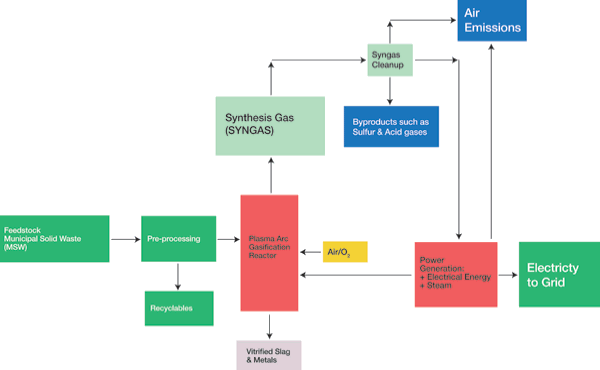
The images here are reproduced from an article in Waste Management World. They illustrate the revenues, efficiencies, and product choices for various methods of incineration and gasification.  The image above is a basic schematic for plasma arc gasification of municipal solid waste for purposes of power generation.
WMW

The graphic above illustrates net energy production of various technologies in kWh per ton and kWh per tonne, of municipal solid waste.
WMW
This graph compares net revenues before taxes for various technologies, illustrating the advantages of gasification technologies.
WMW
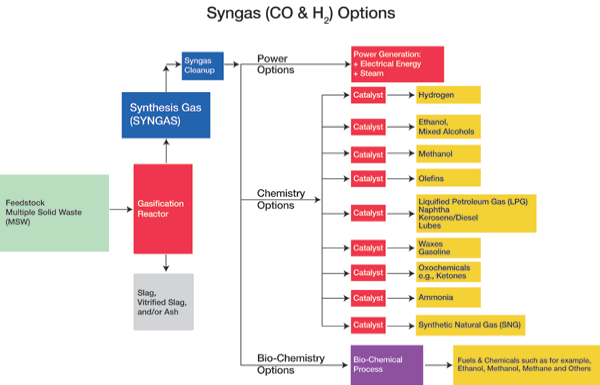
Finally we see the various Syngas options -- power production, chemical production, and bio-chemical production.

It should be noted that plasma arc gasification is shown to be superior to the other technologies shown, in terms of efficiencies and revenues. The end products are likewise far easier to dispose of, with very little if any toxicity compared to waste products of other methods. More at original article.

Despite all of the advantages of plasma arc gasification, loudly vocal lefty-Luddite groups have united in opposing all forms of reliable and abundant energy production -- including arc gasification methods.

It certainly seems as if all faux environmentalists who complain about overpopulation, wail about resource scarcity, and also promote a reduction in human energy use and a reduction in human population -- it seems as if these persons should take the proactive step of self-immolation.

Fortunately, Oynklent Green [OTC:OYNK] has developed just the technology for such as those, which coincidentally enough, consists of a thermochemical approach to the production of fuels and energy. Follow the Oynklent Green label for more information.

Labels: ,

Saturday, September 11, 2010

Are Baboons Running the Environmental Movement?

Sorry, the title above is unkind -- to baboons. In reality, you would have to remove at least one half a baboon's brain for the primate to be as unintelligent as the average (faux) environmentalist. One of the latest of the host of environmental faux-llies is the organised movement against waste-to-energy gasification plants. Wisconsin legislators are trying to attract a gasification waste-to-energy plant to Milwaukee. But (faux) environmental organisations have banded together to stop them:
Earlier this year, the state Legislature passed a law that would qualify the waste-to-energy system as a renewable energy technology complying with the state’s green-power mandate. At the time, Gov. Jim Doyle said the technology has real potential to help us address the growing need for clean renewable power."

But bill was opposed by environmentalists who objected to the trash-to-energy project and its potential impact on air pollution. Environmental groups that are actively opposing these types of projects in other states have branded them as “incinerators in disguise.”

Josh Morby, a spokesman for Alliance Federated Energy, said that characterization is unfair because no incineration is involved in the plasma gasification process.

Under this technology, the municipal waste is not burned but is instead converted into a syngas that can be used to generate electricity, steam or biofuels. _JSOnline
Gasification -- particularly ultra-hot plasma gasification such as is being planned for Milwaukee -- reduces waste to its component atoms and plasma. Environmentalists may lack the brain power to understand the difference between simple incineration and plasma gasification, but most humans would perceive the distinction fairly quickly.

In New York state, SUNY Cobleskill plans to install a gasification plant on campus as part of a research and training program for the new Environmental and Energy Technology Program. Not a bad idea, given how much garbage is generated at the average institution of higher indoctrination learning. But SUNY plans to turn the gasification program into a 4 year degree! Sorry, SUNY, but while 4 years may be required for a rigorous thermochemical / thermomechanical waste and biomass to energy program, learning to tweak and operate one single gasifier should not take nearly so long.

Tampa Electric will be installing a 250 MW IGCC (integrated gasification combined cycle) demonstration plant in partnership with RTI. Not a bad idea. But what genius is forcing them to incorporate CO2 sequestration as part of the demonstration? Don't they know they will lose up to half the generated energy and do no one any good at all by sequestering the plant food otherwise known as CO2? Oh, yes -- the idiots geniuses at Obama - Pelosi's DOE!

And to prove that gasification is nothing if not versatile, companies in Israel, Colorado, and elsewhere are developing solar powered gasification plants, using concentrated sunlight to gasify biomass and waste.

Faux environmentalists, deep down, want to reduce the human population of Earth by at least 90%. You do not expect these neo-Luddites to be looking for solutions to real world problems such as potential energy shortages. No, they oppose every form of energy that might possibly work -- including nuclear, biomass gasification, IGCC for clean coal, shale gas, and so on.

It requires a lot of energy to support heavily sub-specialised civilisations such as those in the developed world. If your goal is to reduce the human population of the planet well below 1 billion members, cutting off the energy supply to civilisation would be one of the more obvious steps. Clearly, these quasi- half-baboons will not hesitate to take that step and any others they feel necessary to reach their goals.

Labels: ,

Thursday, October 15, 2009

Coskata's New 50,000 gpy Demo BTE Plant

Coskata's novel biomass waste to ethanol demo plant is finally opening. Coskata will use plasma gasification to convert waste biomass to syngas. Syngas will then be fermented to ethanol, using micro-organisms.
Coskata first takes the garbage and turns it into a synthetic vapor courtesy of a Westinghouse plasma generator. Once the syngas is produced, it is fed to microbes that convert it to liquid fuels. The microbes live in large colonies that collect on membranes. Part of the company's intellectual property revolves around coming up with a way to let the microbes live as colonies and form slimes. Coskata has largely been concentrating its efforts on a few microbe species.

In the end, the fuel emits 96 percent fewer greenhouse gases than conventional gas and the company only uses half of the water in the manufacturing process. Although Coskata currently builds its own plants, in the long run it has talked about licensing the process, leaving the massive scaling-up job to the people who are already in the fuel business. Make fuel or license – it's a big debate in the biofuels industry. If anything, the cost of building ethanol plants has recently declined because many early companies are trying to sell mothballed plants. Valero, the big gas distributor, recently bought seven plants. _Greentechmedia
Coskata was once famous for promising $1 per gallon ethanol from biomass waste. It will take some remarkable innovation and scaling for the company to ever meet that goal -- particularly at the rate the US dollar is shrinking in value.

Nevertheless, by proving its concept at larger scales, Coskata has demonstrated the ability to do more than simply make promises. The US political class could learn a great deal from that example.

Labels: , ,

Sunday, May 24, 2009

Plasma Gasification: Hotter Than the Sun


Plasma Gasification - Funny home videos are a click away
Gasification of coal and biomass to liquid fuels is one emphatic answer to the peak oil hysteria that afflicts so many otherwise intelligent humans. This video presents the gasification process in easy to understand terms.

Coal gasification is a cleaner way of using coal, and allows for carbon sequestration -- or preferably diverting of CO2 to algae bioreactors or controlled atmosphere greenhouses.

Biomass gasification allows for a sustained renewable form of solar energy that can provide either liquid fuels, high value chemicals, or clean baseload electricity.

Previously published at Al Fin Potpourri

Labels: ,

Friday, May 22, 2009

Biomass to Energy Two Different Ways

Cellulosic biomass to ethanol, Ecostrat Biorefinery project in Missouri:
Jordon Solomon of Ecostrat explains how the critically important supply of biomass for the Marshall, Missouri biorefinery will be obtained initially and then maintained for the long haul.
The intake of biomass for ethanol production is expected to be 450,000 tons yearly. The annual intake for power production is expected to be 200,000 tons.

"The initial woody biomass needs to come from quite far away. There just isn't 650,000 tons within 100 miles of your town available sustainably," said Solomon.

About 10 percent of the biomass taken in by the facility will be waste, said Solomon, and he mentioned Galveston, Texas, where "almost half a million tons of hurricane debris (is) sitting there, rotting, emitting its carbon into the atmosphere, and shouldn't that be coming here and being made into ethanol?"

The remaining 90 percent of biomass will be "more traditional biomass," he said.

"When you're putting up a large-scale production like this, the most important element is reliable biofuel supply."

During the first three years of the complex's operation, woody biomass provided by Ecostrat will be used. Between years four and six, the refinery will transition to an energy crop. After seven years, the transition will have been completed, and the complex will operate only on the energy crop.

The energy crop Ecostrat has identified is called Miscanthus giganteus, a perennial sterile grass that can grow to more than 13 feet tall. It grows in the spring and will return for 10 or more years after rhizomes are planted. It requires no fertilizer besides leftover leaves, requires no pesticides and can be grown on less-than-fertile land that Solomon called "class three land," meaning it has high clay or sand content. _Bioenergy
If a bioenergy plant cannot get its biomass feedstock, it may as well be a lump of iron sitting in the rain for all the good it will do. The Ecostrat cellulosic ethanol plant intends to start at near full capacity, without having built up its local biomass supply in advance. There is some risk involved in that approach. Better would be a scaled up, modular approach to match growing local supplies of feedstock that are locked in. Whether miscanthus, switchgrass, poplar, or willow, the underlying cellulose source simply has to be available.
The second bioamass-to-energy approach is gasification. In particular, we will look at plasma gasification (at up to 20,000 degrees F). The high temperatures achievable via plasma gasification provide an ultra-clean syngas product.
In plasma gasification, biomass is fed into a closed chamber and superheated to temperatures of up to 20,000 degrees fahrenheit. The intense heat transforms biomass into syngas, which is then reformulated using into ethanol and green diesel, hydrogen, methanol or methane. A secondary process can convert the base materials into other industrial chemicals.

S4 Energy Solutions’ initial focus will be to process medical and other segregated commercial and industrial waste streams. The company’s future commercialization plans may also include the processing of municipal solid waste once the technology has been demonstrated to be economical and scalable for such use. The S4 technology is designed with unique advances in plasma technology that increase the lifespan of high-cost elements such as the refractories.

Tests of the unit have shown that there is no creation of dangerous dioxins, and the process produces hydrogen and carbon monoxide in a 1:1 ratio, while recovering 50-70 percent of the BTUs in the waste. _BiofuelsDigest
Part of the syngas is used to power gas turbines for electricity, to power the plasma itself. Excess electricity is sold to the utility. Excess syngas not used for electricity production can be used for multiple purposes including liquid fuels production and high value chemicals production.

Heat can be recovered from the process and used to power a steam cycle turbine for additional electricity, and to provide process heat -- or to produce environmental heat for commercial or residential use.

Municipal waste is a good feedstock for such a process, since the final product is purified so thoroughly by the 20,000 degree F temperatures. But should many of these plants be built, there will not be enough municipal waste to power them all, and they will need to contract with biomass suppliers in the agricultural and forestry sectors.

Biomass has the advantage of containing built-in solar energy storage. But it is not nearly as energy-dense as fossil fuels. Humans need to use a bit of ingenuity to find efficient ways of densifying biomass. Pyrolysis, gasification, torrefaction, etc. accomplish densification as an intermediate step.

Prior to those processes one needs to harvest, collect, dry, and often compress the biomass close to the source, before moving to intermediate processing above. As long as the biomass is produced locally and regionally for local and regional processing, transportation costs are kept to a minimum.

Producers of bioenergy need to be planting now, in order to have ample supplies of biomass available in a few years when they are ready to produce power and fuels.

Labels: , , ,

Tuesday, October 21, 2008

Plasma Gasification, Promise?

Lou Circeo at the Georgia Tech Research Institute says that the promise of plasma gasification will soon be realized. Circeo says that it is already profitable to turn municipal garbage into energy via plasma gasification. Now the challenge is to achieve profitability using agricultural and forestry waste, and dedicated biomass crops such as miscanthus and poplar.
As with any new technology, navigating through complicated permitting hurdles is a part of the process when developing a new project of this nature. Other factors, such as assessing the type of MSW produced in a specific location, are equally important, according to Surma.

“One of the things we’ve chosen to do is to keep our technology at a scale that meets the needs of local communities,” he says. “The nice thing about keeping it on a smaller scale, say 250 to 500 tons per day, is that you’re dealing with just locally generated material. What has historically been the real issue in getting any of these large waste processing facilities permitted wherever you choose to build it, is that you’re bringing in waste from 20 miles away to fill up that plant and the host community doesn’t particularly like having everyone else’s waste dumped on them.”

In addition to InEnTec, there are two other projects being developed in the United States. The first plasma-based waste disposal system in the country is scheduled to be operational in St. Lucie County, Fla. Developed by Geoplasma Inc., the plant is expected tovaporize 200 to 400 tons of waste per day and is scheduled to come on line in 2009.

The city of Tallahassee, Fla., has signed the largest plasma arc waste-to-energy contract to date with Jacksonville, Fla.-based Green Power Systems LLC to process 1,000 tons of MSW per day using plasma torches designed by Westinghouse Plasma. The Harris Group Inc. is serving as the architect and engineer for the project.

According to Richard Basford, vice president of project development for GPS, completion of the project is scheduled for October 2010. GPS will also deliver 35 net megawatts of electricity to the city of Tallahassee’s electricity provider as part of a 30-year power purchase agreement. _Bioenergy
Financing for large waste-to-energy plants will be more difficult to obtain temporarily, until financial institutions and venture capitalists recover from the current credit crunch. One of society's highest priorities is dealing with waste, however, so any process for doing that which not only saves money but also generates energy, should be promoted by most honest political and economic interests.

The big question mark for the future of energy and economics in the US, is how corrupt Obama's political regime will be. If Obama's past is prelude for his future, it can be extremely corrupt. The US has a long way to fall to become another Zimbabwe, but then Rhodesia fell a long way to become Zimbabwe. Come to think of it a lot of countries that adopted socialist policies have fallen greater distances than that. So cross your fingers.

Alice Finkel

Labels: ,

Older Posts