Thursday, November 22, 2012

China's Great Green Bubble of Overbuilt Unreliables


One-quarter of China’s wind farms are not connected to a power grid—a reflection of poor planning, insufficient transmission lines, and technical concerns by regional utilities that the intermittency of wind power can be disruptive to normal operations. Wind-related power failures have caused blackouts in three provinces, while exploding equipment has been blamed in the deaths of several workers, according to local press accounts. _BW

Responding to a perceived market for green energy in Europe and North America, China engaged in a massive production build-up of wind turbines and photovoltaic panels. China was successful in building a vast production capacity of green energy generation. And now, China must face the consequences of its great success.
China’s $30 billion solar power industry is overbuilt and heavily in debt. Analysts say even billions of dollars in new government loans may not be able to pull it out of the hole.... Suntech Power Holdings (STP), the world’s largest solar panel maker, announced in September it would cut or reassign 1,500 workers at its photovoltaic cell factory in Wuxi. Suntech is counting on a $32 million loan from local authorities to avoid more job losses. To stay solvent, LDK Solar (LDK), China’s second-largest maker of solar wafers, was forced to sell a 20 percent stake to a renewable energy investor part-owned by the city of Xinyu, where LDK is headquartered. The support comes as the companies prepare to report combined 2012 losses of $987 million... Regional governments are loath to let their local solar panel makers fail.

... Help from local governments may be the biggest hurdle to making China’s solar industry competitive, says Shyam Mehta, solar analyst at the Boston consulting company GTM Research: “Until they stop supporting the uncompetitive manufacturers, this won’t go away.”

...LDK and Suntech both have balance sheets “so egregious” they would be “imminent bankruptcy candidates if they were American or European,” says Pavel Molchanov, an analyst at Raymond James & Associates. The companies didn’t respond to requests for comment. Molchanov believes infusions of government money won’t stop the losses until China grapples with its massive overcapacity—the same glut of panels that cut global prices by half in the last two years and drove U.S. solar panel makers such as Solyndra out of business. “Every province, every city, every bank is going to try to protect their vested interest as best they can,” he says. “That’s why kicking the can down the road has been the dynamic so far.” Aaron Chew, an analyst at Maxim Group in New York, concurs: “The government’s subsidy plan is better than nothing, but I don’t think it will save the industry as it’s still not profitable.”

The nation’s investments in wind power are faring no better. One-quarter of China’s wind farms are not connected to a power grid—a reflection of poor planning, insufficient transmission lines, and technical concerns by regional utilities that the intermittency of wind power can be disruptive to normal operations. Wind-related power failures have caused blackouts in three provinces, while exploding equipment has been blamed in the deaths of several workers, according to local press accounts. China Datang Corporation Renewable Power, a state-owned wind energy developer, saw first-half 2012 profits plunge 76 percent, in part because regional utilities simply don’t have the capacity to accept all the energy it produces.

China’s wind turbine manufacturers, responsible for 40 percent of the world’s output, are suffering a double squeeze, as demand has stalled both at home and abroad. Sinovel Wind Group, the world’s largest wind turbine maker by market value, posted a $45 million third-quarter loss this year on an 82 percent drop in sales—its largest loss since its initial public offering in January 2011. _Businessweek
China's green energy woes should have been expected, given the experience of other nations that followed a similar slippery downhill path.

Epic Failure of Spain's Grand Green Energy Gesture

Obama's Legacy of Corrupt Green Failures

Germany pays the price for its green foolishness

Modern industrial power grids cannot tolerate the huge moment-to-moment energy fluctuations of intermittent unreliable energy sources such as big wind and big solar. Whenever attempting a large scale conversion to "green power," initial economic costs are exorbitant. The cost of the power plants themselves, the cost of new power grid infrastructure, and the huge cost of maintaining spinning backup power sources. And then there is the cost to society as lower and middle income customers strain to pay skyrocketing power bills.

But the real costs of such an ideologically driven, top-down attempt to transform a national power grid and power supply, begin to emerge as the unreliables approach 20% or more of total power capacity to the grid. The violent and unpredictable intermittency of big wind power in particular, leads to power failures -- blackouts, brownouts, selective shutdowns of power customers, etc.

Industries begin to bail out of an economy that is unable to provide reliable electrical power. A trickle becomes a flood, and before you know it a former continental powerhouse such as Germany begins to resemble a national ruin such as Greece. A world powerhouse such as the US -- if not for its shale fracking, coal, and remaining old-style nuclear power generation -- becomes an international ruin like Zimbabwe.

Russia and Saudi Arabia would love nothing better than to see the US and Germany bet their futures on intermittent unreliable green energy. Dictators love the fools that guarantee their job security into the indefinite future.

Labels: ,

Tuesday, November 06, 2012

China Threatens to Hit Russia Where it Hurts Most

China is threatening to hit Russia in the pocketbook, where it will hurt the dying bear the most.
China is to subsidize the development of shale gas in an effort to increase the share of unconventional energy sources in its economy. This comes as a part of a broader ‘shale revolution’.

...China is now considered to be home to the world’s biggest shale reserves in excess of 26trln cubic metres. To compare, the United States has an estimated 24trln cubic metres of underexplored recoverable resources of shale gas, according to Valery Nesterov, energy analyst at Sberbank Investment Research.

China may take third place in the world gas arena in another 25 year, as extraction of gas is forecast to skyrocket 5 fold during the period, the International Energy Agency said in May 2012. The US is set to top the ranking by 2035, with Russia dropping to second spot.

...A major move by the world’s economic powerhouses such as the US and Japan to develop shale reserves has worried the Russian Government. In late October President Vladimir Putin recognized the threat posed by alternative fuel sources to Russia’s economy, which is reliant on traditional energy sources. He urged Gazprom to revise its export policy, warning that a market reshape, where shale fuel and liquefied natural gas are increasing their weight, could hit Russia’s export revenues really hard. _Russia Today
China is also working hard to develop its domestic coal bed methane

Russia is being pressed to lower the cost of its natural gas, as a result of the increasingly vast resources of shale gas being developed from North America to Europe to China.

No wonder Russia's president and his crony oligarchs are hoping for US President Obama to win today's US election. Obama would preside over a continued weakening of the US, making Russia seem globally stronger in comparison. Obama's EPA and other agencies are already working to ramp up regulations against shale gas fracking, and to restrict other forms of energy such as coal, offshore oil, and nuclear power.

If a nation such as Russia can get its enemy to cut its own throat, what could be sweeter? As for China, Russia cannot expect such luck. But at least Russia understands the nature of China's corrupt kleptocracy, it being very close in nature to Russia's own.

China will be a tough customer for Russia to negotiate gas prices with, particularly as China gets closer to developing its own significant natural gas resource. And every dollar China saves in dealing with Russia, is a dollar that Russian cronies cannot use to build a new mansion, or stuff in a Swiss bank account. That's gotta hurt.

Labels: , ,

Thursday, October 11, 2012

China's Great Green Overbuild Catching Up With It

China’s strategy is in disarray. Though worldwide demand for solar panels and wind turbines has grown rapidly over the last five years, China’s manufacturing capacity has soared even faster, creating enormous oversupply and a ferocious price war.

The result is a looming financial disaster, not only for manufacturers but for state-owned banks that financed factories with approximately $18 billion in low-rate loans and for municipal and provincial governments that provided loan guarantees and sold manufacturers valuable land at deeply discounted prices. _NYT

China's great green overbuild is not so different from a number of other overbuilt industrial sectors in China. Most of the wind and solar products were meant to be sold overseas -- in Europe or North America -- where the great green dysfunction was hitting its peak. But European governments and the US can no longer afford to waste $billions upon $billions buying devices from China that produce types of energy that do not fit with existing power grids. And they certainly cannot afford to spend $trillions on an entirely new electrical infrastructure, with no guarantee that wind and solar will ever be able to provide more than 20% of demand -- even with brownouts and blackouts.
But banks — which were encouraged by Beijing to make the loans — are not eager to acknowledge that the loans are bad and take large write-offs, preferring to lend more money to allow the repayment of previous loans. Many local and provincial governments also are determined to keep their hometown favorites afloat to avoid job losses and to avoid making payments on loan guarantees, he said.

...The Chinese government also wants to see the country’s more than 20 wind turbine manufacturers, many of which are losing money, consolidate to five or six. “Wind does not need so many manufacturers,” said Mr. Li, who in addition to drafting renewable energy policies is the president of the Chinese Renewable Energy Industries Association.

...The modest cutbacks in production barely put a dent in China’s overcapacity problem. GTM Research, a renewable energy consulting firm in Boston, estimates that Chinese companies have the ability to manufacture 50 gigawatts of solar panels this year, while the Chinese domestic market is on track to absorb only 4 to 5 gigawatts. Exports will take another 18 or 19 gigawatts.

The enormously expensive equipment in solar panel factories needs to be run around the clock, seven days a week, to cover costs.

...The average cost of electricity from solar panels in China works out to 19 cents per kilowatt-hour, said Mr. Li. That is three times the cost of coal-fired power. _NYT
The high cost of generating solar electricity is not even half of the problem with trying to use big solar power. Fitting the intermittent low voltage DC power onto a finely balanced high voltage AC power grid, is not only costly, it is dangerous to the integrity of the overall power supply. Not quite as dangerous as big wind if sited in desert areas with few clouds, perhaps, but dangerous enough to create a significant risk.

More: Patrick Chovanec -- What's Going Wrong With China's Solar Energy?

China's entire economy is based upon massive overbuild -- from steel to high rise construction to highways to railways to automobiles etc. Why should the great green overbuild be any different?

Perhaps it isn't, but every failing industry in China risks becoming the one failure that brought down the rest of the great house of cards. Keep a close watch. Things could happen very fast, and if you were not paying attention you are unlikely to understand what just happened.

Labels: ,

Friday, August 31, 2012

Why China Needs North American Expertise to Develop Its Vast Shale Gas Resource

China possesses one of the larges shale gas reserves in the world. But China lacks the native expertise to develop its tight gas resource. China needs outside help.

But China is more in the habit of stealing technology than of working cooperatively with outsiders. Will China's desperate need to develop its natural gas resource force it to learn to work well with others?

Getting shale out of the ground has proved challenging as China’s shale deposits also have more clay than the brittle marine shale of the US, making fracking more time consuming and less productive. This is compounded by lack of infrastructure that makes the shale revolution possible in the US, including an extensive gas pipeline network and oil workers trained in fracking techniques. Issues that might limit this potential include a lack of water resources around China’s western shale reserves and the deep nature of some basins, coupled with hilly terrain. These factors combined with Chinese companies’ relative inexperience are likely to make such projects more costly than their US counterparts... China's main motive for exploiting shale-gas reserves would be for power generation, and perhaps even for gassifying its transportation system. But the resulting natural-gas liquids could also feed big new petrochemical capacities.

China’s recently announced development plans for shale gas production may be overly optimistic, considering the geological complexities of China’s shale formations, according to natural resources expert GlobalData. The report suggests that the geology of China’s shale gas reserves, as well as the country’s water shortages, insufficient pipeline infrastructure, government control over natural gas prices, and environmental issues will all challenge China’s ambitions, despite the country’s extensive plans to support and encourage industry growth. China’s five-year shale gas development plan for 2011-2015, released on March 16, 2012, boasts the target of 6.5 billion cubic meters (bcm) of annual shale gas production by 2015. The plan states that a two-year appraisal of China’s shale gas reserves, an increase in China’s expertise on shale gas technologies, and the development of a regulatory framework will also be accomplished. However, the industry remains cynical of the ambitious production targets.

The Chinese government promises to support the research and development (R&D) of shale gas technology, and will also accelerate the process permitting investors to develop shale gas reserves. A contract management system will also be put into place to control and monitor industry activity. China will also consider the introduction of subsidies for shale gas projects, which will assist companies with obtaining a waiver or reduction of their license fees, priority for land use permits, and exemption of custom duties for the import of shale gas equipment and related technologies which is unavailable in China. Essentially, the government aims to provide an adequate policy environment for huge shale gas development. The construction of natural gas pipelines will be encouraged at shale gas reserves that are close to existing gas pipeline networks, and the construction of small-scale Liquefied Natural Gas (LNG) or Compressed Natural Gas (CNG) facilities will be encouraged at shale gas reserves remote from existing pipelines. However, the development of the domestic pipeline network will take time and money, and this is expected to slow the pace of shale gas development. China aims to achieve a commercial level of shale gas production which has so far only been achieved in North America.

However, Chinese shale gas companies cannot currently use the high performing drilling technologies used to extract shale gas in the US, as further research is needed to adapt the US’s drilling methods to China’s very different geology.... Lastly, the Chinese government is expected to encourage international exchanges and co-operation, yet state control over natural gas prices will keep natural gas prices artificially low, not reflecting the realities of the natural gas market. Shale gas development companies will therefore have little incentive for development, as profitability will be minimal. With the development of shale gas requiring huge capital investment, the industry remains uninspired as government policies, especially on pricing, threaten to remove any financial attraction from the industry.

If China’s plans are successfully implemented, shale gas will change the pattern [of] China’s energy consumption. _China's Race to Develop Its Shale Resource

In fact, China's main motive for developing its vast shale gas resource will be to negotiate better gas prices with suppliers, including Russia's Gazprom. At least in the beginning. Later, China will want to use methane and natural gas liquids as fuels and as feedstocks for chemical processes -- to substitute for oil based products.

China needs to reduce its dependency on oil in any way it can. This will mean eventually using nuclear process heat to convert natural gas -- and coal -- to liquid fuels, chemicals, fertilisers, polymers, and other essential products.

But China desperately needs outside help to overcome the many obstacles it is facing. For this, China will need to discover a new way of honestly working with international commercial entities. Achieving such honest cooperation may be the most difficult obstacle of all for China to overcome.

Labels: ,

Monday, August 13, 2012

China's Grand Green Charade and the Idiots Who Believe It

This article is cross-posted from Al Fin blog

China is losing a lot of money on solar -- even more than Obama lost betting on the intermittent unreliable form of energy!
China’s top ten photovoltaic makers have accumulated a combined debt of 17.5 billion U.S. dollars so far, leading the whole industry to the brink of bankruptcy, data from U.S. investment agency Maxim Group showed.
Goodness. That’s 35 Solyndras!

LDK Solar, the world’s second-largest maker of solar wafers, and Suntech Power, the world’s largest solar panels producer, are the mostly likely to be headed for bankruptcy, Maxim noted. LDK reported a net profit loss of 1.08 billion yuan in the first half of this year, with a total liability of 26.7 billion yuan, about 88 percent of its total assets. 2.42 billion yuan of debts will come due in 2013, compared with a cash pile of only 830 million yuan. With its debt-to-equity ratio at 7.4, the Jiangxi-based LDK has already been in insolvency based on corporate accounting standards in the Europe and the United States, according to Maxim. A bankruptcy filing or restructuring could be needed for LDK, it added. _Reason

Unfortunately for the Chinese people, solar companies in China are devastating the landscape with toxic waste on a monumental scale.

And more than half of China's installed wind power lies fallow -- disconnected from the power grid! Imagine all the wasted resources, just to be able to claim a large installed wind power base.

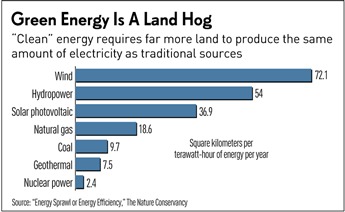
Land Area Required for Various Forms of Generation
But knowledge of the grand green charade of China's wind and solar industries has not reduced the fervour of US green political activists such as Barack Obama or Senator Harry Reid of Nevada. In fact, Senator Reid is indulging in a grand corrupt and nepotistic scheme in his home state of Nevada, involving a public lands give-away to a Chinese solar company and an associated US company involving his own son!

Of course this type of insider political deal is not unusual for either Nevada - style or Chicago - style political operators.

China's grand scheme of infrastructure buildup -- including green infrastructure -- is proving to be something of a big bomb. China has been spending money hand over fist, stalling for time in hope that its big export customers -- Europe and North America -- would pull out of their economic doldrums, and start to buy Chinese products on a grand scale, once again.

China is getting a bit desperate, and cannot help but be relieved every time a foreign sucker -- in Germany, the US, Australia ect. -- gets sucked into another green energy scam.

Yes, China is poisoning itself to build and sell intermittent unreliable products such as big wind and big solar energy generation equipment. But if foreign devils like Harry Reid, Barack Obama, Angela Merkel, etc. are stupid enough to buy this junk at high prices, why not? It's not as if China's people can do anything about it.

More: Is Obama facilitating technology transfer and theft to the Chinese?

Labels: , ,

Monday, July 16, 2012

China Has the Most Shale Gas: What's the Catch?

China apparently has vast resources of tight natural gas, waiting to be horizontally drilled, fracked, separated, and produced. But will China achieve the same incredible production bonanza which North American countries are experiencing? Perhaps not.
EXACTLY HOW MUCH unconventional gas lurks outside America is a matter for conjecture, but the list of countries with potentially large reserves grows steadily. Canada and Mexico are known to have lots. Australia already produces coal-bed methane and has plenty of shale and tight gas too. South Africa also has big deposits, though a fracking moratorium was announced last year. Argentina and India could join the shale club, and so could countries that already export conventional gas, such as Algeria and Libya. Even Russia and Saudi Arabia, the largest conventional oil producers, have the stuff.

But the biggest shale-gas reserves may be lurking in China. At the end of last year the IEA estimated the country’s total recoverable resources at 50tcm, over 70% of it in shale beds, most of the rest coal-bed methane. China already extracts prodigious quantities of the latter—some 10bcm last year. Only a handful of test wells for shale gas have been sunk, and it looks as though the geology may make it harder to get at than America’s.

But China has ambitious targets for getting its hands on it all the same. It wants to use a lot more gas to generate electricity and to fuel its expanding fleet of cars. Since 2000 its appetite for gas has grown by around 15% a year as the lights have come on in new towns and cities and the country’s breakneck economic expansion continues. At present gas makes up just 4% of the country’s primary-energy consumption. The latest five-year plan envisages an increase in that share to 8% by 2016. Even then, China will still lag far behind most rich countries, where gas generally makes up a quarter or more of the total energy mix.

Because of China’s vast size, what sounds like a small shift could have massive implications for the global gas market. An increase of one percentage point in China’s consumption is reckoned to equate to 25bcm a year, roughly half of what Qatar, the world’s biggest exporter of LNG, puts on the market annually.

To meet this enormous demand, China will need imports. Pipelines from neighbouring countries (including one of 1,100 miles from gas-rich Turkmenistan) and LNG regasification terminals have proliferated. At the same time China is making big efforts to step up domestic production of both conventional and unconventional gas.

The country’s eventual capacity to produce gas is hard to gauge. It has been seriously tapping its domestic conventional reserves for only a decade, and what gas it has is in inland provinces far from the economic powerhouses on the coast. But offshore deepwater exploration could yet produce considerable finds more handily placed in the South China Sea.

China is pushing exploration of shale gas by encouraging domestic producers to form partnerships with foreign oil and gas companies. BP, Chevron and others are involved in exploration joint ventures with Chinese partners. In the past couple of years Chinese state energy firms have struck multi-billion-dollar shale deals in America with Chesapeake Energy, mainly for shale oil, and with Devon Energy Corp for gas. The deals gave them an opportunity to learn about shale technology from American operators. Yet shale gas is unlikely to make a serious difference to the country’s supplies for several years yet. _Economist

So why might China's experience with shale gas be less prolific than North America's? First, let's look at one reason why Europe may be slow to develop its rich shale gas resource:
'Whoever owns the soil, it's theirs up to Heaven and down to Hell." So goes the ancient common-law principle. Today, however, almost no major country recognizes full subsurface private property rights, except for the United States.

We mention this because that blessing of American jurisprudence helps explain one of the few bright patches in the Obama economy—the booming production of shale gas and, increasingly, oil. The U.S. ranked 159th in GDP growth last year. But in natural gas production, it's now No. 1. _WSJ
European countries do not typically grant mineral rights to private property owners. Without the chance of profit from the riches under their property, owners are likely to strongly resist oil & gas drilling. And they are likely to do so as a large and powerful political block.

In the US, private property owners with mineral rights are willing to negotiate with drillers -- small or large -- for leasing rights. The hope of striking it rich is contagious, and many US private property owners have profited significantly from signing a simple contract.

Also in the US, legal obstacles to mineral exploration and production are generally lower than in Europe and many other countries -- at least when working on private property.

China's wealth is concentrated in the hands of a relative few, politically connected families and state-connected groups. Property rights are few, and mineral rights to anyone but the state and the state-connected are virtually non-existent.

China's people are already unhappy over the expropriation of their limited land rights by local and regional governments who are eager to build new industrial and real estate infrastructure. China's environmental record is extremely poor on all fronts, and the prospect of opening a vast new land-hungry industry which may conceivably -- if done badly -- further endanger China's air and water supplies, must make many of China's land rights activists very angry.

In many locations, this issue will not come up. And when the issue of limited land rights and land expropriation does occur, the governments of China can put their foot down. But in the age of twitter and other forms of easy communication, China's follies can be broadcast to the world more easily than ever. China will have to tread softly.

But in the long run, China may be able to cut its strings to Russia's Gazprom, and slowly reduce its dependency upon coal (freeing up coal for CTL). China may even have enough gas to go into the GTL and LNG industries.

Whether quickly or slowly, this development has the potential to upset global energy markets, and should be monitored.

Labels: ,

Friday, May 25, 2012

China Slows, Russia Hurts: Cause and Effect?

The New York Times finally stumbles on a relevant news story: China's economy begins to slow. To most of us who have been paying attention, this is not exactly news. And some of us have even suggested that when China's economy slowed, leading to a reduction in demand for commodities, that some of the commodities - supplying countries such as Russia might feel the pinch.

Russia's government requires very high pricing for both oil & gas in order to finance President Putin's ambitious quest to re-build the USSR in everything but name. But with global oil prices slumping -- and the prospects for a significant dive in gas prices over the next several years -- Russia is being slapped in the face with a cold and bracing bucketful of reality.

More on Russia's acute problem of capital flight:
"There is large-scale capital flight from Russia, despite the economic recovery," Dmitriev said. "And this capital is flying into the epicenter of the global financial crisis, which is in Europe. That is actually the same as creating a food supply in the center of an atomic explosion."

...Russia, which relies on oil and gas exports for half of its budget revenue and Europe as a market for more than 50 percent of its exports, may suffer a worse recession than in 2009 if energy prices plunge, according to Dmitriev.

..."If these trends continue, we will see the escalation of political violence and repression on one hand, and the worst economic crisis on the other," said Dmitriev, a deputy economy minister from 2000 to 2004. "This may lead to Putin losing control and a chaotic political transformation." _SFGate

Neither news story on Russia's problems points toward the China slowdown as one of the causes of Russia's downturn, but China's share of the global commodities markets makes it absolutely certain that a downturn in the great dragon's economy would send shocks through the economies of most large exporting nations -- including the giant bear of Russia.

As several of Russia's important energy customers begin learning how to "make their own energy," using newer oil and gas extraction technologies developed in North America, the pain felt by the wounded bear -- already suffering a potentially fatal demographic crisis -- can only worsen.

Labels: , ,

Tuesday, February 14, 2012

China's Massive Shale Gas Wealth Free from Energy Starvation Ideology

China cannot afford the "energy starvation affectation" which certain foppish leaders of western nations are displaying. No, China is in a life or death struggle for its survival as a nation. The leaders of the middle kingdom cannot afford to fool themselves in that way. They must face reality and shape it to their advantage, or they will become history.

GWPF

The Ministry of Land and Resources said Sunday that China will strengthen the survey and appraisal of shale gas in 2012 to expedite discovery and development of China shale deposits. The move comes after the recent approval of the State Council in the capital to list shale gas as an independent mineral resource. China is slowly moving towards producing shale gas.

Currently, the country does not have any shale natural gas production, adding to the country’s overall lack of natural gas in its energy matrix. China’s rough terrain and lack of technological know-how has kept it out of the shale gas biz. The country is largely beholden to coal to keep the lights on.

China’s Ministry of Land estimates the country holds around 31 trillion cubic meters of natural gas hidden under shale, equivalent to the total amount of conventional natural gas. If developed, the country’s shale gas output could exceed 100 billion cubic meters by 2020, Land Ministry’s second in command, Wang Min, told reporters during a national geological survey conference in Beijing this weekend.

China’s reserves are almost 50% greater than those of the U.S., according to the U.S. Energy Information Administration. _GWPF
Once China's shale gas resource hits China's economy -- particularly when transformed by GTL, ethane cracking, and other advanced technologies into far more valuable materials -- the global economy will be shaken to its foundations.

More:  Affirmative on the 100 years of natural gas in the lower 48 states

Labels: ,

Wednesday, January 25, 2012

China Has Abundant Shale Gas, But North America Has the Expertise

China in January approved shale gas as an independent mining resource, a legal status that may allow more Chinese firms to develop the unconventional energy source.

Foreign companies would not be able to participate in the tenders but could partner with the winning Chinese firms.

The world’s top energy user could hold shale gas reserves around 1,275 tcf, according to the EIA, exceeding those of the United States (862 tcf). _FinancialPost
China is the world's largest energy consumer. While China is heavily dependent upon coal power plants and is working to build up its nuclear power plant infrastructure, developing its massive reserves of shale gas would be a huge economic and energy boon to China. Therefore, the Chinese government is beginning to change the rules dealing with shale gas.
Shale gas, or natural gas trapped inside deposits of shale rock, has been a game changer in the United States, where its commercial-scale production has reduced the country's dependence on imported gas and lowered its energy expenses. China, which sits on even bigger shale gas reserves but has yet to tap them, now also hopes to give that fuel a role in its energy mix.

To do so, Beijing on Dec. 31 approved shale gas to be an independent mining resource, a step that opens up its exploration to more participants. The sector previously belonged only to government-controlled companies, but now also welcomes Chinese private firms.

This policy shift will create competition and therefore boost China's shale gas development. It may also help China reduce its greenhouse gas emissions because burning gas produces about half as much as the coal China depends upon for its primary energy source.

Although foreign companies are still not allowed to participate independently, they can gain more partnership opportunities as more Chinese players enter this business and will need their expertise in extracting the fuel from hard-to-access deposits locked in shale rock.

Besides encouraging more companies to produce shale gas, there is also a new incentive for companies to produce more of it. The Chinese government last month began reforming its pricing mechanism in two pilot provinces, for the first time allowing the market to decide wholesale prices for unconventional gas, including shale.

Unlike the government-controlled pricing mechanism, which made producing shale gas unprofitable, this new scheme will raise prices energy companies can charge for their output in China's fast-growing natural gas market, with annual consumption set to triple during the next decade. _eenews
As shale gas production continues to gear up across North America, and begins to pick up in China and other energy import markets, the impact of this huge new energy bonanza cannot be easily over-stated.

China's markets will require significant liberalisation in order to make best use of resources. Such market liberalisation is apt to be applied in very uneven fashion, due to the age-old Chinese fear of disorder and collapse of authority.

Labels: ,

Thursday, February 10, 2011

Why Is China Trying to Disrupt Western Oil & Gas Production?

According to the report, the intruders used widely available attack methods known as SQL injection and spear phishing to compromise their targets. Once they gained access to computers on internal company networks, they would install remote administration software that gave them complete control of those systems. That made it possible for the intruders to search for documents as well as stage attacks on other computers connected to corporate networks.

In addition to their parallels to the Google attacks of last year, the intrusions resembled a Chinese-based electronic espionage network that was found in 2009 and named GhostNet. In that case, researchers at the Munk Center for International Studies at the University of Toronto uncovered an elaborate network aimed at government computers as well as those of nongovernmental organizations like the office of the Dalai Lama. The researchers concluded that the control servers of the attack system were based on the island of Hainan, which is part of China. _NYT
It is bad enough that tin-pot oil dictatorships such as Venezuela and Russa systematically lure international oil&gas companies into partnerships -- only to nationalise all of the multinational's in-country assets. Over and over again. Now China has been caught red-handed attempting to use computer hacking tools to disrupt multinational oil & gas operations. What is in it for the Chinese?
At least five multinational oil and gas companies suffered computer network intrusions from a persistent group of computer hackers based in China, according to a report released Wednesday night by a Silicon Valley computer security firm.

...Operating from what was a base apparently in Beijing, the intruders established control servers in the United States and Netherlands to break into computers in Kazakhstan, Taiwan, Greece and the United States, according to a report, “Global Energy Cyberattacks: ‘Night Dragon.’ ”

The focus of the intrusions was on oil and gas field production systems as well as financial documents related to field exploration and bidding for new oil and gas leases, according to the report. The attackers also stole information related to industrial control systems, the researchers noted, but no efforts to tamper with these systems were observed.

McAfee executives declined to name the victim companies, citing nondisclosure agreements it signed before being hired to patch the vulnerabilities revealed by the intrusions. Last year, when Google announced that intellectual property had been stolen by Chinese intruders, it expressed frustration that while it had observed break-ins at a variety of other United States companies, virtually none of the other companies were willing to acknowledge that they had been compromised. _NYT

The opportunities for western oil&gas companies seem to be expanding almost exponentially, given new drilling and exploration techniques. Oil & gas production in the US and elsewhere around the world are set to rise as a result, with much growth in exploration and production sectors.

What can China expect to gain from disrupting western and multinational oil & gas enterprises? Is is nothing more than a show of force projection, far beyond Chinese borders? Is it a warning? Or is it rehearsal and preparation for a more integrated effort to disrupt western energy supplies and critical information systems?

China is known for its industrial sabotage, its product counterfeiting, its outright theft of technologies from partners, and its iron-fisted control over information sources and expression inside its borders. Is China experimenting with similar exertion of control over global information streamways, with a hoped-for domination over energy, financial, information, and political flow of data?

Clearly, with China one must never let down his guard.

Labels: , ,

Thursday, June 10, 2010

This Corn Has Very High Energy Content!

EnergyTribune

When you think of attacks on energy pipelines, you typically think of Nigeria, Iraq, Yemen, Mexico, and other violent parts of the third world. You may be surprised to learn that China's energy pipelines are under constant attack from criminals, helping to make China perhaps the "leakiest" nation on Earth in terms of fossil fuels.
China may be leaking more oil and gas from its pipeline network than any country in the world, much of it because of criminal activity. Currently, China has a trunk pipeline network for oil and gas of over 70,000 kilometers, transporting 70 percent of the crude oil and 90 percent of the natural gas. By 2020, the network will reach 200,000 km. Pipeline pressure is usually 100 to 120 atmospheres (1470 to 1764 psi).

The safety and security of the network is now getting critical and three factors are affecting that network.

First is the age of the pipelines. About 60 percent of the trunk lines are more than 20 years old and the pipelines in the east part of the country are over 30 years old. Accidents happen often due to corrosion, inadequate maintenance and bad quality original materials.

The second reason for accidents is the lack of regulations and, especially, not following rules even when they are in place. Because of fast urbanization, sometimes land is used without following regulations or applying for permits. For example, a few years ago, a building was constructed on top of a gas pipeline in Liaoning Province. The result was easily predictable: a big explosion. On May 2, 2010 an oil pipeline between Dongying and Huangdao was damaged by a bulldozer which was operating without following regulations. Just 5 months ago, the Lanzhou-Zhenzhou-Changsha oil product pipeline was damaged by a construction crew.

But the biggest and least-known problem is oil pilferage by thieves who drill into oil pipelines. This is the cause of at least 40 percent of China’s oil pipeline leaks. This criminal activity started in the early 1990s and it has never stopped since.

Although alarm systems are installed along the pipelines, men have to be used to prevent oil theft. In Changqing oilfield alone, thousands of security guards are hired to patrol the pipelines in the oilfield area. However, a lot of pipelines are located in remote areas where no communication exists. To totally prevent oil theft is sometimes mission impossible and the stealing is done by drilling into the pipelines, an almost daily occurrence.

Between 2002 and 2009, Sinopec encountered numerous oil stealing cases with some 19,804 cases involving drilling into oil pipelines and 12,167 cases of direct theft from production wells.

Oil theft from pipelines has become so widespread that even undersea pipelines are being attacked. In 2006, both oil and gas pipelines at the bottom of the sea in the Shengli oilfield were drilled and 70 barrels of crude oil were stolen. But much more oil was spilled and that leak caused serious pollution in the area. The government came down hard on the perpetrators and two were executed. The Shengli oilfield had to pay hundreds of millions of dollars to fix the damaged pipelines, clean the seawater pollution and compensate local farmers.

Like many others things in China, strangely, some local people even form so-called “oil collection” teams and get a license to operate. In theory, their mission is to collect oil leaked on the ground and clean up the pollution. This gives them the legal right to steal oil. Drilling into pipelines to steal oil has become an organized crime, including detecting the proper spot, drilling holes into oil pipelines, collecting oil, transportation, refinery, and distribution.

Criminals drill into oil and gas pipelines for two reasons. One is to steal oil to sell to small refineries which rely on stolen oil to maintain crude supply. Another is to deliberately cause an oil leak and then ask for pollution compensation, which usually happens in poor rural areas. _EnergyTribune
The photo above shows a corn field that has become saturated with leaking oil from a pilfered oil pipeline. When burned, such corn should release an unusually high level of heat. Not the type of modification of corn being attempted in western nations, but consider it thinking outside of the box.

Labels: ,

Sunday, April 25, 2010

China Scours Entire World for Coal

China's international coal buyers are reaching out to coal producers around the world. From Australia, to South Africa, to Russia, to the US, China struggles to compensate for shortfalls in domestic coal production by using imported coal.
China has become a net coal importer, and its import volumes continue rising rapidly. During the first quarter of 2010, China imported 48.2 million tons coal, increasing by 2.4 folds compared with the same period of last year, and accounting for near 7 percent of its total coal consumption. A projected coal consumption of 3.2 to 3.3 billion tons for 2010 could put total net coal import at 150 to 200 million tons for the whole year.
Import volumes of all types of coal except for Anthracite that is heavily used as a feedstock for fertilizer and other chemicals soared up dramatically. Coal import sources were extended to almost all major coal producing regions of the world including the US, Canada, Columbia and South Africa. Indonesia, Australia and Vietnam remained as the leading sources, followed by Russia, Mongolia, South Africa and Canada. Evidently, coastal provinces in China are increasingly relying on import. _Source

While western utilities are attempting to move toward cleaner gasification coal plants and the co-firing of biomass with coal, the top priority in China is energy, clean or dirty -- period.

Up to 90% of China's GDP is being churned into infrastructure building -- much of which is going unused and unoccupied, and will collapse and crumble anyway within 20 - 30 years due to poor construction. An "infrastructure to nowhere", in other words. But it is crucial for China to maintain its economic activity at all costs, for the time being, and as long as China is not at war and is not exporting enough to drive the economy, it must use infrastructure-building as its core economic driver. Thus the frantic consumption of the world's energy and material resources.

Labels: ,

Monday, September 08, 2008

China's Economic Prospects Dimming

Higher shipping costs from China to the developed world is making the "outsourcing model" developed a decade ago obsolete. Manufacturers are discovering that those high long-distance shipping costs are stripping away their profits.
With fuel prices at record highs, the cost of sending a standard 40-foot container of goods has gone from $3,000 in 2000 to about $8,000 today, squeezing profit.

So this summer Kazazian, chief executive of Exxel Outdoors, a Los Angeles-based maker of recreational equipment, did something radical: He moved the manufacturing back to Haleyville, Ala.

Soaring energy costs, the falling dollar and inflation are cutting into what U.S. manufacturers call the "China price"-- the 40 to 50 percent cost advantage once offered by Chinese producers.

The export model that has powered China and other Asian countries for three decades will be compromised if fuel prices continue to rise, said Stephen Jen, a managing director for Morgan Stanley.

"Globalization has gone a little bit too far. It has overshot," Jen said. "We're not saying Asia is going to crumble, but we are saying Asia enjoyed extraordinary conditions in the past. Now the conditions are changing very quickly because of the energy shock, and Asia is coming under pressure."

The ripple effects have been far-reaching. The trade imbalance between the United States and China -- a source of political tension for years -- is beginning to right itself as Chinese exports fall and U.S. exports rise. Global trade routes are being transformed, suggesting a possible return to a less integrated world economy.

The model of outsourcing to China emerged at a time when oil was going for $20 a barrel. In the past few months, oil has been trading at about $110, and many experts say it will eventually hit $200.

This has led some companies to move production from China to northern Mexico, next door to the U.S. market. But others have chosen to relocate inside the United States.

Midwestern steelmakers are doing booming business as steel exports from China to the United States slowed down by 38 percent in the first seven months of the year while U.S. steel production rose 10 percent. Manufacturers of furniture, electronic appliances and textiles are also among those shifting production back.

The most prominent company in the group might be Thomasville Furniture, which was criticized a few years ago for sending several thousand American jobs overseas. It announced in June that it was returning production of an entire line of upholstered and wood furniture to the United States. The company says it will add 100 jobs in North Carolina.

_WaPo
A lot of factors in the economic equation are bound to change between now and 2020. Looking back, we will understand why China's stratospheric dreams collapsed.

Labels:

Wednesday, September 03, 2008

India Looks to Colonise South America, Myanmar

While China is hard at work colonising Africa, India is looking farther abroad to South America in order to provide the necessities for its growing population.
“We have formed a consortium of 14 vegetable oil companies, which is in talks with the governments of Paraguay, Uruguay, and Myanmar for buying large tracts of land for cultivating soya bean, sunflower and pulses,” Ashok Sethia, president of the Solvent Extractors’ Association of India, said.

....Analysts say factories and property developers are buying up farmland, while farm output is also restricted by the poor development of irrigation facilities across much of the country.

“There is too much pressure on our farmland and the government knows it has a difficult task ahead in maintaining food supplies,” Sethia said. _Source
China and India have both outgrown their available resources, due to the gross inefficiencies under which both systems of government operate. Other nations do well with higher population densities, but the corruption present in the systems of India and China are difficult to expurgate.

China is already sponsoring the wholesale destruction of ancient rainforests in Malaysia, Indonesia, Philippines, etc. for the valuable hardwood and to make way for huge palm oil plantations. Unfortunately, the third world colonisers are likely to destroy the quality of the land that they appropriate, leaving their host countries even poorer than when they began.

Labels: ,

Monday, June 16, 2008

A Most Revealing Graph

What is lacking in the entire "food vs. fuels" debate is a sense of proportion. Read more.

Labels: ,

Saturday, March 15, 2008

China Boosts Polysilicon Production

Polysilicon is a popular material for building photovoltaic (PV) panels, but has been in short supply. Consequently, the price of polysilicon has gone up from US $20 per kg to over US $300 per kg in 5 years. Chinese industrialists intend to cash in on the production of this newly valuable commodity. Chinese polysilicon factories are poised to produce double the polysilicon currently being produced around the world. Is there a downside to this Chinese boom in solar energy?
In China, a country buckling with the breakneck pace of its industrial growth,...stories of environmental pollution are not uncommon. But the Luoyang Zhonggui High-Technology Co., here in the central plains of Henan Province near the Yellow River, stands out for one reason: It's a green energy company, producing polysilicon destined for solar energy panels sold around the world. But the byproduct of polysilicon production -- silicon tetrachloride -- is a highly toxic substance that poses environmental hazards.___WaPo

On the one hand, Chinese suppliers are making an important material in solar energy production more available. On the other hand, these Chinese factories are ignoring common rules of toxic waste disposal, while paying Chinese government officials to look the other way.

Apparently the news media considers this situation remarkable because the pollution is being done in the name of green energy. But honestly, the monstrous pollution spewed into China's air, onto its soil, and into its waters should be reported as important news every day--until something is done to stop it.

False, invented crises such as "climate change catastrophe" take up far too much of the media's (and the public's) attention, while serious and genuine environmental catastrophes go looking for interested parties.

China is poisoning itself in the name of wealth, power, and world clout. It is also poisoning the rest of the world through its pollution, and its poisoned toys, medicines, toiletries, and unsafe parts for critical machines.

How fascinating that the media cannot be bothered, and the public cannot be concerned over that.

Hat tip Earth2Tech

Labels: , , ,

Older Posts